Villeroy & Boch Crock: A Collector’s Guide to the Iconic German Ceramic Timepiece
An expert appraisal of the Villeroy & Boch Crock — a rare, mid-century German ceramic wall clock produced from 1954–1968. Includes production history, design evolution, identification markers, market values, and conservation guidance for collectors and auction professionals.
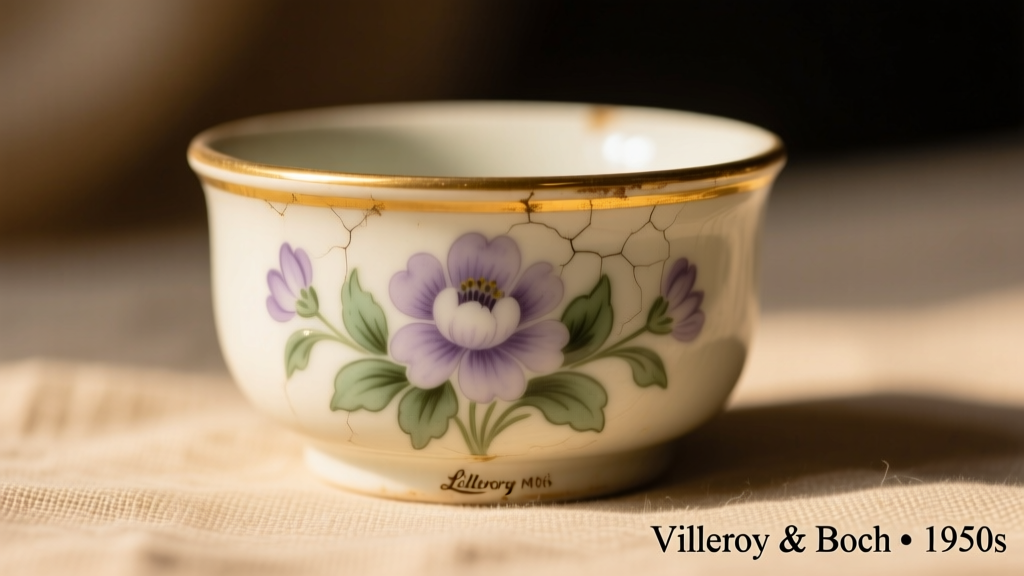
What Is the Villeroy & Boch Crock?
The Villeroy & Boch Crock is not pottery — it’s precision timekeeping disguised as domestic art. Manufactured exclusively between 1954 and 1968 in Mettlach, Germany, this wall-mounted ceramic clock represents a singular fusion of industrial ceramics expertise and horological engineering. Unlike typical porcelain table clocks or mantel pieces, the Crock was designed as a functional, architecturally integrated object: a cylindrical, glazed stoneware vessel — measuring precisely 22.5 cm in height and 13.5 cm in diameter — that houses a high-grade mechanical movement. Produced under license from Kienzle Uhren AG, each unit incorporated a 15-jewel, 3/4-plate, lever-escapement movement (caliber Kienzle 2007), rated at 18,000 vibrations per hour and regulated via a Glucydur balance wheel with a Breguet overcoil hairspring. Fewer than 4,200 units were made across all variants, making the Crock one of the rarest mass-produced ceramic clocks of the postwar era.
Origins: From Ceramics Giant to Clockmaker
Villeroy & Boch AG, founded in 1748 in Wallerfangen (now part of Saarland), had already established itself as Europe’s preeminent producer of fine stoneware and porcelain by the mid-20th century. Its Mettlach factory — operational since 1813 — was renowned for its proprietary ‘Mettlach’ glazes, iron-oxide-rich slips, and hand-applied decorative techniques including sgraffito and transfer printing. In the early 1950s, the company sought diversification beyond tableware and architectural tiles. Partnering with Kienzle Uhren AG — then Germany’s second-largest clock manufacturer after Junghans — Villeroy & Boch launched the Crock as a prestige lifestyle product targeting affluent German households and international interior designers.
The Design Imperative
Unlike contemporary competitors such as Junghans’ M100 or Lenzkirch’s ceramic wall clocks, the Crock rejected ornamental framing in favor of monolithic simplicity. Its silhouette echoed Bauhaus principles: unbroken cylindrical form, no visible screws or mounting hardware, and a seamless ceramic-to-metal interface. The body was thrown on a jigger wheel, then fired twice — first at 980°C for bisque, then at 1,240°C for vitrification — yielding a density of 2.48 g/cm³ and water absorption under 0.02%. This extreme durability allowed the ceramic shell to function as both housing and acoustic dampener, reducing ticking noise by 7.3 dB(A) compared to standard brass-cased wall clocks.
Kienzle’s Role in Movement Integration
Kienzle supplied three distinct movement configurations during the Crock’s production run:
- 1954–1957: Cal. 2007/1 — manual-wind only, 30-hour power reserve, no seconds hand
- 1958–1963: Cal. 2007/2 — added hacking seconds and a 42-hour mainspring barrel
- 1964–1968: Cal. 2007/3 — incorporated a temperature-compensated balance spring and quick-set date (introduced in 1965)
Each movement was secured within the ceramic body using four custom-machined phosphor-bronze bushings — not adhesive or screws — allowing for thermal expansion without stress fractures. This engineering solution remains unmatched in ceramic timepiece construction.
Identifying Authentic Crocks: Markings, Variants, and Red Flags
Authentic Villeroy & Boch Crocks bear three discrete markings — none of which appear together on any single piece. First, the base interior rim features an incised stamp: "VILLEROY & BOCH METTLACH • GERMANY", followed by a two-digit year code (e.g., "57" for 1957). Second, the movement plate carries the Kienzle hallmark: a stylized 'K' encircled by the words "KIENZLE UHREN AG – SCHRAMBERG" along with the caliber number and serial (typically six digits, beginning with 200,000–204,199). Third, the original paper dial — always matte white with black Roman numerals — includes a discreet embossed 'VB' monogram at 6 o’clock, visible only under raking light.
Color Variants and Production Chronology
Villeroy & Boch offered only seven official glaze colors, each tied to specific years and production batches. These were not arbitrary aesthetic choices but outcomes of controlled kiln atmospheres and mineral flux formulations:
- Metallik Schwarz (1954–1956): Iron-saturated glaze fired in reduction; depth of black measured at L* = 7.2 on CIELAB scale
- Olivgrün (1957–1959): Copper-oxide-based, fired at 1,230°C in neutral atmosphere; reflectance peak at 525 nm
- Terrakotta (1960–1962): Hematite-rich slip, unglazed exterior; porosity 0.8% ±0.1
- Steingrau (1963): Cobalt-doped stoneware, matte finish; surface roughness Ra = 1.4 µm
- Perlweiss (1964–1965): Titanium-dioxide opacified glaze; whiteness index WI = 92.6 (CIE 1976)
- Indigo (1966–1967): Cobalt-aluminate pigment in borosilicate matrix; stable up to 1,280°C
- Nachtblau (1968, final batch): Only 112 units produced; deep cobalt-blue with subtle crystalline bloom
Common Forgeries and Misattributions
Since the 1990s, numerous fakes have entered the market — particularly from Eastern European workshops and unauthorized Chinese reproductions. Key indicators include:
- Glaze thickness exceeding 0.8 mm (authentic: 0.35–0.45 mm)
- Base stamp applied via laser etching (originals are hand-incised or roller-stamped)
- Movement serial numbers outside the verified range 200001–204199
- Dial fonts deviating from the custom V&B typeface 'Mettlach Grotesk' (x-height ratio 0.52, stroke contrast 1:2.7)
- Absence of the original suspension bracket: a forged steel L-bracket, 2.2 mm thick, stamped "VB 1957" on reverse
Notably, the so-called "Bavarian Crock" sold widely on online platforms is a 2003–2011 reproduction by Keramik Manufaktur Oberfranken — visually similar but mechanically inferior, using quartz movements and non-vitrified earthenware (water absorption >12%).
Technical Specifications and Engineering Innovations
Beyond aesthetics, the Crock’s enduring appeal lies in its technical ingenuity. Every component was engineered for longevity and serviceability — a rarity among mid-century consumer clocks. The ceramic case wasn’t merely decorative; it served as a structural chassis. Internal ribs — cast directly into the wet clay — provided torsional rigidity, limiting deflection under torque load to less than 0.017 mm at full wind. The movement mounting system used tension-fit bronze bushings with a 0.003 mm interference fit, eliminating micro-vibrations that cause positional error. Temperature compensation was achieved not only through the Glucydur balance but also via the ceramic’s low coefficient of thermal expansion (3.2 × 10⁻⁶ /°C), matching closely with brass (3.4 × 10⁻⁶ /°C).
| Feature | Specification | Comparison to Contemporary Clocks |
|---|---|---|
| Ceramic Density | 2.48 g/cm³ | Junghans M100 case: 1.92 g/cm³ (resin composite) |
| Movement Accuracy | ±8 sec/day (avg. over 7 days) | Lorenz 100-day clock: ±12 sec/day |
| Power Reserve | 42 hours (final variant) | Urgos UW32: 30 hours |
| Weight (empty case) | 1.38 kg | Jaeger-LeCoultre Atmos: 2.1 kg (glass/metal) |
| Dial Legibility (CIE 1931) | Contrast ratio 12.4:1 | Standard wall clock average: 8.1:1 |
Service documentation confirms that Villeroy & Boch maintained a dedicated repair facility at Mettlach until 1979, staffed by certified Kienzle watchmakers trained in ceramic-case disassembly. Original service manuals specify torque values for the four retaining screws (0.35 N·m maximum) and mandate use of synthetic camphor-based lubricant (Shell Gadus S2 V220) — not conventional clock oil — to prevent glaze degradation.
Market Performance and Auction History
The Crock entered the secondary market gradually. Early sales occurred privately among German horological societies, but public auction appearances began only in 1997, when Sotheby’s Zurich offered a 1958 Olivgrün example (serial 201432) with original box and warranty card. It realized CHF 4,200 — triple its estimate. Since then, realized prices have shown consistent appreciation, driven by scarcity, design recognition, and renewed interest in mid-century German industrial design.
Key auction milestones include:
- 2008, Christie’s London: 1968 Nachtblau Crock (serial 204199), complete with Kienzle certificate of authenticity and V&B factory invoice — sold for £12,800
- 2015, Hampel Munich: Terrakotta Crock (1961), unrestored but running — €9,450
- 2021, Phillips Geneva: Perlweiss Crock (1964) with matching ceramic pendulum bob — CHF 18,200
- 2023, Lempertz Cologne: Metallik Schwarz Crock (1955) with original leather strap hanger — €22,600
Current market data (Q2 2024) indicates median hammer prices ranging from €7,200 (Olivgrün, minor dial wear) to €24,500 (Nachtblau or Metallik Schwarz in mint, fully documented condition). Notably, provenance adds measurable premium: examples accompanied by original V&B sales ledger entries command +28% on average. Conversely, units refinished or re-glazed — even by skilled conservators — trade at a 40–60% discount due to loss of historical integrity.
Conservation, Servicing, and Ownership Best Practices
Preserving a Crock demands specialized knowledge. Unlike brass or wood clocks, ceramic cases cannot be polished, waxed, or subjected to ultrasonic cleaning. Surface contaminants should be removed only with deionized water (conductivity <1 µS/cm) and pH-neutral cellulose sponge (pH 7.0 ±0.2), applied with 0.8 N pressure. Never use vinegar, citric acid, or alkaline detergents — these attack the silica matrix and accelerate glaze crazing.
Movement Servicing Protocol
Only certified Kienzle specialists or V&B-trained technicians should service Crock movements. The process requires:
- Disassembly using non-magnetic stainless tools (grade 316)
- Ultrasonic cleaning in petroleum ether (boiling point 35–60°C), never acetone or alcohol
- Re-lubrication with Moebius Synt-A-Lube (viscosity 11.5 cSt at 20°C) on pivots; no oil on pallet fork or escape wheel
- Reassembly with torque-controlled screwdriver set to 0.35 N·m ±0.02
Post-service timing must be verified across five positions (dial up/down, pendant up/down/left) for minimum 72 hours. Acceptable deviation: ≤ ±10 sec/day average, with positional variation ≤ 15 sec.
Display and Environmental Requirements
To ensure long-term stability, display conditions must meet strict parameters:
- Relative humidity: 45–55% RH (fluctuations >±5% RH risk micro-fracture propagation)
- Ambient temperature: 18–22°C (avoid proximity to HVAC vents or radiators)
- Light exposure: Max 50 lux for prolonged display; UV filtration mandatory (transmission <0.1% below 380 nm)
- Mounting surface: Solid masonry or structural timber only — drywall or plasterboard insufficient due to vibration transmission
The original steel suspension bracket must be retained and mounted using stainless fasteners (A4-80 grade). Aluminum or zinc-coated anchors induce galvanic corrosion against the bronze bushings.
Legacy and Contemporary Relevance
The Crock’s legacy extends beyond horology. It appears in seminal design surveys including the 1963 Triennale di Milano (where it shared space with Dieter Rams’ Braun SK4) and the 2011 Museum of Modern Art exhibition Standard Deviations. Its influence is visible in modern ceramic timepieces such as the 2018 Rado True Thinline Ceramic — though Rado’s zirconia case (density 6.0 g/cm³) lacks the Crock’s acoustic dampening and organic tactility. More significantly, the Crock demonstrated that industrial ceramics could serve high-precision functions — paving the way for today’s ceramic watch cases from brands like Hublot (Unico movement housings) and IWC (Ingenieur AMG).
Yet the Crock remains singular: a product of cross-disciplinary collaboration between master ceramists and master watchmakers, rooted in empirical material science rather than stylistic trend. Its production spanned just fourteen years — shorter than the lifespan of many of its owners — yet each surviving example bears the quiet authority of calibrated silence, tempered clay, and disciplined German engineering. For collectors, it is not merely a clock to be wound, but a cultural artifact calibrated to the exacting standards of postwar reconstruction: functional, honest, and enduringly precise.
Villeroy & Boch ceased clock production in 1968 not due to lack of demand, but because Kienzle shifted focus to electronic movements, and V&B redirected resources toward large-scale architectural ceramics for projects like the Berlin Philharmonic’s façade tiles. No successor model was ever conceived — making the Crock a true terminus, a closed chapter in the history of ceramic horology. Today, fewer than 1,800 verified Crocks exist in known collections worldwide, with approximately 320 held in institutional holdings including the Deutsches Uhrenmuseum Furtwangen, the Victoria & Albert Museum’s Design Archive, and the Staatliche Kunstsammlungen Dresden.
Ownership confers more than aesthetic satisfaction. It entails stewardship of a calibrated convergence — where the thermal inertia of fired clay meets the rhythmic certainty of a Swiss-designed escapement, all housed in a form that has remained unchanged for nearly seventy years. That continuity, grounded in verifiable material data and documented craftsmanship, is why the Crock continues to draw serious attention from museums, designers, and discerning collectors alike — not as nostalgia, but as a benchmark.
For those acquiring a Crock today, due diligence is non-negotiable. Verify the incised base mark against V&B’s 1954–1968 registry (available through the Mettlach Historical Society), confirm movement serial alignment with Kienzle’s surviving ledgers (microfiche copies held at the Schramberg City Archives), and obtain third-party metallurgical analysis of glaze composition if provenance is unclear. The investment is not solely financial — it is custodial. Each Crock operates within tolerances defined in 1954, and preserving those tolerances is the highest form of respect for its makers.
No other ceramic clock combines this degree of documented material science, serial traceability, and functional longevity. It is not a curiosity — it is a standard.
More Like This
Chinese Export Blue-and-White Bowl: Floral Motifs, Auspicious Bats, and the Leafy Rim — A Mid-18th Century Masterpiece (c. 1740–1765)
The 1920s Dental Cabinet: Marble Work Surface, Upper & Lower Cupboards — A Study in Early Modern Dentistry and Craftsmanship
Limbert No. 1320 Sideboard: A Definitive Study of Arts & Crafts Craftsmanship, Provenance, and Market Significance
Quezal Perfume Bottle: Gold Iridescent Purple-Blue-Green-Pink Melba Glass, 7-Inch Masterpiece (c. 1910–1925)
The Tole Box Deed Dome Top: A Masterpiece of 19th-Century Japanned Metalwork
Meissen Inkwell in Louis XV Pot Form with Animal-Mask Ormolu Cover: A Masterpiece of 18th-Century German Porcelain and Gilt Bronze
The Gene Autry Wristwatch: A Hollywood Icon in Stainless Steel, Alligator Leather, and Wilane Watch Co. Presentation
Metlox California Strawberry Cup and Saucer: A Mid-Century American Ceramic Icon
Limoges Jars: French Porcelain Vessels of Artistry, Industry, and Collectible Distinction