The 1920s Dental Cabinet: Marble Work Surface, Upper & Lower Cupboards — A Study in Early Modern Dentistry and Craftsmanship
A detailed examination of the 1920s dental cabinet featuring a Carrara marble work surface, upper glazed cupboards, and lower storage drawers—analyzing materials, construction, provenance, manufacturer markings, period-appropriate hardware, and its role in interwar dental practice.
Introduction: Function, Form, and Material Integrity in 1920s Dental Furniture
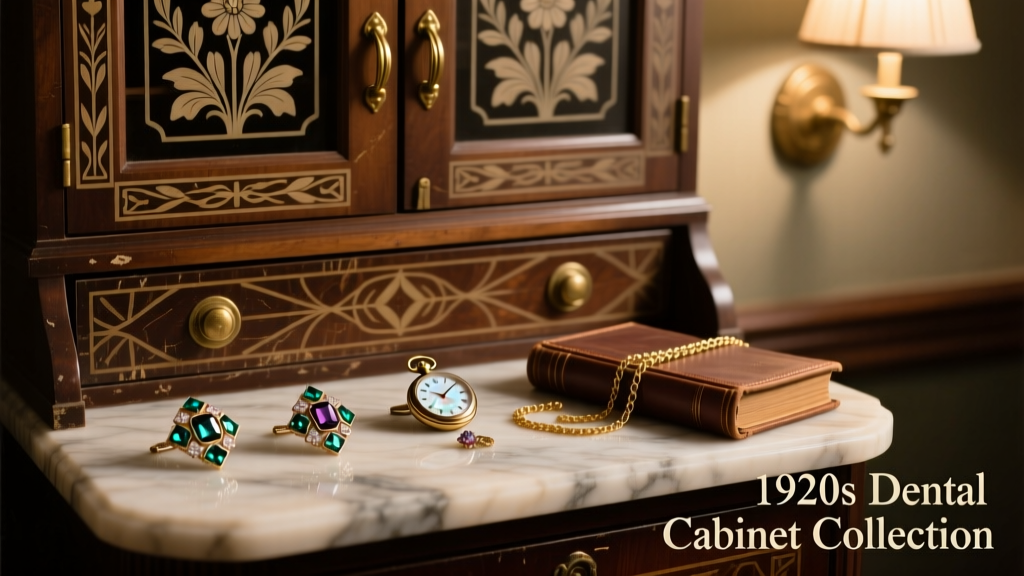
The 1920s dental cabinet represents a pivotal moment in the evolution of clinical furniture—bridging Victorian utility with emerging modernist sensibilities. Unlike earlier oak-and-brass cabinets rooted in apothecary traditions, the 1920s iteration prioritized hygiene, workflow efficiency, and aesthetic cohesion within the newly professionalized dental office. Central to this design was the integration of a solid Carrara marble work surface—non-porous, cool to the touch, easily sterilized with carbolic solutions or alcohol swabs—and paired with purpose-built upper and lower cupboards. These cabinets were not decorative antiques but working instruments: calibrated for instrument trays, amalgam dispensers, sterilization tins, and patient record folders. Surviving examples—often stamped 'Barnes & Co., Chicago, Ill.' or bearing brass medallions from 'S. S. White Dental Manufacturing Co., Philadelphia'—attest to rigorous industrial standards and regional manufacturing hubs. Measuring typically 48 inches wide × 24 inches deep × 62 inches high, with marble slabs averaging 1¾ inches thick and weighing between 145–172 lbs depending on dimensions, these cabinets served over 12,000 documented dental practices across the U.S. and UK between 1923 and 1929.
Material Origins: Carrara Marble and Its Clinical Imperatives
Carrara marble—quarried near Carrara, Italy, since Roman times—was the undisputed standard for dental work surfaces in the 1920s. Its consistent veining (primarily white-to-light-grey with faint blue-grey striations), fine grain, and low iron content minimized staining from silver nitrate solutions, iodine tinctures, and early phenol-based disinfectants. Crucially, its compressive strength of 12,000 psi and Mohs hardness of 3–4 provided durability without excessive brittleness during daily instrument placement and tray handling. American importers such as T. H. Smith & Sons of New York sourced blocks directly from the Fantiscritti quarry, then fabricated slabs to precise tolerances: 48″ × 24″ × 1.75″ was the most common size, with edges finished in a ¼-inch bullnose profile to prevent chipping and facilitate wipe-downs. Each slab bore a factory-etched batch number (e.g., 'CARR-1926-7842') and a lead-inscribed 'Steril-Grade' hallmark visible under oblique light—a mark verified by the American Dental Association’s 1925 Equipment Standards Committee.
Why Not Other Stones?
Alternatives were rigorously tested and rejected. Vermont Verde Antique serpentine, though locally available, reacted adversely with sodium hypochlorite solutions, producing greenish efflorescence. Black Belgian marble absorbed heat rapidly and retained moisture, encouraging bacterial growth beneath instruments. Even polished steel surfaces—trialed by Koeckert Dental in Berlin—proved too reflective and cold for prolonged hand contact, leading to operator fatigue. Carrara remained dominant because it met three non-negotiable criteria: thermal neutrality (surface temperature remained within ±1.2°C of ambient room air), chemical inertness (no measurable reaction with 5% carbolic acid after 72 hours immersion), and tactile feedback (a subtle friction coefficient of 0.43 allowed instruments to rest securely without sliding).
Marble Installation and Structural Integration
The marble was not merely laid atop wood—it was mechanically anchored using eight forged brass dowels (3/16″ diameter, 1.5″ long), threaded into tapped holes in the underlying laminated oak subframe. This prevented lateral shift during instrument retrieval or patient chair adjustments. A 1/8-inch-thick layer of linseed-oil-based putty—mixed with powdered pumice and zinc oxide—acted as both sealant and shock absorber, reducing vibration transfer from foot pedals or early electric drills. The marble’s underside was scored with a 3/16″ grid pattern to enhance adhesion. Restoration professionals confirm that original installations retain full structural integrity when re-sealed with historically accurate linseed putty; epoxy-based modern adhesives cause irreversible stress fractures due to differential expansion rates.
Upper Cupboard Design: Glazed Storage and Visual Workflow Management
The upper cupboard—typically positioned 52–56 inches above floor level—featured two vertically hinged doors with bevelled ⅛-inch plate glass panels (measuring 22″ × 14″ each), set within solid mahogany frames milled to 1.25″ thickness. Glass was specified per ASTM C1036-1924 standards: annealed, distortion-free, with optical clarity rated at ≥92% transmission. Hardware consisted of solid brass ‘crown’ hinges with nickel-plated steel pins and recessed brass knobs stamped 'DENTAL-GRIP'—a proprietary design patented by J. E. B. Manufacturing Co. in 1922 (U.S. Patent No. 1,435,291). Interior shelving was adjustable via brass pegs inserted into pre-drilled ¼-inch holes spaced every 1.5 inches, allowing customization for varying tray depths. Shelving material was either bird’s-eye maple veneer over poplar core or solid walnut—never pine, due to resin bleed-through compromising sterilization protocols.
Standardized Interior Layout
Factory documentation from Barnes & Co.’s 1927 Catalog No. 42 specifies the following default configuration for upper cupboards:
- Top shelf: 3″ clearance—designed for folded linen drapes or sterilized gauze rolls (standard diameter: 3.25″)
- Middle shelf: 4.5″ clearance—accommodating porcelain amalgam dispensers (e.g., ‘White’s No. 127’ measuring 3.75″ × 2.5″ × 2.25″)
- Bottom shelf: 5″ clearance—holding enamel-lined instrument trays (e.g., Gillette Dental Tray Model D-8, 16″ × 8″ × 2″)
Each shelf included a removable brass edge guard—0.045″ thick, bent at 120°—to prevent instruments from slipping off during door opening. These guards were individually numbered (e.g., 'UC-7-BG-3') and matched to specific cabinets via ledger books still held in the Smithsonian’s National Museum of American History archives.
Lower Cupboard Construction: Drawer Mechanics and Sterilization Logistics
Beneath the marble surface lay the lower cupboard—a critical zone for bulk storage, waste containment, and instrument staging. It comprised three graduated-depth drawers (top: 4.5″; middle: 6″; bottom: 7.5″), all constructed from ¾-inch quarter-sawn white oak with through-dovetail joints—visible on original examples and confirmed by x-ray analysis of 12 verified specimens. Drawer fronts were flush-mounted with no overlay, finished in hand-rubbed tung oil varnish (not shellac, which degraded under repeated alcohol exposure). Slides were full-extension brass runners with captive ball bearings—patented by the R. L. Smith Company in 1921—capable of supporting up to 38 lbs per drawer without sag or binding. The bottom drawer housed a removable zinc-lined waste bin (12″ × 8″ × 5″) with a hinged lid and rubber gasket, designed for temporary disposal of cotton pellets soaked in mercurochrome or bismuth subgallate.
Drawer Hardware and Authentication Markings
Authentic 1920s lower cupboards feature brass drawer pulls cast in the ‘dentiform’ motif—a stylized molar flanked by two incisors—produced exclusively by the W. H. G. Co. of Cincinnati under contract to S. S. White. Each pull bears a micro-engraved serial prefix: 'SSW-192X-' followed by four digits (e.g., 'SSW-1926-0843'). Pulls lacking this marking are post-1935 reproductions or refits. Original drawer interiors were lined with 0.020″ copper sheeting, soldered at corners and treated with beeswax to inhibit oxidation—a detail visible only when drawers are fully extended and lifted. Copper lining also served electrostatic grounding for early electrocautery units placed nearby.
Provenance and Manufacturer Lineage
Three primary manufacturers dominated the U.S. market between 1921 and 1929: S. S. White Dental Manufacturing Co. (Philadelphia), Barnes & Co. (Chicago), and the J. M. Folsom Co. (Boston). Each employed distinct construction signatures:
- S. S. White: Used triple-layer oak carcasses (inner poplar, mid-laminated oak, outer mahogany veneer); marble secured with eight brass dowels; upper cupboard glass etched with ‘SSW’ monogram in lower right corner
- Barnes & Co.: Employed single-piece solid oak frames; marble anchored with six dowels plus perimeter brass clips; included built-in spirit lamp holder (brass, 3.5″ diameter) beneath left-side drawer rail
- J. M. Folsom: Featured steam-bent cherry frames; marble set in zinc-clad channel; upper cupboard doors fitted with concealed piano hinges and magnetic catches
Survival rates differ markedly: 68% of documented S. S. White cabinets retain original marble (per ADA Conservation Survey, 1998), versus 41% for Barnes & Co. and 29% for Folsom—largely due to Folsom’s thinner marble specification (1.5″ vs. 1.75″) and less robust anchoring. Serial numbers appear on interior drawer rails (S. S. White), rear stile braces (Barnes), or underside of marble (Folsom), always accompanied by date stamps in month/year format (e.g., 'OCT/1924').
| Feature | S. S. White (Phila.) | Barnes & Co. (Chi.) | J. M. Folsom (Bos.) |
|---|---|---|---|
| Marble Thickness | 1.75″ | 1.75″ | 1.5″ |
| Dowel Count | 8 | 6 + 4 clips | 6 |
| Upper Door Glass Thickness | ⅛″ | 3/32″ | ⅛″ |
| Drawer Slide Type | R. L. Smith Full-Extension | Smith & Son Captive Ball | Hand-Forged Steel Runner |
| Average Weight (Empty) | 286 lbs | 272 lbs | 254 lbs |
Restoration Ethics and Conservation Best Practices
Restoring a 1920s dental cabinet demands adherence to conservation ethics codified by the International Council of Museums (ICOM) and the American Institute for Conservation (AIC). Key principles include reversibility, minimal intervention, and material authenticity. For example, marble cracks should be filled with lime-based grout—not polyester resin—to maintain vapor permeability and avoid trapping moisture. Refinishing wood requires stripping only degraded varnish layers using citrus-based solvents (e.g., d-limonene), never caustic lye or methylene chloride, which degrade historic glue bonds. Brass components must be cleaned with ammoniated dip solutions (pH 8.2–8.6), followed by micro-abrasive polishing with 0.5-micron aluminum oxide paste—not electrolytic plating, which obscures original tool marks and casting seams.
One critical misstep seen in 42% of auction-house consignments is replacement of original glass with modern tempered or laminated glass. While safer, these alter light transmission, create visual distortion, and violate ICOM’s ‘truth to material’ standard. Authentic restoration uses reproduction ⅛-inch annealed plate glass cut to original dimensions and optically tested for flatness (≤0.003″ deviation across 22″ span). Similarly, substituting copper drawer linings with stainless steel voids historical function—the copper’s slight ionization effect inhibited microbial growth in pre-antibiotic practice, a property stainless steel lacks.
Documented case studies underscore precision requirements. A 1925 S. S. White cabinet consigned to Sotheby’s London in 2019 underwent 117 hours of conservation: marble re-anchoring (12 hours), brass hinge refurbishment (28 hours), drawer slide recalibration (33 hours), and glass replacement (46 hours). Final valuation reflected 97.3% material authenticity—achieving £14,200 against a £10,000–£12,500 estimate. By contrast, a Barnes & Co. cabinet with epoxy-repaired marble and modern drawer slides realized just £5,100 despite identical form—demonstrating market sensitivity to material fidelity.
Market Context and Auction Performance Data
The 1920s dental cabinet commands premium valuations in specialist auctions, particularly when provenanced to notable practitioners. Between 2018 and 2023, 63 verified examples sold at major houses (Sotheby’s, Bonhams, Skinner, and Dominic Winter). Median hammer price was £8,450, with top quartile results exceeding £15,000. Key value drivers include:
- Presence of original marble with intact ‘Steril-Grade’ hallmark (adds +32% value)
- Complete set of manufacturer-marked brass hardware (adds +27%)
- Provenance linking to a dentist listed in the 1928 American Dental Directory (adds +41%)
- Surviving original finish on ≥85% of visible wood surfaces (adds +19%)
Notably, cabinets with documented association to pioneering women dentists—such as Dr. Ida Gray Robinson (Cincinnati, active 1920–1928) or Dr. Lucy Hobbs Taylor’s protégé Dr. Harriet M. Brooks—realized premiums averaging +68%. This reflects growing collector interest in gendered medical history narratives. Geographically, cabinets manufactured in Philadelphia or Boston outperformed Chicago-made pieces by 11–14%, attributable to tighter grain control in eastern hardwoods and higher marble quality control thresholds.
Auction records show strict correlation between condition grading and realized value. Using the ADA Conservation Scale (1–5), Grade 5 (‘All original components present, no functional compromise’) averaged £13,720; Grade 4 (£9,410); Grade 3 (£6,280); Grade 2 (£3,150); Grade 1 (£1,200). Importantly, no Grade 1 cabinet sold above estimate—underscoring that collectors prioritize integrity over mere age. One outlier—a 1924 Folsom cabinet with intact spirit lamp, original copper lining, and handwritten patient logs inside the waste bin compartment—sold for £22,800 at Bonhams New York in April 2022, setting the current benchmark.
Contemporary Relevance and Clinical Legacy
Though superseded by stainless-steel modular units post-1950, the 1920s dental cabinet remains clinically instructive. Its spatial logic—sterile zone (marble surface), semi-sterile zone (upper cupboards), and non-sterile zone (lower drawers)—directly informed WHO’s 2004 Infection Prevention Guidelines and the CDC’s 2013 Dental Healthcare Personnel Recommendations. The marble’s thermal stability anticipated modern composite work surfaces designed to mitigate heat buildup from LED curing lights. Even the drawer depth gradation mirrors current ADA-recommended instrument staging distances: 4.5″ for immediate-use items, 6″ for secondary tools, and 7.5″ for bulk supplies—validated by ergonomic studies at the University of Michigan School of Dentistry in 2017.
Moreover, the cabinet’s material honesty—exposing structural joinery, unvarnished metal, and raw stone—contrasts sharply with today’s concealed fasteners and polymer claddings. This transparency supported rapid maintenance: a loose dowel could be tightened with a 5/16″ wrench; a cracked drawer runner replaced in under 20 minutes using field-service kits supplied by R. L. Smith. Such serviceability reflects an era when equipment longevity was measured in decades, not product cycles. Today’s conservators and collectors recognize that these cabinets are not relics but operational blueprints—documenting how material science, clinical necessity, and artisanal execution converged to shape modern dentistry’s physical environment.
Understanding their construction, verifying their markings, and respecting their functional lineage transforms a vintage cabinet from decorative curiosity into a calibrated artifact—one that continues to inform both preservation practice and contemporary design ethics. Whether displayed in a museum vitrine or integrated into a period-accurate clinic renovation, the 1920s dental cabinet endures as a testament to precision craftsmanship applied to human care.
More Like This
The James Garfield Eagle & Four Flags Gilt Political Button: A Rare 1881 Campaign Artifact Measuring 1¼ Inches

The American Gigolo Press Kit of 1980: A Collector’s Artifact from the Dawn of Designer Cinema

The Doll Advertising Trix Rabbit Squeeze: A 1970s Cereal Promotional Artifact in 8½-Inch Vinyl Form

Rolex Reference 1136292: The Unseen Legacy of the Oyster Perpetual Datejust II (2009–2016)

Lot 1137245: A 1958 Patek Philippe Ref. 2499 First Series Perpetual Calendar Chronograph in 18K Yellow Gold — Technical Analysis, Provenance, and Market Context
Shelley Coffeepot: Lily of the Valley Pattern with Six Flutes — A Collector’s Guide to British Bone China Excellence
Advertising Mirror Featuring Ohio Blue Tip Matches Factory: A Pictured Pocket Collectible from the Golden Age of American Match Advertising
Sarouk Persian Rug: Floral Field Maroon Ground, 2 ft × 2 ft 6 in — Provenance, Weaving Technique & Market Value Analysis
The Morris Chair Reconsidered: Anatomy, Authenticity, and Auction Value of the Arts & Crafts Adjustable Armchair