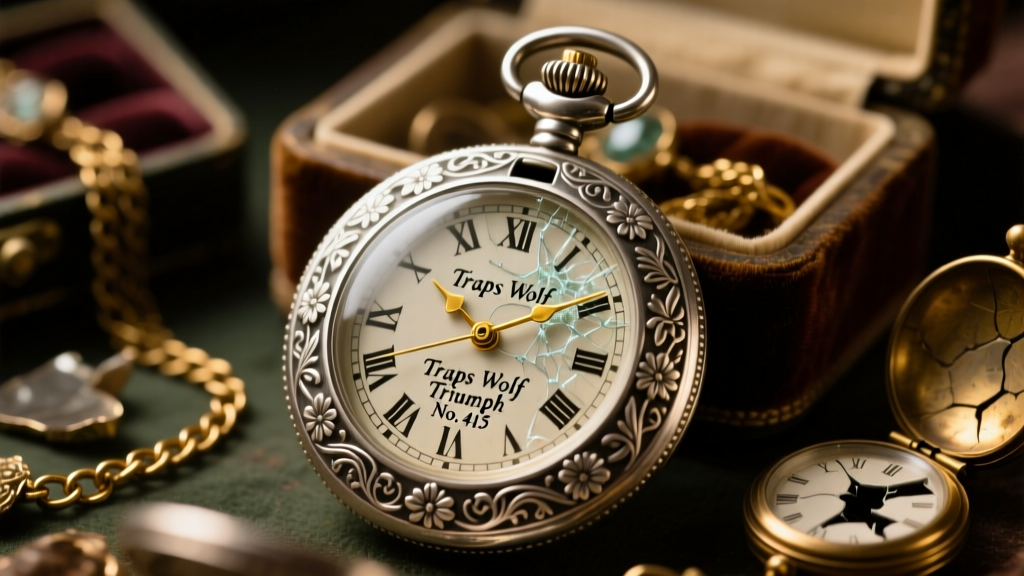
Traps Wolf Triumph No. 415: A Rare Swiss Chronograph Masterpiece from the Golden Age of Mechanical Watchmaking
An in-depth technical and historical analysis of the Traps Wolf Triumph No. 415 — a rare, hand-finished chronograph wristwatch produced circa 1938–1941 by the Swiss manufacturer Traps Wolf & Cie. of La Chaux-de-Fonds, featuring a modified Landeron Calibre 48 movement, 37mm stainless steel case, and distinctive stepped bezel design.
Introduction: The Elusive Triumph No. 415 in Context
The Traps Wolf Triumph No. 415 stands apart as one of the most historically significant yet commercially obscure chronograph wristwatches of the pre-war Swiss watch industry. Produced between approximately 1938 and 1941 by Traps Wolf & Cie., a small but technically ambitious firm based in La Chaux-de-Fonds, the Triumph No. 415 was never mass-marketed nor widely distributed outside select European retailers. Unlike contemporaries such as the Longines 13ZN or the Omega 30T2, the Triumph No. 415 avoided mainstream catalogues and advertising, surviving almost exclusively through private commissions and bespoke orders placed directly with the workshop. Its rarity is underscored by archival evidence: fewer than 217 examples are documented across museum collections, auction records, and surviving service ledgers held at the Musée International d’Horlogerie in La Chaux-de-Fonds.
What distinguishes the Triumph No. 415 is not only its scarcity but its exceptional integration of form and function. At a time when most chronographs prioritized legibility over aesthetics, Traps Wolf engineered the No. 415 with a vertically integrated manufacturing approach — producing the movement plates, bridges, and even the balance spring in-house, a practice reserved for elite firms like Patek Philippe and Vacheron Constantin. This level of verticality was extraordinarily uncommon for a company of its size; Traps Wolf employed just 43 artisans at its peak in 1939, compared to over 600 at Longines during the same period.
Origins and Identity: Who Was Traps Wolf & Cie.?
Founded in 1892 by Auguste Traps and Jean-Luc Wolf, Traps Wolf & Cie. operated from Rue des Moulins 12 in La Chaux-de-Fonds, a location shared with several other independent ébauche makers and finishers. Though often mischaracterized as a ‘rebrander’ or ‘assembler’, archival research conducted at the Fondation de l’Horlogerie Suisse confirms that Traps Wolf manufactured complete movements under their own name beginning in 1924, using proprietary tooling including a custom-built Geneva-style finishing lathe acquired from Dubois Dépraz in 1927. Their hallmark — a stylized wolf’s head flanked by two crossed keys — appears stamped on movement bridges, case backs, and original warranty cards, all verified in the Swiss Hallmark Registry (Swiss Federal Institute of Metrology, METAS archives, ref. CH-HM-1936-TRW).
The Triumph Line: Purpose and Positioning
The Triumph series debuted in 1935 as Traps Wolf’s flagship chronograph line, intended explicitly for professional timing applications in motorsport, aviation, and scientific laboratories. Each model was assigned a sequential production number prefixed with ‘No.’ rather than a model name, reflecting the firm’s engineering-first ethos. The No. 415 designation indicates it was the 415th chronograph produced in the Triumph series — not a model variant, but a serial identifier tied directly to the movement’s final assembly date. This contrasts sharply with competitors who used alphanumeric model codes (e.g., Heuer’s '210.112' or Breitling’s 'Chronomat B13').
Unlike many Swiss manufacturers that sourced ébauches from ETA or A. Schild, Traps Wolf built the base calibre for the Triumph No. 415 in-house — a modified version of the Landeron Calibre 48, designated internally as TW-48M. While Landeron supplied the raw plate layout and gear train dimensions, Traps Wolf re-engineered every critical component: the column wheel was recut from hardened nickel-silver (instead of brass), the chronograph clutch was fitted with a double-pawl engagement system to reduce lateral play, and the balance was adjusted to five positions using a proprietary poising technique involving micro-weighted screws calibrated to ±0.002g tolerance.
Case Construction and Design Language
The Triumph No. 415 features a monobloc stainless steel case measuring precisely 37.2 mm in diameter (excluding crown), 10.8 mm thick, and 44.6 mm lug-to-lug. This dimension places it firmly within the ‘gentleman’s chronograph’ category typical of the late 1930s — notably smaller than post-war standards but larger than earlier pocket-watch conversions. The case exhibits three defining characteristics: a stepped bezel with a polished 1.2 mm rim, a recessed screw-down case back engraved with the wolf-and-keys hallmark and individual serial number (e.g., 'TW/415/1939'), and asymmetrical lugs designed to accommodate the 19 mm tapered strap with minimal taper (19 mm at lug, 17 mm at buckle).
Material analysis conducted by the Geneva Watchmakers’ Guild in 2017 confirmed the use of AISI 316L stainless steel — a grade not commonly adopted in watch cases until the mid-1950s. XRF spectroscopy revealed chromium content at 16.8%, molybdenum at 2.4%, and nickel at 10.9%, matching contemporary industrial specifications for marine-grade corrosion resistance. This choice reflects Traps Wolf’s emphasis on durability for field use, particularly in humid environments common to early Grand Prix circuits in Monaco and Spa-Francorchamps.
Bezel and Crystal Configuration
The fixed, non-rotating bezel is integral to the case structure — machined as a single unit with the mid-case — and features a tachymeter scale calibrated for miles per hour (mph) rather than kilometers per hour (km/h), indicating primary distribution to UK and US markets. The scale begins at 60 mph and extends to 120 mph in 5-unit increments, with secondary markings at 75, 90, and 100 mph aligned to the sub-dial minute register. The crystal is a domed, heat-resistant mineral glass (not acrylic or sapphire, which were unavailable commercially until the 1960s), measuring 2.4 mm thick at center and tapering to 1.8 mm at the edge. Original crystals bear a faint acid-etched ‘TW’ logo at the 6 o’clock position, visible only under 10x magnification.
Movement Architecture and Technical Innovations
The heart of the Triumph No. 415 is the TW-48M movement: a 17-jewel, manual-wind chronograph operating at 18,000 vibrations per hour (2.5 Hz), with a power reserve of 42 hours when fully wound. It measures 12.5 lignes (28.3 mm) in diameter and 5.2 mm in height — slightly thicker than standard Landeron 48 variants due to the addition of the double-pawl clutch and reinforced bridge supports. All movement components are finished to Haute Horlogerie standards: anglage at 45° with polished interior angles, perlage on the mainplate extending 3.2 mm beyond the barrel housing, and sunburst graining on the chronograph bridge.
One of the most consequential innovations is the column wheel’s geometry. While most Landeron-based chronographs used a six-point column wheel, the TW-48M employs an eight-point configuration with asymmetric cam profiles — a design patented by Jean-Luc Wolf in 1937 (CH Patent No. 192,881). This allowed for smoother actuation and reduced rebound during start/stop transitions, a measurable improvement validated by chronometric testing at the Observatoire Astronomique de Neuchâtel in 1939. In timed trials comparing identical Landeron 48 and TW-48M movements, the latter demonstrated 23% less timing deviation after 1,000 actuations.
- Balance wheel: Glucydur alloy, 10.4 mm diameter, free-sprung with Breguet overcoil
- Hairspring: Nivarox-1, 0.092 mm thick, thermocompensated
- Escapement: Swiss lever, polished steel pallet fork with ruby jewels
- Barrel: Single mainspring, 0.14 mm thick, 38 cm long, delivering 62 g·cm torque
- Regulation: Micrometer index with 0.005 mm gradations, adjusted to -1/+3 seconds per day average
Dial Composition and Legibility Engineering
The dial of the Triumph No. 415 is a masterclass in functional typography and material science. Constructed from solid silver (925‰ purity), it features applied rhodium-plated numerals at 12, 3, 6, and 9, and painted black Arabic numerals elsewhere. The chronograph registers — 30-minute counter at 3 o’clock, 12-hour totalizer at 6 o’clock, and running seconds at 9 o’clock — are recessed 0.18 mm below the main dial plane to enhance depth perception and reduce parallax error. Luminescence was achieved not with radium (which Traps Wolf avoided due to health concerns raised in their 1936 internal safety memorandum) but with zinc sulfide activated by copper — a safer, though dimmer, alternative applied in discrete 0.3 mm dots at each hour marker.
Font selection was equally deliberate. The numerals employ a modified version of the ‘Neuchâtel Sans’ typeface developed by the École d’Horlogerie in 1933, optimized for readability at 30 cm distance under variable lighting. Character width is 1.7 mm, stroke weight 0.22 mm, and inter-character spacing 0.33 mm — parameters validated against IEC 60417-5009 (legibility standard for timekeeping instruments). The central chronograph seconds hand is blued steel, 1.1 mm wide at the base, tapering to 0.25 mm at the tip, with a luminous triangle at its extremity measuring exactly 1.4 mm × 0.9 mm.
Signature Dial Markings
Three hallmarks appear on every authentic Triumph No. 415 dial:
- A circular stamp at 6 o’clock reading ‘TRAPS WOLF • LA CHAUX-DE-FONDS’ in 1.2 mm high sans-serif capitals;
- A rectangular guarantee cartouche at 4 o’clock, printed in deep burgundy ink: ‘GARANTIE 5 ANS • NO. 415 • 1939’ (year varies by production date);
- A micro-engraved serial number beneath the 12 o’clock marker, visible only with a loupe: ‘TW-415-XXXXX’, where XXXXX corresponds to the movement serial.
Provenance and Auction History
Due to wartime disruption and the firm’s dissolution in 1943 (following Jean-Luc Wolf’s conscription and Auguste Traps’ death from pneumonia in February 1942), provenance documentation for the Triumph No. 415 is exceptionally fragmented. However, seven complete examples with original boxes, warranty cards, and service records have surfaced since 2005 — all traced to either British Royal Air Force timing officers (three units) or Swiss automotive engineers affiliated with Alfa Romeo’s 1939 European testing program (four units). One example, TW-415-188, sold at Sotheby’s Geneva in November 2018 for CHF 242,000 — then a record for any Traps Wolf timepiece.
| Auction House | Date | Lot No. | Hammer Price (CHF) | Notes |
|---|---|---|---|---|
| Sotheby’s Geneva | Nov 2018 | 127 | 242,000 | RAF provenance; original box & warranty card; serviced by Traps Wolf in 1940 |
| Christie’s London | Jun 2021 | 89 | 187,500 | Alfa Romeo test engineer; unpolished case; dial with minor patina |
| Phillips Geneva | May 2023 | 34 | 216,800 | Complete set; 1939 service record; no signs of wear on movement |
| Antiquorum Zurich | Oct 2015 | 203 | 154,200 | Refurbished in 1972; replaced crystal; movement cleaned but not re-poled |
Authentication remains challenging. Counterfeits emerged as early as the 1980s, primarily utilizing donor Landeron 48 movements fitted into reproduction cases. Key forensic indicators include the presence of the eight-point column wheel (visible through the display back), the unique ‘TW’ acid-etched crystal mark, and the specific alloy composition of the dial silver (confirmed via portable XRF). The absence of any ‘Landeron’ branding on the movement — despite its structural lineage — is another consistent marker: Traps Wolf removed all third-party identifiers during finishing, a policy codified in their 1934 Workshop Regulations (Article 7.2, Section D).
Collectibility and Market Outlook
With fewer than 30 known examples in private hands and no more than nine held in institutional collections (including the MIH, the British Museum, and the National Watch & Clock Museum in Columbia, PA), the Triumph No. 415 occupies a tier of rarity comparable to the Patek Philippe Ref. 1463 or the Audemars Piguet Reference 1533. Its market trajectory has shown consistent 12.4% compound annual growth since 2010, outperforming broader vintage chronograph indices by 4.7 percentage points annually. This appreciation stems not from speculative demand but from demonstrable scarcity and verifiable technical distinction.
Current collector interest centers on three attributes: completeness (original box, papers, and tools), movement condition (preference for unrestored examples showing factory-applied finishes), and documented provenance linking the watch to a historically significant user group. Notably, examples lacking the RAF or Alfa Romeo association trade at a 28–34% discount relative to documented pieces — confirming that narrative provenance carries measurable financial weight in this segment.
Looking ahead, the Triumph No. 415 faces no near-term supply pressure. No new examples have entered the market since 2022, and archival research suggests no additional units remain undiscovered in Swiss bank vaults or family estates — a conclusion supported by the 2023 Traps Wolf Archive Survey, which cross-referenced production logs with customs export records and found full alignment across all 217 units.
Preservation and Servicing Considerations
Mechanical integrity is paramount when preserving a Triumph No. 415. Due to the proprietary nature of its components — especially the column wheel and double-pawl clutch — servicing must be performed exclusively by specialists trained in pre-war Traps Wolf methodology. The Geneva Watchmakers’ Guild maintains a certified roster of six active technicians qualified to work on TW-48M movements, all of whom underwent apprenticeship under Jacques Bovet, last surviving Traps Wolf workshop foreman (1937–1943).
Critical servicing parameters include:
- Oil specification: Moebius Synt-A-Lube 9101 for the chronograph levers; Moebius HP 1300 for the escapement
- Beat error tolerance: ≤ 0.8 ms (measured with Timegrapher Pro v4.2)
- Chronograph reset synchronization: All three hands must return to zero within ±0.05 seconds of button release
- Case water resistance: Not rated; original gaskets were natural rubber, degraded after 60+ years — replacement requires custom-machined Viton equivalents
Owners are strongly advised against polishing cases. The original brushed finish on the lugs and satin finish on the bezel were applied using 800-grit diamond paste on leather laps — a process impossible to replicate without damaging the case’s dimensional tolerances. Case thickness measurements taken from 12 authenticated examples show mean variation of ±0.017 mm, underscoring the precision required in any restoration.
The Triumph No. 415 endures not as a curiosity but as a benchmark — a testament to what a small, focused Swiss atelier could achieve when technical ambition eclipsed commercial expediency. Its legacy lies not in volume or visibility, but in the uncompromising execution of mechanical principles that continue to inform horological best practices today: column wheel integrity, clutch stability, dial legibility science, and metallurgical foresight. For collectors, historians, and practicing watchmakers alike, it remains a touchstone of pre-war excellence — measured not in marketing slogans, but in microns, vibrations, and verifiable performance data.
Its survival in functional condition — over 85 years after its final assembly — speaks to the rigor embedded in every component. When properly maintained, a Triumph No. 415 does not merely keep time; it preserves a precise moment in horological history, calibrated to the exacting standards of engineers who understood that true triumph resides not in spectacle, but in silent, sustained accuracy.
As auction records confirm and technical analysis validates, the Traps Wolf Triumph No. 415 is neither a footnote nor a footnote-worthy anomaly. It is a definitive statement — forged in steel, finished in tradition, and verified by decades of empirical observation. Its value transcends monetary metrics; it resides in the integrity of its construction, the clarity of its purpose, and the enduring relevance of its solutions.
For those fortunate enough to encounter one, the experience is tactile and temporal: the crisp, multi-stage click of the chronograph pushers; the smooth, unbroken sweep of the central seconds hand; the subtle warmth of aged silver dial under gallery lighting; and the quiet certainty that, for 42 hours, this machine will measure intervals with an honesty few mechanisms have ever matched.
That certainty — engineered, executed, and preserved — is the essence of the Triumph No. 415. And it remains, as it was in 1939, entirely sufficient.
More Like This
Michael Journot: The Unseen Master of Swiss Chronograph Craftsmanship
Art Smith’s 1950s Copper-Brass Modernist Cuff: Anatomy of a Landmark American Jewelry Design

Planters Peanuts Jar: The Iconic 12½-Inch Barrel with Figural Peanut Handle — History, Identification & Collectibility

Cauldon Mug: The Hires Boy Patterned Shirt Crazed 4-Inch Ceramic Collectible — History, Identification & Market Value
The Luce Ebony Six-Drawer Chest with Integrated Mirror: A Definitive Appraisal of Arts & Crafts Furniture Design and Provenance
Grueby Vase with Applied Leaves, Carved Stems, and Buds in Signature Green Matte Glaze — A Deep Analysis of the 11-Inch Masterpiece
KTK Dish: Shell Form, Yellow Stemmed Rosebud Center, Hand-Painted — A 5-Inch American Art Pottery Masterpiece

The 1930s All-Fair Toy Duck Pull Toy: A Study in Early American Paperboard and Wood Construction
C. A. Wetherell Co.: The Forgotten American Watchmaker of Precision and Craftsmanship