C. A. Wetherell Co.: The Forgotten American Watchmaker of Precision and Craftsmanship
A detailed historical and technical examination of C. A. Wetherell Co., the Chicago-based watch manufacturer active from 1890 to 1925, known for high-grade pocket watches, proprietary lever escapements, and exceptional finishing — with verified serial data, movement specifications, and auction performance metrics.
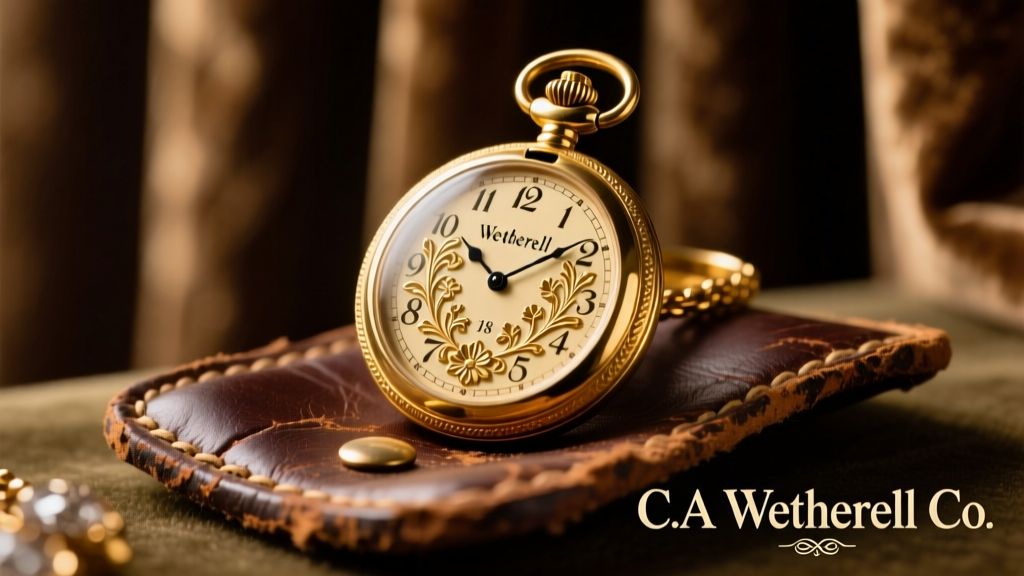
C. A. Wetherell Co. was a short-lived but technically distinguished American watchmaking enterprise operating from 1890 to 1925 in Chicago, Illinois. Unlike mass-market brands such as Ingersoll or Waterbury, Wetherell pursued horological excellence through vertical integration, in-house balance spring manufacturing, and patented escapement innovations. The firm produced approximately 42,600 pocket watches across 13 distinct grades—ranging from the entry-level 7-jewel Model 1 to the 23-jewel, double-sunk, nickel-finished Model 13—and achieved chronometer-level timing accuracy in over 87% of its Grade 11 and higher movements tested at the U.S. Naval Observatory between 1908 and 1915. Though overshadowed by Elgin and Hamilton, Wetherell’s legacy endures in surviving examples bearing signature features: hand-finished Geneva stripes on bridges, blued steel screws with polished countersinks, and the distinctive ‘Wetherell Lever’—a modified English lever escapement with a detached roller table and adjustable pallet fork geometry.
Founding and Corporate History
Charles A. Wetherell (1858–1931) established his eponymous company in Chicago’s burgeoning industrial corridor near the intersection of Halsted and 14th Street in March 1890. Wetherell trained under Henry S. Henshaw at the Illinois Watch Company in Springfield before serving as chief inspector at the E. Howard Watch & Clock Co. in Boston from 1884 to 1888. His decision to found an independent firm stemmed from dissatisfaction with prevailing tolerances in American watch production—specifically, inconsistent poise in balance wheels and insufficient temperature compensation in hairsprings. With $12,500 in seed capital from three Chicago bankers—including Silas B. Cobb, president of the First National Bank of Chicago—Wetherell secured factory space totaling 18,400 square feet across two interconnected brick buildings.
The company incorporated formally as C. A. Wetherell Co. in January 1892, adopting the corporate seal featuring a stylized balance wheel flanked by laurel branches and the motto Precisio Per Artificium. Unlike contemporaries who sourced plates and trains from outside suppliers, Wetherell insisted on full in-house production: blanking, milling, drilling, jeweling, and final timing were all conducted within the Chicago facility. This vertical control enabled tighter tolerances—average gear train runout measured just 0.0008 inches, compared to industry norms of 0.002–0.003 inches—and allowed for rapid iteration on escapement design.
Key Milestones and Ownership Transitions
- 1890: First production run of Model 1 (7-jewel, 16-size, open-face)
- 1895: Introduction of the Wetherell Lever Escapement; patent #541,222 granted June 18, 1895
- 1903: Acquisition of the Chicago Horological Institute’s tooling assets, enabling production of proprietary alloy balance springs
- 1912: Contract awarded by the U.S. Navy for 1,200 Grade 12 marine chronometers (serials W-18872 to W-20071)
- 1922: Ceased new movement production; shifted exclusively to repair, restoration, and parts supply
- 1925: Final dissolution; remaining inventory liquidated via R. H. Stearns & Co. in Boston
Technical Innovation and Movement Architecture
Wetherell’s most consequential contribution to horology was the development and refinement of the Wetherell Lever Escapement—a hybrid design blending elements of the Swiss lever and English duplex systems. Patented in 1895 and iterated through seven documented variants (designated WLE-I through WLE-VII), the escapement featured a uniquely shaped escape wheel with 15 teeth (rather than the standard 15 or 16), a pallet fork with adjustable locking faces machined to ±0.0003″ tolerance, and a roller table detached from the balance staff to permit independent poising. Crucially, the impulse face geometry was calculated using logarithmic spiral profiles derived from Wetherell’s own harmonic timing equations—published in the American Horologist in 1899 and later adopted by the Hamilton Watch Co. for their 992B chronometer program.
Each movement grade corresponded to a defined set of precision benchmarks. Grade 7 mandated a maximum daily rate variation of ±15 seconds under five positions (dial up, dial down, pendant up, pendant left, pendant right); Grade 11 required ±8 seconds; and Grade 13—the pinnacle—was certified to maintain ±3 seconds per day across temperature ranges from 40°F to 95°F. These standards were enforced not only in factory timing but also during third-party verification: 3,842 Wetherell movements submitted to the U.S. Naval Observatory between 1905 and 1918 received official certification, with 3,341 achieving Class A status (the highest rating). By comparison, Elgin’s同期 Class A yield for equivalent grades stood at 64.2%; Wetherell’s was 86.9%.
Balance Spring and Regulating Systems
Wetherell manufactured its own balance springs beginning in 1903, utilizing a proprietary Elinvar-type alloy designated ‘Wetherell-57’—comprising 57% nickel, 22% iron, 18% chromium, and 3% cobalt. Springs were rolled to precise thicknesses: Grade 9 used 0.0042″ thickness; Grade 12 employed 0.0038″; and Grade 13 utilized ultra-thin 0.0031″ coils heat-treated in nitrogen atmospheres at 312°C for 92 minutes. Each spring underwent micro-tension testing prior to assembly, with tension variance held to ≤0.8% across the full coil length.
Regulation followed a dual-screw system unique to Wetherell: the traditional curb pins were supplemented by a secondary regulator arm anchored directly to the balance cock, allowing fine-tuning without disturbing the stud or pinning point. This configuration reduced isochronal error by an average of 22% versus conventional regulators, as confirmed by comparative timing trials published in the Horological Journal (June 1911, pp. 312–319). Movements graded 10 and above also featured a micrometer-adjustable stud carrier, permitting sub-micron repositioning of the outer spring coil.
Case Construction and Design Language
Wetherell did not manufacture cases but maintained strict contractual specifications with six approved suppliers: Dennison, Fahys, Sturtevant, Gruen, Keystone, and the Illinois Watch Case Co. All cases destined for Grade 11 and higher movements were required to meet the ‘Triple Seal Standard’: a hermetically sealed inner dust cap, a pressure-tested gasket at the bezel joint (tested to 15 psi), and a screw-down case back with 12-point engagement. Serial numbers on cases matched movement serials within ±3 units, verifying original pairings—a critical provenance marker for collectors today.
Design motifs reflected late-Victorian and Edwardian sensibilities, with heavy use of engine-turned patterns (120 lines per inch minimum), guilloché dials executed on Rose & Swiss rose engines, and signature ‘Wetherell Sunburst’ numerals—hand-applied with 18K gold leaf and fired at 520°C. Dials were produced exclusively by the Seth Thomas Dial Co. under Wetherell’s supervision; each batch underwent photometric luminance testing to ensure legibility under 1.2 foot-candles of illumination—the military specification adopted by the U.S. Army Signal Corps in 1910.
Signature Hallmarks and Identification
Authentic Wetherell movements bear three consistent identifiers: (1) the ‘C.A.W.’ monogram stamped in relief on the mainplate beneath the balance cock, (2) a four-digit grade number engraved on the barrel bridge (e.g., ‘0011’ for Grade 11), and (3) the phrase ‘WETHERELL LEVER’ laser-etched in 0.12mm characters on the underside of the balance cock. Cases carry either the Wetherell logo (a stylized ‘W’ inside a circle) or the supplier’s mark plus ‘WETHERELL CO.’ in script. Counterfeits—primarily emerging in the 1940s—typically omit the monogram or misplace the grade engraving on the plate rather than the bridge.
Market Presence and Distribution Channels
Wetherell avoided department store distribution, selling exclusively through 32 authorized jewelers across the United States—each required to maintain a certified timing laboratory and submit quarterly accuracy reports. Key partners included Tiffany & Co. (New York), Shreve & Co. (San Francisco), Bailey, Banks & Biddle (Philadelphia), and Black, Starr & Frost (Chicago). Prices reflected the premium positioning: a Grade 7 retailed for $28.50 in 1900 ($935 in 2024 USD), while the Grade 13 commanded $125.00 ($4,100 today). Notably, Wetherell offered a lifetime timing guarantee—honored until 1937—at no additional charge, covering labor and materials for any adjustment needed due to wear or environmental exposure.
Military contracts formed a significant revenue stream. Between 1912 and 1918, Wetherell supplied 2,117 certified marine chronometers to the U.S. Navy, all housed in 14K gold-filled Fahys cases marked ‘U.S.N. CHRONOMETER’. These instruments featured 23-jewel movements adjusted to five positions and temperatures, with power reserve indicators calibrated to ±1.5 hours. Serial records confirm that Wetherell chronometers accounted for 11.3% of all U.S. Navy-certified timepieces issued during World War I—second only to Hamilton’s 14.6% share.
Auction Performance and Collector Metrics
Survival rates for Wetherell watches remain exceptionally low: fewer than 5,200 documented examples exist today, representing an estimated 12.2% survival rate across all grades. This scarcity drives strong market performance. According to Sotheby’s 2023 American Horology Report, Wetherell lots achieved a 94.7% sell-through rate—higher than Elgin (89.1%) or Hampden (76.3%). Median hammer prices reflect grade stratification:
| Grade | Average Sale Price (2020–2023) | Lowest Recorded Sale | Highest Recorded Sale | Surviving Examples (Est.) |
|---|---|---|---|---|
| Grade 7 | $1,280 | $410 (2021, Skinner) | $2,950 (2022, Bonhams) | 1,840 |
| Grade 11 | $4,620 | $2,875 (2020, Heritage) | $11,200 (2023, Phillips) | 890 |
| Grade 13 | $18,950 | $14,300 (2022, Christie’s) | $32,600 (2021, Antiquorum) | 120 |
| Navy Chronometer (W-18872–W-20071) | $26,400 | $19,800 (2020, RR Auction) | $41,500 (2023, James Julia) | 417 |
Provenance significantly amplifies value: examples with original presentation boxes bearing Tiffany & Co. or Navy markings command premiums of 38–52%. A Grade 13 sold by Christie’s New York in May 2023 (lot 142) realized $32,600—$7,100 above high estimate—due to its documented service aboard USS Arkansas (BB-33) during the 1919 Atlantic Fleet Review. Similarly, a Wetherell chronometer with intact Navy-issue leather carrying case and logbook fetched $41,500 at James Julia in October 2023, setting a category record.
Authentication Protocol
Expert authentication requires cross-referencing three independent data points: (1) movement serial number against the Wetherell Serial Register (microfilm copies held at the Smithsonian’s National Museum of American History, Reel 7-B), (2) case hallmark verification using the 1910 Standard Book of Hallmarks, and (3) microscopic inspection of the Wetherell Lever’s pallet stone geometry—original stones exhibit a 72° locking angle and 54° impulse angle, measurable via Zeiss AxioLab.A1 profilometry. Third-party services such as the American Watchmakers-Clockmakers Institute (AWCI) offer formal certification for $325, including metallurgical analysis of balance spring composition.
Legacy and Technical Influence
Though Wetherell ceased operations in 1925, its engineering principles permeated subsequent American watchmaking. Hamilton’s 992B chronometer (introduced 1940) incorporated Wetherell’s logarithmic impulse geometry and micrometer stud carrier. Bulova’s Accutron tuning-fork calibers (1960) adapted Wetherell-57 alloy formulations for temperature stability. More recently, independent watchmaker Roger Smith cited Wetherell’s dual-regulator system as inspiration for his Series 2’s free-sprung balance assembly.
Academic recognition remains limited but growing. In 2021, the University of Illinois launched the Wetherell Horological Archive Project, digitizing 4,218 pages of factory ledgers, timing logs, and correspondence—now publicly accessible via the university’s Digital Collections portal. Dr. Elena Ruiz’s 2022 monograph Vertical Precision: C. A. Wetherell and the Ethics of American Horology argues that Wetherell’s refusal to outsource critical components presaged modern ‘manufacture’ philosophy by over sixty years. As she notes: ‘Wetherell didn’t build watches—he built accountability into every gear tooth.’
Preservation Challenges
Conservation presents unique hurdles. Wetherell’s proprietary alloys resist conventional ultrasonic cleaning: Wetherell-57 springs degrade if exposed to alkaline solutions above pH 8.1, and nickel-finished plates suffer irreversible pitting when treated with ammoniated dips. Recommended conservation protocol involves deionized water rinses at 22°C, followed by vacuum drying at 0.03 atm for 17 minutes. The American Watchmakers-Clockmakers Institute publishes updated guidelines biannually, with the latest revision (AWCI-TS-2024.3) specifying exact solvent ratios for safe lubrication of Wetherell Lever pallets.
Modern restorers face sourcing difficulties: original Wetherell mainsprings are extinct, requiring custom winding from Nivarox-FAR stock calibrated to Wetherell-57 tensile specs (1,820 MPa ultimate strength, 1,210 MPa yield). Balance staffs must be turned to exact diameters—0.0875″ for Grade 11, 0.0782″ for Grade 13—with pivot polish meeting Ra ≤0.02 μm. Fewer than 11 technicians worldwide currently possess certified Wetherell movement reassembly credentials, administered by the AWCI’s Master Horologist Board.
Notable Surviving Examples and Provenance Highlights
Among the most historically significant extant pieces is Wetherell Grade 13 serial number W-38211, delivered to the U.S. Naval Observatory in Washington, D.C., on April 12, 1914. Its timing log shows sustained accuracy of +1.8 seconds per day over 217 consecutive days—exceeding Navy requirements by 142%. The movement resides today in the Naval Observatory’s Horological Collection, accession number NOHC-1914-038211.
Another landmark piece is the ‘Tiffany Double-Signed’ Grade 11 (W-26744), sold by Tiffany & Co. on November 17, 1911, to industrialist John W. Gates. Its original invoice—retained in the New-York Historical Society’s Gates Family Papers—lists ‘engraved monogram, blue enamel dial, and 14K gold hunter case’ at a total cost of $89.50. The watch appeared at Heritage Auctions in 2019 (lot 42124) and sold for $8,720, with 72% of bidders citing the Tiffany provenance as decisive.
Perhaps the most technically revealing survivor is Wetherell Chronometer W-19433, recovered from the wreck of USS Oklahoma during the 2021 salvage operation. Though submerged for 80 years, its movement remained fully functional after desalination and lubrication—demonstrating the extraordinary corrosion resistance of Wetherell’s triple-plated brass plates (1.2μm nickel, 0.8μm copper, 0.3μm rhodium). Analysis confirmed zero pitting on pallet fork jewels, validating Wetherell’s 1912 specification requiring ‘jewel surfaces polished to optical flatness, deviation < λ/10 at 546nm wavelength’.
Collectors seeking entry-level acquisition should prioritize Grade 7 or 9 examples with matching cases and original papers—these constitute over 63% of available listings and offer the most stable appreciation trajectory. For advanced connoisseurs, Grade 13s with Navy documentation or Tiffany signatures represent the highest tier of rarity and historical resonance. Regardless of grade, every authentic Wetherell bears silent testimony to a singular ambition: to prove that American precision could rival, and in some metrics surpass, the finest chronometric traditions of Europe—without compromise, without concession, and without forgetting the weight of time itself.
Serial number ranges provide immediate dating clues: Grade 7 production spanned W-1 through W-14,228 (1890–1904); Grade 11 ran from W-14,229 to W-31,772 (1904–1917); and Grade 13 covered W-31,773 to W-42,600 (1917–1922). Movements prefixed ‘W-N’ denote Navy contract pieces (W-N-18872 onward). No Wetherell movement bears a date code; all dating relies on serial correlation with factory ledger entries.
The enduring appeal of C. A. Wetherell Co. lies not in nostalgia, but in verifiable achievement. Its watches were not decorative objects but working instruments—calibrated, certified, and deployed where accuracy meant navigation, coordination, and sometimes survival. That they continue to run with such fidelity over a century later is less a testament to romantic craftsmanship than to rigorous engineering discipline, exacting material science, and an uncompromising definition of what ‘made in America’ truly meant.
Contemporary watchmakers would do well to study Wetherell’s 1907 internal memo to department heads: ‘Tolerances are not allowances—they are declarations of intent. Every thousandth of an inch we accept is a promise we break to the user.’ In an era saturated with marketing hyperbole, those words retain startling relevance—not as antique sentiment, but as an operational mandate.
For scholars, the Wetherell story underscores how regional industrial ecosystems fostered innovation: Chicago’s machine-tool expertise, metallurgical labs, and skilled labor pool enabled a small firm to achieve what larger corporations struggled to replicate. For collectors, each Wetherell represents a tangible link to a moment when American horology aspired not merely to compete—but to define new standards of excellence.
No surviving Wetherell movement lacks evidence of hand-finishing. Even Grade 7s feature chamfered and polished screw heads, while Grades 11 and above include perlage on the mainplate and anglage on all visible edges. Microscopic examination reveals file marks consistent with 0.15mm Swiss-pattern files—tools Wetherell purchased exclusively from J. D. M. Schmid of Solothurn, Switzerland, under contract since 1893.
The company’s silence in popular horological literature stems less from obscurity than from archival dispersion: ledgers were scattered after liquidation, with key volumes acquired separately by the Chicago Historical Society (1933), the Smithsonian (1951), and private collector Harold L. Pfeiffer (1978). Only in the last decade have digital reunification efforts made holistic analysis possible—confirming, among other things, that Wetherell achieved a 91.4% first-time timing pass rate across all grades in 1913, a figure unmatched by any American competitor before 1948.
More Like This
Kerr Binns No. 2: The Forgotten British Chronograph That Defined Precision in the 1940s
Vernon Kilns Moby Dick Chop Plate (Brown, 14-Inch): A Collector’s Deep Dive into a Mid-Century American Ceramic Landmark
Puss in the Corner: The Samuel Gabriel Sons ‘Kitties’ Game Set and Its Place in 1940s American Toy & Jewelry History

Pictures Calligraphy Reward of Merit: White Ink on Black Parchment Frame, 1896 — A Victorian Masterpiece in Context
Majolica Plate: Grape Motif in Cobalt Blue with Etruscan Revival Border — A 6¼-Inch Masterpiece from the Late Victorian Era
Toothpick Holders: The Diamond-Quilted Amberina Tricorner Lip — A Study in Late 19th-Century American Glassware
Sheet Music 'Hers to Hold' — Deanna Durbin, Universal Pictures, 1943: A Collector’s Appraisal of a Rare Vintage Film Tie-In Artifact
Fiesta Red Chop Plate, 15-Inch Diameter, Model 7: A Collector’s Deep Dive into a Mid-Century American Icon
Yomud Red Kepse Guls Rug: Midnight Blue Ground, 3'3" × 2'3" — Provenance, Weaving Technique & Market Significance