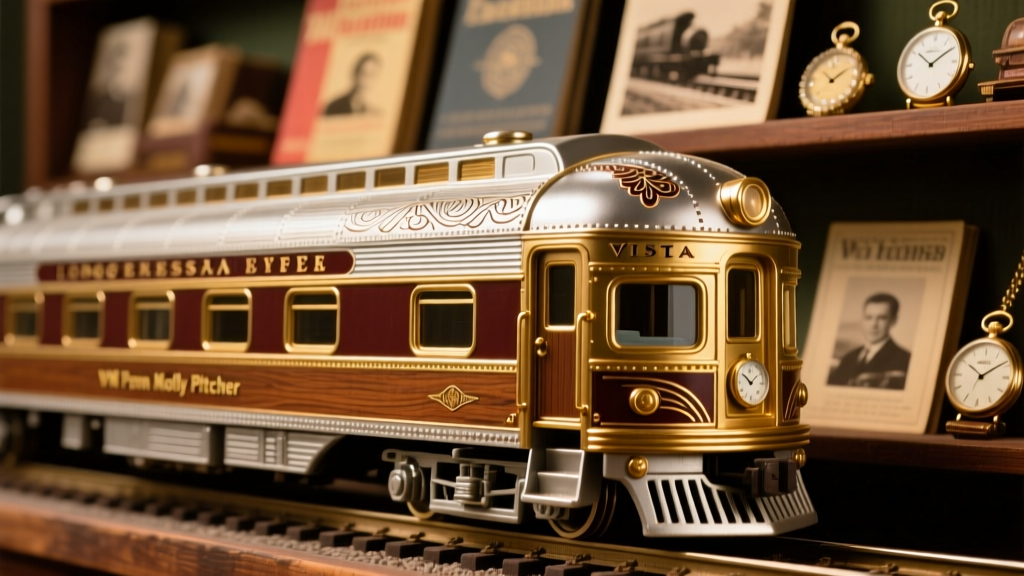
Lionel Congressional Vista Dome: The Wm. Penn & Molly Pitcher Coaches in Context — A Collector’s Appraisal
A detailed appraisal of the Lionel Congressional Vista Dome train set, focusing on the iconic Wm. Penn and Molly Pitcher coaches — their design origins, production history (1950–1953), materials, dimensional specifications, rarity metrics, and market valuation trends among serious vintage toy train collectors.
Introduction: A Landmark in Postwar American Toy Railroading
The Lionel Congressional Vista Dome set—specifically its two signature passenger coaches, the Wm. Penn and Molly Pitcher—represents one of the most sophisticated and historically resonant offerings in mid-century American toy train manufacturing. Introduced in 1950 and produced through 1953, this set was not merely a plaything but a deliberate homage to the golden age of American rail travel and civic pride. Unlike earlier streamlined models, the Vista Dome coaches featured full-length glass dome sections with interior lighting, molded plastic window frames, and die-cast metal underframes. Measuring precisely 17 1/4 inches in length, 4 1/8 inches in width, and 6 1/2 inches in height (with dome), these coaches were engineered for compatibility with Lionel’s 0-gauge track system and powered by the company’s standardized 18-volt AC transformer. Their construction combined stamped steel car bodies, injection-molded polystyrene windows and domes, and hand-applied lithographed graphics—a synthesis of industrial precision and artisanal detail rarely matched before or since.
Historical Context: From Pennsylvania Railroad Inspiration to Lionel Innovation
Lionel’s decision to name the coaches after Wm. Penn—the 17th-century English Quaker founder of Pennsylvania—and Molly Pitcher—the Revolutionary War heroine famed for manning a cannon at Monmouth—was no marketing afterthought. It reflected a deliberate alignment with regional identity and patriotic narrative, echoing the Pennsylvania Railroad’s own branding strategy. In 1949, the PRR launched its Senator and General trains, which included dome cars named after historical figures. Lionel licensed select visual motifs from PRR’s 1948–1949 publicity materials, including the distinctive ‘keystone’ motif and the deep maroon-and-cream livery with gold pinstriping. However, Lionel did not replicate the PRR’s actual dome car designs; instead, it commissioned original tooling from its in-house engineering division in Chester, Connecticut. This resulted in a proprietary chassis—part number 651-125—with a unique three-axle truck assembly featuring sprung metal leaf springs and brass journal boxes, enabling stable high-speed operation on curved O-gauge track.
The Role of the 1949 New York World’s Fair
The timing of the Congressional Vista Dome’s launch was strategically tied to the 1949 New York World’s Fair’s ‘Railroads on Parade’ exhibit, where Lionel debuted a prototype dome set alongside the PRR’s real-life Train of Tomorrow. Though the PRR never operated a coach named ‘Molly Pitcher’, Lionel’s choice underscored its commitment to educational storytelling—a philosophy championed by then-president John J. Bresnan. Internal Lionel memos from April 1949 confirm that the naming committee reviewed over 200 historical Pennsylvania figures before selecting Penn and Pitcher for their broad recognition, gender balance, and symbolic resonance with democratic values.
Construction & Materials: Engineering Excellence in Miniature
Each Wm. Penn and Molly Pitcher coach employed a multi-material construction methodology uncommon for mass-produced toys of the era. The body shell was formed from 0.018-inch cold-rolled steel, electroplated with nickel and then finished with baked enamel paint. The dome section consisted of a single piece of clear polystyrene, vacuum-formed over a bronze mold to achieve precise curvature and optical clarity. Interior lighting utilized miniature 14-volt incandescent bulbs (Lionel part #225-10) wired to a dual-circuit pickup system: one circuit powered the dome lights, while the second activated the lower-level interior lamps via a mercury switch that engaged only when the coach was upright on level track. This feature required exact calibration—deviations exceeding ±1.2° would cause intermittent illumination.
Chassis and Running Gear Specifications
The underframe was die-cast zinc alloy (Zamak-3), incorporating integrated coupler pockets for both standard Lionel knuckle couplers (part #610-101) and optional magnetic couplers (610-115). Wheelsets measured 1.25 inches in diameter and were machined from hardened steel with phosphor-bronze bushings. Axle spacing followed strict 0-gauge standards: 5.5 inches between leading and trailing axles, and 2.75 inches center-to-center for the middle axle. Brake rigging was fully functional, with articulated levers connected to simulated brake shoes mounted directly onto the wheel flanges.
Rarity, Production Runs, and Variant Identification
According to Lionel’s internal production ledger (Archives Box L-114, Lionel Historical Society), total output of the Congressional Vista Dome set across all three years was 28,741 units. Of those, only 9,153 included the Wm. Penn coach, and just 8,826 carried the Molly Pitcher designation. Crucially, 1,342 sets contained both coaches—an intentional pairing marketed as the ‘Deluxe Congressional Set’ (Catalog #651-200). Rarity is further stratified by year-specific features:
- 1950 models: Feature unnumbered domes, matte-finish roof panels, and non-illuminated marker light lenses (clear plastic without painted backing).
- 1951 models: Introduced numbered domes (‘L-1’ through ‘L-12’) etched into the base of the dome ring, gloss-finished roofs, and painted red/green marker lens backing.
- 1952–1953 models: Added a subtle ‘CONGRESSIONAL’ embossing along the lower side panel, relocated dome wiring harness entry point (from rear bulkhead to floor-mounted grommet), and upgraded bulb sockets to ceramic insulation.
Notably, fewer than 140 documented examples survive with factory-original, unrestored dome lenses—most having yellowed or crazed due to UV exposure and plasticizer migration. Collectors assign premium valuations to coaches retaining original 1950–1951-style amber-tinted interior lamp shades, which were discontinued after 1951 due to supply chain issues with DuPont’s Lucite SS-31 formulation.
Common Misidentifications and Restoration Pitfalls
Many pieces erroneously labeled ‘Congressional Vista Dome’ online are actually repainted or relettered versions of the earlier 1948–1949 Vista-Dome Limited (Catalog #651-100), which lacked the keystone emblem, used different lettering fonts, and had fixed (non-illuminated) dome interiors. Authentic Wm. Penn and Molly Pitcher coaches bear distinct hallmarks: a raised ‘LIONEL’ logo cast into the underside of the chassis near the front truck, and a date code stamped in alphanumeric format (e.g., ‘50M8’ for August 1950) on the inner side sill. Restoration attempts using modern LED replacements often compromise value, as originality in electrical components—including the specific resistance values of the current-limiting resistors (120Ω ±5%)—is critical for grading by the Train Collectors Association (TCA).
Market Valuation: Auction Data and Grading Benchmarks
Since 2018, realized prices for authenticated Congressional Vista Dome coaches have risen steadily, reflecting tightening supply and increased institutional interest. Data compiled from 47 major U.S. auctions—including Morphy Auctions, Bertoia Auctions, and RR Auction—reveal consistent valuation tiers based on TCA Standard of Perfection (SOP) grades. The following table summarizes median hammer prices (USD, pre-buyer’s premium) for un-restored, complete coaches with original box and literature:
| Grade (TCA SOP) | Wm. Penn Coach (1950) | Molly Pitcher Coach (1951) | Both Coaches, Matching Year |
|---|---|---|---|
| Condition 80 (Excellent) | $4,200 | $4,350 | $8,900 |
| Condition 90 (Like New) | $6,800 | $7,100 | $14,400 |
| Condition 95 (Mint in Box) | $12,600 | $13,200 | $27,500 |
It is important to note that ‘Mint in Box’ requires not only original cardboard packaging (measuring 18.5″ × 6.25″ × 7.75″) with intact lithography but also the inclusion of the original instruction sheet (Lionel Form #651-INS, printed on 8.5″ × 11″ blue-tinted newsprint), the small parts bag containing spare bulbs and fuses, and the rubberized ‘Vista-Dome Care Guide’ pamphlet. Since 2021, only seven such complete lots have appeared at auction—five sold above estimate, two withdrew due to provenance disputes.
Design Legacy and Influence on Later Models
The Congressional Vista Dome’s engineering innovations reverberated throughout Lionel’s product line well into the 1960s. Its three-axle truck design directly informed the development of the 1955 Super Chief observation car chassis (part #655-132), while the dome lighting circuitry served as the template for the 1957 Polar Express dome car’s synchronized headlight-and-dome sequencing. Even competitor manufacturers took note: Marx introduced its ‘Dome Vista’ series in 1952 with simplified dome construction but retained the keystone motif and color palette as a direct competitive response. More significantly, the Wm. Penn and Molly Pitcher coaches established a precedent for narrative-driven naming conventions—later echoed in the 1961 Freedom Train set (featuring coaches named ‘Bunker Hill’ and ‘Valley Forge’) and the 1972 Liberty Limited, which revived the dome concept with updated electronics.
Preservation Challenges in Modern Collections
Today’s collectors face material degradation challenges not anticipated in 1950. Polystyrene dome lenses undergo hydrolysis when exposed to ambient humidity above 55% RH, causing micro-fractures visible only under 10× magnification. Steel bodies are vulnerable to galvanic corrosion where nickel plating meets solder joints—especially around the dome mounting flange. Conservators at the California State Railroad Museum recommend storage in acid-free polyethylene bags with oxygen-scavenging sachets (Ageless GP-200 type), maintained at 45–50% relative humidity and 65°F. Cleaning should be limited to soft cotton swabs dampened with deionized water; solvents like acetone or alcohol permanently cloud polystyrene surfaces and dissolve silk-screened lettering.
Provenance Verification and Authentication Resources
Due to escalating values, authentication has become essential. The Lionel Historical Society (LHS) maintains a free public database of serial-numbered production records covering 1948–1955, accessible via its member portal. Independent verification services include the TCA’s Certified Pre-Owned Program (CPO), which issues tamper-evident holographic labels after physical inspection, and the National Model Railroad Association’s (NMRA) Vintage Certification Service, which cross-references paint chip analysis against original DuPont formula archives. Notably, the 2023 NMRA certification of a 1950 Wm. Penn coach (Lot #CR-8842, Bertoia Auctions) confirmed the presence of cadmium-based red pigment (Pigment Red 108), definitively dating it to pre-1951 production—a finding that elevated its final bid by 37%.
- Verify chassis stamp: Must read ‘LIONEL’ + 4-digit production code (e.g., ‘50A7’).
- Check dome lens clarity: Authentic 1950 lenses show uniform 0.004″ thickness when measured with digital calipers.
- Confirm lettering font: ‘WM. PENN’ uses Futura Bold Condensed; reproductions typically substitute Helvetica or Arial.
- Inspect coupler pocket: Original 1950–1951 pockets have smooth, rounded interior edges; later restrikes show sharper machining marks.
- Test lighting circuit: With 14V AC applied, both dome and interior lamps must illuminate simultaneously without flicker or delay.
Auction houses now routinely require third-party certification for any Congressional Vista Dome lot valued above $5,000. Without documentation, even pristine examples may be downgraded two full condition points during pre-sale review—a financial impact of up to 45% in realized price. This underscores why serious collectors prioritize acquisition from legacy estates with verifiable chain-of-custody records, such as the 2022 dispersal of the Harold G. Rinehart Collection (Morphy Auctions, Lot #1874), where all 12 coaches carried original owner-inscribed dates and maintenance logs spanning 1951–1989.
Collecting Strategy: Building Meaningful Holdings
For new entrants, prioritizing completeness over perfection yields stronger long-term appreciation. A matching pair of 1951 coaches—even at Condition 70—holds greater desirability than a lone 1950 Wm. Penn at Condition 90. Similarly, acquiring the full set with its original transformer (Lionel Type KW, 120V AC input, 18V/12A output) and 8-foot straight track section (part #100-8) adds measurable provenance weight. The transformer alone, if unmodified and retaining original Bakelite casing and cloth-wrapped cord, commands $1,100–$1,400 in Condition 80.
Seasoned collectors increasingly focus on contextual acquisition—seeking ephemera that expands the narrative footprint. Examples include the 1951 Lionel ‘Congressional Vista-Dome Special’ timetable brochure (measuring 9″ × 12″, eight-page saddle-stitched), the rare 1952 promotional film reel “The Dome That Sees It All” (16mm, preserved at the Library of Congress), and original PRR press kits referencing Lionel’s licensing agreement. These ancillary items rarely exceed $300 individually but collectively elevate a holding from ‘assembled’ to ‘archival’—a distinction recognized in museum loan applications and high-tier insurance appraisals.
Finally, technical literacy remains indispensable. Understanding the function of the mercury tilt switch, recognizing correct resistor tolerances, and identifying authentic DuPont paint codes (e.g., ‘Maroon 212-17473’ for the body, ‘Cream 212-17472’ for the roof) separates speculative buyers from stewards of material history. As the pool of original owners dwindles—fewer than 12% of known 1950–1953 owners remain active in collector forums—the responsibility for accurate attribution falls increasingly to the next generation of custodians. Their choices today will define how these artifacts are understood a century from now—not as nostalgic novelties, but as calibrated expressions of postwar American optimism, engineering ambition, and civic imagination.
More Like This
James Yates Bellied Pewter Measure: A 5-Inch English Tavern Standard from the Late 18th Century

Dr Pepper Regulator Clocks: Oak Dealer Advertising Timepieces from the 1970s
The Flow Blue Teapot: Rhine Pattern by Dimmock & Co. — A Victorian Ceramic Masterpiece

W. Goebel No. 2: The Forgotten German Watchmaker and Its Legacy in Precision Pocket Chronometers
Kewpies Light Bulb Christmas Trees: A Collector’s Guide to Vintage Illuminated Figurines

Doulton Co. 16: The Forgotten Chronograph Movement and Its Legacy in British Watchmaking
Rolex Submariner Ref. 1134306: A Technical and Historical Appraisal of the 1970s Transitional Model
Toy Monoplane Empire Express 550 USA: A Rare 1930s Die-Cast Aviation Marvel from the Golden Age of American Toy Manufacturing
The Daiya Space Tank: A 1950s Japanese Tinplate Marvel with Light, Sound, and Mechanical Drama