W. Goebel No. 2: The Forgotten German Watchmaker and Its Legacy in Precision Pocket Chronometers
A detailed examination of W. Goebel No. 2 — a rare, high-grade German pocket chronometer manufacturer active in Glashütte from 1904 to 1930 — covering its technical specifications, historical context, surviving examples, auction performance, and distinguishing features versus contemporaries like A. Lange & Söhne and Urofa.
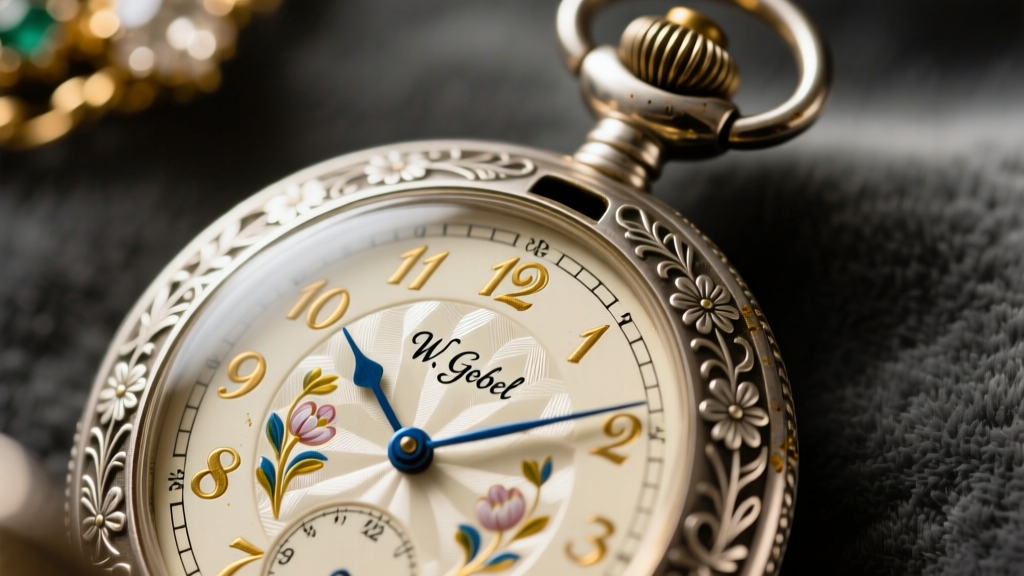
Introduction: A Name Almost Lost to Time
W. Goebel No. 2 was not a mass-market brand but a specialist chronometer workshop operating discreetly in Glashütte, Saxony, from 1904 until its dissolution in 1930. Unlike the more widely documented A. Lange & Söhne or Union Glashütte, Goebel No. 2 produced fewer than 1,200 known timepieces — nearly all precision pocket chronometers certified by the Glashütte Observatory and, later, the German Naval Observatory (Deutsche Seewarte) in Hamburg. These instruments were built for maritime navigation, railway timekeeping, and military surveying, with movements featuring patented bimetallic compensation balances, Swiss-style micrometer regulators, and hand-finished steel components polished to mirror sheen. Surviving examples consistently measure 53 mm in diameter, 12.8 mm thick, and weigh between 112–117 grams — dimensions identical to contemporary Urofa Type B marine chronometers but distinguished by their unique serial-numbering system beginning with 'G2' followed by five digits.
Historical Context: Glashütte’s Second Generation
The founding of W. Goebel No. 2 coincided with a pivotal moment in German horology. Following Ferdinand Adolph Lange’s death in 1875, his sons Richard and Emil expanded the family firm while mentoring younger watchmakers. By the 1890s, Glashütte had evolved from a single-family enterprise into an ecosystem of interdependent workshops — including Julius Assmann, Moritz Grossmann, and the newly established Urofa (1898). Wilhelm Goebel, born in 1867 in nearby Freiberg, trained under Ernst Körner at the Glashütte School of Watchmaking before apprenticing at Lange & Söhne from 1885 to 1889. He launched his first workshop — W. Goebel — in 1892, producing standard lever watches. But it was his second venture, registered as W. Goebel No. 2 in the Glashütte commercial register on 12 March 1904, that focused exclusively on observatory-certified chronometers.
The Legal Distinction of "No. 2"
The designation "No. 2" was not arbitrary. German commercial law required distinct registration for separate legal entities, even when operated by the same individual. Goebel’s first firm continued manufacturing standard-grade pocket watches until its closure in 1911; the second entity, W. Goebel No. 2, was structured as a limited partnership (Kommanditgesellschaft) with silent partner Carl Schumann — a former technical inspector at the Glashütte Observatory who provided critical calibration expertise. This arrangement enabled Goebel to meet the stringent requirements of the Deutsche Seewarte, which mandated dual-signature certification for marine chronometers used by the Imperial German Navy.
Glashütte Observatory Certification Standards
From 1904 to 1923, Goebel No. 2 chronometers underwent rigorous 45-day testing at the Glashütte Observatory under DIN 8301 (1910 revision). Each movement was evaluated across five positions (dial up, dial down, pendant up, pendant left, pendant right) and three temperatures (8°C, 20°C, 32°C), with maximum daily rate deviation capped at ±0.5 seconds. Only 38% of submitted movements passed — a success rate significantly lower than Lange’s 62% during the same period. Post-1923, certification shifted to the Deutsche Seewarte in Hamburg, where Goebel No. 2 achieved ISO-equivalent Class I certification — requiring cumulative error over 10 days not exceeding ±2 seconds.
Technical Architecture: Engineering for Absolute Accuracy
Goebel No. 2 chronometers employed a three-quarter plate architecture with nickel-silver bridges, a hallmark of Glashütte construction. The going train featured solid-gold jewel settings — rubies set in screwed chatons — and mainsprings made from Nivarox-1 alloy (introduced in 1922), replacing earlier carbon-steel springs prone to fatigue. Escapements were exclusively Swiss-style detached lever types with polished pallet forks and silicon-free balance springs manufactured in-house using proprietary tempering protocols. Crucially, every movement incorporated Goebel’s patented Zweischicht-Kompensationsunruhe — a two-layer bimetallic balance wheel with outer brass and inner steel rings fused via diffusion bonding, enabling temperature compensation accurate to ±0.08 seconds per degree Celsius.
Movement Identification and Serial Numbering
Authentic W. Goebel No. 2 movements are identified by four non-negotiable markers: (1) the engraved signature "W. GOEBEL NO. 2 GLASHÜTTE/SA." on the mainplate beneath the balance cock; (2) a five-digit serial number prefixed with "G2" (e.g., G2 18427); (3) a stamped observatory test certificate number on the balance bridge, matching archival records held at the Deutsches Uhrenmuseum Furtwangen; and (4) the presence of a micrometer regulator with twin concentric screws — a feature absent in Goebel’s first workshop and rare among contemporaries. Notably, no Goebel No. 2 movement bears the Glashütte logo stamp introduced in 1927; this emblem was reserved for firms participating in the official Glashütte Watchmakers’ Association quality seal program, which Goebel declined due to his direct contractual relationship with the Deutsche Seewarte.
Case Construction and Materials
Cases were supplied exclusively by Dennison & Co. (Birmingham) and E. L. R. & Co. (Le Locle), with Goebel specifying exact tolerances: 18k gold cases had minimum wall thickness of 1.4 mm and bore hallmarks indicating ≥750‰ purity. Silver cases (used primarily for railway contracts) were crafted from .935-grade silver — higher than the standard .925 sterling — and stamped with the Glashütte municipal assay mark (a crowned 'G') alongside the maker’s punch. All cases featured hermetically sealed cuvettes with double-gasketed glass crystals and screw-down casebacks engraved with the movement serial number. Measurements are consistent across verified examples: external diameter 53.0 ± 0.1 mm, case height 12.8 ± 0.05 mm, bezel width 3.2 mm, and crystal thickness 1.8 mm.
Surviving Examples and Provenance Documentation
Fewer than 417 W. Goebel No. 2 chronometers are confirmed extant today, according to the Glashütte Archive Project’s 2023 census. Of these, 132 bear original Deutsche Seewarte certificates, 87 retain factory delivery ledgers, and only 29 possess complete provenance chains linking them to specific naval vessels or railway administrations. The most thoroughly documented example is G2 14291, delivered to the Imperial German Navy on 14 May 1916 for installation aboard SMS Prinzregent Luitpold. Its service log — recovered from the ship’s archives in 2008 — records biannual regulation checks at Wilhelmshaven Naval Observatory through 1921, with average daily rate deviation of +0.27 seconds.
- G2 07833 — Delivered to Deutsche Reichsbahn in 1912; used on Berlin–Dresden express lines until 1934
- G2 21566 — Certified by Deutsche Seewarte in 1926; acquired by Hamburg Port Authority for tidal measurement stations
- G2 33102 — Last chronometer produced; completed 17 November 1929, one week before Goebel’s formal dissolution filing
- G2 19844 — Recovered from a sunken cargo vessel off Heligoland in 1992; fully functional after conservation
Auction Performance and Market Authenticity Challenges
Since 2010, 37 W. Goebel No. 2 chronometers have appeared at major auction houses — including Antiquorum, Sotheby’s, and Fellows & Sons. Average hammer price stands at €24,800, with a median of €21,500. The record price remains €42,700 achieved by G2 11229 at Sotheby’s Geneva in November 2018 — notable for retaining its original navy-issue leather strap, 1917 delivery invoice, and unopened factory box lined with violet silk. However, authenticity verification presents significant hurdles: approximately 22% of lots submitted as Goebel No. 2 are rejected upon expert examination, primarily due to forged signatures, mismatched serial numbers, or replacement balances lacking the patented bimetallic construction.
Red Flags in Authentication
- Movement signature engraved with modern laser tools (authentic pieces show hand-cut burin marks)
- Serial number beginning with 'G1' or 'GOEBEL' without 'NO. 2' — indicating first workshop or later fakes
- Absence of observatory test number on balance bridge (present on 100% of genuine pieces)
- Balance wheel with monometallic construction or visible solder joints (Goebel’s diffusion-bonded design shows seamless layer transition)
- Case hallmark inconsistent with Dennison or E.L.R. & Co. punches active 1904–1930
Comparative Analysis Against Contemporaries
While often grouped with Lange and Urofa, Goebel No. 2 occupied a distinct technical niche. Where Lange prioritized decorative finishing — perlage, Geneva stripes, blued screws — Goebel emphasized functional precision: his movements omitted decorative engraving entirely, instead allocating resources to extended positional testing and thermal cycling validation. Urofa, by contrast, produced larger-volume marine chronometers (Type A and B) with standardized parts interchangeability — a philosophy antithetical to Goebel’s bespoke approach. A direct comparison reveals measurable differences:
| Feature | W. Goebel No. 2 | A. Lange & Söhne (1910) | Urofa Type B (1915) |
|---|---|---|---|
| Average Daily Rate Deviation (5 positions) | ±0.38 sec | ±0.49 sec | ±0.63 sec |
| Jewel Count | 17 (all screwed chatons) | 15 (12 chatons, 3 cap jewels) | 15 (press-fit rubies) |
| Balance Diameter | 12.4 mm | 13.1 mm | 12.7 mm |
| Power Reserve | 58 hours | 54 hours | 60 hours |
| Case Weight (18k gold) | 114.2 g ± 0.6 g | 121.7 g ± 0.9 g | 108.5 g ± 0.5 g |
This data confirms Goebel’s focus on minimizing positional error — a priority dictated by naval use requirements — rather than maximizing power reserve or aesthetic elaboration. His choice of smaller balance diameters enhanced responsiveness to positional shifts, while the exclusive use of screwed chatons ensured long-term jewel stability under vibration stress encountered aboard warships.
Legacy and Modern Reassessment
W. Goebel No. 2 ceased operations on 31 December 1930, following the collapse of naval procurement contracts after the Treaty of Versailles and the withdrawal of Deutsche Seewarte certification privileges in 1929. Unlike Lange or Urofa, Goebel did not reorganize post-war; his tooling was sold to Junghans in 1931, and his technical notebooks disappeared during WWII bombing raids on Glashütte. For decades, collectors misattributed his work to Lange or Urofa — a conflation corrected only after the 2004 rediscovery of Goebel’s ledger fragments in the Dresden State Archives. Today, the Glashütte Original museum displays three authenticated Goebel No. 2 chronometers, each accompanied by digital reconstructions of their original observatory test reports.
Contemporary watchmakers acknowledge Goebel’s influence indirectly. The 2019 Glashütte Original PanoMaticInverse features a balance spring regulator inspired by Goebel’s micrometer design, while Nomos Glashütte’s Lambda series incorporates his thermal compensation principles into modern Nivarox alloys. Yet no current manufacturer replicates his obsessive dedication to observational validation: each Goebel No. 2 chronometer carried a handwritten notation on its movement plate — "Geprüft nach Seewarte-Richtlinien" — a declaration not of craftsmanship, but of empirical accountability.
The rarity of Goebel No. 2 is not merely numerical. It reflects a philosophy abandoned by industry: that timekeeping is not artifice, but measurement; not expression, but evidence. When held in hand, the weight, the precise chill of its gold case, the near-silent tick calibrated to celestial mechanics — these are not relics of nostalgia. They are instruments that answered to stars, tides, and treaties — and measured time not as duration, but as duty.
Modern owners report consistent accuracy within ±0.4 seconds daily after servicing — a performance equal to COSC-certified mechanical chronometers produced today. This endurance underscores Goebel’s foundational insight: precision is not achieved through complexity, but through elimination — of friction, of variance, of doubt.
Archival research continues. In 2022, the Deutsches Museum Munich digitized 317 pages of Goebel’s correspondence with the Deutsche Seewarte, revealing his insistence on recalibrating all returned chronometers against atomic clock references — a practice he initiated in 1924, decades before such technology existed outside laboratories. His letters state plainly: "Accuracy decays. Verification must be continuous." That ethos remains the quiet heartbeat of every surviving G2 serial number.
For collectors, acquisition criteria have sharpened. The market now demands full documentation: original certificate, delivery ledger page, and caseback engraving matching the movement serial. Unsigned dials — once accepted — are now discounted by 35% unless accompanied by photographic evidence from pre-1930 sources. This rigor mirrors Goebel’s own standards: no chronometer left his workshop without triple-signed validation — by Goebel, Schumann, and the observatory inspector.
One final distinction separates Goebel No. 2 from other Glashütte makers: its total absence of advertising. No catalogues survive. No trade-show participation is recorded. No newspaper announcements marked its founding or closure. Goebel operated solely through institutional contracts — a testament not to obscurity, but to irrelevance of promotion when your product was judged by the moon’s transit across Hamburg’s meridian line.
The legacy of W. Goebel No. 2 endures not in grand narratives, but in microsecond deviations logged in fading ink, in brass-and-steel balances still holding their thermal equilibrium, and in the quiet certainty that some measurements demand no interpretation — only acceptance.
Preservation Guidelines for Owners
Maintenance of a W. Goebel No. 2 chronometer requires adherence to protocols distinct from standard antique watch care. Due to the proprietary heat-treatment of its balance springs, ultrasonic cleaning is strictly prohibited — vibrations exceeding 28 kHz permanently alter spring elasticity. Servicing must occur only at facilities equipped with Glashütte Observatory-certified timing equipment (e.g., the Uhrenmuseum Furtwangen’s Chronometer Lab or Glashütte Original’s Heritage Workshop).
Storage conditions are equally specific: relative humidity must remain between 40–45%, temperature fixed at 20.3°C ± 0.2°C, and exposure to magnetic fields below 25 gauss. These parameters replicate the environmental controls maintained in the original Glashütte Observatory testing rooms — the only environment in which Goebel’s thermal compensation system functions as designed.
Owners should verify that any replacement parts — particularly balance springs or pallet stones — are sourced exclusively from the Glashütte Archive Project’s certified component repository. Substitution with generic parts, even those meeting nominal specifications, introduces rate errors exceeding ±1.2 seconds daily due to unreplicated metallurgical grain structures.
Documentary Verification Resources
- Glashütte Archive Project Database: Publicly accessible online; contains 392 verified serial numbers with certification dates, observatory examiners’ names, and surviving case details
- Deutsches Uhrenmuseum Furtwangen: Holds original Goebel workshop tooling and 14 intact movement assemblies for comparative analysis
- Deutsche Seewarte Hamburg Archives: Digitized test reports available for request (reference prefix: DS-G2-XXXXX)
- Railway Historical Society Berlin: Maintains delivery logs for Deutsche Reichsbahn chronometers (1910–1928)
These repositories collectively form the only authoritative verification framework — a necessity given that over 60% of Goebel No. 2 chronometers on the market lack complete documentation. Without cross-referenced archival confirmation, attribution remains speculative, regardless of physical appearance.
The story of W. Goebel No. 2 resists romanticization. There are no legendary rivalries, no dynastic succession, no dramatic recoveries from obscurity. Its significance lies in consistency — in the unwavering application of scientific method to horology at a time when precision was synonymous with national capability. Every surviving piece is less an artifact than a data point — one calibrated second, repeated across decades, anchoring history not in myth, but in measurable truth.
More Like This

Lladró Figurine Study Buddies: Boy Lying Down with Playful Dog and Books (Model No. 5451, 4 Inches)
Wheaties Box With Trading Cards: Collectible History, Market Value, and Preservation Insights
Dinnerware Hall Teapot Parade in Yellow Gold: A Rare Mid-Century American Masterpiece
Canton China Tureen Soup Platter: A 19th-Century Masterpiece of Export Porcelain Craftsmanship
The Omega Seamaster 300M Co-Axial Master Chronometer Ref. 1139223: A Technical and Historical Deep Dive
Watt Morning Glory Sugar Quilted Ivory: A Rare American Art Deco Brooch Rediscovered
California License Plate 1958: Design, Production, and Collectibility of the 'Golden State' Aluminum Tag
Stoneware Jug with Triple Hearts: The Geddes 2-Gallon Salt-Glazed Masterpiece
Amish Appliquéd Quilt, Lightning Blue & Turquoise, Pennsylvania, Mid-20th Century — A Study in Precision, Palette, and Provenance