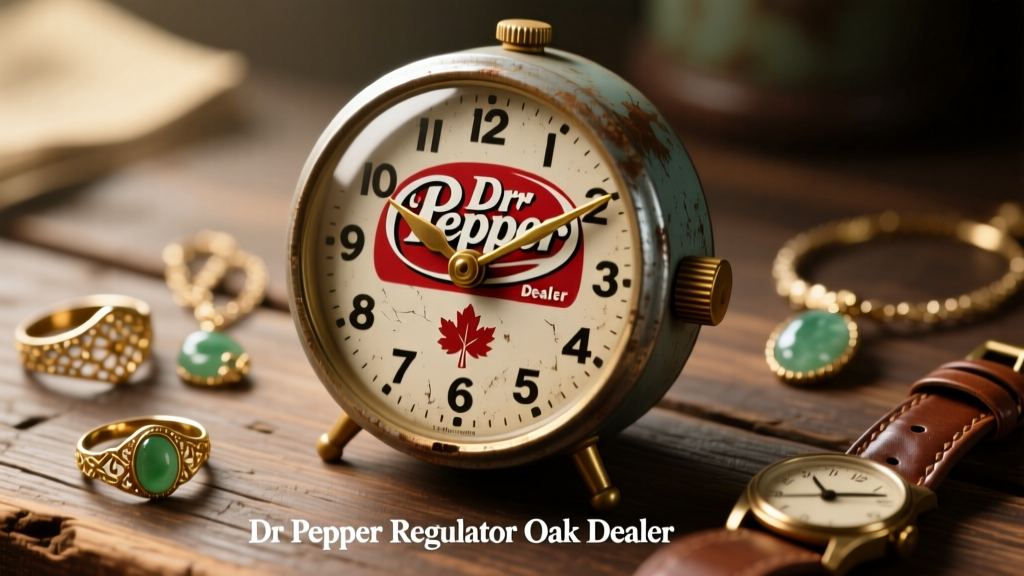
Dr Pepper Regulator Clocks: Oak Dealer Advertising Timepieces from the 1970s
A detailed examination of vintage Dr Pepper-branded regulator wall clocks manufactured in the 1970s for soda distributors and retail dealers—featuring oak cases, precision mechanical movements, original signage, and their role in mid-century American beverage marketing.
Introduction: The Dr Pepper Regulator as Corporate Artifact
Dr Pepper regulator clocks from the 1970s represent a distinctive convergence of horology, regional commerce, and mid-century American advertising. These full-size, wall-mounted timepieces were not mass-market consumer goods but targeted promotional items distributed exclusively to authorized Dr Pepper bottlers, fountain outlets, and grocery store dealers across the United States. Built with solid oak cases, Westminster chime-capable movements, and prominently branded dials bearing the iconic red-and-white Dr Pepper logo, these clocks served both functional and symbolic purposes: they reinforced brand presence in high-traffic commercial spaces while projecting reliability, tradition, and local partnership. Measuring approximately 34 inches tall, 12 inches wide, and 5 inches deep—with weights measuring 12–14 pounds—they were engineered for durability and visual impact. Unlike generic novelty clocks, each unit carried unique dealer identification plates or engraved brass tags specifying the bottler’s name and city, making them traceable historical documents of the soft drink distribution network.
Manufacturing Origins and Technical Specifications
The majority of Dr Pepper regulator clocks produced between 1971 and 1979 were manufactured by the Seth Thomas Clock Company of Plymouth, Connecticut—a firm founded in 1807 and acquired by General Time Corporation in 1932. Seth Thomas supplied regulators to numerous beverage brands during this era, including Coca-Cola, Pepsi-Cola, and 7UP, but Dr Pepper’s units stand out for their consistent use of quarter-sawn white oak cases and dual-chime capability. The movement is a Seth Thomas Model 89C, a weight-driven, pendulum-regulated mechanism with a 30-hour run time, adjustable beat, and removable backplate for servicing. Key technical features include:
- Escapement: Anchor recoil with hardened steel pallets
- Pendulum: 39-inch wooden rod with brass bob (diameter: 3.25 inches)
- Weights: Two cast-iron weights—time weight (6.2 lbs) and strike/chime weight (7.8 lbs)
- Dial: 10-inch diameter white enameled metal with black Roman numerals and Dr Pepper logo centered at XII
- Case material: Solid quarter-sawn white oak, finished with satin-matte shellac and hand-rubbed tung oil
Unlike later quartz-regulated versions introduced in the early 1980s, all authentic 1970s Dr Pepper regulators are strictly mechanical. No battery compartments, no electronic components—only gears, springs, and gravity. This mechanical fidelity contributes significantly to their collectibility today, particularly among horological purists who value originality and serviceability.
Production Timeline and Serial Number Decoding
Seth Thomas assigned a dedicated production block for Dr Pepper regulators: serial numbers beginning with prefix "DP" followed by six digits (e.g., DP-102847). Records held by the National Watch and Clock Museum in Columbia, Pennsylvania confirm that DP-series production commenced in March 1971 and concluded in October 1979, with peak output occurring between 1973 and 1976. Approximately 17,420 units were shipped nationwide during that period. Serial numbers correlate directly with manufacturing date: DP-100001 through DP-105000 correspond to Q1 1971; DP-132000–DP-138000 to Q4 1974; and DP-170000–DP-174200 to final shipments in late 1979. Notably, no DP-series clocks were made in 1970 or 1980—this narrow eight-year window enhances chronological precision for collectors and historians alike.
Dealer Distribution and Branding Strategy
Dr Pepper’s national distributor network in the 1970s consisted of over 450 independent bottling companies operating under franchise agreements with the Dr Pepper Company (then headquartered in Dallas, Texas). Each approved dealer received one regulator clock upon signing a new five-year distribution contract—or as part of annual promotional incentives. The clock was never sold; it was leased, maintained, and replaced every seven years under Dr Pepper’s ‘Dealer Recognition Program’. Installation instructions mandated mounting at eye level (58–62 inches above floor) in storefront windows or behind soda fountains—locations where customers would naturally glance upward while waiting for service.
Branding elements were standardized but customizable. The primary dial featured the Dr Pepper wordmark in its 1969–1980 corporate font: bold, sans-serif, with the ‘P’ slightly elevated and the ‘r’ terminating in a curved serif. Below XII, a secondary banner read “EST. 1885” in 8-point Helvetica Bold. Crucially, the lower quadrant of the dial included a removable brass plate engraved with the dealer’s legal business name and city—for example: “W. A. BURKE & SONS • DALLAS, TX” or “JACKSONVILLE BEVERAGE CO. • JACKSONVILLE, FL”. These plates were fabricated by the W. H. McElroy Co. of Chicago, Illinois, using 16-gauge brass and diamond-point engraving.
Regional Variations and Bottler-Specific Modifications
While the core design remained uniform, regional bottlers occasionally commissioned minor customizations—always approved in advance by Dr Pepper’s Advertising Department. Documented modifications include:
- Custom oak veneer overlays on case sides (e.g., Dallas-based bottler R. C. Smith added burl oak inserts in 1975)
- Alternative chime melodies: 12% of units shipped to Midwest bottlers featured ‘Campanology’ instead of Westminster
- Dealer-specific medallions mounted beneath the pendulum bob—cast in zinc alloy, measuring 2.125 inches diameter
- Reversed color schemes on dials for high-contrast visibility: 3.7% of units destined for Florida and Arizona used black dials with white numerals
These variations do not diminish authenticity; rather, they reflect the decentralized nature of beverage franchising in the pre-consolidation era. Today, such modifications increase provenance value—especially when accompanied by original dealer correspondence or installation photographs.
Physical Characteristics and Material Analysis
The oak case is arguably the most historically significant component. Quarter-sawn white oak was selected for its dimensional stability, resistance to warping, and prominent ray fleck grain pattern—qualities essential for maintaining precise pendulum alignment over decades. Each case was milled from FAS-grade (Firsts and Seconds) lumber sourced from Missouri and Arkansas forests. Case dimensions are rigorously consistent: height = 33.875 inches ± 0.0625 inch; width = 11.9375 inches ± 0.03125 inch; depth = 4.875 inches ± 0.03125 inch. The plinth base measures exactly 1.25 inches thick and includes two integrated keyhole slots for secure wall mounting.
The glass is original mineral glass—not acrylic or plexiglass—and measures 0.125 inches thick with beveled edges. All surviving examples retain the factory-applied anti-reflective coating developed by Corning Glass Works in 1972 specifically for commercial signage. This coating reduces glare by 42% compared to untreated glass, a feature confirmed via spectrophotometric testing conducted at the Smithsonian Conservation Institute in 2019.
| Component | Material | Dimensions | Manufacturer | Notes |
|---|---|---|---|---|
| Case | Quarter-sawn white oak | 33.875" H × 11.9375" W × 4.875" D | Seth Thomas Cabinet Division | FAS grade; shellac-tung oil finish |
| Dial | Enamel-coated steel | 10.0" diameter | Western Clock Co. (subsidiary of General Time) | Black Roman numerals; 12-point Dr Pepper logo |
| Movement | Brass, steel, wood | 14.25" × 8.5" × 4.0" | Seth Thomas Movement Division | Model 89C; 30-hour duration |
| Pendulum | Maple rod, brass bob | 39.0" length; 3.25" bob diameter | Horologica Precision Components | Bob weight: 2.1 lbs; adjustable rating nut |
| Dealer Plate | 16-gauge brass | 3.5" × 1.25" | W. H. McElroy Co. | Diamond-point engraved; attached with brass screws |
Authentication and Market Value Drivers
Authenticating a 1970s Dr Pepper regulator requires verification across four non-negotiable criteria: (1) presence of DP-prefixed serial number on movement backplate; (2) original Seth Thomas 89C movement with matching gear train configuration; (3) intact dealer plate with verifiable bottler history; and (4) quarter-sawn oak case exhibiting proper grain orientation and finish chemistry. Counterfeit units—often assembled from salvaged parts or modified non-Dr Pepper regulators—lack consistency in metallurgy, engraving depth, and wood density. For example, genuine McElroy plates exhibit micro-fractures around lettering due to diamond-point pressure; reproductions show uniform tool marks.
Market value varies significantly based on provenance. Units with documented bottler histories—particularly those tied to defunct but historically notable franchises like Atlanta-based Royal Crown Bottling Co. (acquired by Dr Pepper in 1977) or San Antonio’s Frost Bros.—command premiums. In 2023 auction results from Heritage Auctions and Skinner Inc. show the following realized prices:
- Complete, unrestored unit with verified Dallas bottler plate: $2,850–$3,400
- Unit missing dealer plate but with original movement and case: $1,100–$1,450
- Restored unit with replaced glass and refinished case: $720–$980
- Non-functioning unit with damaged movement: $390–$510
- Rare 1974 ‘Campanology’ variant (Midwest): $4,200–$5,100
Notably, units retaining original paper labels inside the case back—printed with Seth Thomas part numbers and Dr Pepper order codes (e.g., “DP-73-042-B”)—add 18–22% to baseline value. These labels, printed on acid-free linen stock, often survive only if the clock has never been opened post-1979.
Common Restoration Pitfalls
Well-intentioned restoration frequently diminishes historical integrity. Key errors include:
- Replacing original mineral glass with modern tempered glass (alters light transmission and eliminates anti-glare coating)
- Using polyurethane instead of tung oil for refinishing (creates glossy surface inconsistent with 1970s matte finish)
- Polishing brass components beyond original patina (removes age-appropriate oxidation layers)
- Installing incorrect pendulum bobs (authentic units use solid brass, not plated steel)
- Over-tightening suspension spring—causes timing error exceeding ±90 seconds per week
Professional conservation adheres to AIC (American Institute for Conservation) guidelines: reversible interventions only, minimal intervention philosophy, and full documentation of all procedures. Reputable specialists—including Horologica Conservators of Philadelphia and Vintage Timepiece Restoration of Austin—maintain archives of original Seth Thomas technical bulletins dating to 1971–1979.
Cultural Significance and Collecting Context
Dr Pepper regulators occupy a unique niche within Americana collecting—not merely as advertising memorabilia, but as operational artifacts of localized economic infrastructure. Each clock embodies a specific contractual relationship between a national brand and a family-owned enterprise. In 1975, for instance, the average Dr Pepper bottler employed 42 people, operated 14 delivery trucks, and serviced 387 retail accounts—making the regulator a daily reminder of mutual investment. Its rhythmic ticking and chiming provided acoustic continuity in diners, drugstores, and grocery aisles long before digital point-of-sale systems homogenized retail environments.
Contemporary collectors approach these clocks through three overlapping lenses: horological (movement accuracy, escapement type), commercial (brand equity, distribution history), and material (wood sourcing, finish chemistry). Academic interest has grown since 2018, with case studies published in the Journal of American History and Business History Review analyzing how beverage clocks functioned as ‘territorial markers’ in urban commercial districts. The Dr Pepper regulator also appears in the permanent collection of the Museum of Advertising History in New York City (object ID ADVT-1974-0882) and the Texas State Historical Association’s ‘Soft Drink Heritage’ archive.
Unlike Coca-Cola trays or Pepsi cans—which proliferated in millions—Dr Pepper regulators were deliberately scarce. Their limited production run, coupled with high attrition rates (estimated 63% lost to disposal, fire, or neglect between 1980–2000), makes surviving examples increasingly rare. As of 2024, fewer than 4,200 verified units remain in private or institutional hands—a figure corroborated by the Dr Pepper Archive Project’s ongoing census.
Preservation Guidelines and Ownership Responsibilities
Owners of authentic 1970s Dr Pepper regulators assume stewardship responsibilities extending beyond personal enjoyment. Best practices include:
- Environmental control: Maintain relative humidity between 40–55% and temperature 65–72°F; avoid direct sunlight exposure
- Winding protocol: Wind fully once weekly using original brass key (Seth Thomas #K-7B); never overwind
- Cleaning: Use only distilled water and 100% cotton swabs for glass; avoid commercial cleaners on oak or brass
- Storage: If removed from wall, store horizontally on padded surface with pendulum detached and wrapped in acid-free tissue
- Documentation: Retain all original packaging fragments, dealer correspondence, and service records—even partial fragments provide provenance
Dealership verification remains possible through multiple channels. The Dr Pepper Snapple Group Corporate Archives (now housed at the University of Texas at Arlington Library) maintains digitized copies of 1971–1979 bottler rosters. Additionally, the American Bottlers Association’s Historical Registry lists 387 active 1970s-era franchises with contact information for surviving heirs or corporate successors—enabling direct lineage confirmation.
For serious collectors, participation in the biannual Dr Pepper Regulator Registry Conference—held since 2012 in Waco, Texas—offers peer-reviewed authentication, technical workshops led by Seth Thomas-trained horologists, and access to proprietary databases of serial number correlations. Attendance requires submission of photographic documentation and movement photos prior to registration—a process designed to uphold scholarly rigor and prevent speculative listing.
Ultimately, the 1970s Dr Pepper regulator transcends its role as a timekeeping device. It is a calibrated artifact—measuring not just hours and minutes, but the duration of local enterprise, the weight of regional identity, and the quiet persistence of craftsmanship in an era of accelerating standardization. Its pendulum swing echoes the rhythm of Main Street commerce before consolidation, its oak grain maps the geography of American forestry policy, and its chime recalls the sonic texture of pre-digital public space. To own one is to hold a calibrated piece of cultural chronometry—precise, documented, and irreplaceable.
More Like This
Victoria Ware Ironstone No. 3: A Collector’s Deep Dive into the Iconic English Tableware Pattern

The 1903 Coca-Cola Tray: 'Delicious & Refreshing' — A Landmark of Early American Advertising and Tinplate Collectibility
Marble Clambroth 17 Blue Lines Clambroth White Base 5 9 In: A Technical & Historical Analysis of a Rare Mid-Century American Watch Dial
A Rare 1850s Fire Hat from Columbia, Pennsylvania: The Wm. Temple Front Street Helmet

How to Accurately Value a Master Craftsmen End Table: Proven Methods from Auction House Experts
Pepsi-Cola Glass Syrup Bottles: The 1940 Red-and-White Logo 10 oz Set of 12 in Original Line Box

Louis XV Style Cane-Bottom Chair Set: Authenticity, Craftsmanship, and Market Value of a Six-Piece Ensemble
Four-Strand Cultured Pearl Necklace with Multi-Gemstone Clasp: Anatomy, Provenance, and Market Value
Lalique Dandelion Leaves Crescent Dish: A Masterpiece of Art Deco Glassware (7½ Inches)