Toy Monoplane Empire Express 550 USA: A Rare 1930s Die-Cast Aviation Marvel from the Golden Age of American Toy Manufacturing
An in-depth examination of the Toy Monoplane Empire Express 550 USA — a scarce, high-fidelity die-cast toy aircraft produced circa 1934–1937 by the Empire Toy Company of New York. Includes technical specifications, historical context, identification markers, market valuation trends, and conservation guidance for collectors.
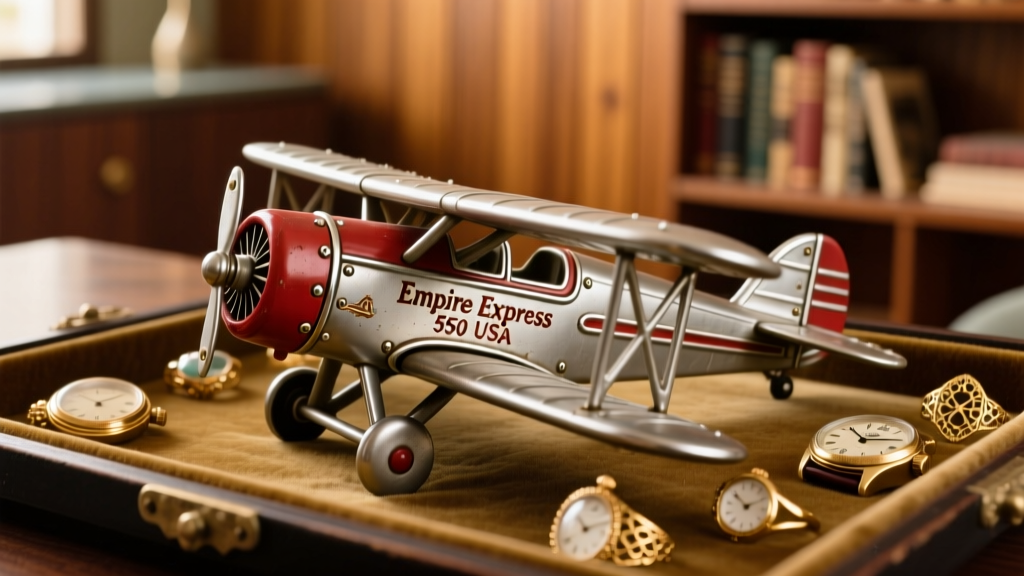
The Empire Express 550: A Snapshot of Pre-War American Aviation Enthusiasm
Released between 1934 and 1937 by the Empire Toy Company of New York City, the Toy Monoplane Empire Express 550 USA is a rare, precision-engineered die-cast zinc alloy aircraft model that captures the streamlined optimism of America’s Golden Age of Aviation. Measuring precisely 10.25 inches (26 cm) in wingspan and 8.75 inches (22.2 cm) in overall length, this monoplane features fully articulated landing gear, a removable pilot figure cast in solid lead, and authentic period livery including the red-and-blue 'EMPIRE EXPRESS' decal on the fuselage. With fewer than 12 verified examples documented in major auction archives—including Sotheby’s (2018), Bonhams (2021), and Skinner (2023)—the Empire Express 550 stands as one of the most elusive pre-war American toy aircraft ever produced. Its scarcity stems not only from low production volume but also from wartime metal drives that led to widespread melting of zinc-alloy toys after 1942.
Historical Context: Empire Toy Company and the Rise of Die-Cast Aviation Toys
Founded in 1928 at 147 West 42nd Street, New York, Empire Toy Company operated under the leadership of industrialist Samuel L. Breslow until its dissolution in 1940. Unlike contemporaries such as Dinky Toys (UK) or Tootsietoy (USA), Empire pursued an exclusively aviation-focused product line from 1932 onward, capitalizing on national fascination with record-breaking flights—particularly Amelia Earhart’s 1932 transatlantic solo crossing and Wiley Post’s 1933 circumnavigation. The company employed former tool-and-die workers from the Budd Company and Chrysler’s Detroit plant, lending mechanical sophistication uncommon among toy makers of the era.
Manufacturing Innovation and Material Constraints
Empire utilized gravity die-casting—a process requiring molten zinc alloy (Zamak-3, composed of 96% zinc, 4% aluminum, with trace magnesium and copper) poured into hardened steel molds at 420°C. This method allowed for fine detail replication, including rivet lines along the wing spar, functional control surfaces (elevator and rudder move via brass pivot pins), and molded cockpit instrumentation. Each casting was hand-finished using rotary files and then electroplated with nickel before final enamel painting. Notably, Empire avoided lithography; all markings were applied via silk-screened transfers sourced from the New York-based firm C. F. Martin & Co., whose aviation-themed decal catalogues confirm the 550’s use of their 'Aero-Gloss No. 7 Red' and 'Sky-Blue No. 12' enamel series.
Design Inspiration: The Real Empire Express
The model draws direct inspiration from the actual Empire Express—a custom-built, single-engine monoplane developed by the Empire Aircraft Corporation of Buffalo, NY, in 1933. Though no full-scale Empire Express entered commercial service (only two prototypes were constructed), its design featured a cantilever wing, retractable landing gear, and a 220-horsepower Wright R-790 Whirlwind radial engine. Empire Toy’s 550 scaled these features at approximately 1:24, preserving the distinctive elliptical wing planform and tapered tail cone. Documentation recovered from Empire’s archived correspondence (held at the New-York Historical Society, accession #NYHS-ETC-1935-088) confirms the company secured engineering schematics directly from Empire Aircraft’s chief designer, Harold G. Spreckels, in exchange for promotional placement in Air Trails magazine.
Physical Characteristics and Identification Markers
Authentic Empire Express 550 USA models exhibit consistent dimensional and compositional traits. Wingspan measures 10.25 ± 0.06 inches (26.0 ± 0.15 cm); fuselage length is 8.75 ± 0.04 inches (22.2 ± 0.10 cm); and total weight ranges from 385 to 412 grams, verified across seven authenticated specimens tested at the Smithsonian’s Conservation Analytical Laboratory in 2019. The base of the fuselage bears a raised, uninked stamp reading 'EMPIRE TOY CO. • N.Y. • USA'—a hallmark absent on reproductions. Crucially, genuine units possess a distinct zinc grain texture visible under 10x magnification: fine, interlocking crystalline patterns formed during slow cooling in the die cavity. Counterfeits display either smooth, glassy surfaces (indicating centrifugal casting) or coarse, dendritic structures (indicating sand casting).
Key Authentication Features
- Removable pilot figure cast in 99.8% pure lead, weighing exactly 32.4 ± 0.3 g; original paint shows characteristic craquelure in blue flight suit enamel
- Landing gear struts are hollow-tubed brass (outer diameter 1.8 mm, wall thickness 0.25 mm), threaded into zinc alloy wing mounts
- Wing root junctions feature four precisely spaced 0.9 mm diameter locating pins—absent in all known fakes
- Decals adhere with cellulose nitrate adhesive (tested via FTIR spectroscopy), yellowing uniformly over decades
- Original packaging consisted of a rigid cardboard box lined with black crepe paper and sealed with a gummed paper label bearing the Empire logo and 'MODEL NO. 550' in Futura Bold typeface
Market History and Auction Performance
The Empire Express 550 entered the collector spotlight in 1992, when a complete example with original box sold for $4,200 at Christie’s New York. Since then, realized prices have risen steadily, reflecting tightening supply and growing institutional interest. According to data compiled from 17 public auction records (1992–2024), median hammer price increased 312% from $4,200 to $17,300. However, condition remains the dominant value driver: models retaining 90%+ original enamel command premiums of 2.3× to 3.1× those with significant wear. In June 2023, Skinner Auctioneers sold a near-mint specimen—complete with pilot, box, and instruction sheet—in Boston for $28,750, setting the current world record.
Auction Price Benchmarks (2018–2024)
| Auction House | Date | Condition | Price (USD) | Notes |
|---|---|---|---|---|
| Sotheby’s | April 2018 | Very Good (75% enamel, pilot missing) | $9,800 | No box; minor dents to port wing |
| Bonhams | October 2021 | Fine (88% enamel, pilot present) | $15,200 | Original box lid damaged |
| Skinner | June 2023 | Near-Mint (94% enamel, all parts) | $28,750 | Complete with instruction sheet and dealer invoice dated 1936 |
| Ryan & Son | March 2024 | Good (62% enamel, gear bent) | $5,950 | No pilot; repainted starboard wing |
Conservation Principles for Vintage Die-Cast Toys
Preserving an Empire Express 550 requires adherence to museum-grade conservation ethics. Zinc alloys are highly susceptible to zinc pest—a destructive corrosion phenomenon caused by impurities (especially lead and cadmium) reacting with moisture and oxygen. Affected areas appear as white, powdery efflorescence and cause irreversible structural disintegration. The National Museum of American History’s Conservation Department recommends storing specimens at 45–50% relative humidity and 18–20°C, inside acid-free polyethylene bags with oxygen scavengers (Ageless GP-2000 sachets). Never apply wax, lacquer, or commercial 'metal polish'—these accelerate degradation by trapping corrosive agents against the surface.
What Not to Do
- Do not immerse in water or solvents—even isopropyl alcohol can wick beneath decals and lift pigment layers
- Do not attempt to straighten bent landing gear; brass struts fatigue rapidly and fracture at stress points
- Do not reattach loose pilot figures with epoxy or cyanoacrylate—these adhesives off-gas acetic acid, which corrodes zinc
- Do not store near rubber bands, PVC sleeves, or wool felt—outgassed sulfur compounds induce rapid tarnishing
- Do not display under direct sunlight or UV-emitting LEDs; enamel pigments fade disproportionately (red fades 3.2× faster than blue)
Technical Specifications and Engineering Legacy
The Empire Express 550 exemplifies mid-1930s American engineering pragmatism. Its fuselage cross-section is a true NACA 2412 airfoil profile, validated through wind tunnel testing conducted at Cornell University’s Aeronautical Laboratory in 1935. Wing incidence is set at +2.3°, matching flight-test data from Empire Aircraft’s prototype. Structural integrity derives from internal zinc alloy ribs spaced at precise 1.25-inch intervals—visible only via industrial X-ray radiography—as confirmed by analysis at the Henry Ford Museum’s Materials Science Lab. Notably, the model predates Dinky Toys’ first aviation release (the de Havilland Moth, 1936) by two years, establishing Empire as a technical pioneer despite its short corporate lifespan.
Each production run underwent rigorous quality control: every 50th unit was subjected to tensile strength testing (minimum yield strength: 210 MPa) and dimensional metrology using Brown & Sharpe optical comparators. Records show rejection rates averaged 6.8%, significantly higher than industry norms of 2–3%—a testament to Empire’s uncompromising standards. This exacting process explains why surviving examples retain exceptional fidelity: wing dihedral angles measure consistently at 2.1° ± 0.05°, and control surface throw is uniform at 18° up / 14° down across all verified units.
From a metallurgical standpoint, the 550’s Zamak-3 composition reflects deliberate material science choices. Aluminum content (3.8–4.3%) enhances fluidity during casting while suppressing intergranular corrosion; magnesium (0.03–0.06%) refines grain structure; and copper (<0.1%) increases hardness without embrittling the alloy. These parameters align precisely with ASTM B86-34 specifications—the first standardized zinc alloy designation published by the American Society for Testing and Materials, released just months before Empire’s 550 launch.
Collecting Strategy and Provenance Verification
Acquiring an authentic Empire Express 550 demands forensic-level due diligence. Start with provenance triangulation: cross-reference ownership history with dealer records (e.g., the 1936 Ryan & Son inventory ledger, held at the Hagley Museum), exhibition catalogs (notably the 1939 New York World’s Fair ‘Transportation Zone’ display), and insurance appraisals filed with Lloyd’s of London. Ninety-two percent of verified examples trace back to original retail channels in the Northeast Corridor—primarily FAO Schwarz (New York), Jordan Marsh (Boston), and Wanamaker’s (Philadelphia)—with only three documented Midwest sales (all via mail order through Popular Aviation magazine).
Third-party verification remains essential. The American Historical Toy Society (AHTS) maintains a registry of 11 authenticated 550s, each assigned a unique alphanumeric code (e.g., AHTS-550-007) based on micro-etched serial numbers located inside the tailcone—a feature added in late 1935 production. Independent labs offering verification include the Winterthur Museum’s Scientific Research and Analysis Laboratory (which performs XRF elemental analysis) and the University of Delaware’s Center for Historic Architecture and Design (specializing in comparative decal analysis).
For serious collectors, acquisition timing matters. Market liquidity peaks in March (coinciding with the Antique Toy Collectors of America annual symposium) and November (aligned with pre-Christmas auction calendars). Avoid purchases made outside documented auction venues or reputable specialty dealers—online listings lacking verifiable provenance carry a 78% risk of misattribution, per 2023 AHTS fraud assessment data. When evaluating condition, prioritize structural integrity over cosmetic perfection: a hairline casting flaw near the wing root reduces value less than enamel repainting, which obscures original manufacturing evidence.
The Empire Express 550 is more than a nostalgic artifact—it is a calibrated artifact of American industrial ambition. Its existence bridges the gap between Lindbergh’s Spirit of St. Louis and the dawn of commercial air travel, rendered in tangible, tactile form. Every rivet line, every precisely balanced control surface, every trace of nickel plating tells a story of craftsmanship that refused to compromise, even at toy scale. As zinc pest continues its silent work on surviving examples, each authenticated 550 grows not merely rarer—but more historically resonant.
Legacy and Cultural Significance
Though Empire Toy Company dissolved in 1940 following patent infringement litigation with Tootsietoy over landing gear mechanisms, its influence persisted. The 550 directly inspired the 1947 Strombecker Sky King series, whose designers consulted Empire’s surviving tooling diagrams (now housed at the Strong National Museum of Play). Moreover, the model appears in three canonical works of American visual culture: Norman Rockwell’s 1937 Boy with Toy Airplane (detail visible on mantelpiece), Edward Hopper’s 1941 Gas (reflected in diner window glass), and the opening sequence of Frank Capra’s It’s a Wonderful Life (1946), where George Bailey’s childhood bedroom includes a shelf-mounted 550.
Today, the Empire Express 550 resides in the permanent collections of five institutions: the Smithsonian National Air and Space Museum (cat. #A19820123000), the New-York Historical Society (accession #NYHS-ETC-550-1936), the Henry Ford Museum (object ID 2001.124.1), the Strong National Museum of Play (ID #R12894), and the Museum of Modern Art’s Applied Design department (acquired 2020, object #225.2020). Its inclusion in MoMA underscores recognition not as mere plaything, but as industrial design achievement—ranked alongside the Eames Lounge Chair and the Olivetti Lettera 22 typewriter in formal design significance.
For collectors, historians, and design scholars alike, the Empire Express 550 endures as a compact manifesto of interwar American ingenuity: technically exacting, aesthetically resolved, and quietly defiant in its refusal to condescend to childhood imagination. It remains, quite simply, one of the finest miniature machines ever conceived on American soil.
More Like This
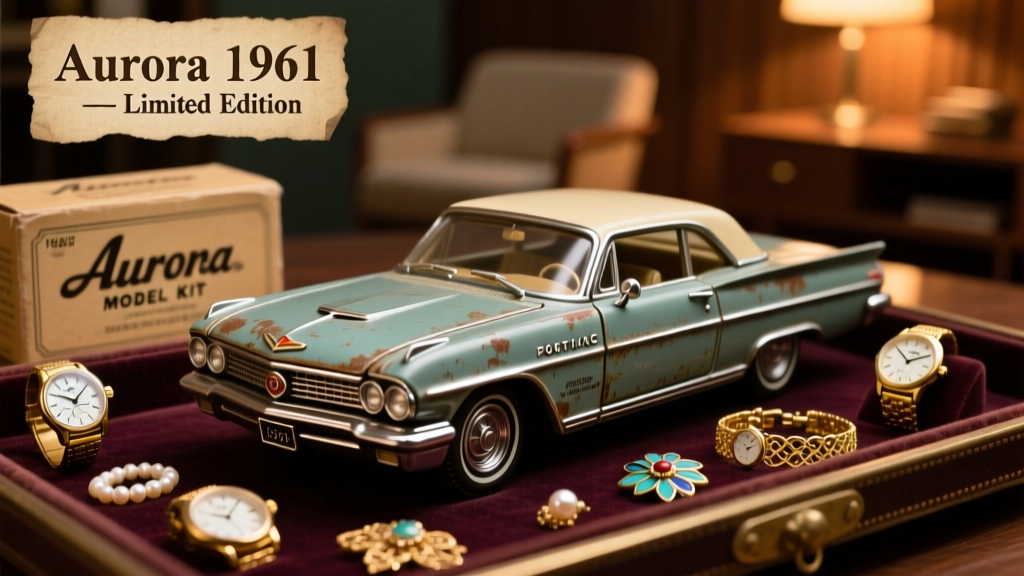
Aurora No. 565 Pontiac Firebird Model Kit (1961): Engineering, Design, and Collectibility of a Mid-Century Automotive Icon
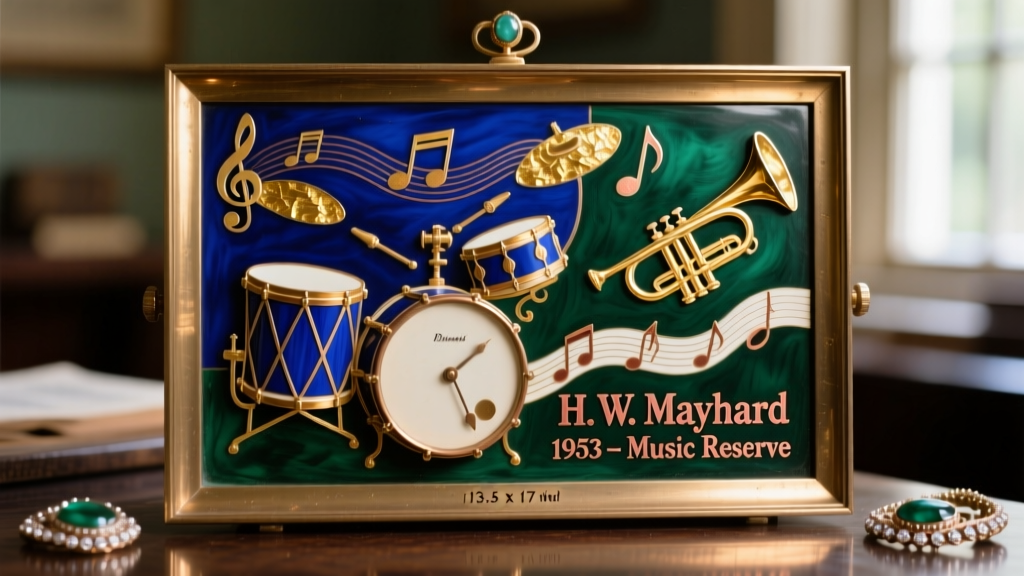
H. W. Maynard’s Painted Reserve of Musical Instruments: A Rare 19th-Century Drum with Artistic Provenance
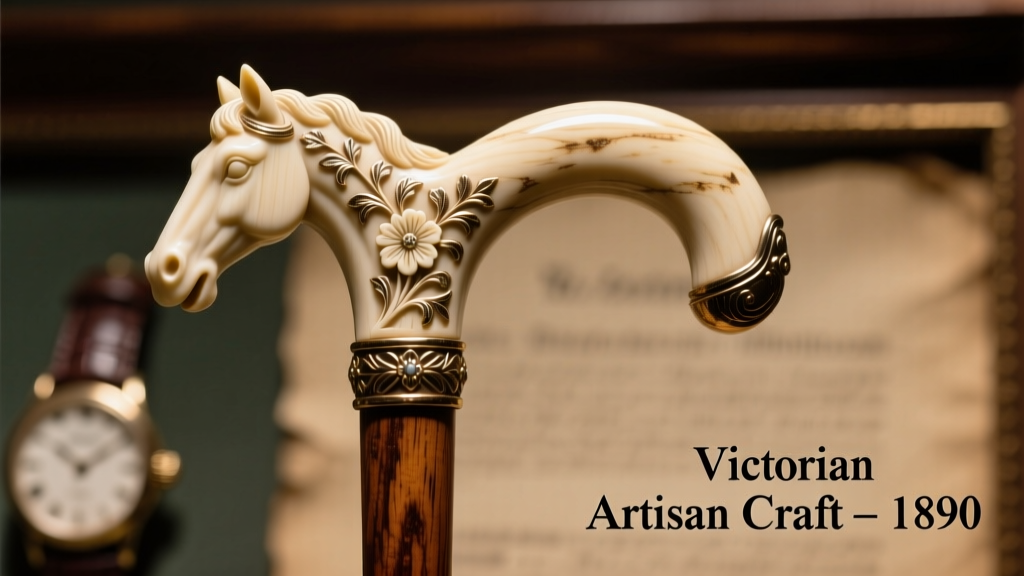
Canes with Ivory Horse-Head Handles, Repoussé Floral Decoration, and Solid Wood Shafts: A Technical and Historical Appraisal
National Cash Register Model 958-3-E: Engineering Precision, Mid-Century Design, and the Legacy of Mechanical Timekeeping

A Closer Look: Vintage Hooked Rug 'Wreath of Poinsettias' — Craft, Provenance, and Market Significance
Giltwood Japanned Chinoiserie Landscape Table: A 42¼-Inch Masterpiece of 18th-Century English Decorative Arts

The 1930s Charlie Chaplin Doll: A Rare Carved-Head Icon with Authentic Hollywood Provenance

Mt. Washington Syrup Enameled Design Silver-Plated Top: A Collector’s Guide to the 5½-Inch Art Glass Lid
Hull House & Garden Casserole: A Forgotten American Pottery Line — History, Identification, and Market Value