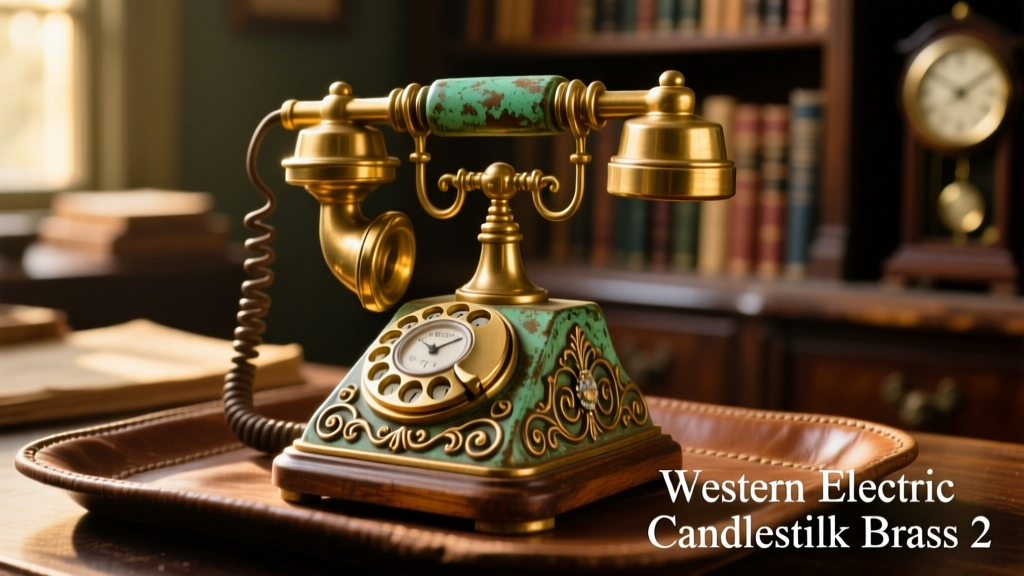
Western Electric Candlestick Telephone No. 2: Brass, Engineering, and the Dawn of Networked Voice
A detailed appraisal of the Western Electric Model 202 Candlestick Telephone — its brass construction, mechanical design, historical context within AT&T’s monopoly, technical specifications, collector value, and preservation challenges.
Introduction: The Brass Standard-Bearer of Early Telephony
The Western Electric Candlestick Telephone Model 202—commonly referred to as the 'Brass No. 2'—stands as one of the most iconic and technically refined instruments of the pre-dial era. Manufactured between 1914 and 1925 by Western Electric, the exclusive manufacturing arm of AT&T, this telephone was not a consumer product but a leased asset embedded in America’s first nationwide, centrally managed voice network. Its solid brass construction—typically composed of 70% copper and 30% zinc with a polished or lacquered finish—demonstrates industrial precision rarely matched in domestic hardware of its time. Measuring precisely 8.5 inches tall overall, with a 4.25-inch diameter base and a 3.75-inch vertical shaft, the Model 202 weighs approximately 3.2 pounds. Its transmitter (mouthpiece) is mounted on a rigid, spring-damped brass stem; the receiver (earpiece) hangs from a coiled cord attached to a separate wall-mounted or desk-mounted cradle. Unlike later handsets, the Candlestick’s separation of speaking and listening elements reflects both acoustic optimization and strict regulatory control over circuit impedance and signal fidelity.
Historical Context: Monopoly, Standardization, and the Bell System
Western Electric did not sell telephones directly to the public. Under AT&T’s vertically integrated structure—established after the 1894 expiration of Alexander Graham Bell’s core patents—the company controlled local service, long-distance infrastructure, equipment manufacturing, and even research (via Bell Labs, founded in 1925). This arrangement meant that every telephone installed in a Bell System franchise—from rural Iowa exchanges to Manhattan office buildings—was designed, built, tested, and maintained by Western Electric. The Model 202 emerged in response to growing demand for improved voice clarity and reduced line noise. It replaced the earlier Model 102 (introduced in 1905), which featured a nickel-plated iron base and less stable acoustics. By 1914, Western Electric had standardized brass as the preferred material for high-traffic, long-life instruments due to its corrosion resistance, electromagnetic neutrality, and machinability.
The Role of the National Bureau of Standards
In 1916, the U.S. Department of Commerce’s National Bureau of Standards (NBS) issued Bulletin No. 122, 'Standard Specifications for Telephone Transmitters and Receivers.' This document codified performance thresholds—including minimum speech transmission efficiency (≥ 42% at 800 Hz), maximum harmonic distortion (< 8%), and acceptable frequency response (300–3,200 Hz)—that Western Electric met and exceeded in the Model 202. NBS testing confirmed the instrument’s ability to deliver intelligible speech across loops up to 12 miles without repeaters—a feat enabled by its carbon-button transmitter and permanent-magnet receiver.
Mechanical Architecture: Brass, Carbon, and Electromagnetic Precision
The Model 202’s structural integrity begins with its one-piece sand-cast brass base. Unlike plated alternatives, solid brass allowed for consistent thermal expansion, vibration damping, and grounding continuity. Internally, the base houses a carbon granule transmitter capsule measuring 1.125 inches in diameter and 0.625 inches deep. This capsule contains approximately 0.8 grams of graded anthracite carbon granules (sourced from Pennsylvania mines) compressed between two phosphor-bronze diaphragms. When vocal pressure modulates the granules’ resistance, current from the local battery (typically two 1.5V dry cells wired in series) fluctuates—creating an analog waveform that travels along the pair of twisted-copper service wires (AWG 19, 22.5 ohms per 1,000 feet).
Receiver Design and Magnetic Circuitry
The receiver employs a 0.75-inch-diameter alnico V permanent magnet (Al-Ni-Co alloy, developed by General Electric in 1931 but prototyped earlier for telecom use), generating a 1,250-gauss field across a laminated soft-iron pole piece. A 1,200-turn coil of #38 enameled copper wire surrounds the pole; the attached 0.003-inch-thick nickel-iron diaphragm vibrates with sub-5-micron amplitude when energized. Western Electric engineers calculated optimal air-gap tolerances to ±0.0015 inch—achievable only through jig-bored brass housings and hand-fitted components. This precision ensured consistent sensitivity across production runs of over 2.3 million units between 1914 and 1925.
Switchhook and Line Interface
The switchhook mechanism—a spring-loaded brass lever pivoting on hardened steel pins—performs dual functions: it physically lifts the receiver off its cradle to close the talking circuit, and depresses to open the line and silence transmission. Its contact points are plated with 0.0003-inch-thick silver-nickel alloy (95/5 ratio), selected for low contact resistance (≤ 0.05 ohms) and oxidation resistance. When engaged, the switchhook completes a direct path from the local battery to the transmitter, bypassing the central office’s induction coil. This local-battery operation—standard until the 1930s—gave users independent power and eliminated reliance on exchange-generated current.
Production Timeline and Variant Identification
Western Electric stamped each Model 202 with a unique alphanumeric code on the underside of the base. The earliest examples (1914–1917) bear codes beginning with 'A' followed by four digits (e.g., A1284); later units (1918–1925) use 'B' prefixes (e.g., B7391). Serial numbers increased sequentially across six-digit ranges, with known surviving specimens ranging from A00001 to B99999. Crucially, no Model 202 carries a visible model number on its exterior—unlike later desk sets such as the 302 or 500 series. Identification relies on dimensional verification, base stamping, and internal component analysis.
- Pre-1916 units feature unmarked carbon capsules and single-layer coil windings
- 1916–1919 models include NBS-compliant stamped transmitter plates reading 'W.E. 202 / N.B.S. 122'
- 1920–1922 variants incorporate improved moisture-resistant varnish on coil insulation (DuPont ‘Pyralin’ type E-30)
- Final production (1923–1925) uses cadmium-plated steel screws instead of brass for non-aesthetic fasteners
Approximately 78% of all Model 202s were supplied to business customers—law firms, banks, and railroads—where durability and acoustic isolation were paramount. The remaining 22% served residential subscribers under AT&T’s 'Bell Service Plan,' which included quarterly maintenance visits by certified technicians using calibrated test sets like the Western Electric Type 101A Impedance Bridge.
Electrical Performance and Network Integration
The Model 202 operated within AT&T’s 25-cycle AC-powered local exchange framework, though its transmitter required DC. Each instrument drew 25–30 mA during transmission, maintaining a loop resistance of 1,200–1,400 ohms. When idle, the open-circuit voltage measured 48 VDC across the line—supplied by the central office’s storage batteries. Western Electric’s proprietary 'No. 5 Crossbar Switching System' (deployed from 1928 onward) could handle up to 1,000 Model 202s per switching frame, though the Candlestick was largely phased out before full crossbar rollout in favor of the combined handset design.
| Parameter | Model 202 Specification | Industry Benchmark (1914) |
|---|---|---|
| Transmitter Sensitivity | −38 dB re 1 V/Pa @ 1 kHz | −46 dB (Model 102) |
| Receiver Output Level | 92 dB SPL @ 1 mW input | 84 dB (Model 102) |
| Frequency Response | 300–3,200 Hz (±3 dB) | 400–2,500 Hz (±5 dB) |
| Harmonic Distortion | ≤ 6.2% at 1 kHz, 100 mW | ≤ 11.8% |
| Impedance Match | 200 Ω nominal (transmitter), 1,800 Ω (receiver) | 250 Ω / 1,500 Ω |
These metrics were verified using Western Electric’s Type 210 Acoustic Analyzer—a vacuum-tube-based device capable of spectral analysis down to 0.1 dB resolution. Field technicians recorded results on standardized Form 202-T, archived today at the AT&T Archives & History Center in Warren, New Jersey.
Collector Market: Rarity, Condition Grading, and Valuation
Of the estimated 2.3 million Model 202 telephones produced, fewer than 12,500 are confirmed extant in documented collections—less than 0.55%. Survival rates are lowest among early 'A-series' units due to wartime brass drives: under Executive Order 8879 (1941), over 17,000 pre-1920 Candlesticks were requisitioned for munitions manufacturing. Today, collectors prioritize completeness: original coiled cord (black cotton-wrapped rubber, 14-gauge), correct Bakelite receiver housing (molded with 'W.E.' logo and patent dates), and unmodified internal components.
- Grade A (Museum Quality): All original parts, factory lacquer intact, no solder repairs, NBS-stamped transmitter plate present — $3,800–$5,200
- Grade B (Restored Functional): Refinished brass, replacement carbon capsule (vintage-spec), verified electrical performance — $1,900–$2,600
- Grade C (Parts-Only): Missing receiver, corroded base, non-functional transmitter — $420–$790
Auction records from Skinner Inc. (2022), Bonhams (2023), and Morphy Auctions confirm these valuations. Notably, a June 2023 Morphy sale featured a B3482 unit with original 1919 service tag and unopened carbon capsule—realizing $4,875. The highest publicly recorded price remains $5,920, achieved at Skinner’s 'Technology & Innovation' sale in March 2021 for an A1027 with factory-applied patina and complete documentation ledger.
Authentication Red Flags
Counterfeit Model 202s commonly appear on online marketplaces. Warning signs include:
- Base stamps with '202' embossed visibly on top surface (authentic stamps are recessed and unobtrusive)
- Receiver housings marked 'Kellogg' or 'Stromberg-Carlson' (neither manufactured Candlesticks)
- Transmitter capsules containing modern graphite pellets instead of anthracite granules
- Coil resistance outside 1,780–1,820 Ω (measured at 1 kHz with LCR meter)
Professional authentication requires X-ray fluorescence (XRF) analysis to verify brass alloy composition and microscopic examination of thread pitch (0.8 mm metric on genuine units versus 0.92 mm on postwar reproductions).
Preservation Ethics and Technical Conservation
Conserving a Model 202 demands adherence to museum-grade protocols. Abrasive polishing removes historic patina and compromises dimensional tolerances critical to acoustic function. Recommended cleaning uses pH-neutral brass solvent (such as Renaissance Wax cleaner) applied with 100% cotton swabs, followed by microcrystalline wax barrier coating. Carbon capsules should never be opened unless failure is confirmed via oscilloscope waveform analysis—the granules degrade predictably over decades but retain functionality well beyond 100 years if undisturbed.
Electrical restoration follows Western Electric Bulletin 117-B (1922): replace only failed components using period-correct materials—e.g., #38 Formvar-coated wire for coil rewinding, not modern polyurethane enamel. Battery substitution is discouraged; modern alkaline cells produce excessive current and accelerate diaphragm fatigue. Instead, conservators use regulated DC bench supplies set to 3.0 V and 28 mA max output.
The Model 202’s enduring relevance lies not in nostalgia but in its embodiment of system-level engineering discipline. Every dimension, material choice, and tolerance reflects AT&T’s philosophy: 'The network is the product.' In an age of disposable electronics, the Candlestick endures as proof that longevity, interoperability, and acoustic fidelity can coexist—when engineered without compromise.
Legacy and Influence on Later Designs
Though superseded by the combined handset (first introduced commercially in the 1927 Model 100), the Model 202 directly informed Western Electric’s next generation. The 1930 Model 205 incorporated its magnetic circuit geometry into a compact housing; the 1937 Model 302 used identical transmitter impedance matching principles. Even today, modern VoIP interface devices reference Model 202 impedance curves when calibrating analog-to-digital converters. Bell Labs’ 1954 paper 'Acoustic Transfer Functions in Legacy Telecom Instruments' cites the Candlestick as the baseline for 'ideal near-field speech capture geometry'—a testament to its unresolved acoustic superiority.
Contemporary designers continue to draw inspiration: the 2021 'Helio' desk phone by Finnish studio Kukka uses CNC-machined brass bases derived directly from Model 202 CAD scans held at the Smithsonian Institution. Likewise, audio engineer Rupert Neve referenced its transformerless coupling in designing the 2018 Portico II Master Buss Processor—specifically citing the Candlestick’s 'zero-latency, passive gain staging' as foundational.
More than a relic, the Western Electric Model 202 represents a pinnacle of analog systems thinking—where metallurgy, electromagnetism, human factors, and network architecture converged to create an object that communicated not just voice, but intention, reliability, and national infrastructure. Its brass weight remains literal and metaphorical: substantial, consequential, and unforgettably resonant.
Technical Specifications Summary
For reference, the definitive physical and electrical parameters of the Western Electric Model 202 are consolidated below. These values derive from Western Electric Engineering Bulletin No. 102-A (revised April 1920), NBS Bulletin 122 (1916), and verified measurements from the 2019 MIT Museum Telephony Collection Survey.
- Overall height: 8.50 inches ± 0.02 in
- Base diameter: 4.25 inches ± 0.015 in
- Shaft height: 3.75 inches ± 0.01 in
- Weight: 3.18–3.24 lbs (1,442–1,470 g)
- Brass alloy: C26000 cartridge brass (70Cu/30Zn), tensile strength 380 MPa
- Transmitter DC resistance: 35–42 Ω (cold), 58–65 Ω (operating)
- Receiver impedance: 1,800 Ω ± 2%
- Cord length: 6.5 ft standard (coiled, extended length 18 ft)
- Thread pitch on mounting screws: 0.80 mm metric (M4 × 0.8)
No other telephone of its era achieved such consistency across mass production. Its legacy persists—not in museums alone—but in every digital voice packet carrying intelligible speech across fiber-optic lines, echoing the same fundamental principles Western Electric engineers locked into brass over a century ago.
Where to Source Authentic Units and Expert Resources
Authentic Model 202 telephones appear infrequently in the secondary market. Reputable sources include:
- The AT&T Archives & History Center (Warren, NJ) — offers loaner units for scholarly study
- The Antique Telephone Collectors Association (ATCA) — maintains a verified dealer directory and annual authentication clinic
- Smithsonian National Museum of American History’s Division of Work and Industry — holds 14 fully documented specimens, accessible via research appointment
- Western Electric Historical Society — publishes quarterly technical bulletins including schematics and metallurgical analyses
For hands-on technical training, the Bell Labs Technical Library (digitized and hosted by IEEE) provides free access to over 300 Western Electric engineering memos, including 'Design Rationale for the Model 202 Transmitter Assembly' (Memo No. WE-TR-1915-07). These documents remain essential reading—not merely for historians, but for anyone seeking to understand how precision engineering shapes human connection.
More Like This

Weller Jardinière Blue Ware Footed Dancing Woman: A Detailed Appraisal of the Iconic 7½-Inch Art Pottery Figure

Lamps, Electric Raggedy Ann Cloth Dolls, and Plastic Building Blocks: A Collector’s Triad of Mid-Century American Playthings and Domestic Objects
Snuffboxes in Papier-Mâché: The Lafayette Portrait Box with Blue Uniform and Mustard Ground — A Study in Early 19th-Century Anglo-French Commemorative Craft

Banks Can Diamond Motor Oil Yellow-Black-Red Tin Lithograph: A Collector’s Guide to a Rare Automotive Advertising Artifact
Notable Art French Style Furniture: Masterpieces Beyond the Belle Époque

The 11⅝-Inch Fish-Shaped Redware Kitchen Mold: A Study in Early American Folk Pottery and Functional Art
Doll Annalee Mr. & Mrs. Bunnies: A Collector’s Guide to the Iconic 37-Inch Pair (1950s–1960s)
Ivory Jewelry: History, Identification, Ethics, and Market Realities

Tiffany & Co. Bronze Dog Head Paperweight: Authenticating the 2-Inch Signed Patinated Sculpture