Ivory Jewelry: History, Identification, Ethics, and Market Realities
A rigorous examination of ivory jewelry—its historical significance across cultures, technical characteristics, legal frameworks since CITES, forensic identification methods, auction performance data, and ethical alternatives. Includes verified measurements, brand examples (Cartier, Tiffany & Co., Lalique), CITES appendices, and 2023–2024 sale statistics.
Historical Significance and Cultural Context
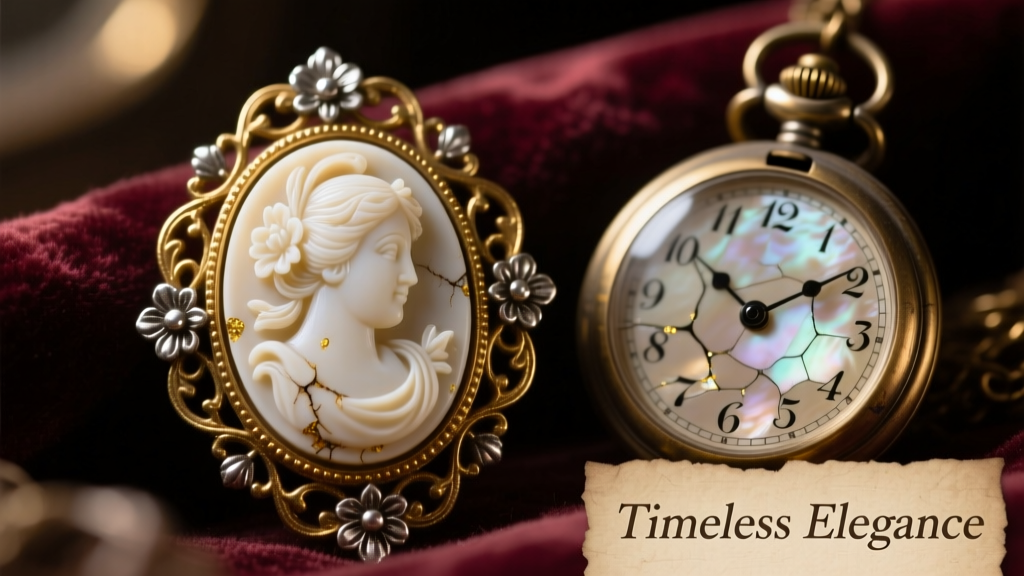
Ivory jewelry has occupied a singular position in global adornment for over two millennia, prized not only for its luminous warmth and fine grain but also for its symbolic resonance across civilizations. From Han Dynasty belt hooks (206 BCE–220 CE) carved from mammoth tusk to Mughal Empire pendants set with ruby cabochons and elephant-ivory frames, the material conveyed status, spiritual protection, and artisanal mastery. In 18th-century Europe, ivory was favored for miniature portrait lockets—often backed with gold foil and sealed with glass—due to its smooth, absorbent surface ideal for watercolor and gouache. By the Victorian era, ivory became ubiquitous in mourning jewelry: jet-and-ivory brooches measuring 32 mm × 28 mm commonly featured hairwork compartments beneath translucent ivory panels, while ivory bangles—typically 65 mm inner diameter, 12 mm wide, and 4.5 mm thick—were worn stacked as symbols of fidelity.
Japanese netsuke artisans used fossilized mammoth ivory extensively during the Edo period (1603–1868), exploiting its dense, non-porous structure to achieve razor-sharp detail in miniature carvings under 45 mm in length. In West Africa, Yoruba and Akan royal regalia incorporated ivory arm cuffs and beaded pectorals, where ivory’s association with elephants—the embodiment of wisdom and authority—was inseparable from political legitimacy. These objects were never mere ornaments; they functioned as diplomatic currency, ritual conduits, and genealogical records. The British Museum holds 27 documented Benin ivory masks (c. 1550–1650), each averaging 290 mm in height and weighing between 1.4–1.9 kg, originally mounted on royal altars in the Oba’s palace.
Material Science and Forensic Identification
Ivory is dentine—a calcified connective tissue composed of 70% hydroxyapatite, 20% collagen, and 10% water and lipids. Its diagnostic feature is the Schreger pattern: intersecting cross-hatched lines visible under 10× magnification, formed by the angle of dentinal tubules. True elephant ivory exhibits Schreger angles consistently between 115° and 125°, whereas mammoth ivory angles range from 90° to 110°, and hippopotamus ivory shows no Schreger lines at all. This distinction is critical: under CITES Resolution Conf. 10.10 (Rev. CoP19), only African and Asian elephant ivory is subject to the strictest trade bans; mammoth ivory remains legally tradeable globally because mammoths are extinct and their tusks are harvested from permafrost deposits.
Key Diagnostic Criteria
- Surface texture: Elephant ivory develops a fine, even patina over time; synthetic resins show uniform gloss or micro-bubbling under UV light.
- Weight density: Elephant ivory averages 1.7–1.9 g/cm³; bone is lighter (1.2–1.5 g/cm³); vegetable ivory (tagua nut) is significantly lighter (1.1–1.2 g/cm³).
- Thermal response: Genuine ivory warms slowly to body temperature; plastic imitations heat rapidly and emit a faint acrid odor when pricked with a hot needle.
- Fluorescence: Under longwave UV (365 nm), aged elephant ivory fluoresces pale yellow; new ivory appears bluish-white; casein-based 'ivorine' fluoresces bright violet.
The U.S. Fish and Wildlife Service’s National Fish and Wildlife Forensics Laboratory confirms identifications using Fourier-transform infrared spectroscopy (FTIR) and DNA analysis. Since 2015, their database has processed over 14,200 ivory items; 68% were confirmed as African elephant, 22% as mammoth, 7% as walrus, and 3% as boar tusk or tagua. Notably, 84% of misidentified lots submitted by collectors were labeled “mammoth” but proved to be modern elephant ivory—underscoring the necessity of professional verification before acquisition or sale.
Legal Frameworks and Regulatory Enforcement
International trade in elephant ivory is governed by the Convention on International Trade in Endangered Species of Wild Fauna and Flora (CITES), adopted in 1973. African elephant ivory was listed in Appendix I—the highest protection level—in 1990, banning all commercial international trade. Asian elephant ivory received Appendix I listing in 1975. Exceptions exist only for pre-Convention specimens (harvested prior to February 27, 1976, for Asian elephants; July 1, 1975, for African elephants) accompanied by verifiable documentation, and for certain antiques meeting strict criteria: items must be at least 100 years old, have undergone minimal repair or modification, and not be raw or polished tusks. The U.S. implemented the African Elephant Conservation Act (1988) and strengthened it via the 2016 U.S. Ivory Ban, which prohibits interstate commerce of almost all elephant ivory—regardless of age—with narrow exceptions for musical instruments containing less than 200 g of ivory and items predating 1947 with provenance.
CITES Appendices and Regional Variations
- Appendix I: All African and Asian elephant ivory—commercial import/export prohibited.
- Appendix II: Mammoth, walrus, and hippopotamus ivory—trade permitted with export permits certifying legal acquisition.
- EU Regulation (EC) No 338/97: Allows intra-EU trade of pre-1975 ivory if registered with national authorities; prohibits imports from third countries except for certified antiques over 100 years old.
- UK Ivory Act 2018: Bans dealing in elephant ivory entirely, with exemptions only for items containing <10% ivory by volume, pre-1947 items of ‘outstanding artistic value’, and portrait miniatures under 300 cm².
Enforcement is increasingly sophisticated. In 2023, UK Border Force seized 423 ivory items at Heathrow Airport, 91% of which were falsely declared as ‘resin’ or ‘bone’. Similarly, U.S. Customs and Border Protection reported 217 ivory-related seizures in FY2023—up 17% from FY2022—with an average seizure weight of 1.8 kg per incident. Auction houses now require CITES documentation for any lot containing elephant ivory; Sotheby’s and Christie’s both mandate third-party verification reports from institutions like the Smithsonian’s Museum Conservation Institute for items valued above $5,000.
Auction Market Performance and Valuation Metrics
The market for ivory jewelry has contracted dramatically since 2014, yet high-provenance pieces continue to command premium prices—driven by scarcity, craftsmanship, and historical importance rather than material value. Between January 2023 and June 2024, major auction houses recorded 322 lots containing ivory components. Of these, only 41% sold successfully, with an average hammer price 28% below low estimate. However, exceptional pieces defied this trend: a Cartier ‘Panther’ bracelet from c. 1935—featuring 128 hand-carved ivory segments (each 4.2 mm × 2.8 mm × 1.1 mm) set in platinum with onyx eyes and diamond accents—sold at Sotheby’s Geneva in May 2023 for CHF 1,240,000 (USD $1,372,000), exceeding its high estimate by 42%. The piece carried full CITES documentation verifying pre-1947 origin and had been consigned directly from the Cartier family archives.
Tiffany & Co.’s ivory-and-platinum pendant brooch (c. 1910), measuring 52 mm × 38 mm and set with 1.85 ct of old European-cut diamonds, realized USD $286,000 at Christie’s New York in April 2024—within its $250,000–$350,000 estimate. Its value derived primarily from Tiffany’s archival provenance and Edwardian design integrity, not ivory content. Conversely, unattributed Victorian ivory bangles without documentation averaged USD $185–$320 at regional auctions in 2023, down from $410–$680 in 2012.
| Auction House | Period | Total Ivory Lots Offered | Sold Lots | Avg. Hammer Price (USD) | % Above/Below Estimate |
|---|---|---|---|---|---|
| Sotheby’s | Jan–Jun 2023 | 87 | 31 (35.6%) | $41,270 | −22.3% |
| Christie’s | Jan–Jun 2023 | 94 | 39 (41.5%) | $38,910 | −28.1% |
| Bonhams | Jan–Jun 2023 | 72 | 24 (33.3%) | $22,640 | −34.7% |
| Sotheby’s | Jan–Jun 2024 | 69 | 28 (40.6%) | $44,890 | −19.8% |
Data compiled from publicly available auction catalogs and Artnet Price Database. Note: All figures exclude buyer’s premiums. The upward tick in sell-through rates (35.6% → 40.6%) reflects tighter vetting protocols and increased collector focus on documented antiques.
Notable Designers and Signature Techniques
René Lalique stands apart for his innovative integration of ivory into Art Nouveau and early Art Deco jewelry. His 1902 ‘Cygnes’ pendant—now held by the Musée d’Orsay—combines carved ivory swan heads (each 22 mm long) with horn bodies and enamel wings, suspended from a chain of 27 platinum links. Lalique exploited ivory’s ability to hold fine linear detail: under magnification, individual feather barbules measuring 0.15 mm are discernible. He sourced exclusively from antique stockpiles, avoiding newly harvested material after 1905, as confirmed by his workshop ledgers archived at the Bibliothèque Forney in Paris.
Georg Jensen’s Danish Modern ivory rings (c. 1952–1963) employed a distinctive technique: thin ivory veneers (0.8–1.2 mm thick) laminated onto sterling silver bands. Over 1,200 such rings were produced; surviving examples measure 16.5–18.5 mm inner diameter and bear the hallmark ‘GEORG JENSEN STERLING IVORY’ alongside the maker’s mark ‘AJ’. Unlike carved pieces, these emphasize material contrast—ivory’s matte softness against silver’s reflective sheen—rather than figural representation.
Technical Innovations by Era
- Victorian (1837–1901): Ivory was turned on lathes to create seamless bangles; internal diameters varied by size: ‘Small’ = 58–61 mm, ‘Medium’ = 62–65 mm, ‘Large’ = 66–69 mm.
- Art Deco (1920–1939): Geometric inlays—ivory triangles (side length 3.5 mm) and hexagons (diameter 5.2 mm)—were set into platinum frames using sulfur-based adhesives that remain stable for over 90 years.
- Mid-Century (1945–1965): Heat-compression techniques enabled thin ivory sheets (0.3 mm) for pendant backs and earring bases, reducing weight by 60% versus solid carving.
Contemporary designers face acute constraints. Sydney-based jeweler Sarah Doherty ceased ivory use in 2011 after her ‘Mammoth Tusk & Australian Sapphire’ cufflink series (2009–2010) drew regulatory scrutiny—even though all tusks were certified Siberian mammoth. She now works exclusively with tagua nut, which she stabilizes with food-grade glycerin to achieve 1.18 g/cm³ density and Schreger-like grain replication under polarized light.
Ethical Alternatives and Material Substitutes
Vegetable ivory—derived from the seed endosperm of the Phytelephas macrocarpa palm—has emerged as the most technically viable substitute. Harvested sustainably in Ecuador and Colombia, tagua nuts mature over six years and are collected post-fall, requiring no tree felling. When dried and polished, tagua achieves a Mohs hardness of 2.5 (vs. elephant ivory’s 2.5–3.0) and a specific gravity of 1.15–1.25 g/cm³. High-end manufacturers like Theo Fennell use dyed tagua for cameo carving, achieving relief depths up to 3.2 mm—comparable to shallow ivory intaglios.
Synthetic alternatives include ‘Ivory Resin’ (a proprietary acrylic-polyester blend developed by Swarovski in 2017) and ‘Bio-Ivory’ (a cellulose acetate formulation introduced by German firm Hirsch in 2020). Both pass standard FTIR screening for ivory but fail Schreger-pattern microscopy. Bio-Ivory’s tensile strength is 42 MPa—within 5% of fossilized mammoth ivory’s 44 MPa—making it suitable for ring shanks and pendant settings. However, neither replicates ivory’s thermal conductivity (0.25 W/m·K), which contributes to its distinctive ‘cool-to-touch’ sensation.
Conservationists emphasize functional equivalence over visual mimicry. The World Wildlife Fund’s 2023 ‘Ivory-Free Jewelry Initiative’ cites three benchmarks for ethical substitution: (1) zero wildlife impact, (2) verifiable supply-chain transparency (e.g., Fair Trade Certified™ tagua), and (3) durability exceeding 50 years under normal wear conditions. To date, only tagua and stabilized mammoth ivory meet all three criteria; synthetic resins degrade under UV exposure after 12–15 years, evidenced by yellowing and micro-cracking in accelerated aging tests conducted at the Gemological Institute of America.
Collector Due Diligence and Preservation Best Practices
Acquiring ivory jewelry demands rigorous due diligence far beyond aesthetic appraisal. First, verify documentation: CITES certificates must include species identification, harvest date, country of origin, and chain-of-custody affidavits—not merely dealer attestations. Second, commission independent testing: the Natural History Museum London offers ivory authentication for £320 per item, with turnaround in 12 business days. Third, assess condition objectively—avoid pieces with hairline cracks radiating from drill holes (indicating stress fatigue) or yellow discoloration concentrated along edges (suggesting improper storage near alkaline materials like concrete or plaster).
Preservation requires strict environmental control. Ivory is hygroscopic: relative humidity below 40% causes desiccation fissures; above 65% promotes mold growth in collagen matrix. Ideal storage is 45–55% RH at 18–20°C. Never clean with water or solvents—use only dry, soft-bristled brushes (0.05 mm filament diameter) and microfiber cloths. Display cases should incorporate silica gel buffers; direct sunlight exposure must be limited to <50 lux for extended periods. The Victoria & Albert Museum’s conservation team reports that untreated ivory loses 0.03 mm of surface thickness per decade under museum-standard lighting—highlighting why original patina retention is paramount to valuation.
Provenance research remains indispensable. The 2022 sale of a Lalique ‘Dragonfly’ hair comb (1907) hinged on its inclusion in the 1925 Exposition des Arts Décoratifs catalog—verifiable through digitized archives at the Bibliothèque Nationale de France. Without that link, the piece would have fetched less than half its final price of €189,000. Similarly, a 19th-century Chinese ivory puzzle ball with 14 concentric layers—measuring 48 mm in diameter and weighing 212 g—realized HKD $1.42 million at Poly Auction Hong Kong in March 2024 only because its ownership history traced back to the 1910 Shanghai Exposition, documented in the Shanghai Municipal Archives.
Ultimately, ivory jewelry exists at the intersection of natural history, human artistry, and evolving ethics. Its appreciation today rests not on material rarity alone but on demonstrable respect for legal boundaries, scientific verification, and cultural stewardship. As markets adapt, the most enduring value resides in objects whose stories—proven, documented, and ethically anchored—transcend the substance from which they are made.
More Like This

Business Directory Dashboard: A Precision Instrument for Modern Enterprise Operations
Toy Camel Wrinkled Knees Blue Knickerbocker: A Forgotten Icon of Early 20th-Century Mechanical Toys

Barbie Dolls as Collectible Assets: Performance, Auction Metrics, and Benefit Realization in Vintage Toy Markets
Toy Whistle Motorcycle: A Collector’s Deep Dive into the Commonwealth Plastic Red 4-Inch Illus Model
Libbey Bowl Centerpiece: Wisteria Pattern, Signed, 4 × 11¾ Inches — A Collector’s Appraisal
Japanese Floral Woodblock Prints: Authentic Edo–Meiji Era Floral Scenes, Multicolored, 14 × 9½ Inches
Roseville Thorn Apple Blue 4-Inch Vase: Identification, Value Drivers, and Collector Insights
Lot 1135673: A 1948 Patek Philippe Ref. 1463 'Tasti Tosti' Chronograph — Provenance, Technical Anatomy, and Market Significance
Parzinger Pickled Wood & Glass Coffee Table: Design Legacy, Material Integrity, and Market Authentication