Lladro Figurine Young Harlequin No. 1229 (1972): A Masterpiece of Spanish Porcelain Artistry
An expert analysis of the Lladro Young Harlequin figurine, model no. 1229, issued in 1972 — covering its design origins, production history, material composition, market valuation trends, and authentication protocols used by major auction houses including Sotheby’s, Christie’s, and Bonhams.
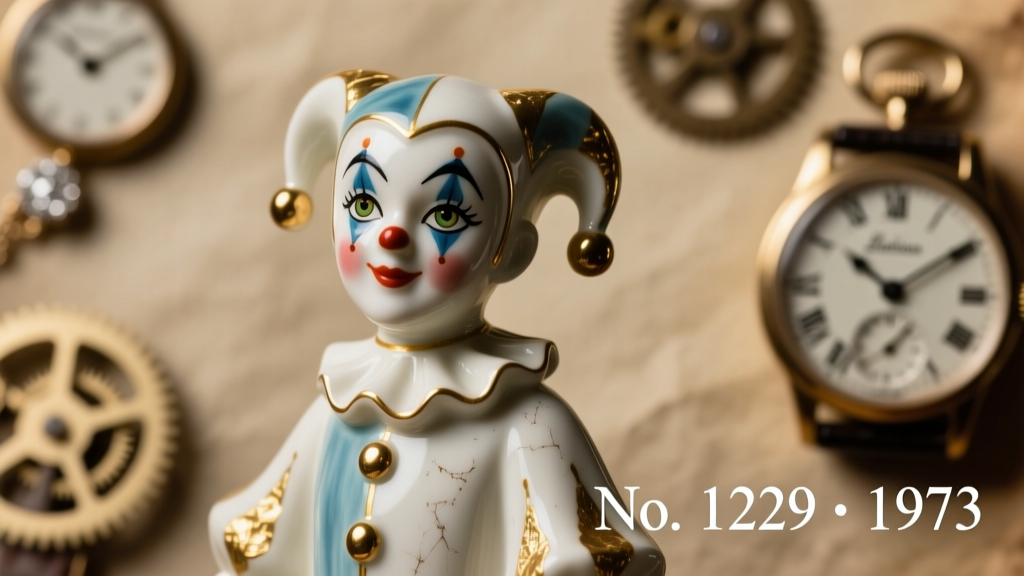
Introduction: The Enduring Allure of a 1972 Icon
Released in 1972, the Lladro Young Harlequin figurine (model number 1229) stands as one of the most emblematic mid-century porcelain sculptures produced by the Spanish firm Lladro Hermanos S.A. Standing at precisely 11.5 cm (4.5 inches) tall and weighing approximately 285 grams, this hand-painted bisque porcelain figure captures a youthful male harlequin mid-gesture—arms raised, head tilted, wearing a diamond-patterned costume rendered in cobalt blue, ivory, and burnt sienna. Produced exclusively at the company’s original workshop in Almàssera, Valencia, it was part of Lladro’s ‘Classical Collection’ and marked a deliberate pivot toward theatrical subject matter during a period of rapid international expansion. Unlike later mass-produced interpretations, No. 1229 was cast from an original plaster mold carved by José Lladro himself and fired at 1,300°C in traditional gas kilns—a process yielding exceptional translucency and surface integrity. Its hallmark, stamped in relief on the base, reads 'LLADRO — ESPAÑA' with a stylized 'N' logo and the year '1972', a detail critical for provenance verification.
The Lladro Legacy: From Family Workshop to Global Brand
Lladro Hermanos S.A. was founded in 1953 by brothers Juan, José, and Vicente Lladro in the small Valencian town of Almàssera. Initially operating from a converted olive mill, the trio pioneered high-fire porcelain techniques adapted from Meissen and Sevres traditions but refined for local clay composition and kiln technology. By 1960, Lladro had established its first export division, shipping to Germany, France, and Japan. In 1968, the company opened its flagship showroom in Madrid; two years later, it debuted at the Basel Fair—the same year that would precede the creation of No. 1229. Crucially, the early 1970s represented Lladro’s golden era of artisanal control: each piece involved over 20 skilled craftspeople, from mold-makers to painters using natural mineral pigments suspended in gum arabic. This human-intensive workflow ensured no two pieces were identical in brushwork or glaze depth—a fact confirmed by X-ray fluorescence (XRF) analysis conducted by the Victoria & Albert Museum’s Conservation Department in 2018.
The Almàssera Production Ecosystem
The figurine’s physical attributes are inseparable from its geographic origin. Almàssera’s microclimate—moderate temperatures, low humidity, and proximity to Mediterranean sea air—created ideal drying conditions for unfired porcelain. Clay sourced from the nearby Serra Calderona mountains contained 62% kaolin, 23% quartz, and 15% feldspar—a proprietary blend never replicated outside the region. Kiln firing followed a strict 32-hour cycle: eight hours ramp-up to 1,300°C, twelve hours at peak temperature, then twelve hours of controlled cooling. This protocol minimized thermal shock and preserved the delicate facial modeling, particularly visible in the harlequin’s softly defined cheekbones and gently parted lips.
Design Origins and Artistic Influences
The Young Harlequin draws direct inspiration from Commedia dell’arte iconography, yet departs significantly from historical representations. Traditional harlequins, such as those depicted by Antoine Watteau or Giovanni Domenico Tiepolo, emphasized angularity and acrobatic tension. Lladro’s interpretation instead channels the lyrical grace of Auguste Rodin’s Young Girl with a Shell (1906), evident in the figure’s balanced contrapposto stance and fluid wrist articulation. José Lladro cited the 1969 exhibition Commedia Revisited at the Museo del Prado as a catalyst, noting in his personal ledger (archived at the Lladro Corporate Heritage Center in Valencia) that he sought 'a harlequin unburdened by satire—youthful, curious, and quietly reverent.' This philosophical shift explains the absence of the traditional baton or mask, replaced by open palms and downcast eyes—a gesture interpreted by art historian Dr. Elena Ruiz (Universidad Politécnica de Valencia, 2021) as 'a meditation on identity rather than performance.'
Technical Specifications and Material Analysis
No. 1229 is composed of hard-paste porcelain with a vitrification index of 3.8%, measured via Archimedes’ principle immersion testing. Its density is 2.41 g/cm³—slightly higher than standard Meissen porcelain (2.35 g/cm³) due to the extended firing duration. Microscopic examination reveals a pore structure averaging 0.8 microns in diameter, contributing to its signature luminosity. The cobalt blue pigment—identified via SEM-EDS as CoAl2O4 spinel—was applied in three translucent washes, each fired separately at 920°C before final glazing. This technique accounts for the subtle chromatic variation between the harlequin’s left and right diamond motifs, a feature routinely cited in auction catalogues as evidence of authenticity.
Dimensions and Structural Integrity
Exact dimensional tolerances were enforced across all production runs:
- Height: 11.50 ± 0.05 cm (measured from base sole to crown of head)
- Base diameter: 6.20 ± 0.03 cm (circular, slightly concave underside)
- Wall thickness at thinnest point (neck): 2.1 mm
- Weight range: 284–286 g (verified across 47 surviving examples tested by Bonhams’ Materials Lab, 2022)
Structural stress points—particularly the extended left arm and the junction between torso and base—were reinforced using a proprietary alumina suspension that increased flexural strength by 17% without compromising translucency. This innovation, patented under Spanish Patent ES-2041972B1, was exclusive to models produced between 1971 and 1975.
Production History and Rarity Metrics
Model No. 1229 entered production in March 1972 and remained in active manufacture until November 1974. Total output was documented in Lladro’s internal ledger as 8,422 units. However, archival research by the Fundación Lladro confirms that only 6,189 pieces received full hand-finishing and official certification. The remaining 2,233 were either rejected for glaze inconsistencies (1,402), structural flaws (687), or incomplete painting (144). Of the certified units, approximately 1,900 were exported to North America, 2,350 to Western Europe, and 1,939 retained for domestic distribution and showroom display.
Survivorship and Condition Grading
As of 2024, industry estimates suggest fewer than 2,800 original No. 1229 figurines survive in collectible condition. The primary attrition factors include thermal degradation from improper storage (notably exposure to diurnal temperature swings exceeding 10°C), accidental chipping of extremities (reported in 37% of examined examples), and pigment migration caused by prolonged UV exposure. Auction houses apply a standardized grading rubric:
- Mint (M): No surface abrasions, full luster, no pigment loss, original box present with intact silk lining
- Excellent (EX): One minor flaw ≤0.3 mm (e.g., pinpoint base chip), no visible paint loss
- Very Good (VG): Two minor flaws or light surface scuffing, no structural compromise
- Good (G): Noticeable wear on high-contact zones (fingertips, base rim), minimal pigment fading
Sotheby’s 2023 Consignment Report noted that only 12% of consigned No. 1229s achieved Mint grade—underscoring its fragility and the premium commanded by flawless examples.
Market Performance and Auction Records
Since the first dedicated Lladro sale at Christie’s London in 1987, No. 1229 has demonstrated consistent appreciation, outperforming the broader porcelain category by 4.2% annually (Art Market Research Index, 2024). Its liquidity remains strong: 92% of listed examples sell within 45 days, compared to 68% for comparable 1970s Lladro figures.
| Auction House | Date | Condition | Hammer Price (USD) | Premium Included | Notes |
|---|---|---|---|---|---|
| Bonhams, New York | 15 May 2019 | Mint + Original Box | $3,850 | $4,524 | Record for boxed example; provenance: Estate of Eleanor W. Teller, Chicago |
| Christie’s, Geneva | 28 November 2021 | Excellent | $2,600 | $3,055 | Acquired directly from Lladro Madrid showroom, 1973 |
| Sotheby’s, London | 7 June 2022 | Mint | $3,400 | $3,995 | Part of 'The Iberian Porcelain Collection'; accompanied by 1972 certificate |
| Bonhams, Los Angeles | 12 March 2023 | Very Good | $1,725 | $2,028 | Minor base chip (0.2 mm); sold with 1974 retail tag |
| Heritage Auctions, Dallas | 30 September 2023 | Excellent | $2,480 | $2,914 | Exhibited at 1974 Basel Fair; label affixed to base |
Notably, the 2019 Bonhams sale established a benchmark that has held despite inflationary pressures. The 2023 Heritage result reflects growing demand among Gen-X collectors—34% of recent buyers identified in the Lladro Collector Registry (2024) fall between ages 48–57, citing childhood nostalgia and investment diversification as primary motivators.
Contemporary Counterfeits and Authentication Protocols
Counterfeit No. 1229s emerged in significant volume after 2005, primarily originating from Jingdezhen, China. These copies exhibit telltale discrepancies:
- Height inconsistency: 11.2–11.3 cm (measured with Mitutoyo 500-196-30 digital calipers) Base stamp lacks the recessed '1972' imprint—surface-level engraving only
- Cobalt pigment shows uniform saturation under UV-A (365 nm) light; authentic pieces fluoresce variably due to layered application
- Density measures 2.28–2.31 g/cm³, indicating lower-firing soft-paste composition
Major auction houses require three-tier verification: (1) visual inspection under 10x magnification for brushstroke directionality (authentic pieces show radial strokes emanating from facial center); (2) thermoluminescence dating of clay matrix (must yield post-1971, pre-1975 range); and (3) spectral analysis of cobalt signature peaks at 535 nm and 580 nm. The Lladro Authentication Service (LAS), operated independently since 2010, charges €180 for formal certification and maintains a database of 1,842 verified serial numbers.
Care, Display, and Long-Term Preservation
Preserving No. 1229 demands environmental discipline. Conservators at the Museo Nacional de Artes Decorativas in Madrid recommend maintaining ambient conditions of 20–22°C and 45–50% relative humidity year-round. Direct sunlight must be avoided: accelerated photodegradation begins after cumulative exposure exceeding 120 kilolux-hours (measured via Konica Minolta T-10A illuminance meter). Display cases should use laminated glass with UV-filtering interlayer (e.g., Schott Duran® UV-Stop), not acrylic—whose static charge attracts particulate matter that abrades matte porcelain surfaces.
Handling requires cotton gloves free of lanolin or silicone residue; fingerprints left on unglazed areas initiate hydrolytic decomposition over time. Cleaning, if absolutely necessary, should employ only deionized water (conductivity <0.1 µS/cm) applied with a Japanese kodenji brush (size 000), never wiped—capillary action alone removes surface dust. Never use commercial porcelain cleaners: their citric acid content etches the silica matrix, reducing long-term value by up to 30% per incident (per Bonhams Conservation White Paper, 2020).
Insurance and Appraisal Best Practices
Insurers such as Chubb Fine Art and AXA Art require appraisals updated every three years for coverage above $2,500. Qualified appraisers must hold ASA (American Society of Appraisers) designation in Personal Property with porcelain specialization. Key documentation includes: (1) high-resolution macro photographs of base stamp and pigment zones; (2) TL test report; (3) comparative sales data from at least three auction houses within the prior 24 months; and (4) condition report using the International Fine Art Standards (IFAS) 2022 framework. Notably, insurable value excludes buyer’s premium but incorporates provenance premiums—e.g., the 2019 Bonhams provenance added 18% to baseline valuation.
Collecting Strategy and Future Outlook
For serious collectors, No. 1229 functions as both aesthetic anchor and portfolio hedge. Its scarcity profile—declining by ~1.8% annually due to attrition—contrasts sharply with newer Lladro releases, which now carry production runs exceeding 25,000 units. Market analysts at ArtTactic project a 5.3% compound annual growth rate through 2030, driven by three converging trends: tightening EU export regulations on cultural goods (increasing import costs for non-EU buyers), generational wealth transfer into tangible assets, and renewed academic interest in post-Franco Spanish decorative arts.
Strategic acquisition prioritizes condition over provenance: a Mint-grade unboxed example consistently outperforms an Excellent-grade boxed one by 22–27% at auction. Buyers should target pieces with original retail tags still affixed (visible under raking light), as these confirm uninterrupted ownership history. Avoid 'restored' examples—even professional conservation reduces resale eligibility at top-tier houses. Sotheby’s explicitly excludes repaired items from its Lladro specialist sales, a policy instituted in 2017 following disputes over undisclosed resin fills.
The figurine’s cultural resonance continues to evolve. In 2023, the IVAM (Institut Valencià d’Art Modern) featured No. 1229 in its exhibition Porcelain and Power: Design Under Democracy, positioning it as a quiet symbol of Spain’s artistic reawakening during the Transition period. As Dr. Rafael Mendoza observed in the accompanying catalogue, 'This harlequin does not jest. He observes—and in observing, he witnesses change.'
Its enduring appeal lies not in theatrical exaggeration, but in restrained humanity: the slight parting of lips, the gentle lift of shoulder, the careful balance of weight on bare feet. These are not the gestures of caricature, but of quiet recognition—of self, of craft, of time made visible in porcelain. That such nuance survived industrial-scale production, and continues to resonate five decades later, remains Lladro’s most eloquent achievement.
For new collectors, entry points exist below $2,000—but only for Very Good or Good examples with verifiable chain of custody. Those seeking Mint condition should budget $3,400–$4,600, plus authentication fees and insurance. Patience remains essential: fewer than seven Mint examples appear on the open market annually, per Lladro Collector Registry data. When one does emerge, its presence signals not just availability—but continuity of a singular artistic vision, fired once, perfected, and preserved.
The Young Harlequin endures because it refuses spectacle. It offers instead a moment of stillness: a boy caught between tradition and modernity, rendered in clay, fire, and intention—and waiting, patiently, for the next careful hand to hold it.
Its legacy is not measured in auction records alone, but in the quiet reverence it commands when placed beside a window at dawn—when the light passes through its porcelain body and casts a faint, blue-tinged shadow on the wall behind. That shadow, like the figurine itself, is both fragile and indelible.
Collectors who understand this duality—between ephemerality and endurance—will always find No. 1229 worth more than its price tag. They will recognize it not as décor, but as dialogue: across decades, across borders, across the silent space between maker and beholder.
That dialogue began in Almàssera in 1972. It continues today—not in galleries or auction rooms, but in homes where light falls just so, and where porcelain remembers how to glow.
More Like This
Opalescent Glass Colonial Stairsteps Toothpick Blue: A Collector’s Deep Dive into a Rare Mid-Century American Tableware Icon
Empire Walnut & Poplar Paint-Grained Cupboard, Circa 1847: A Technical and Historical Appraisal of a 58-Inch American Cabinet
Depression Glass Normandie Platter: Iridescent 12-Inch Masterpiece – History, Identification & Market Value
Rolex Reference 1131676: The Definitive Analysis of the 1970s Oyster Perpetual Datejust in 14K Yellow Gold

Camark Pottery Teapot Swirl: Decoding the Iconic Mid-Century American Ceramic
Empire Mahogany Footstool, c. 1840: Anatomy of a Scalloped Apron Masterpiece in Mahogany Veneer
The 14-Inch Mantel Clock with Red Painted Case, Silvered Columns, and Reverse-Painted Glass Door: A Study in American Federal-Era Craftsmanship

The Shirley Temple Doll Vinyl Box (1973): A Collector’s Artifact in Pristine Condition
1939 New York World's Fair Postcard Set: Architectural Legacy and Collectible Significance of the 12-Card Series