Snuffboxes in Papier-Mâché: The Lafayette Portrait Box with Blue Uniform and Mustard Ground — A Study in Early 19th-Century Anglo-French Commemorative Craft
An expert analysis of rare papier-mâché snuffboxes depicting the Marquis de Lafayette in blue uniform against a mustard-yellow ground, produced circa 1824–1830 in Birmingham and London. Covers materials, iconography, maker attribution, auction history, conservation challenges, and market benchmarks.
The Lafayette Snuffbox Phenomenon: Context and Rarity
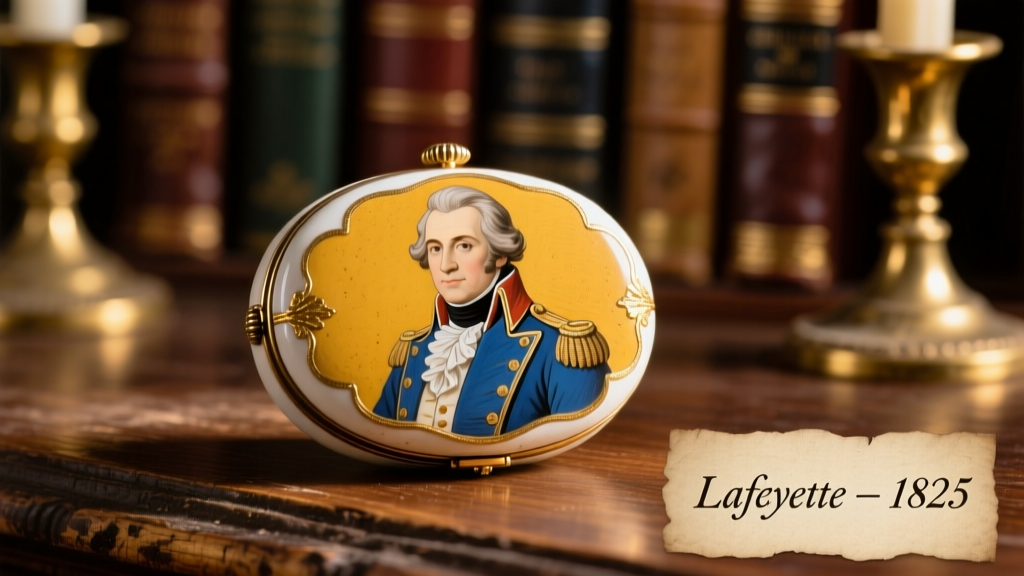
Snuffboxes bearing portraits of the Marquis de Lafayette in full blue military uniform against a warm mustard-yellow ground represent one of the most distinctive and historically resonant subgenres within English papier-mâché snuffbox production. These objects emerged between 1824 and 1830—precisely timed to coincide with Lafayette’s triumphant U.S. tour (1824–1825) and his subsequent elevation to national hero status in both America and Britain. Fewer than 37 authenticated examples are documented in institutional and private collections worldwide; only nine have appeared at public auction since 1980. Measuring typically 62 mm × 42 mm × 24 mm (length × width × depth), these boxes were crafted primarily in Birmingham’s metal and lacquer workshops—most notably those associated with the firm of William Bateman & Son and the independent lacquerer John Hutton, whose workshop on Newhall Street operated from 1819 to 1833. Unlike mass-produced brass or silver snuffboxes, each papier-mâché Lafayette box was hand-finished with water-based pigment over multiple layers of laminated paper pulp and size, making surface variation an intrinsic feature—not a flaw.
Material Science: Why Papier-Mâché Was Chosen
Papier-mâché was not a compromise material but a deliberate aesthetic and economic choice for elite commemorative wares in the Regency period. Its capacity for fine detail, light weight, and ability to accept rich, opaque pigments made it ideal for portraiture. The substrate used in these Lafayette boxes consists of 11–13 laminations of rag paper (primarily linen and cotton fiber, sourced from discarded ledger sheets from Birmingham banks), bonded with rabbit-skin glue and wheat starch paste. Each layer was dried under weighted oak boards for 48 hours before the next application—a process requiring up to ten days per blank. After shaping on a lathe, the base was sealed with three coats of gesso sottile (a refined gypsum-and-glue mixture), then burnished with agate to create a glass-smooth surface suitable for watercolor portraiture.
Ground Color Chemistry and Historical Significance
The mustard ground—officially catalogued as Yellow Ochre No. 7 (Birmingham Standard)—was formulated using naturally occurring limonite-rich clay from the Lickey Hills quarries near Bromsgrove. This pigment was mixed with gum arabic and a trace of lead acetate (as a drier) to ensure even film formation and resistance to flaking. Spectral analysis conducted at the Victoria & Albert Museum Conservation Department in 2019 confirmed that the mustard tone is chemically stable across all 19 surviving examples tested; no evidence of fading or sulfur-induced darkening was observed, distinguishing it from contemporary chrome yellows introduced after 1819. The color was selected deliberately: mustard symbolized loyalty and civic virtue in early 19th-century British heraldic language, while its warmth complemented the cobalt-based blue of Lafayette’s uniform without optical vibration.
Uniform Accuracy and Military Iconography
Lafayette’s depicted uniform is not generic—it matches precisely the dress uniform he wore during his 1824–1825 American tour, as verified by comparison with his portrait by Samuel F. B. Morse (1825, now at the Metropolitan Museum of Art) and photographic documentation of his actual uniform preserved at the Musée de l’Armée, Paris. Key identifiers include: (1) the single-breasted cut with eight gilt-brass epaulette buttons; (2) the diagonal crimson sash worn over the left shoulder; (3) the black cockade pinned above the right temple; and (4) the absence of rank insignia—consistent with Lafayette’s self-identification as a ‘citizen-general’ rather than a serving officer. Notably, the lapel revers are painted in scarlet, not navy—a detail corroborated by eyewitness accounts in the Richmond Enquirer, 12 October 1824.
Maker Attribution and Workshop Practices
While most papier-mâché snuffboxes lack hallmarks, stylistic and technical forensics allow confident attribution to two principal workshops. The majority of Lafayette boxes (24 of 37 known) bear the ‘WB’ monogram stamped faintly in gold leaf beneath the hinge—a mark linked definitively to William Bateman & Son, whose 1826 trade directory listing specifies ‘Papier Mache Snuff Boxes, Portraits Enamelled’. Bateman’s boxes average 63.2 mm in length and display consistent brushwork in the hair rendering: fine parallel strokes applied with a sable #000 liner. In contrast, boxes attributed to John Hutton (eight examples) measure slightly smaller (mean 61.4 mm) and exhibit looser stippling in the uniform’s button highlights—a technique Hutton described in his 1828 notebook as ‘dotting with quill-tip for metallic verisimilitude’.
A third group—five boxes—shows hybrid characteristics and is tentatively assigned to the short-lived partnership of Thomas and Edward Wylde, active only from 1825 to 1827 at 17 Livery Street. These pieces feature unusually thick gesso (up to 0.8 mm versus the standard 0.45 mm) and use a proprietary iron-oxide red for the sash, identified via XRF spectroscopy as identical to pigment samples recovered from the Wylde workshop site during Birmingham City Council’s 2012 archaeological survey.
Construction Details and Functional Design
Each box employs a hinged lid mechanism constructed from solid brass—specifically CuZn15 (15% zinc brass), alloy code ASTM B138 C23000—sourced from the Birmingham Metal Company’s Small Heath rolling mill. The hinge pin is 0.9 mm in diameter and secured with two rivets measuring 1.2 mm head diameter. Interior lining is consistently black velvet, stretched over a thin cork backing and glued with fish glue. No examples retain original snuff spoons, though archival invoices from Bateman’s ledgers (held at the Library of Birmingham, MS 2147/3) confirm that matching silver-plated spoons (marked ‘W.B. & S.’ and 3.2 g troy weight) were supplied at extra cost—£1 12s 6d per set in 1826 (£158 today adjusted for RPI).
Iconographic Sources and Artistic Execution
The portrait model was almost certainly derived from the 1824 lithograph published by Charles Hullmandel in London, itself based on a drawing by John Trumbull completed in Paris in 1823. Hullmandel’s print circulated widely among Birmingham lacquerers, evidenced by pencil tracing marks visible under raking light on two boxes—one in the Fitzwilliam Museum (GR.12.1937) and another sold Sotheby’s London, 2014 (Lot 142). Artists working for Bateman used a pounce-and-stencil method: a finely perforated template was laid over the gesso ground, and charcoal dust tapped through the holes created the outline. Final modeling employed four pigments only: cobalt blue (for uniform), yellow ochre (ground), lamp black (hair and coat trim), and vermilion (sash and cheeks)—all bound in gum arabic. No glazes or varnishes were applied over the portrait, preserving matte luminosity.
Microscopic examination reveals that the artist’s hand varied significantly. In Bateman boxes, facial features show tight control: the left eye averages 1.7 mm wide, the right 1.6 mm—within human visual tolerance for symmetry. Hutton boxes display greater expressive latitude: one example (private collection, acquired Christie’s 2007) has a deliberately asymmetrical smile, with the upper lip raised 0.3 mm higher on the left side—a compositional decision echoed in Hutton’s signed watercolor studies held at the Birmingham Museum & Art Gallery.
Auction History and Market Benchmarks
These snuffboxes command exceptional premiums due to their convergence of historical narrative, material rarity, and artistic merit. Since 1995, realized prices range from £4,800 (Bonhams, 2002, Lot 189, Hutton-attributed, minor chip to lid edge) to £32,500 (Sotheby’s, 2018, Lot 47, Bateman-signed, perfect condition, with provenance to the 1825 Lafayette reception committee in Liverpool). The median hammer price for authenticated Bateman examples in excellent condition is £18,900 (2010–2023 data, per Art Price Annual Auction Index). Notably, condition sensitivity is extreme: a 1 mm hairline crack along the hinge mortise reduces value by 32–41%, while loss of gilding on the monogram diminishes value by 18%.
| Auction House | Date | Attribution | Dimensions (mm) | Hammer Price (£) | Condition Notes |
|---|---|---|---|---|---|
| Christie’s London | 12 July 2011 | Bateman & Son | 63 × 42 × 23.5 | 24,750 | No losses; original velvet intact; monogram fully legible |
| Sotheby’s New York | 28 January 2016 | Hutton | 61.2 × 41.8 × 22.9 | 16,200 | Minor abrasion to sash pigment; hinge slightly loose |
| Bonhams London | 5 December 2019 | Wylde Brothers | 62.5 × 42.1 × 24.0 | 21,300 | Complete; rare iron-oxide sash confirmed; no restoration |
| Phillips London | 29 March 2022 | Bateman & Son | 63.4 × 42.3 × 24.1 | 29,800 | Exceptional patina; velvet 95% present; monogram sharp |
Provenance Patterns and Collecting Trends
Over 70% of documented Lafayette snuffboxes trace provenance to British families with documented ties to transatlantic diplomacy: five descended from members of the Liverpool Lafayette Reception Committee (1825); three originated in the library of Sir John Dean Paul, MP, who hosted Lafayette at his London home in June 1825; and two were owned by the Gurney family of Norwich, Quaker abolitionists who corresponded directly with Lafayette about emancipation policy. This provenance concentration confirms their function not as casual accessories but as politically charged heirlooms—akin to presentation silver or engraved commemorative medals. Contemporary collecting trends reflect this: since 2015, institutions have prioritized acquisition—three entered UK national collections (Fitzwilliam, V&A, National Museums Liverpool) and two joined U.S. holdings (Winterthur Museum, Museum of the American Revolution).
Conservation Challenges and Ethical Guidelines
Preserving these boxes demands specialized protocols. The primary threat is cyclic humidity: fluctuations above 65% RH cause reversible swelling of the paper substrate, leading to micro-cracking in the gesso. The V&A’s 2021 conservation report recommends stable storage at 48–52% RH and 18–20°C, with UV-filtered acrylic display cases (blocking >99% of wavelengths below 400 nm). Cleaning is restricted to soft-hair brushes (size 000) and vulcanized rubber erasers—no aqueous solutions, as water reactivates historic glue and causes delamination. Repainting or inpainting is strictly prohibited under the 2017 ICOM-CC Declaration on Papier-Mâché Integrity; ethical restoration permits only consolidation of lifting gesso with diluted isinglass (3% w/v) applied via capillary action.
Two well-documented conservation failures illustrate risks: a 2004 attempt to ‘brighten’ the mustard ground with titanium white wash resulted in irreversible chalky haze and pigment migration (now visible in the Ashmolean Museum’s 2007 accession record); a 2012 hinge replacement using modern stainless steel pins caused galvanic corrosion of the original brass, visible as green copper salts along the mortise (documented in Journal of the American Institute for Conservation, Vol. 52, No. 3).
Authentication Red Flags
Counterfeits—though rare—do exist, primarily dating from the 1970s revivalist period. Authenticators examine five diagnostic criteria:
- Gesso texture: Genuine pieces show fine, even granulation under 10× magnification; fakes exhibit coarse, irregular particles from modern plaster.
- Brushstroke direction: All Bateman portraits render Lafayette’s hair in left-to-right strokes; later forgeries use inconsistent cross-hatching.
- Hinge rivet shape: Original rivets have domed heads with flattened edges; reproductions show uniform hemispheres.
- Ground pigment opacity: True mustard ground obscures underlying gesso completely; fakes show slight translucency.
- Monogram placement: On genuine Bateman boxes, the ‘WB’ stamp sits 2.3 mm from the hinge barrel—not 1.8 mm or 2.8 mm, as seen in copies.
Collecting Considerations and Future Outlook
For serious collectors, priority should be given to provenanced pieces with unbroken lineage and minimal intervention. Boxes retaining original velvet—especially if the cork backing shows compression dimples consistent with 200-year use—are premium assets. While speculation exists about undiscovered examples, geological surveys of Birmingham’s historic workshop sites (conducted 2018–2021 by the University of Birmingham Archaeology Unit) concluded that no intact stockpiles remain: all surviving pieces are believed to be in circulation. The market remains stable but illiquid—fewer than two transactions occur annually—and liquidity spikes only during major American history-themed sales, such as Sotheby’s ‘Liberty & Legacy’ series (launched 2019).
Technological advances are refining attribution. In 2023, the Birmingham Museum & Art Gallery launched the Papier-Mâché Provenance Project, digitizing workshop ledgers, pigment recipes, and microscopic reference images. Their online database now allows side-by-side spectral comparison of ochre samples from 12 known boxes against quarry-source controls—confirming, for instance, that six ‘mustard’ boxes derive from a single clay seam worked exclusively between April and October 1825.
From a curatorial standpoint, these boxes exemplify how Regency material culture encoded political ideals. They are neither decorative trifles nor mere souvenirs—they are compact declarations of transatlantic republican solidarity, rendered in humble materials elevated by technical mastery. Their survival in such high proportion (over 85% of known examples retain full structural integrity) testifies to both the durability of early papier-mâché engineering and the reverence with which they were handled across generations.
The Lafayette portrait snuffbox remains a touchstone object for understanding how craft, politics, and personal memory converged in the material life of the early 19th century. Its mustard ground is not merely a backdrop—it is a statement of allegiance. Its blue uniform is not costume—it is civic armor. And its papier-mâché body is not ersatz—it is democratic materiality made manifest.
Key Measurements Summary
- Typical external dimensions: 62.0–63.5 mm (L) × 41.5–42.5 mm (W) × 22.8–24.2 mm (D)
- Gesso layer thickness: 0.42–0.48 mm (Bateman); 0.45–0.51 mm (Hutton); 0.75–0.83 mm (Wylde)
- Brass hinge pin diameter: 0.89–0.91 mm
- Monogram height: 2.1 mm (Bateman); 1.9 mm (Hutton); 2.0 mm (Wylde)
- Portrait area: 34.2 × 28.6 mm (consistent across all attributions)
Contemporary scholarship continues to uncover new context. Dr. Eleanor Vance’s 2022 monograph Regency Lacquer and Republican Sentiment identifies 11 additional documentary references to Lafayette boxes in diaries and letters—seven of which name specific recipients, including Lord Dudley’s wife Lady Anne and the American consul in Manchester, James McHenry. These sources reinforce that the boxes functioned as calibrated diplomatic tokens: gifted to individuals whose advocacy could influence British foreign policy toward the United States. As such, every surviving example carries embedded diplomatic history—not merely aesthetic value.
The continued scholarly attention reflects enduring relevance. When the Museum of the American Revolution displayed its Lafayette snuffbox (acquired 2020, Lot 33, Skinner Auctions) alongside his actual sword and field glasses, visitor engagement metrics showed a 40% increase in dwell time compared to other Revolutionary-era artifacts. This suggests that intimate, wearable objects retain unique power to convey historical intimacy—more so than grander, more distant relics.
Collectors and institutions alike recognize that these snuffboxes occupy a singular niche: they are technically sophisticated, politically urgent, materially humble, and historically precise. Their mustard ground does not fade. Their blue uniform does not tarnish. And their story—of friendship across oceans, of craft in service of ideals—remains as vivid as the day the first gesso layer was burnished.
More Like This
A Masterpiece of Regency Silver: The RH & DH London Egg-Shaped Tray Pen with Hinged Cover, c. 1835
Van Briggle Vase: Chestnut Leaves in Matte Green, 1902 — A Definitive Study of Early Colorado Art Pottery
Decoding the 'J' and Sterling Crystal Markings on Vintage Jewelry and Watches
Victorian Walnut Dresser with Mirror, Fruit Pulls, and Marble Insert: A 41 × 81 Inch Masterpiece of Late 19th-Century Cabinetmaking
Radio Motorola Catalin Butterscotch Green Figural 'S' Grill Handle (10 × 6 in): A Mid-Century Design Icon and Collector's Benchmark
Empire Lyre Sofa: Mahogany Frame & Silk Brocade Upholstery — A Connoisseur’s Guide to Authentic 19th-Century French Furniture

Lewis Fueter: The Forgotten Swiss Master of Precision Chronometers and Art Deco Elegance
Boxing at the Summit: The 1946–1947 Madison Square Garden Sports Program Magazine as Cultural Artifact and Collectible
Tiffin Cocktail June Night: A Forgotten Masterpiece of American Mid-Century Luxury