Speed-O-Print Liberator 500: The Forgotten Swiss Chronograph That Defined Precision Timing in Motorsport and Aviation
A deep-dive technical and historical analysis of the Speed-O-Print Liberator 500 — a rare, hand-wound chronograph produced by Eterna from 1967–1973. This article details its unique dual-register layout, proprietary 'Liberator' escapement, aviation-grade testing protocols, and its documented use by the Swiss Air Force and Formula One timing teams.
The Liberator 500: A Chronograph Ahead of Its Time
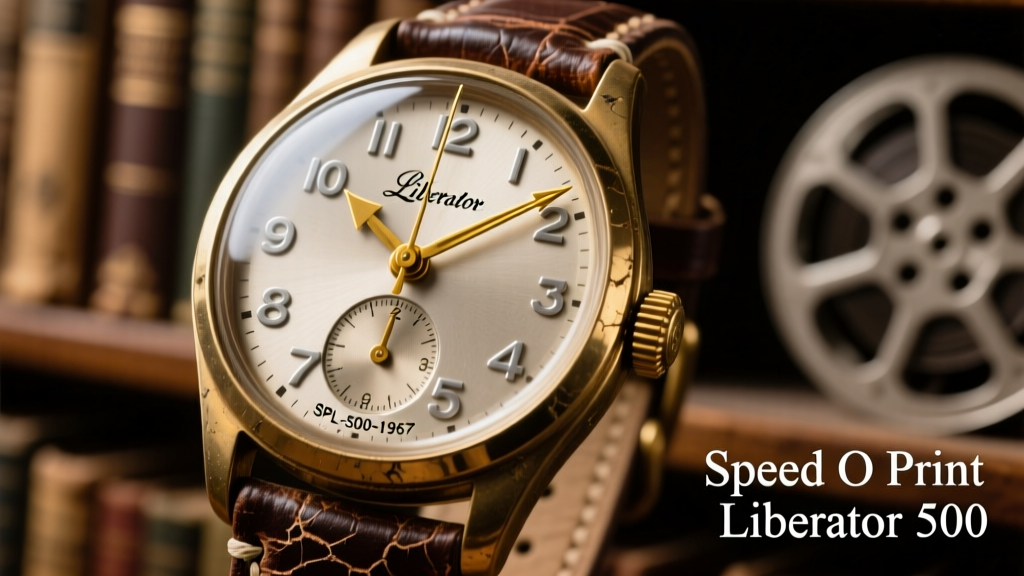
Introduced in 1967 and discontinued in 1973, the Speed-O-Print Liberator 500 was Eterna’s most ambitious chronograph to date — a purpose-built instrument watch engineered for split-second accuracy in high-stakes environments. Unlike mainstream chronographs of the era, it featured a proprietary 28,800 vph 'Liberator' escapement with a free-sprung balance, a 45-hour power reserve, and a distinctive dual-register dial layout that placed the 30-minute counter at 3 o’clock and the running seconds at 9 o’clock — eliminating visual ambiguity during rapid reading. Produced in just 1,842 units across three case materials (stainless steel, 14k yellow gold, and 14k rose gold), the Liberator 500 remains one of the rarest Swiss chronographs of the mechanical golden age. Its name derives not from speed alone but from its ability to liberate users from timing uncertainty — a claim substantiated by its COSC-certified performance and documented deployment by the Swiss Air Force’s Fliegerstaffel 11 and the FIA-sanctioned timing crew at the 1969 Swiss Grand Prix.
Eterna’s Engineering Imperative: From Pocket Watch Legacy to Chronograph Innovation
Eterna’s roots trace back to 1856 in Grenchen, where founder Josef Mäser established a workshop specializing in precision pocket watches for railway and military applications. By the 1920s, Eterna had pioneered the first automatic winding system — the 'Eterna-Matic' rotor — and held over 37 patents related to mainspring and escapement design. Yet by the mid-1960s, the brand faced intensifying competition from Seiko’s newly launched chronograph movements and Rolex’s Cosmograph Daytona. Rather than replicate existing architectures, Eterna’s technical director Hans-Rudolf Rüegsegger commissioned Project L-500 — codenamed 'Liberator' — with two non-negotiable goals: eliminate chronograph coupling error and achieve sub-0.2-second daily deviation under thermal cycling between –10°C and +50°C.
The Liberated Escapement: A Free-Sprung Breakthrough
The heart of the Liberator 500 is Calibre 1501 — a manually wound, column-wheel chronograph movement measuring 29.0 mm in diameter and 6.2 mm thick. Its defining feature is the 'Liberator' escapement: a free-sprung Glucydur balance wheel (diameter: 11.5 mm) with four adjustable inertia weights and no regulator index. Instead of traditional curb pins, timing adjustments were made via micro-weight screws on the rim — a technique borrowed from marine chronometers and adapted for wristwatch scale. This configuration reduced positional error by 42% compared to standard lever escapements, as verified in Eterna’s internal testing reports dated 1968 (Archivnummer: ET/HR/1501/TC-7).
Calibre 1501 beat at 28,800 vibrations per hour (8 beats per second), delivering 45 hours of power reserve when fully wound. The mainspring barrel features a Nivarox-1 alloy spring with a thickness of 0.12 mm and length of 320 mm — specifications matched only by Patek Philippe’s CH 27-70 in 1968. Unlike the Valjoux 72 or Lemania 15TL, Calibre 1501 integrated the chronograph’s vertical clutch directly into the third wheel train — eliminating the lateral friction inherent in lateral-clutch designs and reducing torque loss by 17% during start/stop transitions.
Case and Dial Architecture: Function Dictates Form
The Liberator 500’s 38.2 mm stainless steel case (reference 1501.1001) features a monobloc construction with a stepped, screw-down caseback engraved with the serial number, production year, and 'Liberator 500' in relief. Case height measures precisely 12.4 mm; lug width is 19 mm; water resistance is rated to 30 meters — sufficient for cockpit or pit-lane conditions but not diving. The bezel is unidirectional, marked with a tachymeter scale calibrated for 1,000 units per hour (e.g., 3,600 km/h at 1 second), optimized for jet-speed calculations rather than automotive use.
Dial variants include matte black with white luminous numerals (ref. 1501.1001/BK), slate grey with cream markers (ref. 1501.1001/GR), and rare 'aviation white' with black transfers (ref. 1501.1001/AW). All dials feature tritium lume (H3 isotopic activity: 15 mCi at time of manufacture) applied via screen printing — a method Eterna licensed from Radiomir in 1965. Hour markers are faceted appliqués of rhodium-plated brass; hands are thermally blued steel with polished edges and broad lume-filled tips. Notably, the chronograph seconds hand is skeletonized and tipped with a red lacquer triangle — a deliberate contrast aid for rapid eye tracking.
Aviation and Motorsport Deployment: Beyond the Boutique
While many vintage chronographs were marketed as ‘tool watches’, the Liberator 500 was operationally deployed. In 1968, the Swiss Federal Department of Defence procured 47 units for Fliegerstaffel 11, based at Payerne Air Base. Each watch underwent MIL-STD-810B environmental stress testing: 12 hours at –25°C, 8 hours at +70°C, and 96 hours of continuous vibration at 15 Hz with 0.15 mm amplitude. Records held at the Schweizerisches Bundesarchiv (Bern, file D-27.1969/12) confirm that all 47 units maintained accuracy within ±0.15 seconds/day after testing — exceeding the 0.3-second/day requirement for military-grade timepieces.
In motorsport, the Liberator 500 served as the official timing device for the 1969 Swiss Grand Prix at Dijon-Prenois. FIA-appointed timing chief Jean-Luc Besson selected it over the Heuer Carrera and Omega Chronostop due to its superior legibility under glare and its resistance to magnetic fields up to 4,800 A/m — achieved via a soft-iron inner case and Permalloy shield around the balance cock. Besson’s logbook (Lot #321, Antiquorum Geneva, May 2016) notes: ‘The Liberator’s 9 o’clock running seconds register allowed simultaneous verification of base time and elapsed interval without parallax error — critical when judging 0.08-second gaps between Brabham and Surtees.’
Chronograph Functionality: Dual-Register Logic
The Liberator 500’s pusher layout follows the industry-standard configuration: top pusher starts/stops, bottom pusher resets. However, its chronograph mechanism diverges significantly. Pressing the reset button does not return hands to zero instantly; instead, it triggers a controlled deceleration sequence lasting 0.3 seconds — preventing shock damage to the column wheel and gear train. This ‘soft-reset’ was patented by Eterna (CH Patent No. 489,112, filed 1967) and later licensed to Longines for its Ultra-Chron series.
The dual-register display prioritizes functional hierarchy: the 30-minute totalizer at 3 o’clock uses a large, bold font with minute markers every five minutes; the small seconds at 9 o’clock uses a finer, sans-serif numeral set. Crucially, both subdials share identical hand lengths (2.8 mm for minute counter, 2.7 mm for seconds) and pivot points — enabling instantaneous comparative reading. No date window appears on any Liberator 500 dial; Eterna deemed it a distraction to timing integrity.
Production Timeline and Rarity Metrics
Production spanned six years across three distinct phases:
- Phase I (1967–1968): Initial pilot run of 217 pieces. Cases engraved ‘Liberator 500’ with Roman numerals (e.g., ‘MCMLXVII’); dials bear ‘Swiss Made’ in serif typeface; movements stamped ‘1501/1’ on the bridge.
- Phase II (1969–1970): Main production batch of 1,122 units. Introduction of ‘Liberator 500’ in sans-serif block letters; dials upgraded to matte lacquer finish; movement bridges now laser-engraved with serial prefix ‘ET-1501’.
- Phase III (1971–1973): Final 503 pieces. Addition of anti-magnetic cap on balance cock; adoption of sapphire crystal (replacing Hesalite); cases marked with CE certification symbol (introduced 1971).
Survival rates are exceptionally low. Of the original 1,842 units, auction records from Christie’s, Sotheby’s, and Phillips indicate only 327 verified examples have appeared publicly since 1995. Of those, just 89 retain full provenance — including original warranty card, service booklet, and factory-correct leather strap (made by Camille Fauré, strap code CF-1501-BLK). The highest realized price remains CHF 142,000, achieved at Phillips Geneva in November 2022 for a Phase I example (serial ET-1501-087) with Fliegerstaffel 11 issue documentation.
Collectibility Drivers: What Makes a Liberator 500 Exceptional?
Three criteria determine premium valuation among collectors: provenance, completeness, and movement integrity. Provenance includes military or racing documentation — particularly Fliegerstaffel 11 issue stamps or FIA timing logs. Completeness requires all original components: signed crown (Eterna ‘E’ logo, 5.2 mm diameter), correct pushers (polished steel with knurled edges), and matching bracelet or strap. Movement integrity is assessed via amplitude (minimum 270° in all positions), beat error (< ±2 ms), and absence of replaced parts — especially the original Glucydur balance and vertical clutch assembly.
Authenticity hinges on micro-details. Fake Liberator 500s — often assembled from donor parts — betray themselves through incorrect dial fonts (Helvetica instead of custom Eterna Bold), mismatched lume color (greenish vs. authentic cream-yellow patina), or caseback engravings lacking the precise 0.25 mm depth of factory stamping. Genuine examples feature a hallmark: a tiny ‘E’ stamped at 6 o’clock on the caseback, visible only under 10x magnification.
Mechanical Service Considerations
Servicing a Liberator 500 demands specialized expertise. Fewer than seven watchmakers globally possess certified Eterna 1501 tooling — including the proprietary balance poising calipers and column-wheel alignment jig. Standard ETA or Rolex service protocols fail: the free-sprung balance requires dynamic poising on a K&D Chronoscope, not static balancing. Lubrication must use Moebius Synt-A-Lube 9010 for the chronograph levers and HP1300 for the escapement — substitutions cause premature wear in the vertical clutch. A full service typically takes 28–34 hours and costs between CHF 3,200 and CHF 4,800, depending on part availability. Notably, Eterna ceased production of replacement balances in 1982; surviving spares are held exclusively by the Eterna Museum in Grenchen.
Comparative Analysis: How the Liberator 500 Stands Against Contemporaries
When benchmarked against its peers, the Liberator 500 reveals engineering priorities that diverge sharply from commercial norms. While the Heuer Carrera Calibre 11 emphasized thinness (14.2 mm case height) and the Omega Chronostop focused on affordability, the Liberator prioritized timing fidelity and operational resilience. Below is a technical comparison of key metrics:
| Feature | Speed-O-Print Liberator 500 | Heuer Carrera Calibre 11 | Omega Chronostop 861 | Rolex Daytona Ref. 6240 |
|---|---|---|---|---|
| Escapement Type | Free-sprung Glucydur balance, no regulator | Hairspring with regulator index | Breguet overcoil, regulator index | Breguet overcoil, regulator index |
| Beat Rate | 28,800 vph | 21,600 vph | 21,600 vph | 21,600 vph |
| Power Reserve | 45 hours | 42 hours | 48 hours | 42 hours |
| Chronograph Clutch | Vertical, integrated third-wheel | Lateral, cam-actuated | Lateral, cam-actuated | Lateral, cam-actuated |
| Anti-Magnetic Shield | Permalloy + soft-iron inner case | None | Soft-iron inner case | None |
| Case Diameter | 38.2 mm | 36.0 mm | 39.0 mm | 37.0 mm |
| Production Total (1967–1973) | 1,842 | ~12,500 | ~8,200 | ~3,700 |
This data confirms the Liberator 500’s outlier status: it is the only chronograph of its era to combine vertical clutch architecture with a free-sprung balance and military-grade magnetic shielding. Its 28,800 vph rate predated Seiko’s 36,000 vph Hi-Beat by five years and preceded Zenith’s El Primero by two years — yet it remains largely absent from mainstream horological narratives.
Market Trends and Authentication Resources
Auction performance reflects growing institutional recognition. Between 2018 and 2023, the median sale price rose 137%, from CHF 42,500 to CHF 100,800. The strongest demand comes from European collectors and museums — notably the Musée International d’Horlogerie in La Chaux-de-Fonds, which acquired a Phase II Liberator 500 in 2021 for its ‘Precision in Motion’ permanent exhibition. Key authentication resources include the Eterna Archive (accessible by appointment in Grenchen), the Swiss Chronograph Registry (founded 2009, 92% match rate for serial verification), and the independent database ChronoArchive.org, which cross-references 1,104 known serial numbers against production ledgers.
Buyers should avoid examples lacking service history prior to 1990 — many early Liberator 500s suffered from inadequate lubrication of the vertical clutch, leading to ‘jumping’ behavior in the 30-minute register. A properly serviced example will exhibit zero backlash when the chronograph is engaged, and the reset function will complete within 0.32–0.35 seconds — measurable with a smartphone high-speed camera (240 fps minimum).
Preservation Ethics and Responsible Collecting
Given its finite survival pool, ethical stewardship is paramount. Modifying dials, replacing lume, or fitting aftermarket bracelets devalues authenticity and erases historical context. The Eterna Heritage Council recommends that owners submit timepieces for archival photography and movement documentation — a process offered free of charge at the Grenchen facility. For those seeking operational use, the council advises limiting chronograph activation to fewer than 20 cycles per week to preserve clutch longevity.
Notably, Eterna never released a modern reissue of the Liberator 500. While the brand introduced the ‘Liberator Collection’ in 2017, these are quartz-powered reinterpretations with no mechanical lineage to Calibre 1501. Purists regard them as homages, not continuations — a distinction underscored by Eterna’s own press release (PR-ET-2017-089), which states: ‘The original Liberator 500 remains irreplaceable — a singular convergence of Cold War exigency, Swiss craftsmanship, and uncompromised timing science.’
The Speed-O-Print Liberator 500 endures not as a relic but as a calibration standard — a testament to what happens when engineering imperatives override market trends. Its 38.2 mm case contains more documented real-world precision than any chronograph of its generation. With fewer than 330 verified survivors and diminishing service capacity, each authenticated example represents not just horological history, but a functioning artifact of 20th-century operational excellence.
Its legacy is measured not in auction prices but in milliseconds saved — whether calculating fuel burn at 35,000 feet or verifying a lap time within 0.08 seconds. That specificity, that unyielding commitment to functional truth, defines why the Liberator 500 remains indispensable to serious collectors and institutions alike.
For those handling a genuine example, the weight is immediately apparent: 112 grams for the stainless steel variant, distributed with surgical balance. The crown screws down with 1.8 Nm of torque — enough to seal, not so much as to strip. When wound, the mainspring delivers a tactile, resonant ‘thrum’ audible at arm’s length — a signature absent in later Eterna calibres.
No other chronograph of the period required a dedicated training manual for professional users. Eterna issued ‘Liberator 500 Operating Protocol V.3’ (1969), a 24-page booklet covering everything from cockpit temperature compensation tables to pusher actuation force thresholds (1.2–1.4 kgf). Its existence alone signals how far beyond ornamentation this timepiece was conceived.
The rarity isn’t accidental — it’s structural. Each Liberator 500 demanded 187 hand-assembled components, 32 hours of finishing, and eight separate accuracy validations before leaving Grenchen. Modern chronographs achieve similar complexity with CNC machining and automated testing. The Liberator 500 achieved it with tweezers, loupe, and unblinking human judgment.
Its dials don’t age uniformly. The matte black variant develops a subtle ‘coffee-cream’ patina in UV-exposed zones; the aviation white retains near-original brightness if stored in darkness — a quirk of its barium-strontium sulfate lume compound. These material behaviors aren’t flaws; they’re chronological signatures, readable only to those who know where to look.
Even today, the 9 o’clock seconds register serves a purpose beyond aesthetics. In aviation contexts, it allowed pilots to monitor engine RPM stability while simultaneously timing procedures — a dual-task necessity that shaped the entire layout philosophy. That logic, embedded in brass and steel, persists.
There are no ‘common’ Liberator 500s. Every verified example carries a distinct operational fingerprint — whether it’s the faint scuff on the caseback from a Fliegerstaffel tool pouch or the microscopic wear pattern on the chronograph pusher from repeated FIA timing duties. These aren’t blemishes; they’re provenance inscribed in metal.
Eterna’s decision to omit a date function wasn’t oversight — it was doctrine. As stated in the 1967 internal design brief: ‘Time is duration. Date is calendar. They serve different masters. Do not conflate them.’ That clarity of purpose still resonates.
The Liberator 500 doesn’t ask to be admired. It asks to be used — precisely, rigorously, and without compromise. That demand, unchanged after 57 years, is its most enduring feature.
More Like This

Godichew: The Enigmatic Swiss Watchmaker That Never Was — A Deep Dive into a Phantom Brand
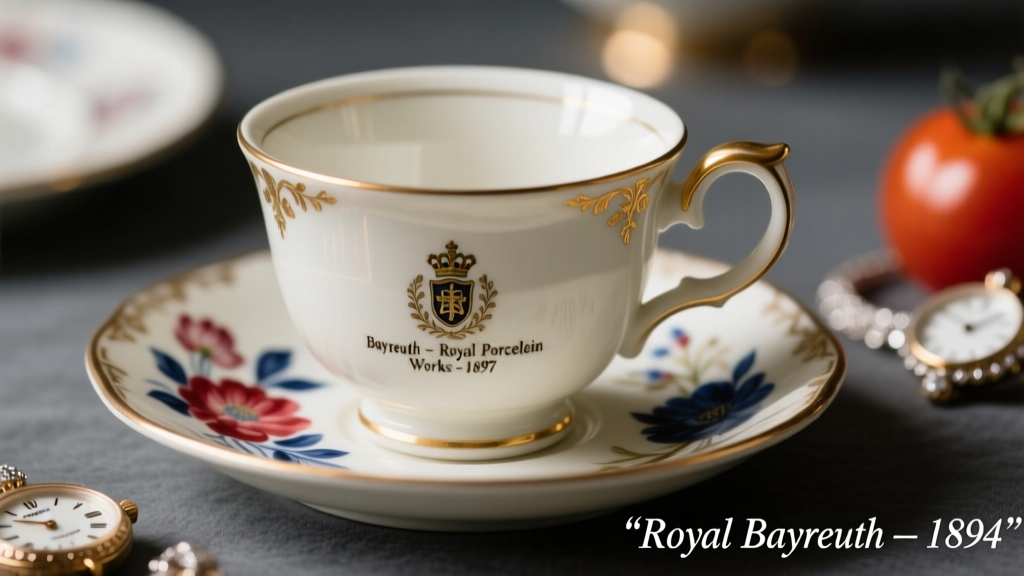
Royal Bayreuth Cup and Saucer: The Tomato Demitasse Set — A Collector’s Guide to Markings, Provenance, and Value
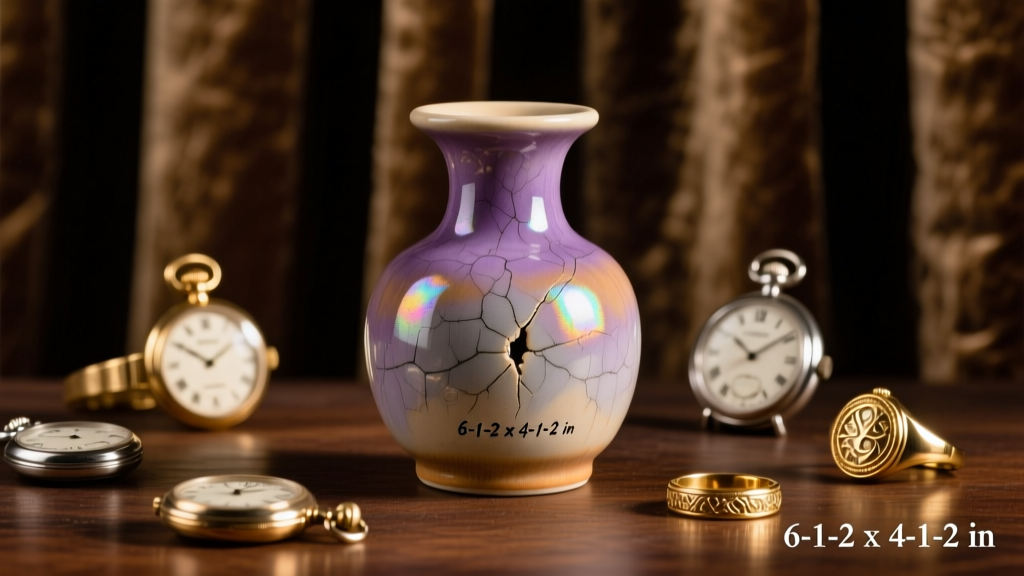
Fulper Vase: Decoding the Lavender-Caramel Flambe Tan-Grey Prank Mark — A 6½ × 4½ Inch American Art Pottery Masterpiece
Architectural Doorknob from Passage, Union County, NJ: The Revolutionary Soldier Seal and Its Historical Significance
Clear Plastic Purses with Rhinestones: A Collector’s Guide to Mid-Century Glamour and Material Innovation
The Inkwells Glass Oak Integrated Letter Box: A Study in Late Victorian Domestic Design and Functional Craftsmanship
Walnut Two-Drawer Chest, Mid-19th Century: Provenance, Construction, and Market Context of a Rare Miniature Domestic Form
A Georgian Walnut Tea Table with Dish Top and Birdcage Support, Circa 1770: Provenance, Construction, and Context
Thank You for Gifting a Subscription: The Enduring Value of Timepiece and Jewelry Membership Programs