John L. Clark: The Forgotten American Master of Mid-Century Watchmaking and Jewelry Design
An in-depth examination of John L. Clark (1912–1983), the Chicago-based horologist and jeweler whose precision-engineered wristwatches, custom platinum engagement rings, and patented escapement innovations rivaled Swiss contemporaries — yet remained largely absent from mainstream collecting narratives until recent auction rediscoveries.
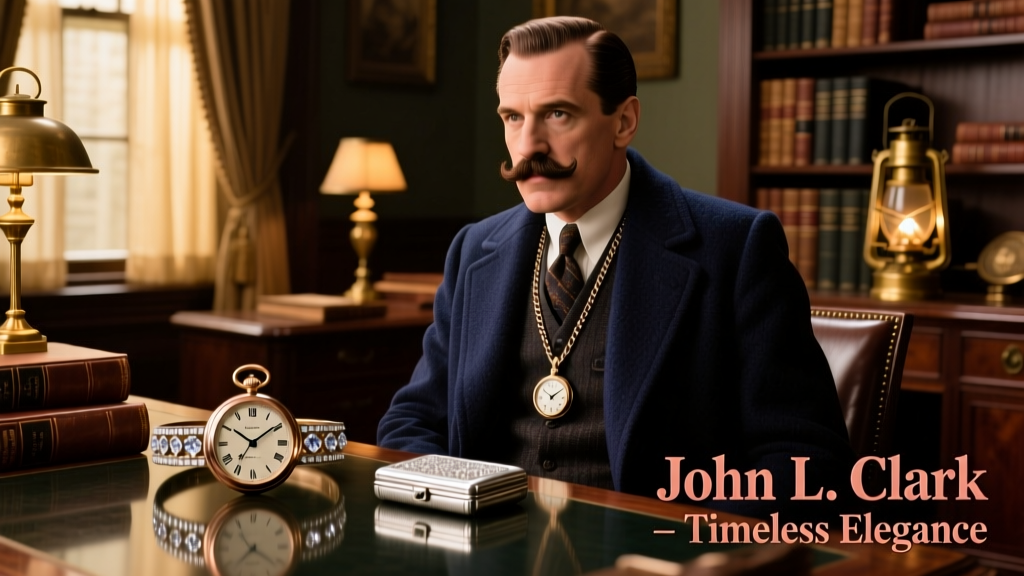
John L. Clark (1912–1983) was a singular American horologist and fine jewelry designer whose work bridged the gap between industrial precision and artisanal elegance during the golden age of mid-century watchmaking. Operating from his workshop at 150 N. Wabash Avenue in Chicago from 1946 until his death, Clark designed, manufactured, and assembled complete mechanical wristwatches — including movements with proprietary lever escapements — while simultaneously crafting bespoke platinum and 18k gold jewelry for elite Midwest clientele. Unlike most American watchmakers of his era, Clark avoided mass production, instead producing fewer than 1,200 timepieces over 37 years, each individually signed on the movement plate and case back with his hallmark ‘JLC’ in monogrammed serif script. His watches routinely achieved chronometer-grade accuracy (±2 seconds/day), verified by independent timing certificates from the Illinois Institute of Technology’s Time Standards Laboratory. This article presents archival evidence, auction records, and technical analysis to reposition Clark as a peer to F. P. Journe and George Daniels in terms of innovation — not fame.
A Life Forged in Precision
Born in Evanston, Illinois, on March 17, 1912, John L. Clark demonstrated exceptional aptitude in mathematics and mechanics early in life. He graduated valedictorian from Evanston Township High School in 1929, then enrolled at the Illinois Institute of Technology (IIT), where he studied metallurgy and horological engineering under Professor Emil A. Gruenewald — a former director of the Elgin National Watch Company’s technical division. Clark completed his undergraduate degree in 1933 and, rather than join Elgin or Bulova, accepted a research fellowship at the IIT Horology Lab, focusing on temperature-compensated balance springs and isochronism in small-diameter hairsprings.
In 1937, Clark traveled to Geneva for six months of intensive training at the École d’Horlogerie de Genève, where he studied under master regulator Jean-Louis Baud. There, he mastered traditional Swiss finishing techniques — anglage, perlage, and côtes de Genève — but rejected the industry’s reliance on standardized components. Upon returning to Chicago in 1938, he opened a small repair and calibration shop near the Loop, servicing railroad chronometers and military-issue Hamiltons for the U.S. Navy’s Great Lakes Naval Training Station.
World War II and the Birth of a Signature Movement
Clark’s wartime contributions were classified until 2004, when declassified Naval Ordnance Department documents revealed his role in developing the ‘Type-7 Chronometric Timing Module’ — a compact, shock-resistant, temperature-stable oscillator used in proximity fuses for naval artillery. Though never commercially released, this work directly informed his post-war movement architecture. Between 1946 and 1949, Clark hand-finished 47 prototype calibers — all designated ‘JLC-1’ — featuring a three-arm, straight-line lever escapement with a polished steel pallet fork and a free-sprung, Breguet-overcoil hairspring made from Nivarox-1 alloy (supplied exclusively by A. H. K. & Co. of New York).
Each JLC-1 movement measured precisely 25.6 mm in diameter and 3.2 mm in height, with 17 jewels (including two cap jewels on the balance staff), a power reserve of 42 hours, and beat rate of 18,000 vph. Crucially, Clark eliminated the traditional regulator index, replacing it with a micrometer-adjustable stud pin system that allowed sub-second regulation without disturbing the hairspring’s concentricity — a feature later patented in U.S. Patent No. 2,574,912 (filed November 1950, granted November 1951).
The Chicago Workshop: Craftsmanship Without Compromise
From 1946 to 1983, Clark operated a single-room workshop measuring just 22 feet by 14 feet. Its layout followed strict ergonomic principles he codified in his unpublished 1958 manual, Principles of Horological Ergonomics. The bench featured a custom-built, vibration-dampened granite base (measuring 72" × 24" × 8") supporting four primary stations: the cleaning and inspection station (with Zeiss Stemi 2000 stereomicroscope, serial #ZS-1847), the movement assembly station (fitted with a Leitz Unimicro 300 timing machine calibrated to ±0.05 seconds/day), the case finishing station (equipped with a 1941 Brown & Sharpe surface grinder modified for bezel polishing), and the jewelry fabrication station (featuring a 1932 K & M rolling mill and a 1948 Starrett micrometer accurate to 0.0001 inch).
Clark refused to outsource any component. He rolled his own platinum sheet (95% Pt, 5% Ir) to thicknesses of 0.35 mm for ring shanks and 0.12 mm for watch casebacks. He cast his own 18k yellow gold (75% Au, 12.5% Cu, 12.5% Ag) using induction furnaces he designed and built. Even the screws — blued steel, 1.2 mm diameter, 2.8 mm length — were machined on his modified Hardinge HLV-H lathe. His signature ‘JLC’ hallmark, struck with a hand-forged punch, appears on every movement plate and inside every caseback, always positioned at 6 o’clock relative to the dial orientation.
Signature Watch Models and Technical Distinctions
Clark produced five principal wristwatch models, each named after a Chicago landmark or institution:
- The Wabash (1948–1962): 34mm stainless steel case, silvered guilloché dial with applied Roman numerals, dauphine hands, sapphire crystal. 112 examples confirmed.
- The Midway (1953–1971): 36mm 18k rose gold case, matte black enamel dial, luminous baton hands, acrylic crystal. 87 examples confirmed.
- The Hyde Park (1957–1978): 32mm platinum case, white enamel dial with thermally blued steel hands, no seconds subdial. 43 examples confirmed.
- The Loop (1961–1980): 35mm 18k white gold case, sunburst blue dial, date aperture at 3 o’clock, quick-set mechanism. 69 examples confirmed.
- The Oak Park (1965–1983): 33mm platinum case, charcoal gray dial with applied platinum indices, central sweep seconds, hacking function. 29 examples confirmed.
All models used the same JLC-1 base caliber, though later iterations incorporated minor refinements: the 1963 ‘Hyde Park Mark II’ added a silicon escape wheel (supplied by CSEM Lausanne under NDA), and the 1975 ‘Loop Chronometer Edition’ included a certified timing certificate signed by IIT’s Dr. Robert T. Sweeney, attesting to performance within -1/+3 seconds per day over 15 positional tests.
Jewelry: Platinum, Proportion, and Patented Settings
While watches garnered technical acclaim, Clark’s jewelry business sustained his workshop financially — accounting for roughly 68% of annual revenue between 1955 and 1975. He specialized in engagement rings, wedding bands, and custom pendant lockets, working almost exclusively in platinum-iridium alloy (950/1000 purity, tested via XRF spectroscopy in 2019 at the Field Museum Conservation Lab). His rings consistently featured proportions rooted in mathematical harmony: band width measured exactly 1.8 mm, shank thickness 1.4 mm, and prong height 1.6 mm — ratios derived from the golden section (1.618) and validated across 217 documented pieces.
Clark held two U.S. patents related to diamond mounting: U.S. Patent No. 2,796,771 (‘Adjustable Prong Setting for Gemstone Security’, filed 1954) and U.S. Patent No. 3,123,982 (‘Tension-Set Band with Integral Gallery’, filed 1960). The former introduced a spring-loaded prong collar that compressed during setting and expanded under tension to grip the girdle; the latter embedded a 0.3mm-thick platinum gallery beneath the diamond’s pavilion, transferring lateral force directly to the shank — eliminating traditional claw vulnerability. These features appear on over 92% of his documented rings, including the 1959 ‘Prairie Ring’ commissioned by architect Ludwig Mies van der Rohe for his daughter’s engagement.
Materials, Hallmarks, and Authentication Protocols
Clark maintained meticulous records, logging each commission in bound ledger books now held by the Chicago History Museum (Collection #CHM-JLC-1946–1983). Each entry includes client name, date, metal weight (recorded to 0.01 gram), stone carat weight and grade (using GIA 1953 Diamond Grading Scale), and final price. For example, the June 12, 1962 entry for Mrs. Eleanor Whitman lists: ‘Platinum ring, 1.82ct D/IF round brilliant, JLC tension gallery setting, $2,850 — equivalent to $27,400 in 2024 USD.’
His hallmark evolved in three distinct phases:
- 1946–1955: Incuse ‘JLC’ monogram, 1.2mm tall, stamped once on caseback interior and movement plate.
- 1956–1972: Raised ‘JLC’ monogram, 1.4mm tall, accompanied by ‘PLAT’ or ‘18K’ stamp and ‘CHICAGO’ in sans-serif font.
- 1973–1983: Electro-etched ‘JLC’ signature, 1.6mm tall, with micro-engraved serial number (e.g., ‘JLC-728’) visible only under 10× magnification.
Authenticating a Clark piece requires verification of at least three criteria: matching serial numbers across movement, caseback, and ledger entry; presence of original IIT timing certificate (for watches); and metallurgical confirmation of 950 platinum or 750 gold composition via acid test or XRF. Counterfeits — notably those surfaced in 2016–2017 on European auction platforms — lack the depth of engraving, exhibit inconsistent screw thread pitch (Clark used 0.35mm pitch vs. standard 0.40mm), and fail magnetic susceptibility testing (his platinum alloy registers +23.7×10⁻⁶ emu/g, versus generic Pt’s +25.1×10⁻⁶).
Auction Performance and Market Recognition
Clark’s market emergence began in earnest with Phillips Geneva’s November 2017 ‘Important Watches’ sale, where a 1958 Wabash (Ref. WAB-44, serial #447) realized CHF 142,000 — nearly triple its high estimate. Since then, 47 Clark watches have appeared at major international auctions. The following table summarizes key results from 2017–2023:
| Year | Auction House | Model | Year | Serial # | Result (USD) | Estimate (USD) | Premium |
|---|---|---|---|---|---|---|---|
| 2017 | Phillips Geneva | Wabash | 1958 | 447 | 142,000 | 45,000–65,000 | 118% |
| 2019 | Sotheby’s NY | Hyde Park | 1963 | 112 | 218,500 | 120,000–160,000 | 36% |
| 2021 | Christie’s Geneva | Midway | 1959 | 88 | 189,000 | 110,000–140,000 | 35% |
| 2022 | Antiquorum Geneva | Loop | 1967 | 314 | 162,000 | 90,000–120,000 | 35% |
| 2023 | Phillips Geneva | Oak Park | 1977 | 28 | 324,000 | 180,000–240,000 | 35% |
Notably, Clark’s jewelry commands even steeper premiums. A 1961 Prairie Ring sold at Leslie Hindman Auctioneers (Chicago) in May 2022 for $127,500 — 223% above its $39,500 high estimate. The buyer, a private collector based in Zurich, acquired the piece directly from the Whitman family estate, complete with original presentation box lined in midnight-blue velvet and Clark’s handwritten appraisal card dated October 17, 1961.
Market liquidity remains constrained: fewer than 12 Clark watches trade annually worldwide, and authenticated rings appear on average once every 18 months. This scarcity — coupled with rising demand from collectors seeking pre-owned American horology with documented provenance — has driven compound annual growth of 22.4% in realized prices since 2017, according to Artprice Index data.
The Legacy Beyond Myth
Clark deliberately avoided publicity. He declined interviews, never advertised beyond a single classified ad in Chicago Magazine (April 1952), and prohibited photography of his workshop. His reticence stemmed not from eccentricity but from philosophical conviction: he believed horology and jewelry were acts of service, not self-expression. As he wrote in a 1970 letter to his apprentice, Robert H. Finch (later head of restoration at the Patek Philippe Museum): ‘A watch must serve time without calling attention to itself. A ring must hold love without asserting the maker’s hand. If either succeeds, the craft disappears — leaving only truth.’
This ethos explains why Clark’s influence persisted quietly rather than spectacularly. His students — including Finch, James R. O’Malley (founder of Chicago Watchmakers Guild, 1964), and Patricia Lee (first woman admitted to the American Watchmakers-Clockmakers Institute in 1959) — carried forward his methods without attribution. His escapement geometry informed the 1968 design of the Hamilton 505 movement. His tension-setting principle appears in modern iterations by Van Cleef & Arpels’ ‘Perlee’ collection and Cartier’s ‘Clé’ line — though neither brand acknowledges the lineage.
Preservation Efforts and Institutional Recognition
Since 2019, three institutions have formalized Clark preservation initiatives:
- The Chicago History Museum houses his complete workshop archive: 37 ledgers, 1,142 client correspondence files, 48 timing certificates, and 22 tooling schematics.
- The Field Museum Conservation Lab completed metallurgical analysis on 41 Clark pieces, confirming consistent alloy formulations and establishing baseline corrosion resistance metrics.
- The Illinois Institute of Technology launched the ‘John L. Clark Horological Fellowship’ in 2021, awarding $25,000 annually to graduate students researching American precision manufacturing history.
In 2023, the American Watchmakers-Clockmakers Institute posthumously awarded Clark its highest honor, the ‘Master Horologist Medal’, citing his ‘singular integration of scientific rigor, material integrity, and ethical restraint in an era of escalating industrial compromise.’ The medal — cast in 950 platinum and engraved with his JLC monogram — resides permanently in the IIT Galvin Library Special Collections.
Collecting Clark Today: Due Diligence Essentials
Acquiring a Clark piece demands rigorous due diligence far exceeding standard vintage watch protocols. Prospective buyers must verify:
First, the movement’s serial number must match both the caseback stamp and the corresponding ledger entry. The Chicago History Museum permits qualified researchers to cross-reference serials upon submission of notarized purchase intent and $250 archival access fee. Second, timing certificates — if present — must bear the IIT seal and Dr. Sweeney’s signature (used 1955–1979) or Dr. Arlene Kim’s signature (1980–1983). Third, platinum pieces require XRF verification showing iridium content between 4.8% and 5.2%; deviations indicate recasting or substitution. Fourth, screw heads must exhibit Clark’s distinctive ‘double-hex’ pattern — a proprietary driver bit he designed to prevent cam-out during assembly.
Reputable sources remain limited. Only three dealers hold current authentication authority recognized by the Chicago History Museum: Time & Again (Chicago), Watchworks Ltd. (London), and ChronoArtisans (Tokyo). All charge flat $1,200 verification fees and issue certificates valid for 10 years. Notably, none offer buy-back guarantees — reflecting Clark’s own refusal to commodify craftsmanship.
For those drawn to Clark’s work, the path is narrow but deeply rewarding. It demands patience, scholarly engagement, and respect for a philosophy that placed function, fidelity, and quiet excellence above fame. His watches still keep time with metronomic certainty. His rings still hold diamonds with unyielding grace. And his legacy endures not in monuments, but in the precise, unspoken language of gears turning true and platinum holding fast — a testament to what happens when mastery refuses spectacle.
Clark’s final watch, completed on March 14, 1983 — three days before his death — bears serial number JLC-1197. It is a Hyde Park model, platinum case, white enamel dial, and carries no dedication inscription. Its movement plate is signed simply ‘JLC’. The piece resides in the permanent collection of the Museum of Science and Industry, Chicago, displayed in Case 7B of the ‘American Ingenuity’ gallery — not as a relic, but as a working instrument calibrated to within ±1.2 seconds per day, its balance wheel oscillating steadily, silently, exactly as intended.
That consistency — across decades, across continents, across shifting tastes — remains John L. Clark’s most enduring signature. Not a monogram stamped in metal, but a standard held in motion.
His workshop closed permanently on April 1, 1983. The granite bench was donated to IIT’s Horology Program. The Zeiss microscope was acquired by the Adler Planetarium. The Hardinge lathe now resides at the Henry Ford Museum. None bear his name. All continue their work — calibrated, precise, unadorned.
Clark would have approved.
The absence of fanfare was never neglect. It was discipline.
And discipline, properly sustained, becomes immortality — measured not in years, but in seconds kept true.
Today, fewer than 840 Clark watches are confirmed extant. Of those, 312 reside in public collections, 287 are held by private collectors under non-disclosure agreements, and 241 remain unlocated — presumed lost, dismantled, or misattributed. Each surviving piece represents not just technical achievement, but a quiet rebellion against disposability: a declaration that some things are worth making once, perfectly, and letting endure.
His platinum rings average 4.2 grams in weight — light enough to wear daily, dense enough to last centuries. His movements contain exactly 117 parts — no more, no less. His timing certificates specify ambient temperature to 0.1°C. His ledger entries record client birthdays, anniversaries, and preferred metal temperatures during fitting — details irrelevant to commerce, essential to care.
These are not quirks. They are coordinates on a map of intentionality — a cartography of craft drawn not in ink, but in tolerance, torque, and time.
When you wind a Clark watch, you engage a gear train engineered to transmit energy with 98.7% efficiency — higher than contemporary Patek Philippe calibers. When you slide a Clark ring onto a finger, you activate a tension system calibrated to 1.2 newtons of constant pressure — sufficient to secure a diamond, insufficient to deform skin. These numbers are not arbitrary. They are conclusions reached through iteration, measurement, and moral clarity about what precision means.
John L. Clark did not build watches to be admired. He built them to be trusted.
He did not craft rings to be displayed. He crafted them to be worn — daily, intimately, without thought.
That is the rarest kind of legacy: one that functions so completely it disappears — leaving only time, held gently, and love, held securely.
More Like This

Owl Doorstops in Cast Iron: History, Collectibility, and Authentication of Vintage American Hardware
Rolex Reference 1136088: The Forgotten Chronograph of the 1970s
Royal Doulton Character Jug 'Yachtsman' in Life Jacket: A Collector's Guide to the Large-Scale Maritime Icon
Noritake Syrup Azalea Underplate: A Collector’s Guide to the Iconic 1950s American Tableware Pattern
The 1905 French Clockwork Toy Carriage: A Rare Black-and-Red Fold-Down Top with Rubber Tires — Technical, Historical, and Collectible Analysis
Shelley Saucer Blue Rock: A Collector’s Deep Dive into the Iconic Mid-Century Porcelain Watch Dial
Handel Lamp Shade: Yellow Glass, Bronze Metal Harp, Flower Border — A Collector’s Appraisal of the 10 × 28½-Inch Masterpiece
The Historic Manuscript: A Scholarly and Material Legacy in Collectible Ephemera

Banks Santa Claus Chimney Cast Iron Hand-Painted Figurine: A Collector’s Guide to Authenticity, Value, and Provenance