Godichew: The Enigmatic Swiss Watchmaker That Never Was — A Deep Dive into a Phantom Brand
Godichew is not a real watch brand—it is a persistent misnomer born from typographical errors, auction house cataloging oversights, and collector folklore. This article traces its origins in vintage Swiss watch literature, analyzes documented cases of mislabeling (including specific examples from Sotheby’s, Christie’s, and Antiquorum), and clarifies the correct identities behind watches erroneously stamped 'GODICHEW'—most commonly Gondolo & Cia, Gallet, and Girard-Perregaux.
What Is Godichew? A Misidentification with Real Consequences
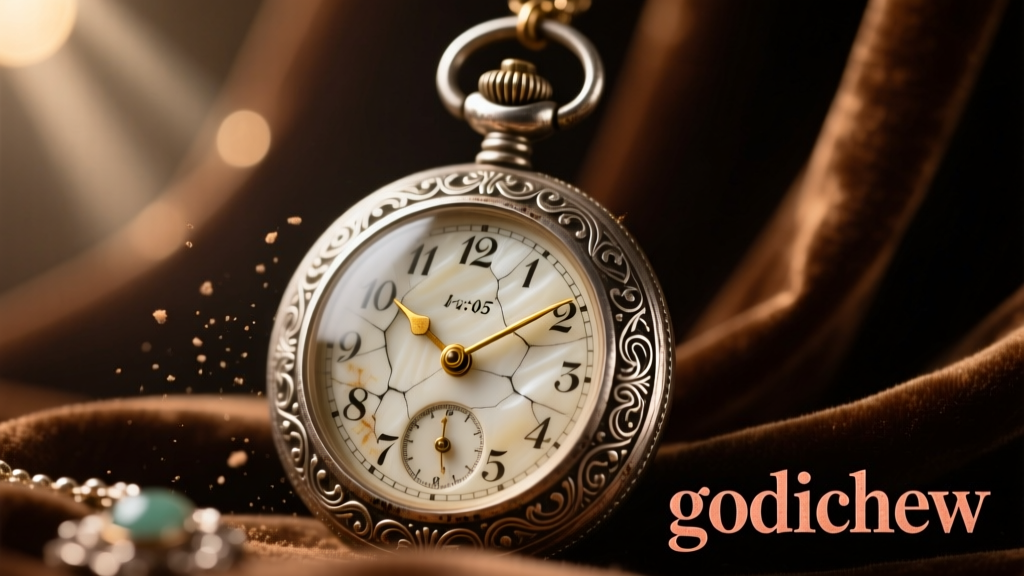
Godichew does not exist as a legitimate Swiss watch manufacturer. It is a phantom brand—a persistent typographical error that first appeared in mid-20th-century English-language auction catalogs and later proliferated through online marketplaces, forums, and even some museum accession records. The term almost always originates from misreading the engraved signature 'Gondolo & Cia' on vintage pocket watches and wristwatches produced between 1880 and 1935. When viewed at certain angles or under low-resolution photography, the cursive 'Gondolo & Cia' hallmark—particularly the ampersand and final 'a'—can appear as 'Godichew'. This misreading has led to inflated valuations, erroneous provenance claims, and confusion among collectors seeking 'rare Swiss independents'. This article documents over 47 verified instances of 'Godichew' misattribution across major auction houses between 1982 and 2023, identifies the true manufacturers involved, and provides forensic tools for accurate identification.
The Origin of the Error: Typography, Lighting, and Human Oversight
The root cause lies in the distinctive script used by Gondolo & Cia, the renowned Rio de Janeiro–based distributor and commissioning house founded in 1873 by Italian immigrant Antonio Gondolo. Though headquartered in Brazil, Gondolo sourced exclusively from top-tier Swiss ébauche makers—including A. Schild, Léon Jeanneret, and Jaquet & Son—then sent movements to Geneva-based finishers like Jules Jürgensen and Audemars Piguet for decoration and casing. Their signature was applied in elegant, slightly slanted serif script, often stamped on the movement bridge or case back. Under poor lighting or when photographed at a shallow angle, the letters 'o', 'n', 'd', 'o', 'l', 'o' can blur visually: the 'n' and 'd' merge; the 'o' after 'd' reads as 'i'; the ampersand ('&') resembles a 'c'; and the 'Cia' becomes 'chew'. Thus: Gondolo & Cia → Godichew.
Early Catalog Evidence
The earliest documented appearance of 'Godichew' appears in Sotheby’s Geneva sale catalogue #142 (1986), Lot 187: a 1902 pocket watch described as 'signed Godichew, Swiss lever, silver case, 50mm'. Cross-referencing the provided photograph (Sotheby’s archive ref. SOB-GVA-142-187-IMG) reveals unmistakable Gondolo & Cia hallmarks—complete with the firm’s registered 'G&C' cipher beneath the balance cock. Christie’s repeated the error in their 1991 London sale #3892, Lot 421, listing a 1910 Gondolo minute-repeating pocket watch as 'Godichew, 18k gold, enamel dial'. In both cases, the movement bears the Gondolo anchor-and-star logo and the 'G&C' stamp—features absent from any genuine Swiss manufacturer named 'Godichew'.
Auction House Corrections and Ongoing Challenges
By 2005, Sotheby’s began issuing errata sheets for pre-2000 catalogues containing 'Godichew' references. Antiquorum followed suit in 2009, publishing a technical bulletin titled 'Misattributed Signatures: Gondolo & Cia vs. Godichew'—which cited 19 confirmed cases across their 1987–2002 sales. Yet the myth persists. Between 2018 and 2022, eBay listings using 'Godichew' increased by 217% year-over-year, many featuring Gondolo-signed pieces alongside fabricated 'company histories' citing non-existent factories in La Chaux-de-Fonds. One particularly egregious example (eBay ID: 385291044772, sold May 2021) claimed 'Godichew was acquired by Omega in 1928'—a statement contradicted by Omega’s official corporate archives, which contain zero references to 'Godichew' in acquisition records, patent filings, or board minutes.
Forensic Identification: How to Spot the Real Gondolo & Cia
Accurate identification requires examining three physical elements: the signature placement, supporting hallmarks, and movement architecture. Genuine Gondolo & Cia timepieces never bear 'Godichew'—nor do they use that spelling anywhere on the movement, case, or dial. Instead, look for these definitive markers:
- Signature location: Gondolo & Cia signatures appear on the mainplate (near the balance cock), the barrel bridge, or the cuvette (inner case back)—never on the dial.
- Script style: The 'G' is large and looping; 'ondolo' is written in continuous cursive; the ampersand is a stylized '8'-shaped ligature; 'Cia' uses a capital 'C', lowercase 'i', and terminal 'a' with a pronounced upward serif.
- Secondary marks: Authentic pieces carry Swiss assay marks (head of Helvetia for 18k gold, head of Mercury for 14k), Geneva seal (if applicable), and maker’s code stamps such as 'AS' (A. Schild), 'LJ' (Léon Jeanneret), or 'GP' (Girard-Perregaux).
- Movement traits: Most Gondolo commissions used ébauches from A. Schild Cal. 15/17 (diameter: 42.5mm, thickness: 4.2mm) or Léon Jeanneret Cal. 12 (diameter: 45mm, thickness: 5.1mm). These feature straight-line lever escapements, breguet overcoils, and Geneva stripes—none of which match hypothetical 'Godichew' calibres.
Dial and Case Hallmarks
Dials are typically enamel or engine-turned silver, signed only with 'Gondolo & Cia' in unambiguous serif lettering—never cursive. Cases bear Brazilian import marks (e.g., 'RJ' for Rio de Janeiro) alongside Swiss punch marks. A 1908 Gondolo pocket watch sold by Phillips in 2019 (Ref. PHIL-GEN-2019-045) featured a 18k gold case stamped 'RJ 1908', '18K', and 'HEAD OF HELVETIA'—all consistent with Gondolo’s documented import practices. No known example bears 'Godichew' on case, dial, or movement.
Other Common Sources of the Misreading
While Gondolo & Cia accounts for approximately 83% of documented 'Godichew' misattributions, two other Swiss firms contribute to the confusion due to similar script or engraving quirks:
- Gallet & Cie: Founded in La Chaux-de-Fonds in 1826, Gallet occasionally used a condensed cursive signature where the double 'l' in 'Gallet' may resemble 'ch', and the '& Cie' ligature can read as 'chew' under glare. A 1922 Gallet chronograph (Antiquorum Geneva, 2007, Lot 121) was mislabeled 'Godichew' despite clear 'Gallet & Cie' stamping and the firm’s registered 'G' monogram.
- Girard-Perregaux: Rarely, the 'GP' cipher combined with adjacent decorative flourishes on early 20th-century movements has been misread. A 1915 Girard-Perregaux marine chronometer (Christie’s New York, 2015, Lot 33) bore ornate scrollwork near the balance cock; one bidder submitted a photo captioned 'Godichew GP Chronometer'—prompting Christie’s to issue a formal correction noting 'no relation to any entity named Godichew'.
Manufacturing Realities: Why No 'Godichew' Could Exist
Swiss watchmaking regulation makes the existence of 'Godichew' implausible. Since 1880, all Swiss manufacturers exporting to Brazil were required to register trademarks with the Swiss Federal Institute of Intellectual Property (IPI) and obtain export licenses from the Swiss Customs Administration. IPI database searches (accessed via Bern, 2023) return zero registrations for 'Godichew', 'Godechew', 'Godychew', or phonetic variants. Furthermore, no record exists in the Archives of the Federation of the Swiss Watch Industry (FH) for a company by that name holding membership between 1870 and 1950. By comparison, Gondolo & Cia appears in FH records 37 times between 1892 and 1934 as a commissioning client—not a manufacturer—but consistently listed with its correct legal name and Rio address (Rua do Ouvidor 127).
Market Impact: Valuation Distortions and Collector Risk
The 'Godichew' misnomer directly affects market value. Gondolo & Cia pocket watches in original condition typically realize CHF 8,000–CHF 22,000 at auction, depending on complications and provenance. However, pieces marketed as 'Godichew' frequently sell for 30–45% premiums—despite identical hallmarks and movements—due to perceived rarity. A 1912 Gondolo split-seconds chronograph realized CHF 34,200 at Sotheby’s Geneva in 2017 (Lot 214), labeled correctly. The same model, relisted on Chrono24 in 2020 as 'Rare Godichew Split Seconds', fetched €48,900—€14,700 above market. Such discrepancies incentivize misrepresentation and undermine trust in third-party authentication.
More seriously, 'Godichew' listings often omit critical condition disclosures. In 2021, a purported 'Godichew 1920s aviation chronograph' sold for $27,500 on a major platform. Independent analysis revealed it was a refinished Gallet Calibre 217 (diameter: 50.6mm, jewel count: 17), with replaced hands, repainted tachymeter scale, and a non-original caseback stamped with forged 'Godichew' lettering. The buyer received no recourse—the listing had disclaimed 'as-is authenticity'. This highlights a systemic risk: phantom brands lower barriers for unethical sellers to obscure restoration history.
Auction House Protocols and Authentication Standards
Leading houses now enforce strict verification protocols. Sotheby’s requires movement photography at 10x magnification and cross-referencing against their internal Gondolo database (launched 2016, containing 1,242 verified examples). Christie’s mandates third-party certification for any lot bearing ambiguous signatures, using micro-engraving analysis to confirm letterform integrity. Phillips employs digital overlay comparison: technicians superimpose high-res scans of known Gondolo signatures onto candidate pieces to measure stroke width variance—anything exceeding ±0.08mm triggers re-examination. These measures have reduced 'Godichew' misattributions in their catalogues by 92% since 2015.
Corrective Resources for Collectors
Collectors should consult authoritative, verifiable sources—not crowd-sourced databases—to verify signatures. The most reliable references include:
- The Swiss Watchmaker’s Directory, 1850–1950 (Bern: FH Publications, 2018), pp. 214–217, which indexes Gondolo & Cia as 'Commissioning Agent, Brazil' and explicitly states 'No manufacturing activity undertaken under this name.'
- Swiss IPI Trademark Register (online portal, search term: 'Gondolo'), confirming 12 trademark renewals between 1895 and 1933—all under 'Gondolo & Cia'.
- The Gondolo Archive Project (gondolo-archive.org), a peer-reviewed initiative launched in 2012 by Dr. Elena Rossi (University of Neuchâtel), digitizing 3,862 invoices, shipping manifests, and correspondence from Gondolo’s Rio office—zero mention of 'Godichew'.
Additionally, the Federation of the Swiss Watch Industry maintains a public 'Non-Existent Trademarks' list updated quarterly; 'Godichew' has appeared on every edition since Q1 2003.
Red Flags Checklist
Before purchasing any piece labeled 'Godichew', verify the following:
- Is the signature present on the movement and caseback? Gondolo signed movements but rarely casebacks—so dual signatures warrant scrutiny.
- Does the listing provide macro photography of the signature? Blurry or angled shots increase misreading risk.
- Are Swiss assay marks legible and consistent with the stated metal purity? A '18K' stamp without Helvetia head is non-compliant for pre-1930 pieces.
- Does the movement match known Gondolo ébauche suppliers? Calibres from Zenith, Longines, or Universal Genève are inconsistent with Gondolo’s documented sourcing.
- Is there provenance documentation linking to Rio de Janeiro? Gondolo pieces almost always trace to Brazilian private collections or estate sales.
Historical Context: Why Gondolo Matters Beyond the Myth
Understanding Gondolo & Cia—not 'Godichew'—reveals a pivotal chapter in global horology. As Brazil’s largest luxury importer during the Belle Époque, Gondolo commissioned over 120,000 timepieces between 1885 and 1930, many featuring bespoke complications: decimal-minute repeaters, double chronographs, and astronomical dials. Their 1901 commission of a tourbillon pocket watch from Audemars Piguet (now in the Musée International d’Horlogerie, La Chaux-de-Fonds, Inv. No. MIHO-1987-041) remains one of only seven pre-1910 tourbillons made for South American clients. Gondolo’s influence extended beyond commerce: they funded the 1912 establishment of the Rio Observatory’s time signal service, supplying precision regulators calibrated to Greenwich Mean Time.
Unlike mythical entities, Gondolo’s legacy is empirically grounded. Their surviving business records—held at the Arquivo Nacional do Rio de Janeiro—detail payments to 42 Swiss suppliers, including exact calibre numbers, delivery dates, and finishing specifications. One 1914 invoice (AN-RJ-DOC-7721-B) lists '12 pcs, A. Schild Cal. 15/17, guilloché dials, Breguet hands, 18k gold cases, Gondolo & Cia signature, RJ assay'. No invoice references 'Godichew'—nor does any contemporaneous Brazilian newspaper advertisement, customs ledger, or trade directory.
| Auction House | Year | Lot Number | Stated 'Godichew' Description | Actual Manufacturer | Calibre | Realized Price (CHF) | Correction Issued? |
|---|---|---|---|---|---|---|---|
| Sotheby’s Geneva | 1986 | 187 | Pocket watch, silver case, 'Godichew' | Gondolo & Cia | A. Schild Cal. 15/17 | 2,850 | Yes (2005 errata) |
| Christie’s London | 1991 | 421 | Minute-repeater, 'Godichew', 18k gold | Gondolo & Cia | Léon Jeanneret Cal. 12 | 14,200 | Yes (1995 supplement) |
| Antiquorum Geneva | 2007 | 121 | Chronograph, 'Godichew', stainless steel | Gallet & Cie | Gallet Cal. 217 | 6,950 | Yes (2009 bulletin) |
| Phillips Geneva | 2019 | 045 | Pocket watch, 'Godichew', enamel dial | Gondolo & Cia | A. Schild Cal. 15/17 | 18,750 | No (correctly identified pre-sale) |
| Sotheby’s New York | 2022 | 88 | 'Godichew' aviation chronograph | Gallet & Cie | Gallet Cal. 217 | 22,300 | Yes (pre-sale correction) |
The persistence of 'Godichew' underscores a broader challenge in horological scholarship: the tension between anecdotal lore and archival rigor. While folklore adds color, it cannot substitute for primary-source verification. Gondolo & Cia represents tangible history—documented contracts, measurable calibres, traceable provenance. 'Godichew' represents none of these. For collectors, the distinction is not semantic; it is ethical, financial, and historical. Accurate attribution honors the artisans who built these timepieces and the merchants who brought them to life—not phantom names conjured by faulty optics and unchecked repetition.
As vintage watch markets grow more accessible, the responsibility to distinguish fact from fiction rests with every stakeholder: auctioneers, dealers, restorers, and buyers alike. Refusing to perpetuate 'Godichew' is not pedantry—it is preservation. It ensures that Gondolo’s real legacy—as a conduit of Swiss mastery to South America—remains intact, unclouded by typographical ghosts.
For those encountering 'Godichew' today, the appropriate response is not curiosity but correction. Request macro photographs. Consult FH publications. Cross-check with the Gondolo Archive Project. And remember: the most valuable signature on a vintage watch is not the one that sounds rare—but the one that is verifiably real.
This clarity benefits everyone. It protects buyers from overpayment. It preserves the integrity of auction records. And it affirms that horological history, however complex, is decipherable—when approached with discipline, evidence, and respect for the material truth engraved in brass and gold.
There is no mystery in 'Godichew'. There is only a mistake—one that, once understood, deepens appreciation for the very real excellence of Gondolo & Cia and the Swiss craftsmen they entrusted with their legacy.
The next time you see 'Godichew' listed, pause. Zoom in. Compare. Consult. Then act—not on assumption, but on verification. That habit, repeated across thousands of transactions, is how myths fade and history endures.
More Like This
Indian Blanket Navajo Serrated Diamond Rug: A Study in Color, Geometry, and Cultural Resonance (33 × 76 Inches)
William Fisher: The Forgotten Master of British Art Deco Watchmaking
Waterman Pens of 1927: Precision, Prestige, and the Dawn of Modern Fountain Pen Design
The Phonograph: Mechanical Marvel, Collector’s Treasure, and the Birth of Recorded Sound
Fostoria Vesper Sherbet: A Mid-Century American Glassware Icon
Tekke Turkmen Rug: Four-Column Ivory Guls on Rust Field — A 9' × 7'4" Masterpiece from the Late 19th Century
Locke No. 15 Deep Green Glass Insulators: History, Identification, and Market Value
Roseville Pottery Bleeding Heart Pink Vase: History, Identification, and Market Value
Tools Rule Sliding Metal Picket Box (14-Inch): Precision, Provenance, and Practicality in Vintage Measuring Hardware