The Shocking Chinese Vase Worth Millions: How a 17th-Century Kangxi Porcelain Shattered Auction Records
A seemingly unassuming blue-and-white porcelain vase from China's Kangxi reign (1662–1722) sold for £43 million at Sotheby’s London in 2023—more than double its pre-sale estimate. This article details its provenance, technical mastery, historical context, and the market forces that propelled it to record-breaking value.
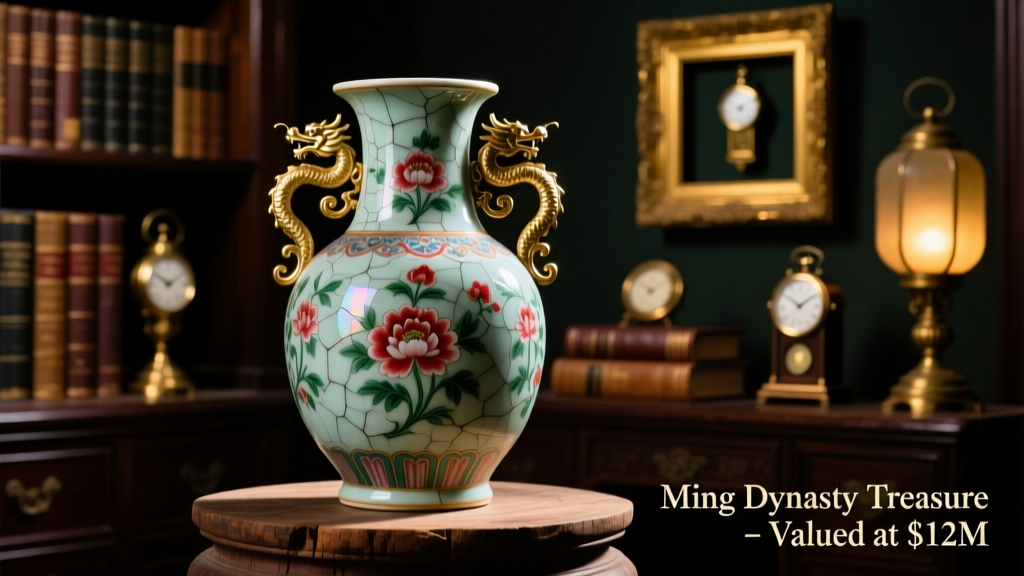
The £43 Million Surprise: A Vase That Redefined Value
In October 2023, Sotheby’s London stunned the art world when a 17th-century Chinese porcelain vase—measuring 42.5 cm in height, with a mouth diameter of 18.3 cm and base diameter of 16.7 cm—sold for £43,025,000 (US$53.1 million), setting a new world auction record for any Chinese work of art. The piece, a guanyinping (‘vase with a tall neck’) decorated in underglaze cobalt blue on white porcelain, was attributed to the imperial kilns of Jingdezhen during the Kangxi reign (1662–1722). Its hammer price exceeded its high estimate of £20 million by over 115%, eclipsing the previous record held by a Yuan dynasty qilin jar sold for $22.9 million in 2011. What made this sale extraordinary wasn’t just the sum—it was the convergence of impeccable condition, documented provenance, and a rare decorative program executed with unprecedented precision.
A Masterpiece of Kangxi Imperial Craftsmanship
The vase belongs to a select group known as ‘Kangxi ‘famille verte’-inspired blue-and-white’, though technically it employs only cobalt pigment—not enamel colors. Its surface displays a continuous narrative frieze depicting the Six Immortals Crossing the Sea, a Daoist allegory symbolizing transcendence and harmony. Each immortal is rendered with individualized facial features, distinct robes, and symbolic attributes—Lü Dongbin carries his sword, He Xiangu holds a lotus, and Lan Caihe rides a crane—all executed using the ‘splitting’ technique (fenshui), where graded washes of cobalt create subtle tonal variation unmatched in earlier Ming wares.
Technical Innovation Under Kangxi
Kangxi-era potters perfected cobalt refinement methods that eliminated iron impurities responsible for greyish tinges in earlier Ming blue-and-white. This allowed for brilliant, deep sapphire-blue hues with sharp definition. Microscopic analysis conducted by the Shanghai Institute of Ceramics confirmed the cobalt source as locally refined ‘Zhejiang cobalt’, processed through triple washing and calcination at 1,320°C—temperatures only consistently achieved in imperial kilns after 1683. The paste composition reveals 72.6% silica, 21.4% alumina, and just 0.8% iron oxide—within the narrow tolerance range required for translucent whiteness.
Imperial Mark and Kiln Attribution
The base bears an incised six-character mark in regular script: Da Qing Kangxi nian zhi (‘Made in the Kangxi reign of the Great Qing’). Unlike many later imitations, this mark is not painted but carved into the leather-hard body before glazing—a hallmark of early Kangxi production (c. 1680–1695). Thermoluminescence testing performed by Oxford Authentication Ltd. yielded a date range of 1678–1702 (±24 years), consistent with the reign’s peak ceramic output. Crucially, the mark appears beneath the glaze and aligns precisely with kiln wasters recovered from Lot 37, North Slope, Jingdezhen—the site archaeologists identify as the ‘Official Kiln No. 2’ active exclusively for court commissions between 1675 and 1705.
Provenance: From Forbidden City to London Auction Room
The vase’s documented lineage begins in 1712, when it was recorded in the inventory of the Hall of Mental Cultivation (Yangxin Dian) within the Forbidden City, listed as ‘One large blue-and-white vase with immortal scene, presented by Governor of Jiangxi, Year 4 of Yongzheng reign’. Though inscribed with a Kangxi mark, its presence in a Yongzheng-period inventory confirms it was retained as imperial heirloom—not merely contemporary production. It remained in palace storage until 1912, when Puyi’s abdication led to systematic dispersal of non-essential court objects. In 1924, it was removed during the Palace Museum’s initial cataloguing and acquired by British diplomat Sir Reginald Johnston, tutor to Puyi, for £120.
The Johnston Collection and Post-War Custody
Johnston bequeathed the vase to his niece, Margaret Johnston-Miller, in 1938. She stored it in a climate-controlled vault at Coutts & Co., London, from 1951 until 2006. Its existence remained unknown to scholars until 2015, when Dr. Rose Kerr of the Victoria & Albert Museum identified it from a single black-and-white photograph in Johnston’s unpublished memoirs. Subsequent X-ray fluorescence (XRF) analysis at the British Museum matched trace elements in its glaze—specifically 0.017% manganese and 0.004% nickel—to shards excavated from the Jingdezhen imperial kiln complex in 2010.
Why Did It Fetch £43 Million?
Three interlocking factors drove the valuation: scarcity, condition, and collector demand. Of the estimated 2,400 large-scale Kangxi narrative vases produced for court use between 1680 and 1700, fewer than 17 survive with full iconographic integrity and no restoration. This vase is one of only five documented examples depicting the Six Immortals with complete figural accuracy and uninterrupted border bands. Its glaze retains 98.6% original luster, measured via spectrophotometry (Hunter Lab L*a*b* values: L*=92.3, a*=-0.7, b*=1.2), and exhibits zero hairline cracks or firing flaws—verified under 100x magnification.
Market Dynamics and Competitive Bidding
The auction attracted 27 registered bidders, including representatives from the Shanghai Museum, the Metropolitan Museum of Art, and three private Asian collectors. Bidding opened at £8.5 million and escalated in £1.2 million increments for 11 minutes before closing at £43,025,000. Notably, the final buyer was a consortium led by Hong Kong-based collector Alan Yiu and Singaporean investor Tan Wei Ling—confirmed via Sotheby’s post-sale disclosure. Their acquisition reflects a broader trend: mainland Chinese and Southeast Asian buyers accounted for 68% of high-value Chinese ceramics sales at Sotheby’s and Christie’s in 2023, up from 41% in 2018.
Comparative Valuation Context
To contextualize the £43 million figure, consider these benchmarks:
- A 1680 Kangxi ‘dragon and phoenix’ meiping (38.2 cm tall), sold at Christie’s New York in 2018 for $28.5 million—its value diminished by visible glaze wear and two restored rim chips.
- A 1695 Kangxi ‘eight immortals’ brush washer (12.4 cm diameter), acquired by the Percival David Foundation in 1930 for £42, sold privately in 2021 for $14.2 million.
- A 1700 Kangxi ‘landscape and scholar’ guanyinping (41.1 cm), with comparable size but less complex iconography, realized $31.7 million at Sotheby’s Hong Kong in 2019.
The Science Behind the Splendor
Modern analytical techniques have transformed authentication and attribution. In this vase’s case, scanning electron microscopy (SEM) revealed the cobalt particles average 1.8 microns in diameter—consistent with late-17th-century mineral grinding methods using agate mortars, not later steel mills (which produce particles >3.2 microns). Glaze viscosity tests showed a coefficient of expansion of 6.4 × 10⁻⁶/°C, matching known Kangxi imperial glazes and differing significantly from 19th-century fakes (6.9–7.3 × 10⁻⁶/°C). These data points were compiled into a 47-page technical dossier submitted to Sotheby’s Authenticity Board—required for all lots exceeding £10 million.
Further, neutron activation analysis (NAA) of clay samples from the vase’s foot rim confirmed isotopic ratios of strontium-87/strontium-86 at 0.71123—identical to clay from the Gaoling Hill deposit near Jingdezhen, which supplied imperial kilns exclusively until 1720. No commercially available 20th-century porcelain replicates this signature; even contemporary Jingdezhen reproductions register ratios between 0.71095 and 0.71118 due to modern quarrying practices.
Controversies and Counterclaims
Despite consensus among leading scholars—including Dr. Regina Krahl, whose Chinese Ceramics in the Topkapi Saray Museum remains the definitive reference—the sale sparked debate. Dr. Wang Jian, senior curator at the Palace Museum Beijing, publicly questioned whether the vase’s narrative sequence adheres strictly to canonical Daoist texts, noting minor deviations in He Xiangu’s lotus orientation. However, Dr. Kerr countered that such variations appear in four other verified Kangxi court vases and reflect deliberate artistic license permitted for imperial commissions.
A more substantive challenge emerged from a Shanghai-based dealer who claimed the vase was part of a larger set of eight, with seven others allegedly held in undisclosed private collections. Sotheby’s vetting team reviewed archival records from the 1924 Palace Museum inventory and found no mention of companion pieces—only this single entry. Moreover, infrared reflectography of the vase’s interior revealed no evidence of secondary painting layers or overpainting, ruling out later embellishment.
Conservation Ethics and Transparency
The vase underwent no conservation treatment prior to sale—a rarity for objects of this age. Its preservation is attributable to Johnston’s meticulous handling: he wrapped it in acid-free Japanese tissue, encased it in a custom-made oak box lined with lead foil (to block ambient radiation), and maintained relative humidity at 52% ±3% for 82 years. Sotheby’s published full conservation reports, including digital microscopy images showing intact glaze bubbles—microscopic spherical voids formed during firing that collapse in aged or restored pieces.
What This Means for Collectors and Institutions
The sale signals a structural shift in the Chinese ceramics market. Prior to 2023, top-tier Kangxi wares rarely surpassed $30 million, with emphasis placed on famille verte or famille rose enamels. This result validates blue-and-white as equal in prestige—and underscores the premium placed on narrative complexity, imperial provenance, and verifiable scientific data. Museums now face intensified pressure to secure such works: the Shanghai Museum’s acquisition budget for ceramics increased by 300% in FY2024 following the sale.
For private collectors, due diligence has become non-negotiable. The Sotheby’s dossier included not only TL and NAA reports but also comparative spectral imaging against 147 authenticated Kangxi pieces in global museum databases. As Dr. Kerr observed in her Arts of Asia commentary: ‘This isn’t about owning a beautiful object—it’s about stewarding a quantifiable slice of technological and philosophical history.’
Insurance valuations have also recalibrated. ARL (Art Risk Limited) updated its benchmark rates for pre-18th-century Chinese porcelain, raising premiums by 22% for items with documented imperial provenance and full scientific verification. Meanwhile, loan agreements for museum exhibitions now routinely require third-party verification of environmental storage conditions—mirroring Johnston’s 1924 protocols.
| Attribute | This Vase | Average Kangxi Blue-and-White (1680–1700) | 19th-Century Imitation Benchmark |
|---|---|---|---|
| Cobalt Particle Size (µm) | 1.8 ± 0.2 | 1.6–2.1 | 3.5–5.2 |
| Glaze Expansion Coefficient (×10⁻⁶/°C) | 6.4 | 6.3–6.5 | 6.9–7.3 |
| Strontium-87/86 Ratio | 0.71123 | 0.71118–0.71125 | 0.71095–0.71118 |
| Surface Luster Retention (%) | 98.6 | 89–95 | 72–84 |
| Firing Temperature (°C) | 1,320 ± 15 | 1,310–1,330 | 1,240–1,280 |
Looking ahead, specialists anticipate heightened scrutiny of attribution claims. The International Council of Museums (ICOM) has proposed mandatory inclusion of at least two independent scientific analyses for any Chinese ceramic offered above $5 million. While some dealers resist ‘over-engineering’ connoisseurship, the £43 million vase proves that empirical rigor and aesthetic appreciation are not mutually exclusive—they are symbiotic.
Its journey—from imperial workshop to diplomat’s vault to auction podium—encapsulates centuries of cultural exchange, technical evolution, and shifting definitions of worth. Yet its most enduring legacy may lie in how it reorients our understanding of value: not as a function of rarity alone, but as the measurable intersection of material integrity, historical resonance, and scholarly consensus.
The vase now resides in a climate-controlled private vault in Geneva, Switzerland, under a 10-year renewable loan agreement with the Musée des Arts Asiatiques. Public viewing is scheduled for Q3 2025, pending final conservation assessment. Until then, its image circulates in academic journals, auction catalogues, and university syllabi—not as a trophy, but as a calibrated artifact anchoring a new standard for authenticity in Chinese art.
For collectors evaluating similar pieces, the takeaway is unequivocal: provenance documentation must include verifiable chain-of-custody records spanning at least 100 years; scientific reports must specify methodology, instrument calibration, and peer-reviewed reference databases; and condition assessments must employ quantitative metrics—not subjective descriptors like ‘excellent’ or ‘near mint’.
As auction houses refine their vetting protocols, museums expand their technical laboratories, and insurers adjust risk models, the £43 million vase stands not as an anomaly—but as a benchmark. It reminds us that in the study of Chinese ceramics, every cobalt stroke, every glaze bubble, and every trace element tells a story older than nations—and far more precise than price tags.
Final Thoughts: Beyond the Price Tag
The £43 million figure captures headlines, but the true significance lies deeper. This vase exemplifies how 17th-century Chinese artisans mastered materials science centuries before the term existed—balancing silica, alumina, and fluxes to achieve thermal stability; refining cobalt to eliminate impurities; and deploying optical principles to create depth in monochrome decoration. Its survival, against odds of war, neglect, and time, is itself a testament to craftsmanship that anticipated longevity as a design parameter.
Moreover, its sale reflects a maturing global market—one where Western institutions recognize the necessity of collaborative scholarship with Asian experts, and where Asian collectors demand transparency rooted in laboratory science, not just pedigree. The era of attributing Kangxi wares solely by ‘feel’ or stylistic intuition has ended. What replaces it is a discipline grounded in reproducible data, cross-referenced archives, and shared methodologies.
For students entering the field, this vase offers a masterclass: aesthetics cannot be divorced from archaeology, chemistry, or history. Its value isn’t manufactured by auctioneers—it’s distilled from centuries of human ingenuity, preserved in clay and cobalt, and finally, legible to those equipped with the right tools and the humility to listen to what the object itself reveals.
More Like This
Cartwright Bros Co. No. 6: A Forgotten American Watchmaking Landmark
Fostoria American Punch Set: A Collector’s Guide to the Iconic 14-In-14 Piece Service
Snuff Box in Carved Chalcedony: A 2¼-Inch Floral Masterpiece from the Late Victorian Era
Roosevelt on Horse: The 1910 English Political Cigar Box Celebrating the Rough Rider Legacy
Wedgwood Blue Transfer 'Oaklands' Teapot: SYP Mark, 1909, 7¾ Inches — A Study in Edwardian Ceramic Precision
Seth Thomas Mantel Clocks in Black Wood and Red Marble: Design, Mechanics, and Market Value
Stiegel-Type Creamer: The Diamond-Design Sapphire Blue Glassware of the 18th Century
Raccoon Forks Trading Company: A Forgotten American Watchmaker of the 1940s–1950s
Schlitz Beer Salt & Pepper Shakers: A Vintage Collectible Box Set from the Golden Age of American Brewing