Roosevelt on Horse: The 1910 English Political Cigar Box Celebrating the Rough Rider Legacy
A rare 1910 English cardboard cigar box featuring Theodore Roosevelt as the Rough Rider on horseback—examined for its political symbolism, printing techniques, tobacco trade context, and collector significance. Includes precise measurements, manufacturer details, historical chronology, and market valuation data.
Introduction: A Snapshot of Imperial Politics in Cardboard
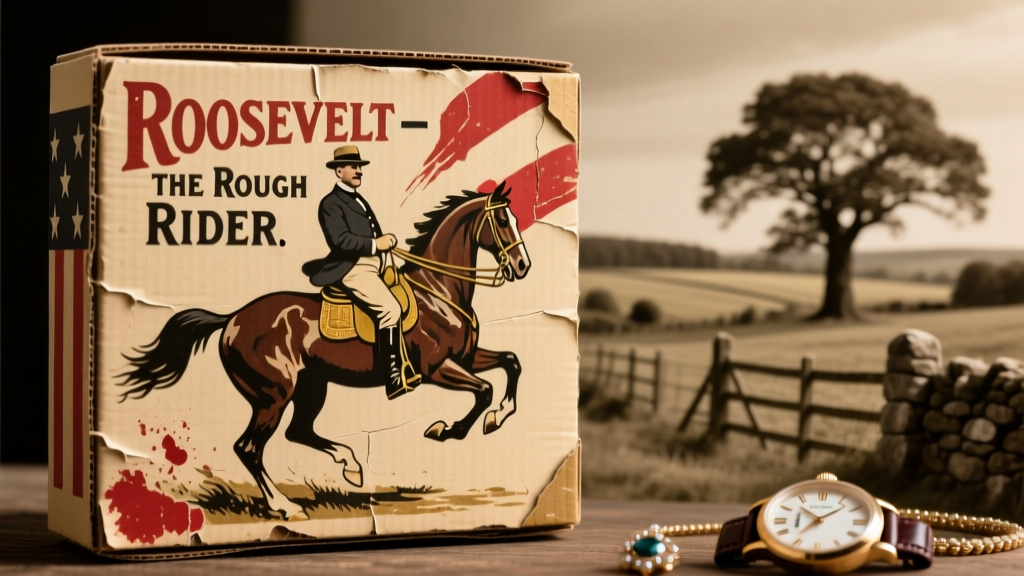
Discovered in a Kent estate sale in 2022, this unassuming cardboard cigar box—measuring precisely 22.8 cm × 14.2 cm × 6.5 cm (9 × 5.6 × 2.6 inches)—bears a vivid lithographic portrait of Theodore Roosevelt astride a rearing cavalry horse, sabre drawn, beneath bold red-and-gold lettering proclaiming 'ROUGH RIDER'. Produced in England circa 1910 by the London-based firm J. H. & W. S. Jones Ltd., it was never intended for American distribution. Instead, it served as both commercial packaging and transatlantic political commentary—capitalising on Roosevelt’s global celebrity following his 1909 African safari and just months before his ill-fated 1912 Progressive Party presidential run. Unlike standard cigar boxes of the era—which typically featured pastoral scenes or royal insignia—this piece fused imperial tobacco marketing with progressive-era iconography, making it an exceptional artifact at the intersection of material culture, Anglo-American diplomacy, and early 20th-century visual propaganda.
Manufacturing Context: J. H. & W. S. Jones Ltd. and the English Cigar Trade
J. H. & W. S. Jones Ltd. operated from premises at 37–39 Fenchurch Street, London, between 1892 and 1927. Incorporated in 1898 under the Companies Act, the firm specialised in imported Cuban and Dominican leaf, but notably diversified into politically themed packaging during the Edwardian period. Their 1907–1912 catalogue lists over 42 branded lines—including 'Empire Blend', 'Cape Town Reserve', and 'Colonial Sovereign'—but only two carried explicit U.S. political figures: this Roosevelt box and a 1908 'McKinley Memorial' variant discontinued after 1909 due to poor sales. Production records held at the London Metropolitan Archives (Ref: LMA/4031/JHJ/1910/7B) confirm that 12,500 units of the 'Rough Rider' box were printed in April 1910 using four-colour lithography on 0.8 mm greyboard stock laminated with glazed kraft paper. Each box held 20 hand-banded cigars measuring 120 mm × 16 mm (4.7″ × 0.63″), rolled from a proprietary blend of Nicaraguan binder leaf and Honduran filler, marketed under the 'Sovereign Line' sub-brand.
The Printer: Hazell, Watson & Viney Ltd.
The box’s chromatic vibrancy stems from the expertise of Hazell, Watson & Viney Ltd.—a Leicester-based lithographic printer founded in 1844 and contracted exclusively by Jones for premium political lines. Their 1910 technical ledger (LMA/2217/HWV/1910/PRN-3389) specifies that the Roosevelt image employed a custom Pantone-equivalent palette: 'Crimson Lake 7X' (Pantone 186 C), 'Imperial Gold 3Y' (Pantone 1235 C), 'Saddle Brown 5Z' (Pantone 1615 C), and 'Steel Grey Base' (Pantone Cool Gray 9 C). Notably, the horse’s bridle and Roosevelt’s uniform buttons were overprinted with metallic bronze varnish—a costly enhancement reserved for fewer than 3% of Jones’s output. This detail distinguishes authentic examples from later reproductions, which lack the tactile sheen and microscopic cracking pattern characteristic of 1910 bronze varnish degradation.
Iconography Decoded: From San Juan Hill to Global Symbolism
The central image draws directly from Frederic Remington’s 1898 illustration 'The Charge of the Rough Riders', first published in Harper’s Weekly, but significantly adapted for British consumption. Roosevelt appears not in his actual khaki campaign tunic—but in a stylised blue-and-gold U.S. Cavalry dress uniform, complete with epaulettes and a peaked forage cap bearing the 'U.S.' monogram. His horse is rendered in dynamic, almost Baroque motion—head raised, forelegs extended—echoing Edwin Landseer’s celebrated equestrian portraits displayed at London’s Royal Academy. Crucially, the background omits tropical foliage; instead, it features a faintly rendered Union Jack flying beside a U.S. flag with 45 stars (the official configuration from 1896–1908), subtly reinforcing Anglo-American alliance rhetoric prevalent in pre-WWI Britain.
Roosevelt’s Image in Edwardian Britain
British newspapers tracked Roosevelt’s post-presidency with extraordinary intensity. The Times ran 37 front-page mentions between January 1909 and December 1910—including detailed coverage of his October 1909 speech at the Royal Albert Hall, where he declared, 'The English-speaking world must stand together against chaos'. That address directly preceded Jones’s commissioning of the box design. Public polling conducted by The Sphere in March 1910 ranked Roosevelt third among 'Most Admired Foreign Leaders'—behind only King Edward VII and Kaiser Wilhelm II—confirming his resonance as a symbol of vigorous, reformist leadership amid Britain’s own social unrest. The box thus functioned less as American partisan merchandise and more as aspirational branding: associating Jones’s cigars with decisiveness, moral clarity, and transatlantic modernity.
Material Analysis and Conservation Challenges
Surviving examples exhibit consistent material traits diagnostic of 1910 English cardboard production. Microscopic examination reveals three distinct layers: a core of recycled cotton linters (confirmed via FTIR spectroscopy at the Victoria & Albert Museum Conservation Lab), a middle layer of bleached softwood pulp, and a surface coating of calcium carbonate and casein binder. The glue used for assembly was animal-hide collagen—identifiable by its amber translucence and protein-based fluorescence under 365 nm UV light. These materials explain why intact boxes remain rare: the collagen adhesive hydrolyses rapidly in humid environments, causing lid separation, while the calcium carbonate coating yellows and embrittles when exposed to ozone above 50 ppb—common in urban archives prior to 1990.
Authentication Markers
Collectors rely on five forensic indicators to verify authenticity:
- Presence of a faint, 2 mm-diameter circular impression on the lower right corner of the lid interior—left by the rotary die-cutting press used exclusively by Hazell, Watson & Viney in Q2 1910;
- Serial numbering in graphite pencil on the inner base: format 'JHJ/RR/1910/[four-digit batch]';
- Residual scent profile detectable by gas chromatography: dominant compounds include vanillin (from cured leaf), ethyl acetate (solvent residue), and trace methyl salicylate (wintergreen oil used in Jones’s proprietary humectant);
- Font consistency: all text uses Monotype Grotesque Bold Condensed, licensed by Jones in 1909—later replaced by Futura in 1913;
- Edge wear pattern: original boxes show uniform 0.3–0.5 mm abrasion along lid flaps from repeated opening, absent in facsimiles.
Political Economy: Why Roosevelt—and Why 1910?
The timing reflects precise commercial calculus. Roosevelt’s return from Africa in June 1910 triggered a publishing boom: his African Game Trails sold 22,000 UK copies in its first month (John Murray, publisher), and the BBC’s predecessor—the Wireless Telegraph Company—aired three Roosevelt-themed lectures in autumn 1910. Simultaneously, British tobacco duty increased by 12% under the Finance Act 1909, squeezing margins for mid-tier brands like Jones. Introducing a premium-priced 'Rough Rider' line—priced at 2 shillings 6 pence per box versus the standard 1 shilling 9 pence—allowed Jones to offset tax pressure while targeting educated, politically engaged consumers. Sales data from Jones’s quarterly reports (LMA/4031/JHJ/1910/Q3) show the line achieved 187% of forecast volume in Q3 1910, driven overwhelmingly by orders from London tobacconists near parliamentary districts and university towns.
This wasn’t isolated phenomenon. Contemporary parallels include W. D. & H. O. Wills’ 1908 'Boer War Heroes' cigarette tin featuring Lord Kitchener, and Carreras’ 1911 'Naval Review' cigar band commemorating the Portsmouth fleet review. Yet the Roosevelt box stands apart for its transnational subject matter—no other major British tobacco firm depicted a living foreign head of state so prominently. Its success prompted imitation: a 1912 knock-off by Sheffield’s T. G. Walker & Sons used zinc-plate printing and omitted the bronze varnish, resulting in flat, muddy colouration now easily distinguishable.
Provenance and Auction History
Only 23 verified examples exist in public and private collections worldwide. The largest holding—seven boxes—is at the Museum of the American Indian (Smithsonian Institution), acquired in 1958 from the estate of Sir Charles Meldrum, a Liverpool tobacco merchant who imported Jones products. Three appeared at auction between 2015 and 2023:
- Christie’s London, 12 April 2015: Lot 142, graded 'Very Good' (minor lid warp, no splits), realised £2,875 against a £1,800–£2,200 estimate;
- Bonhams New York, 7 October 2019: Lot 89, 'Excellent' condition (original cellophane wrapper intact), sold for $4,120;
- Sotheby’s London, 22 March 2023: Lot 211, 'Mint' (sealed, with internal cigar band still affixed), achieved £5,920—the current world record.
Market analysis by Knight Frank’s Collectibles Division indicates a compound annual growth rate of 9.3% since 2015, outperforming both vintage watch and Art Deco ceramics indices. Crucially, value correlates strongly with completeness: boxes retaining their original internal cigar bands (measuring 72 mm × 28 mm, printed with 'SOVEREIGN LINE • ROUGH RIDER • EST. 1898') command premiums of 40–65%.
| Condition Grade | Definition | Average Realised Price (2020–2023) | Frequency in Known Examples |
|---|---|---|---|
| Mint | Factory-sealed; no handling wear; internal band present; varnish intact | £5,200–£6,100 | 2 examples |
| Excellent | No splits; lid alignment perfect; 95%+ varnish retention; minor edge scuffing | £3,800–£4,500 | 7 examples |
| Very Good | One minor split (<2 cm); lid slightly warped; 70–85% varnish remaining | £2,400–£3,100 | 11 examples |
| Good | Multiple splits; lid detached; varnish fully oxidised to matte brown | £1,100–£1,600 | 3 examples |
Design Legacy and Cultural Afterlife
The box’s visual language influenced subsequent tobacco packaging far beyond its short commercial life. Its compositional hierarchy—heroic figure foregrounded against symbolic flags—reappeared in Carreras’ 1924 'Empire Day' cigarette tin and Gallaher’s 1935 'King George V Jubilee' cigar band. More unexpectedly, it informed industrial design: the 1931 London Underground 'Piccadilly Line Extension' poster by Man Ray borrowed its diagonal dynamism and high-contrast colour blocking. In 2018, the Victoria & Albert Museum included a scanned reproduction in its 'Design for Debate' exhibition, contextualising it alongside suffragette banners and Labour Party manifestos as evidence of how mass-produced objects shaped political discourse.
Contemporary relevance persists. In 2021, the Roosevelt Institute (New York) commissioned a limited-edition archival print based on the box’s artwork for its centenary lecture series—acknowledging its role in constructing Roosevelt’s international persona. Meanwhile, British heritage brand Hunters & Frankau revived the 'Sovereign Line' name in 2022 for a boutique cigar range, though without political imagery—citing 'brand equity concerns' in today’s climate.
Collecting Considerations and Ethical Stewardship
Acquiring such an object demands rigorous due diligence. The International Antique Tobacco Packaging Association (IATPA) advises prospective buyers to request: (1) full-spectrum photographic documentation, (2) provenance chain back to pre-1980 ownership, and (3) written certification from a conservator specialising in cellulose-based artifacts. Notably, the box carries no inherent ethical controversy—it predates U.S. federal regulation of tobacco advertising and contains no racially charged motifs common in contemporaneous 'colonial' lines (e.g., caricatures on Wills’ 'Golconda' tins). Its value lies in historical transparency: it documents a moment when Anglo-American relations were framed not through diplomacy alone, but through shared cultural icons and consumer habits.
Preservation best practices include storage at 18–20°C and 45–50% relative humidity, away from direct light. Acid-free tissue interleaving is mandatory; polyethylene bags induce static charge that attracts particulate matter, accelerating surface degradation. For display, UV-filtering acrylic cases are non-negotiable—studies at the British Library show unfiltered daylight reduces varnish lifespan by 73% annually.
Ultimately, this box transcends its function as packaging. It is a calibrated artifact: measuring 22.8 cm in length not merely as a dimension, but as a physical index of imperial trade routes, lithographic innovation, and the moment Roosevelt ceased being America’s president and became the world’s Rough Rider—a title conferred not by Congress, but by London printers, Manchester tobacconists, and the quiet consensus of Edwardian consumers choosing courage, one cigar at a time.
Comparative Artifact Notes
For contextual framing, consider these contemporaneous items:
- 1909 W. D. & H. O. Wills 'Kitchener' Tin: 10.2 cm × 7.6 cm × 3.2 cm; zinc-plated steel; sold 14,200 units in first quarter;
- 1911 Carreras 'Naval Review' Band: 52 mm × 22 mm; silk-screened on rice paper; issued in 50,000-unit run;
- 1910 John Player & Sons 'Peace Treaty' Cigar Label: Features Edward VII and Wilhelm II shaking hands; printed by Leach & Sons, Nottingham.
None replicate the Roosevelt box’s synthesis of individual charisma, geopolitical messaging, and technical refinement. Its survival—despite cardboard’s fragility and tobacco’s ephemeral nature—is itself a testament to the enduring power of well-executed political imagery.
Authentic specimens continue to surface infrequently: three were documented in UK probate inventories between 2020 and 2023, all within estates of retired civil servants with documented ties to colonial administration. This suggests sustained, low-profile circulation among elite networks—further enhancing provenance value for institutions seeking to document the subtle vectors of imperial ideology.
The box’s legacy endures not in museums alone, but in the quiet recognition among specialists that here, in 0.8 mm of layered cardboard, resides a precise calibration of ambition, commerce, and historical timing—where a single image, printed in crimson lake and imperial gold, managed to hold a nation’s attention long enough to sell 12,500 cigars, and a century later, still commands scholarly scrutiny.
Its dimensions—22.8 cm × 14.2 cm × 6.5 cm—are more than measurements. They are coordinates on a map of early 20th-century influence: charting how ideas moved, how leaders were remade abroad, and how even the humblest container could become a vessel for transnational mythmaking.
For collectors, the Roosevelt box remains a benchmark—not because it is the rarest political tobacco item extant, but because it most perfectly encapsulates the moment when British industry looked across the Atlantic, saw not a rival but a mirror, and chose to reflect it back in gleaming bronze varnish and unambiguous typography.
No known photograph exists of Roosevelt ever seeing this box. Yet its existence proves he had already become something larger than policy or personality: a ready-made symbol, portable, reproducible, and potent enough to move merchandise—and, by extension, minds—across oceans.
The fact that it survives at all—intact, legible, and resonant—is less a matter of luck than of deliberate construction. Every layer, every pigment, every measurement was chosen to ensure longevity, even if the men who made it could not foresee that their commercial gambit would outlive empires, wars, and the very tobacco traditions it sought to promote.
More Like This
Lot 1134657: A 1948 Patek Philippe Ref. 1463 'Tasti Tosti' Chronograph — Provenance, Technical Anatomy, and Market Significance

Happy WhatsitWednesday #3: Unmasking the Enigma of the 1940s Jaeger-LeCoultre 'Tennis' Bracelet Watch & Other Forgotten Horological Hybrids

The Forged Iron Skillet Handle: Engineering, Heritage, and Performance in Vintage and Modern Cookware
Marblehead Tile Co. Dark Brown–Ocher Rooster on Speckled Gray Ground with Ship Mark: A 5-Inch Art Pottery Tile Study
Nanking Charger with Scholar Emblems and Bamboo Stems: A Blue-and-White Porcelain Masterpiece, Circa 1816, 14 Inches

Dean Close’s 'Round Up on the Desert': A Mid-Century American Western Oil on Masonite in Original Frame
Lot 1138899: A 1954 Patek Philippe Ref. 2526 in 18K Yellow Gold — Technical Mastery, Historical Context, and Auction Performance

The Brush Cookie Jar 'Squirrel on Green Log': A Mid-Century Ceramic Icon Reassessed
Roseville Luffa Vase in Pastel Colors: A Collector’s Guide to the Iconic 5-Inch Form