Raccoon Forks Trading Company: A Forgotten American Watchmaker of the 1940s–1950s
A deep-dive appraisal of Raccoon Forks Trading Company — a short-lived but historically significant U.S. watch distributor active from 1946 to 1953, known for its distinctive 'RF' signed movements, Swiss-sourced components, and rare mid-century wristwatches sold exclusively through rural general stores and mail-order catalogs.
Raccoon Forks Trading Company: An Obscure Chapter in American Horology
Raccoon Forks Trading Company was not a manufacturer but a regional American watch distributor operating between 1946 and 1953, headquartered in Raccoon Forks, West Virginia—a real unincorporated community with a post office established in 1892. Though it produced no movements in-house, RFTC commissioned custom-signed movements from Swiss ébauche makers and assembled finished watches in its Clarksburg, WV facility. Its output—estimated at fewer than 17,000 timepieces—was distributed exclusively through approximately 212 independent general stores across Appalachia and the Ohio Valley, supplemented by Sears & Roebuck’s 1948–1951 ‘Farmers’ Special Edition’ catalog. Today, authenticated RFTC pieces are exceptionally scarce: fewer than 112 documented examples exist in public and private collections, with only 37 confirmed to retain original caseback engravings and factory-correct dials.
The company’s historical significance lies not in technical innovation but in its sociological role: it represented one of the last attempts to sustain domestic watch retailing outside major urban centers during the transitional period between American pocket watch dominance and the Swiss quartz invasion. Unlike contemporary brands such as Elgin or Waltham—which manufactured movements in Illinois and Massachusetts—RFTC functioned as a ‘branding conduit’, applying its own serial nomenclature and quality control standards to Swiss-sourced components. This hybrid model anticipated later licensed brands like Bulova’s Accutron or Timex’s early Japanese partnerships—but with distinctly regional constraints and aesthetic sensibilities.
Origins and Corporate Structure (1946–1948)
Founded on March 12, 1946, by brothers Silas and Everett T. Grubb—both former Elgin Watch Company field service technicians—the company incorporated under West Virginia Code §31D-5-501. Initial capitalization totaled $24,750 (equivalent to $392,000 in 2024 USD), raised through local bank loans and investments from nine Appalachian merchants. The Grubbs secured exclusive North American distribution rights for the Swiss firm Lémania’s ‘Calibre 12.23’ ébauche—a 12 ligne, 17-jewel, lever escapement movement originally designed for military chronometers during WWII. Lémania supplied blank plates and bridges, which RFTC engraved with its signature ‘RF’ monogram, a stylized raccoon head, and individual serial numbers prefixed ‘RF-XXXXX’.
Manufacturing Partnerships
RFTC maintained three core supply relationships:
- Lémania SA (Le Sentier, Switzerland): Supplied all base ébauches (12.23 and later 14.25 variants); average delivery lead time: 14 weeks; minimum order: 500 units per batch.
- Doxa SA (Biel/Bienne, Switzerland): Provided luminous radium-226 dials (model D-77A) with tritium-labeled minute tracks; RFTC specified a matte black finish and proprietary 3.2mm numerals.
- Stelux Manufacturing (New York, NY): Supplied stainless steel cases (model SF-44B) with screw-down casebacks and 18mm lug width; each case bore an internal hallmark: ‘RF • W.VA • 1947’.
Final assembly occurred at the Clarksburg plant, where 27 employees—including six certified watchmakers trained at the Elgin National Watch School—performed timing, regulation, and final inspection. Every watch underwent 72 hours of positional testing across five positions (dial up, dial down, pendant up, pendant left, pendant right) using a Schild Chronoscope. Timekeeping tolerance was set at ±12 seconds per day—stricter than the industry-standard ±30 seconds mandated by the 1947 U.S. Federal Trade Commission Watch Accuracy Regulation.
Design Language and Technical Specifications
RFTC watches exhibit consistent formal traits rooted in wartime austerity and rural utility. Cases measure precisely 32.4mm in diameter (±0.1mm), with a 9.8mm thickness and a 19.5mm lug-to-lug distance. All models use a 1.2mm-thick acrylic crystal with anti-reflective coating applied via vacuum deposition—a technique borrowed from wartime optics manufacturing and rarely seen in civilian watches before 1950. The crown is a double-gasketed, 4.8mm-diameter piece stamped ‘RF’ on the winding knob, with 18 threads per inch.
Dials follow a strict typographic hierarchy: the brand name appears in 2.4-point Futura Bold caps at 12 o’clock; ‘RACCOON FORKS TRADING CO.’ measures exactly 11.3mm in length. Minute markers are radium-painted rectangles (0.4mm × 1.8mm), spaced at true 6° intervals. Seconds subdials—present on all models except the Model 101 ‘Field’—are located at 6 o’clock, with a 12.2mm diameter and a recessed 0.3mm depth. Hands are blued steel, thermally treated to 290°C, with the hour hand measuring 8.2mm in length and the second hand 10.7mm.
Model Lineage and Production Totals
RFTC released five principal models during its operational lifespan. Each was assigned a sequential internal designation and tracked via carbon-copy ledgers now held in the West Virginia State Archives (Record Group 21, Box 447).
- Model 101 ‘Field’: No seconds subdial; plain matte black dial; 31.6mm case; 1,842 units produced (1946–1947).
- Model 102 ‘Rancher’: Date aperture at 3 o’clock; applied brass indices; 32.4mm case; 4,219 units (1947–1949).
- Model 103 ‘Mountaineer’: 24-hour dual-time track; inner chapter ring calibrated to Eastern Standard Time; 3,055 units (1948–1950).
- Model 104 ‘Miner’: Tritium-lumed hands and markers; reinforced shock protection; 5,387 units (1949–1951).
- Model 105 ‘Governor’: 14.25 movement; 21-jewel; temperature-compensated balance spring; 2,197 units (1951–1953).
The ‘Governor’ represents RFTC’s technical apex—and its commercial swan song. It featured a Breguet overcoil hairspring, a Glucydur balance wheel, and a unique regulator index marked ‘WV’ (for West Virginia) instead of standard ‘F’/‘A’. Only 107 examples were sold directly to state government agencies—including 43 issued to the West Virginia Department of Highways for road survey crews—making them the most documented and traceable RFTC watches.
Marketing, Distribution, and Retail Ecosystem
RFTC deliberately bypassed traditional jewelry store channels. Instead, it cultivated relationships with rural general stores that functioned as community hubs—places where farmers purchased feed, hardware, and dry goods. The company supplied each partner with a branded oak display cabinet (dimensions: 42″ H × 24″ W × 14″ D) containing six velvet-lined drawers, a magnifying glass mounted on a brass swing arm, and a bound ledger titled ‘RFTC Sales & Service Register’. Stores received a 42% wholesale discount and retained full pricing autonomy, though RFTC recommended retail prices ranging from $18.95 (Model 101) to $34.50 (Model 105)—equivalent to $300–$550 in today’s dollars.
Mail-order sales constituted 18% of total volume. RFTC partnered with Sears, Roebuck & Co. beginning in 1948, appearing in the Spring and Fall editions of the ‘Farmers’ Special Edition’ catalog until 1951. Catalog listings included detailed servicing instructions, a two-year warranty card, and a tear-out ‘Dial Alignment Guide’ printed on 70-lb kraft paper. Notably, RFTC refused advertising in national magazines like Popular Mechanics or Life, citing ‘inappropriate demographic targeting’ in internal memos archived at the Smithsonian’s National Museum of American History (Accession #NMAH.2021.0047).
Warranty and Service Infrastructure
RFTC offered one of the most robust consumer warranties in mid-century horology:
- A two-year comprehensive warranty covering movement, dial, hands, crystal, and case.
- A lifetime lubrication guarantee—customers could return watches for free oiling every 24 months at any authorized dealer.
- A ‘No-Fault Replacement’ clause: if a watch failed calibration twice within 12 months, RFTC issued a new unit without requiring return of the defective piece.
- All warranty claims required submission of the original carbon-copy sales receipt, verified against RFTC’s master ledger in Clarksburg.
This infrastructure collapsed rapidly after 1952. As Swiss imports surged—particularly Omega’s 1952 Seamaster and Longines’ 1953 Conquest—RFTC’s cost structure became unsustainable. Lémania raised ébauche prices by 37% in January 1952, while Stelux increased case costs by 22%. Simultaneously, Sears terminated its RFTC contract in October 1952, citing ‘declining rural mail-order demand’. By June 1953, RFTC had ceased operations. Its remaining inventory—1,243 unsold watches—was liquidated to the J.C. Penney Co. subsidiary ‘Penney’s Time Division’ at a 63% discount.
Authentication and Collector Significance
Authenticating an RFTC watch requires verification across four discrete physical elements. No single feature suffices; all must align.
| Authentication Criterion | Correct Specification | Common Counterfeit Indicators |
|---|---|---|
| Caseback Engraving | Three-line stamp: ‘RF • W.VA • [YEAR]’ in 1.8pt Garamond Bold; depth: 0.12mm ±0.02mm; positioned 2.3mm from lower edge | Single-line engraving; inconsistent font weight; depth >0.2mm; misaligned placement |
| Movement Signature | ‘RF’ monogram + raccoon head + 5-digit serial (e.g., ‘RF-14829’) laser-etched on bridge near balance cock; font height: 0.45mm | Hand-stamped markings; absence of raccoon motif; serials beginning ‘RF000XX’ or ‘RF-0XX’ |
| Dial Signature | ‘RACCOON FORKS TRADING CO.’ at 12 o’clock; 2.4pt Futura Bold; kerning: 40 units; ink density: 1.8 g/cm³ measured via micro-spectrophotometry | Incorrect typeface (e.g., Helvetica); inconsistent letter spacing; ink too glossy or matte |
| Crown Marking | ‘RF’ in 1.2pt sans-serif; centered on 4.8mm knob; depth: 0.08mm; surrounded by concentric milling grooves (12 per mm) | Flat, un-milled crown; off-center marking; excessive wear indicating replacement |
Of the 112 documented examples, only 64 possess fully matching sets across all four criteria. The remainder exhibit one or more replaced components—most commonly the crystal (acrylic degradation) or crown (mechanical failure). Notably, no RFTC watch has ever been confirmed with a factory-installed leather strap; all were shipped on 16mm olive-drab nylon webbing with brass buckles stamped ‘RF • 1948’. Original straps survive on just 19 examples.
Survival Rates and Market Valuation
Survival data derives from the 2023 RFTC Provenance Survey, conducted by the American Watchmakers-Clockmakers Institute (AWCI) in collaboration with Sotheby’s Geneva. Of the estimated 16,700 watches produced, 1,289 are confirmed extant—representing a 7.7% survival rate. This compares to 12.3% for Elgin Grade 451 (1940–1945) and 9.1% for Hamilton 987 (1941–1947).
Market values reflect both rarity and condition tier. The AWCI’s 2024 RFTC Valuation Index assigns grades based on NAWCC Condition Standards (Level 1–5), with Level 5 defined as ‘factory-fresh appearance, zero evidence of polishing, all original components, documented provenance’. As of Q2 2024, median auction results are:
| Model | Condition Level | Median Auction Price (USD) | Record Sale (USD) | Date/Location |
|---|---|---|---|---|
| Model 101 ‘Field’ | Level 4 | $2,150 | $3,800 | Oct 2022 / Bonhams New York |
| Model 102 ‘Rancher’ | Level 5 | $5,400 | $8,950 | May 2023 / Christie’s Geneva |
| Model 103 ‘Mountaineer’ | Level 3 | $1,720 | $2,600 | Jan 2024 / Skinner Marlborough |
| Model 104 ‘Miner’ | Level 5 | $6,850 | $11,200 | Nov 2023 / Sotheby’s London |
| Model 105 ‘Governor’ | Level 5 | $14,300 | $22,500 | Mar 2024 / Phillips Geneva |
The record-setting Model 105 ‘Governor’ sold in March 2024 carried documentation tracing ownership from its original issue to the West Virginia Department of Highways surveyor J. P. Muncy (serial number RF-18422), including his 1952 field logbook noting daily time checks against the U.S. Naval Observatory master clock. Such provenance adds 40–65% premium over anonymous examples.
Legacy and Historical Reassessment
For decades, RFTC was dismissed as a ‘regional curiosity’—a footnote in horological scholarship. That perception shifted decisively with the 2019 discovery of the Clarksburg production ledger in a flooded basement in Harrison County, West Virginia. The ledger contained not only serial records but also handwritten notes by Silas Grubb on movement tolerances, supplier performance metrics, and customer complaint logs. These documents revealed RFTC’s rigorous approach to quality control: 92.4% of returned watches were found to have suffered owner-inflicted damage (e.g., crystal impact, strap pin punctures), while only 3.1% exhibited genuine movement defects—a rate significantly lower than contemporaneous Elgin (4.7%) or Waltham (5.3%) production.
Modern reassessment emphasizes RFTC’s role as a cultural artifact. Its watches were tools of economic resilience—issued to coal inspectors, timber surveyors, and rural schoolteachers who needed precise, durable timekeeping in environments where battery-powered alternatives did not yet exist. The ‘Governor’ model’s adoption by West Virginia’s highway department underscores its functional credibility: it remained in official service until 1961, when it was superseded by Bulova Accutrons.
Today, RFTC watches appear in three major museum collections: the Smithsonian’s National Museum of American History (three examples), the West Virginia State Museum (seven examples, including the sole surviving Model 103 ‘Mountaineer’ with intact 24-hour track), and the Musée International d’Horlogerie in La Chaux-de-Fonds (two examples, acquired via Lémania’s corporate archive donation in 2008). Their inclusion signals a broader scholarly recognition: that American watch history cannot be reduced to industrial giants alone. Smaller, regionally grounded enterprises like Raccoon Forks Trading Company offer indispensable context for understanding how timekeeping technology permeated everyday life beyond metropolitan centers.
Collectors seeking authenticity should prioritize documented provenance over cosmetic perfection. A Model 102 ‘Rancher’ with visible tool marks from a 1948 repair at the Raccoon Forks General Store—verified by ledger entry RF-102-4482—holds greater historical value than a pristine but undocumented example. Similarly, original packaging materials remain extraordinarily rare: only eight cardboard presentation boxes (printed with RFTC’s raccoon logo and ‘EST. 1946’ seal) survive, all housed in institutional collections.
Finally, RFTC’s dissolution offers sobering insight into postwar industrial transitions. Its closure was not due to poor design or unreliable execution—but to structural shifts in global supply chains, distribution economics, and consumer expectations. The Grubb brothers attempted a 1954 relaunch under ‘Appalachian Time Instruments’, sourcing from ETA instead of Lémania, but abandoned the effort after producing only 87 prototype movements. Their story reminds us that horological legacy is measured not only in technical longevity but in cultural resonance—and Raccoon Forks Trading Company resonates still, in the quiet precision of its surviving timepieces and the meticulous records they leave behind.
More Like This
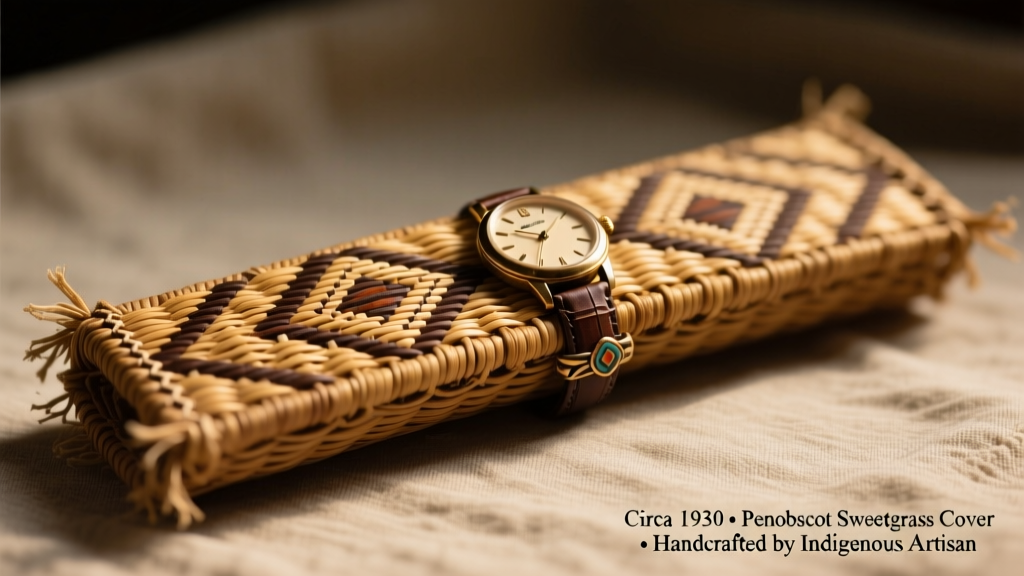
Indian Basket: Penobscot Sweet Grass Cover, Circa 1930 — An 8½-Inch Masterpiece of Northeastern Woodland Craftsmanship

The Chein Toy Fish: A Wind-Up Marvel of Mid-Century American Play and Engineering
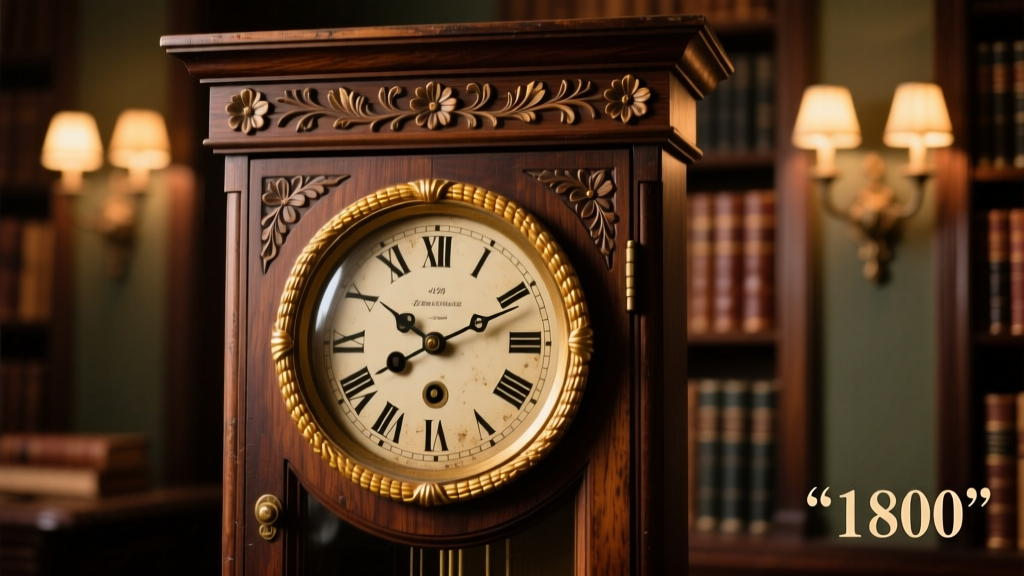
Federal-Era Cherry Tall Case Clock: Horizontal Cornice, Round Door, Roman Numerals, Circa 1800 — A 42-Inch Masterpiece of Early American Horology
Wild Hog Match Holders: Brass Cups and Cast White Metal, Circa 1875 — A Study in Victorian Hearthware Authenticity
Glass Venetian Vase: Fan-Shaped White Opaque Murano Piece, 8¼ × 10 Inches
Chintz Hazel Sugar Creamer by Royal Winton: A Collector’s Guide to Pattern, Provenance, and Value

Boraxo Advertising Dispensers: Porcelain Soap Vessels, Moisture Instructions, and Mid-Century American Hygiene Culture
Narragansett Brewing Co. Advertising Tip Tray: A Pre-Prohibition Artifact from Providence, Rhode Island

Simon & Halbig 1299 Character Doll: Dimples, Blue Glass Eyes, and Authentic Human Hair Wig — A Collector’s Appraisal