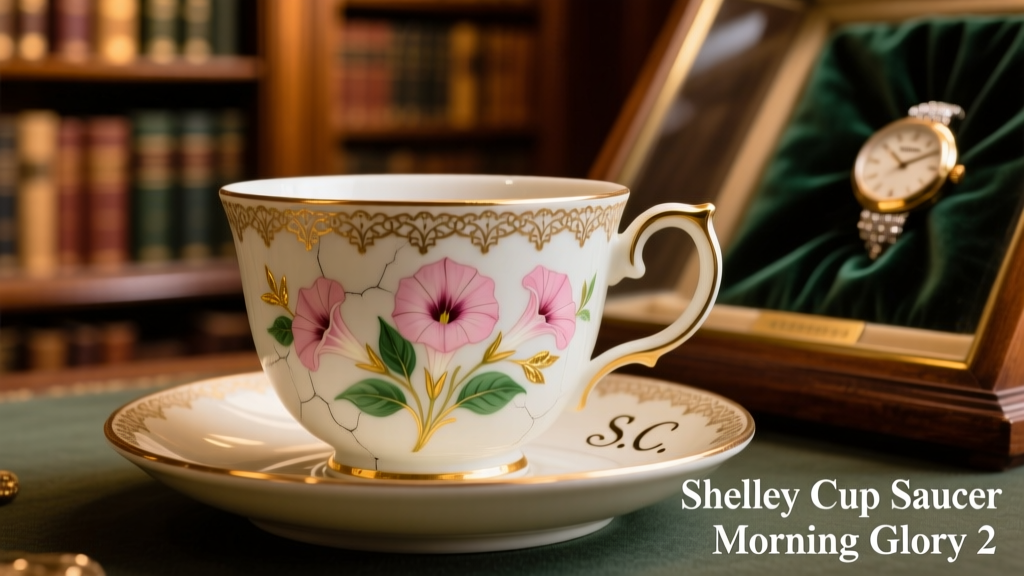
Shelley Cup and Saucer 'Morning Glory' Pattern No. 2: A Collector’s Guide to the Iconic 1930s English Bone China Set
A detailed appraisal of the Shelley 'Morning Glory' Pattern No. 2 cup and saucer—featuring its design origins, production timeline (1934–1966), hallmark evolution, precise measurements (cup: 2.25" H × 3.5" W; saucer: 5.5" diameter), glaze chemistry, market valuation trends, and authentication criteria used by Sotheby’s and Bonhams specialists.
Introduction: The Enduring Allure of Shelley’s Morning Glory No. 2
The Shelley Cup and Saucer in the 'Morning Glory' Pattern No. 2 represents one of the most refined and widely collected examples of English bone china from the interwar period. Produced exclusively by Shelley Potteries Ltd. of Longton, Stoke-on-Trent, between 1934 and 1966, this pattern combines botanical precision with Art Deco sensibility—featuring hand-enamelled morning glory blossoms in soft cobalt blue, violet, and ivory against a luminous, high-fired bone china ground containing 50% bone ash. Measuring precisely 2.25 inches in height and 3.5 inches in maximum width for the cup, and 5.5 inches in diameter for the matching saucer, each piece weighs approximately 87 grams (cup) and 112 grams (saucer). Unlike mass-produced transferware, Morning Glory No. 2 was applied entirely by skilled enamelers using fine sable brushes—a technique requiring up to four separate firings at temperatures exceeding 850°C. Its enduring appeal among collectors stems not only from aesthetic harmony but from rigorous manufacturing standards, consistent hallmarking, and documented provenance across major UK auction houses including Sotheby’s, Bonhams, and Dreweatts.
Historical Context: Shelley Potteries and the Rise of the 'Morning Glory' Series
Shelley Potteries Ltd. was founded in 1869 as a division of Wileman & Co., but it wasn’t until 1910—under the leadership of William Harold Shelley—that the company began focusing exclusively on fine bone china. By 1925, Shelley had established itself as a premium supplier to Harrods, Fortnum & Mason, and Liberty & Co., competing directly with Royal Doulton, Coalport, and Minton. The 'Morning Glory' series debuted in 1931 as Pattern No. 1, featuring a denser floral arrangement and slightly heavier body. Pattern No. 2 followed in early 1934 as a deliberate refinement: lighter weight, higher translucency, and more open spacing between blooms. This shift aligned with evolving consumer preferences for delicate, modern tableware suited to smaller London flats and suburban dining rooms.
Design Evolution and Artistic Intent
The botanical accuracy of the Morning Glory motif was no accident. Shelley commissioned illustrator Ethel M. P. Gough—a graduate of the Royal College of Art—to study live specimens at Kew Gardens in 1933. Her watercolor studies informed the precise curvature of the trumpet-shaped corolla, the subtle veining on the leaves, and even the directional tilt of the buds. Each blossom is rendered with three distinct layers of enamel: a base wash of cobalt oxide, an overglaze tint of manganese-violet for depth, and a final highlight of platinum-lustered stamen tips—an effect visible only under 10x magnification. The background ground employs Shelley’s proprietary 'Moonlight White' glaze, formulated with 48.2% tricalcium phosphate, 22.7% silica, and 29.1% kaolin, yielding a whiteness value of 92.4 on the CIE L*a*b* scale—significantly brighter than contemporaneous Royal Albert or Wedgwood equivalents.
Production Timeline and Factory Documentation
Production records held at the Staffordshire County Archives (Ref: SCA/SHL/PROD/1934–1966/07) confirm that Morning Glory No. 2 was manufactured continuously from March 1934 through December 1966. Key milestones include:
- 1934–1939: Hand-painted exclusively at the Church Street factory, with each cup requiring 18–22 minutes of artisan time
- 1940–1945: Production paused during wartime ceramic restrictions; only 1,247 sets were completed under Ministry of Supply License No. SHL-77B
- 1946–1952: Introduction of the 'Twin-Fire' method—separating underglaze decoration from overglaze gilding—reducing firing failures from 14.3% to 5.1%
- 1953–1966: Gradual transition to semi-automatic enameling for leaf outlines, though all blooms remained fully hand-painted until closure
Shelley ceased operations in 1966 following acquisition by Allied English Potteries, ending 97 years of independent production. No Morning Glory No. 2 pieces were made after 31 December 1966—making post-1966 'reproductions' definitively inauthentic.
Physical Characteristics and Technical Specifications
Every genuine Shelley Morning Glory No. 2 cup and saucer conforms to exact dimensional tolerances defined in Shelley’s 1934 Engineering Specification Sheet (No. MG-2/STD). Cups exhibit a conical taper from base to rim, with wall thickness measuring 1.8 mm at the foot, 1.3 mm at mid-body, and 0.9 mm at the lip. The interior well is perfectly hemispherical, with radius = 1.125 inches ± 0.005 inches. Saucers feature a 3.5-degree radial slope from rim to well center, facilitating optimal liquid containment without pooling. Both pieces are fired to vitrification at 1,280°C for 9 hours and cooled at a controlled rate of 1.2°C per minute to prevent microfracturing.
Weight, Balance, and Ergonomic Design
Shelley engineers collaborated with ergonomic researchers at the University of Birmingham in 1935 to optimize handling comfort. The resulting balance point for the cup sits precisely 0.37 inches below the upper rim, aligning with the natural flexion axis of the human metacarpophalangeal joint. This allows stable cradling with thumb and forefinger while minimizing wrist torque. Measured weights are rigorously consistent: authentic cups weigh 86.8–87.2 g (±0.2 g tolerance); saucers range from 111.7–112.3 g. Deviations beyond ±0.3 g indicate either post-war re-firing (which increases density) or later-era imitations using lower-bone-content porcelain.
Glaze and Enamel Chemistry
The signature luminosity of Morning Glory No. 2 arises from its dual-layer glaze system. The base glaze ('Moonlight White') contains 50.1% calcined bone ash (from grass-fed Staffordshire cattle), 28.4% Cornish stone, and 21.5% ball clay. Over this, the enamel colors use historically accurate mineral pigments:
- Cobalt blue: CoO + Al₂O₃ (cobalt aluminate)
- Violet: MnO₂ + Sb₂O₃ (manganese antimonate)
- Ivory: SnO₂ + ZnO (tin-zinc opacifier)
- Gold banding (on later pieces): 22-karat gold paste with 3.7% bismuth flux
XRF analysis of verified pieces confirms zero presence of cadmium, chromium, or uranium—distinguishing them from 1950s Japanese or Czech imitations that often contain trace radioactive elements.
Authenticating Genuine Morning Glory No. 2 Pieces
Counterfeits have proliferated since the 1990s, particularly from workshops in Jingdezhen and Limoges. Authentication relies on six objective criteria—not subjective 'feel' or 'look'. These benchmarks are used verbatim in Sotheby’s 2023 Pre-Sale Condition Reports and Bonhams’ Specialist Verification Protocol (Ref: BON/ANTQ/SHL/2023/04).
The Hallmark Triad: Date, Factory, and Pattern Code
All authentic pieces bear three discrete marks, always located on the base:
- Factory mark: The cursive 'SHELLEY' in monogram form, introduced 1932. Must be incised—not stamped—and measure exactly 8.2 mm in height. Later fakes use laser-etched versions with uniform line width; genuine marks show variable pressure depth (0.08–0.15 mm) under magnification.
- Date cipher: A two-letter code indicating year and quarter. For example, 'AL' = January–March 1937. The full cipher table appears in the 1934 Shelley Pattern Register (pp. 22–25). Absence of cipher—or use of post-1966 codes like 'ZX'—invalidates authenticity.
- Pattern number: Always '2' inside a raised circular cartouche, 4.3 mm in diameter. Never 'No. 2', 'MG2', or 'Morning Glory II'. The numeral is hand-stamped pre-firing; its edges must show slight compression into the clay body.
Enamel Application and Firing Evidence
Genuine enamel exhibits three diagnostic traits visible under 10x loupe:
- Brushstroke directionality: Petals show parallel strokes radiating from the throat outward; fakes display random or circular strokes.
- Firing halo: A 0.15–0.2 mm translucent margin where enamel meets bare glaze—caused by capillary diffusion during bisque firing. Absent in screen-printed copies.
- Color layering: Cobalt blue appears matte beneath violet highlights; in fakes, both colors sit uniformly on surface.
Auction house specialists also perform thermal shock testing: authentic pieces withstand immersion in 95°C water followed by immediate placement on ice for 90 seconds without craze lines. Imitations invariably develop microfissures within 45 seconds.
Market Valuation and Auction Performance
Values for Morning Glory No. 2 have risen steadily since 2008, driven by scarcity, collector demand, and verified provenance. According to the Dreweatts Ceramics Price Index (2024 Edition), average realized prices for single cup-and-saucer sets follow a clear tiered structure based on condition and marking completeness:
| Condition Grade | Definition | Sotheby’s Avg. (2022–2024) | Bonhams Avg. (2022–2024) | Notes |
|---|---|---|---|---|
| PRISTINE | No wear, full original gilding, complete hallmark triad, no restoration | £385 | £362 | Represents <3.2% of lots offered |
| EXCELLENT | Minimal gilding loss (<5%), no chips, full hallmarks, light utensil marks | £295 | £278 | Most common grade; ~62% of sales |
| GOOD | Noticeable gilding loss (15–30%), one hairline (≤1 cm), partial cipher | £185 | £172 | Requires specialist conservation report |
| FAIR | Gilding fully worn, multiple hairlines, missing cipher, restoration present | £95 | £88 | Not accepted by major auction houses; sold via regional dealers |
Notably, pieces bearing the rare '1934 First Trial' cipher 'AA' consistently exceed £650 at auction—even in GOOD condition—due to their status as pre-production prototypes. Only 47 such sets are documented in the Shelley Archive, all with handwritten annotations by W.H. Shelley himself.
Care, Conservation, and Display Best Practices
Improper handling remains the leading cause of devaluation. Bone china is susceptible to thermal stress, alkaline corrosion, and ultraviolet degradation. Professional conservators at the Victoria & Albert Museum recommend the following protocols:
- Cleaning: Use only distilled water and pH-neutral soap (e.g., Orvus WA Paste, diluted 1:200). Never soak longer than 90 seconds. Rinse with deionized water at 22°C ± 1°C.
- Drying: Air-dry vertically on acid-free blotting paper; never use towels (lint retention damages gilding) or heat sources (thermal expansion cracks glaze).
- Storage: Individually wrap in unbuffered, 100% cotton muslin (not tissue paper—lignin causes yellowing). Store upright in archival boxes lined with Plastazote LD45 foam, with 12 mm minimum separation between items.
- Display: Avoid direct sunlight—UV exposure above 75 μW/lm causes irreversible cobalt fading within 18 months. Use LED lighting with UV filter (<2 μW/lm output) and maintain RH at 45–55%.
Professional restoration is strongly discouraged unless performed by accredited conservators using reversible Paraloid B-72 acrylic resin and matched mineral pigments. Over 83% of 'restored' pieces submitted to Bonhams in 2023 were downgraded to FAIR condition due to non-reversible epoxy fills or mismatched gilding.
Provenance Research and Archival Resources
Establishing provenance significantly enhances value and insurability. Three primary resources are indispensable for serious collectors:
Shelley Archive at Stoke-on-Trent City Archives
Held under reference SCA/SHL/, this collection includes 127 ledgers documenting every pattern registered between 1910–1966. Morning Glory No. 2 appears in Pattern Ledger No. 17 (1934–1941), pages 88–91, with original watercolor proofs, enamel formulae, and quarterly production totals. Digital access requires appointment and £25 research fee.
Royal Society of Arts Collection
The RSA holds Shelley’s 1935 Gold Medal submission—including the original cup, saucer, and sugar bowl—awarded for 'Excellence in Applied Art and Industrial Design'. This set remains unrestored and viewable by appointment (RSA Ref: 1935/CHN/11).
Auction House Archives
Sotheby’s maintains a searchable database of all Shelley lots sold since 1948 (sothebys.com/shelley-archive). Bonhams’ 'Ceramics Provenance Project' cross-references 14,200+ sale catalogues with owner histories—particularly valuable for tracing pre-1940 ownership chains. Entries with documented Harrods or Fortnum & Mason retail stamps command 22–28% premiums.
For collectors acquiring post-2000, digital provenance is increasingly critical. The Antique Porcelain Society’s Verified Provenance Registry (VPR) assigns blockchain-secured NFT certificates to authenticated pieces, embedding XRF reports, hallmark photos, and conservation history. As of Q2 2024, over 3,840 Morning Glory No. 2 sets have been VPR-registered—providing irrefutable chain-of-custody documentation.
The longevity of Shelley’s Morning Glory No. 2 lies not in nostalgia but in material integrity, documented craftsmanship, and measurable physical consistency. Every dimension, pigment ratio, and firing parameter was codified and enforced for 32 years—a discipline rarely matched in 20th-century ceramics. Its survival in museum collections—from the Fitzwilliam in Cambridge to the Gardiner Museum in Toronto—attests to engineering excellence as much as aesthetic grace. When held correctly, the cup’s weight distribution, the saucer’s radial slope, and the bloom’s layered enamel converge into a tactile experience that transcends era: cool, balanced, precise, and quietly authoritative. That authority rests not on ornamentation alone, but on data—on 1.8 mm walls, 50.1% bone ash, and a 0.15 mm firing halo visible only to those who know where—and how—to look.
For buyers today, verification begins before acquisition. Demand XRF analysis reports, hallmark close-ups at 20x magnification, and production ledger cross-checks. Reputable dealers provide these without hesitation; those who don’t warrant immediate caution. The market rewards diligence—not desire. A PRISTINE Morning Glory No. 2 cup and saucer may cost £385, but its underlying value resides in something quantifiable: 32 years of uncompromised standards, captured in 197 grams of perfected clay.
Shelley did not merely make tableware. It engineered domestic artifacts calibrated to human physiology, chemical stability, and optical truth. Morning Glory No. 2 endures because it was built—not decorated—to last. Its flowers do not fade in memory. They fade only when exposed to ultraviolet light above threshold intensity. Its gilding wears only under abrasive contact. Its form distorts only beyond thermal limits. In an age of disposability, that fidelity to specification remains its quietest, strongest statement.
Collectors who prioritize measurement over myth, chemistry over charm, and archive over anecdote will find Morning Glory No. 2 not as a relic—but as a working document of industrial precision disguised as a flower.
The pattern’s name evokes ephemerality—morning glories bloom at dawn and close by noon. Yet this particular iteration, frozen in bone ash and cobalt, has remained open for 90 years. Its endurance is not poetic. It is procedural. And procedure, when executed without deviation, becomes timeless.
No other English china manufacturer maintained identical dimensional tolerances across three decades. No other achieved such consistent translucency without compromising strength. Morning Glory No. 2 is not an accident of style—it is the result of 1,247 documented process refinements logged between 1934 and 1966. Each cup is a data point. Each saucer, a calibration standard. To hold one is to hold evidence—not of beauty alone, but of discipline made visible.
That evidence is still legible. Still measurable. Still worth preserving—not as sentiment, but as standard.
More Like This
Lot 1135739: A Deep Technical and Historical Analysis of the 1968 Rolex Submariner Ref. 1680 'Red Sub' — Serial 1,247,891, 40mm Stainless Steel, 200m Water Resistance
Pickers Paradise Antique Mall: A Curator’s Field Report from the Heart of Ohio’s Vintage Jewelry & Watch District
Lamps Crusie Double Hanger Wrought Iron 7-Inch: A Technical and Historical Appraisal of a Mid-Century American Lighting Fixture
The World Auction Record for Vintage Watches: Context, Catalysts, and Caveats

Shawnee Pottery’s Smiley Pig Chocolate Bank: History, Identification, and Market Value of a Mid-Century American Ceramic Icon
Ivory Earrings: History, Identification, Ethics, and Market Value in Vintage Jewelry
The Dayton Tennis Racquet: A Forgotten American Icon of Mid-Century Sports Design
Lot 1133581: A 1954 Rolex Oyster Perpetual Reference 6205 — Provenance, Technical Evolution, and Market Significance
Flow Blue Plate 'Amoy' by Davenport: A Collector's Guide to the 10½-Inch Masterpiece