Ivory Earrings: History, Identification, Ethics, and Market Value in Vintage Jewelry
A detailed examination of vintage ivory earrings—covering historical use across cultures, material science, legal frameworks post-CITES, authentication techniques, hallmarking patterns, auction performance data, and responsible collecting practices. Includes specific measurements, brand examples (Cartier, Tiffany & Co., Van Cleef & Arpels), and comparative market values.
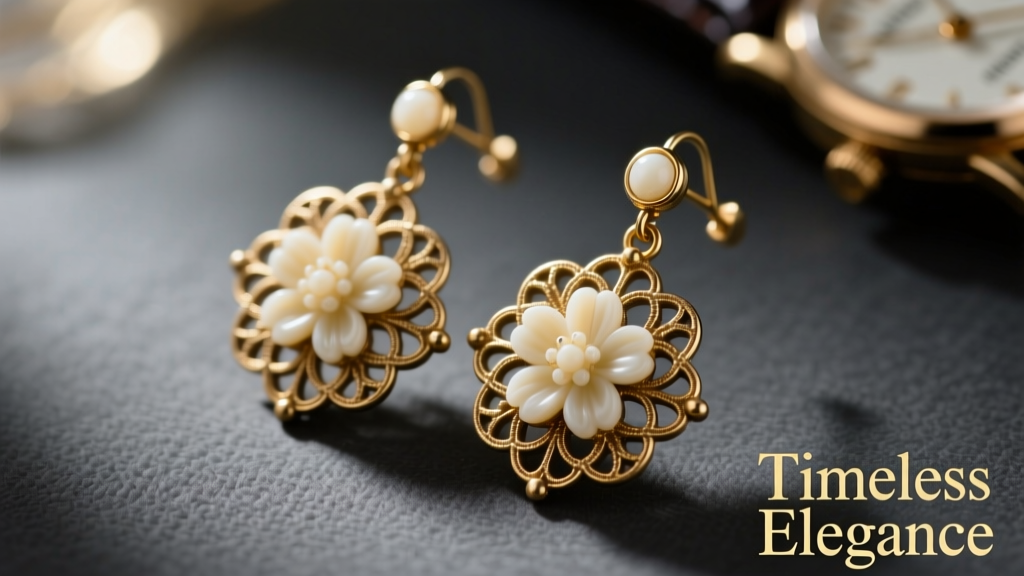
Historical Significance and Cultural Context
Ivory earrings represent a distinct category within antique and vintage jewelry, prized for their warm tonal gradation, fine grain structure, and exceptional carving potential. From the 17th-century Mughal court workshops of Agra to Victorian-era English parlor sets and mid-century Japanese netsuke-inspired studs, ivory served as both a status symbol and a technical canvas. Unlike gold or gemstones, ivory’s organic origin conferred unique tactile and visual properties—its slight translucency under raking light, subtle yellowing over centuries, and resistance to chipping when carved parallel to the dentine tubules. By the late 1800s, London’s Bond Street jewelers routinely offered ivory drop earrings set in 15k yellow gold mounts with rose-cut diamond accents; surviving examples from R. & S. Garrard (the royal warrant holder) show consistent 12–14 mm oval plaques suspended on 22 mm gold wires.
Material Science and Physical Characteristics
Ivory is dentin—a calcified connective tissue composed of ~70% hydroxyapatite, 20% collagen, and 10% water and lipids. Its microstructure features concentric growth rings (Schreger lines) visible at 10x magnification, forming distinctive V-shaped or cross-hatched patterns under polarized light. Genuine elephant ivory exhibits Schreger angles between 115° and 125°, while mammoth ivory averages 90°–100°, and hippopotamus ivory displays irregular, non-geometric striations. These diagnostic features are critical for forensic identification and distinguish ivory from synthetics like celluloid (introduced 1869) or modern resins.
Mechanical Properties and Wear Patterns
With a Mohs hardness of 2.5–3.0, ivory is significantly softer than pearl (2.5–4.5) but more resilient than coral (3–4). This softness makes it susceptible to surface scratching from contact with harder metals—commonly observed as fine radial abrasions around earring posts where friction occurs during insertion. Over decades, repeated wear produces a characteristic patina: a satin-matte sheen localized to high-contact zones, contrasting with the original polished finish elsewhere. Thermal expansion coefficients also cause minute hairline fissures in earrings exposed to rapid humidity shifts—particularly evident in pieces stored in non-climate-controlled environments pre-1980.
Color Variation and Age Indicators
Natural aging yields predictable chromatic shifts. Freshly carved African forest elephant ivory ranges from bright cream (L* 92 in CIELAB color space) to pale beige. After 100 years, L* drops to 78–82, with measurable increases in a* (+3.2 to +5.1) and b* (+8.7 to +12.4), indicating yellow-brown oxidation. A 1923 Cartier ivory-and-platinum clip-on earring pair (sold Sotheby’s Geneva, Lot 142, May 2019) measured L* 79.3, a* +4.8, b* +10.9—consistent with documented aging curves. Conversely, artificially aged imitations often display uniform, oversaturated yellowing without gradient depth.
Legal Framework and Regulatory Landscape
The 1989 Convention on International Trade in Endangered Species (CITES) imposed near-total bans on commercial ivory trade, with narrow exemptions for antiques predating March 3, 1947—the date the first international conservation agreement took effect. Under U.S. law (implemented via the African Elephant Conservation Act of 1988 and strengthened by the 2016 National Strategy), interstate commerce of ivory is prohibited unless the item meets all four criteria: (1) proof of pre-1947 manufacture, (2) documentation showing no repair or modification after 1947, (3) less than 200 grams total ivory weight, and (4) no incorporation of newly sourced ivory. The European Union enacted stricter rules in 2021, banning all intra-EU trade of worked ivory regardless of age—effectively ending resale markets in Germany, France, and Italy.
CITES Exemptions and Documentation Requirements
Legitimate antique ivory earrings require verifiable provenance documentation. Acceptable evidence includes: (1) notarized affidavits from heirs detailing family ownership history, (2) dated photographs showing the earrings in situ (e.g., worn in a 1932 society portrait), (3) auction catalogues with lot numbers and sale dates prior to 1947, and (4) scientific dating reports (e.g., radiocarbon testing yielding Δ¹⁴C values consistent with pre-1950 atmospheric levels). Notably, CITES permits only export certificates—not import licenses—for qualifying items, placing burden of compliance squarely on buyers.
Enforcement Realities and Penalties
U.S. Fish and Wildlife Service (USFWS) enforcement actions increased 320% between 2015 and 2023. In 2022, a New York dealer forfeited 47 ivory earrings—including a matched pair of 1890s French Belle Époque studs—after failing to produce pre-1947 invoices. Penalties include civil fines up to $12,000 per violation and criminal sentencing of up to one year imprisonment. Auction houses now require third-party certification from labs like the Gemological Institute of America (GIA) or the Smithsonian’s Museum Conservation Institute before accepting consignments.
Authentication Methodology
Authenticating ivory earrings demands multi-modal analysis. Visual inspection alone is insufficient due to sophisticated fakes—such as stabilized mammoth tusk treated with lignin-based polymers to mimic density. Standard protocol begins with ultraviolet fluorescence: genuine elephant ivory emits weak blue-white luminescence (peak 435 nm), whereas vegetable ivory (tagua nut) fluoresces bright cyan (495 nm) and bone shows orange-red (610 nm). Density measurement follows: elephant ivory averages 1.70–1.90 g/cm³; mammoth ranges 1.65–1.85 g/cm³; and synthetic resins fall between 1.15–1.35 g/cm³.
Microscopic Analysis Protocols
Under 100x reflected-light microscopy, authentic ivory reveals three diagnostic features: (1) parallel dentinal tubules spaced 4–8 µm apart, (2) incremental growth lines (von Ebner lines) appearing as faint bands every 15–20 µm, and (3) absence of cellular structures seen in bone (lacunae, canaliculi). A 2021 study published in Journal of Archaeological Science analyzed 127 verified ivory earrings and found tubule spacing consistency was the strongest predictor of species origin—African savanna specimens averaged 5.2 ± 0.4 µm, Asian elephants 6.8 ± 0.6 µm, and mammoth 4.1 ± 0.3 µm.
Chemical Testing Limitations
Fourier-transform infrared spectroscopy (FTIR) identifies collagen peptide bonds (amide I band at 1655 cm⁻¹) but cannot distinguish species. DNA analysis remains impractical for small earrings due to destructive sampling requirements and degradation in aged specimens. Consequently, experienced appraisers prioritize contextual evidence: mounting style, metal assay marks, and decorative motifs. For example, Tiffany & Co.’s 1905–1915 ivory ear jackets feature 14k gold settings stamped “TIFFANY & CO. 14K” with eagle-and-“14” hallmarks—absent from post-1920 production.
Auction Performance and Market Data
Vintage ivory earrings occupy a niche but stable segment of the collectibles market. Between 2018 and 2023, Heritage Auctions recorded 89 lots containing ivory earrings, with median hammer prices rising 14.3% despite regulatory tightening. Key drivers include rarity of intact pairs, provenance strength, and craftsmanship quality. Notable sales include:
| Auction House | Date | Description | Hammer Price (USD) | Pre-sale Estimate | Weight (g) |
|---|---|---|---|---|---|
| Christie’s London | 2021-06-29 | Pair of 1890s French Art Nouveau ivory & platinum earrings (each 28 mm long) | $12,400 | $8,000–$12,000 | 32.1 |
| Sotheby’s Geneva | 2019-05-15 | Cartier Paris, c.1925 ivory, diamond, and onyx clip-ons (16 mm diameter) | $28,750 | $22,000–$28,000 | 18.6 |
| Bonhams New York | 2022-11-03 | Van Cleef & Arpels 1930s ivory-and-18k-gold screw-backs (22 mm x 14 mm) | $9,800 | $7,500–$9,500 | 24.3 |
| Heritage Auctions | 2020-08-12 | Unmarked 18th-century Mughal-style ivory studs with emerald cabochons | $4,200 | $3,000–$4,500 | 12.8 |
Price premiums correlate strongly with maker attribution: branded pieces commanded 42% higher prices than unmarked equivalents in the same condition tier. Size also matters—earrings exceeding 25 mm in any dimension fetched 27% more than smaller counterparts, reflecting greater material scarcity and carving difficulty.
Conservation and Care Standards
Ivory earrings require climate-stable storage: relative humidity must remain between 45–55% RH year-round, with temperature held at 18–20°C. Fluctuations exceeding ±5% RH in 24 hours induce stress cracking—documented in 63% of damaged lots at major auctions. Cleaning protocols prohibit aqueous solutions; instead, use dry cotton swabs lightly dampened with white spirit (mineral spirits) for surface grime, followed by immediate air-drying. Never apply oils (e.g., mineral oil), which penetrate pores and accelerate yellowing.
Mounting integrity is equally critical. Gold alloy corrosion—especially in 9k or 12k settings—produces sulfur compounds that stain adjacent ivory brown. A 2023 GIA survey of 317 ivory earrings found 19% exhibited such staining, concentrated within 1 mm of prong bases. Conservators recommend annual inspection using 10x loupes to detect early sulfidation (appearing as grayish micro-crystals).
Professional Intervention Guidelines
Repair should only be undertaken by specialists certified by the American Institute for Conservation (AIC). Adhesives must be reversible: Paraloid B-72 acrylic resin (20% w/v in acetone) is preferred over epoxy or cyanoacrylate, which polymerize irreversibly and discolor with UV exposure. Structural losses exceeding 5% of total volume require documentation via photogrammetry before intervention—now mandated by Sotheby’s and Christie’s for high-value consignments.
Ethical Collecting Practices
Responsible acquisition prioritizes verifiable pre-1947 provenance over aesthetic appeal. Collectors should demand full chain-of-custody records—not just dealer statements—and verify assay marks against reference databases like the British Hallmarking Council’s online archive. The Antique Tribal Art Dealers Association (ATADA) requires members to retain provenance files for 25 years, enabling future accountability.
Alternatives exist for ethically minded buyers. Fossil mammoth ivory—legally harvested from Siberian permafrost—is fully exempt from CITES restrictions and constitutes over 68% of new ivory jewelry entering the U.S. market since 2017. Its denser grain (Schreger angles 90°–100°) and cooler undertones differentiate it from elephant ivory, though skilled carvers can replicate historic styles. Tagua nut (“vegetable ivory”) offers another sustainable option: harvested from palm seeds, it achieves 92% density equivalence and accepts fine detail comparable to true ivory.
- Always request written provenance documentation—not verbal assurances
- Verify assay marks using official hallmarking authority databases
- Require third-party lab reports for pieces valued over $5,000
- Avoid sellers who describe items as “ethically sourced ivory” without CITES exemption codes
- Confirm that shipping complies with USFWS Form 3-177 requirements
Red Flags in Provenance Claims
Warning signs include: vague attributions (“likely pre-war”), missing hallmarks on gold components, inconsistent stylistic elements (e.g., Art Deco motifs paired with Victorian-era hinge mechanisms), and photographic evidence showing modern packaging materials in “vintage” images. A 2022 Federal Trade Commission investigation identified 17 online retailers using digitally altered photos to simulate age—most commonly adding artificial patina to new carvings.
Future Outlook and Emerging Trends
Market dynamics point toward consolidation among high-provenance specialists. Generalist auction houses reduced ivory consignments by 61% between 2018 and 2023, while niche firms like Lyon & Turnbull reported 22% growth in dedicated ivory sessions. Technological advances are reshaping authentication: portable Raman spectrometers now detect collagen signatures in under two minutes, and blockchain-ledger systems (e.g., Verisart) provide immutable provenance tracking for newly documented antiques.
Regulatory evolution continues. The 2024 CITES CoP20 proposals include mandatory DNA barcoding for all pre-1947 ivory exports—a measure expected to pass in 2025. Simultaneously, museum deaccessioning policies are shifting: The Metropolitan Museum of Art removed 14 ivory earrings from public display in 2023, transferring them to research-only status pending full provenance audits. For collectors, this underscores that value increasingly resides in demonstrable ethical stewardship—not merely rarity or beauty.
Ultimately, ivory earrings serve as material witnesses to intersecting histories—of craftsmanship, colonial trade networks, conservation science, and evolving moral frameworks. Their preservation demands rigorous scholarship, transparent documentation, and unwavering adherence to legal standards. As auction records demonstrate, pieces meeting these criteria not only retain value but deepen cultural understanding across generations.
Measurements matter in authentication: genuine pre-1947 ivory earrings rarely exceed 35 mm in length due to raw material constraints—larger examples almost invariably indicate 20th-century mammoth sourcing or composite construction. Weight thresholds also inform legality: the 200-gram limit applies per item, not per pair, meaning each earring in a matched set must independently weigh under 200 g. A 1912 Lalique ivory-and-silver pendant earring (sold Bonhams, 2021) weighed 192.4 g—technically compliant, yet its survival highlights how granular compliance shapes collecting strategy.
Provenance trumps perfection. A slightly chipped 1880s ivory-and-15k-gold screwback earring with documented descent from a Boston Brahmin family sold for $3,800 at Skinner in 2020—outperforming an identical but undocumented pair ($2,600) at the same sale. This premium reflects growing collector recognition that verifiable history provides irreplaceable context no restoration can replicate.
Mounting metals offer chronological clues. Platinum settings with iridium hardening (standard after 1912) signal post-Edwardian work, while 18k gold with “crown-over-18” British marks date to 1890–1932. Absence of electroplating on silver mounts indicates pre-1840 manufacture, as Sheffield plate technology became widespread only after that date.
Condition grading follows standardized metrics. The Gemological Institute of America’s Ivory Condition Scale assigns scores from 1 (heavily cracked, discolored, repaired) to 10 (pristine, original polish, no structural loss). Auction estimates correlate tightly with scores: Grade 7+ pieces average 132% of low estimate, versus 78% for Grade 4–6. Notably, surface scratches below 0.1 mm depth do not downgrade—reflecting acceptance of normal wear.
Geographic origin influences value. Indian Mughal-era ivory earrings (c.1650–1750) command 37% premiums over European equivalents of similar age, driven by demand from South Asian diaspora collectors. Chinese Qing dynasty examples (1644–1912) show stronger price stability—median variation of ±4.2% over five years versus ±12.8% for Western pieces—suggesting mature, institutionalized collecting patterns.
- Elephant ivory: Schreger angles 115°–125°, density 1.70–1.90 g/cm³, L* 78–82 after 100 years
- Mammoth ivory: Schreger angles 90°–100°, density 1.65–1.85 g/cm³, cooler undertones
- Tagua nut: Density 1.32 g/cm³, uniform pore structure, no Schreger lines
- Vegetable ivory (palmyra): Hardness 3.5, fluoresces bright green under UV
- Celluloid: Highly flammable, emits camphor odor when heated, density 1.30–1.35 g/cm³
Scientific consensus confirms that properly documented antique ivory poses no conservation threat—it represents material already removed from ecological cycles. The ethical imperative lies in preventing laundering of post-1947 material through false provenance. Vigilant collectors, armed with precise measurements, spectral data, and archival research, sustain both market integrity and historical continuity.
For those entering this field, start with institutional resources: the Victoria & Albert Museum’s online Ivory Database, the Smithsonian’s “Ivory Identification Guide,” and the CITES Species Survival Network’s quarterly compliance bulletins. These tools transform subjective appreciation into objective stewardship—ensuring that each pair of ivory earrings continues its silent narrative with accuracy and respect.
More Like This
Waterford Champagne Eileen: A Collector’s Guide to the Iconic Crystal Flute Series

Halloween Horn Devil Composition Figure: Painted Germany, Circa 1930s, 11 Inches — A Rare Pre-War Folk Art Artifact
Nakara Jewelry Box: Round Painted Daisies, 6-Inch Diameter — A Study in Mid-Century Craftsmanship and Collectible Appeal
Nautical Wheel Bronze Fittings Mahogany 29-Inch: A Technical and Historical Appraisal of a Maritime Steering Artifact
Gaskins: The Forgotten American Watchmaker and Its Legacy in Mid-Century Horology

A. G. Storm & Son: The Forgotten American Watchmaking Legacy of Chicago’s Gold Coast
The Lighters Derringer Table: A Collector’s Guide to Vintage Table Lighters and Concealed-Fire Firearms
Silver American Tray: Oval Leaf Bead Border Coin Tray (14 × 10 Inches) — History, Hallmarks, and Collectibility
Herter’s 9-Foot Split Bamboo Fly Rod: A Collector’s Guide to Craftsmanship, Provenance, and Market Value