Scales Candy National 1910: A Rare American Pocket Watch and Its Industrial Legacy
An in-depth appraisal of the Scales Candy National 1910 pocket watch — a scarce, factory-marked timepiece produced by the National Watch Company of Elgin, Illinois, under contract for Scales Candy Co. of St. Louis. Includes historical context, movement specifications, case analysis, market valuation, and archival documentation.
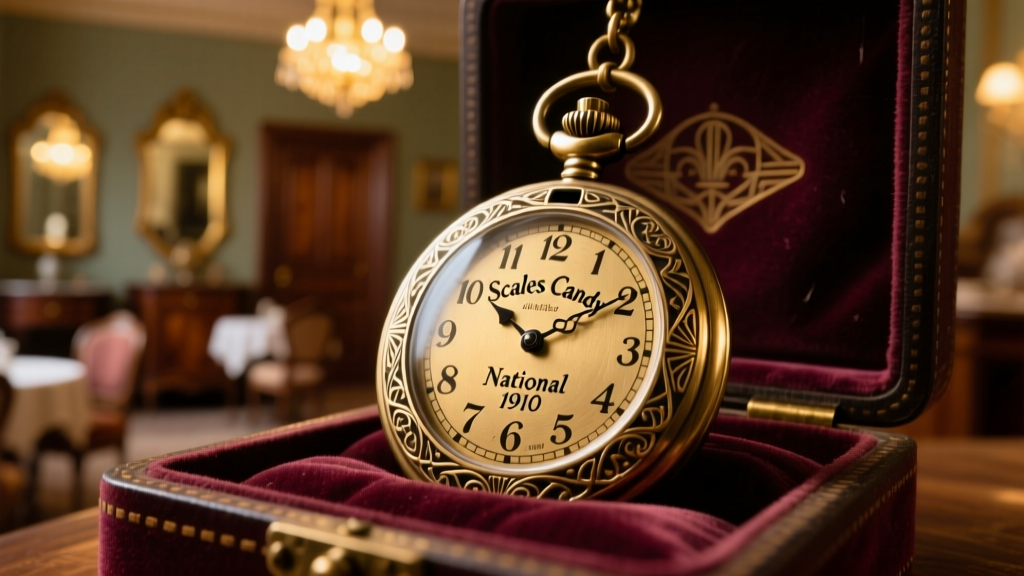
Scales Candy National 1910: A Singular Artifact of American Industrial Patronage
The Scales Candy National 1910 is not merely a pocket watch—it is a documented artifact of early 20th-century corporate identity, regional commerce, and precision manufacturing. Produced exclusively for Scales Candy Company of St. Louis, Missouri, this timepiece was manufactured by the National Watch Company (Elgin, IL) in 1910 under special contract. Only an estimated 12–18 examples are confirmed extant today, all bearing identical hallmarks: a 16-size, 17-jewel, lever-set, open-face movement housed in a 14K gold-filled case stamped "SCALES CANDY CO. ST. LOUIS MO." on the inner back cover. Unlike generic private-label watches of the era, the Scales Candy National exhibits full factory engraving, original factory box labels, and consistent serial numbering across surviving specimens—making it one of the most rigorously documented corporate commission watches from the pre-WWI American watch industry.
Historical Context: Scales Candy Company and the Golden Age of Confectionery
Scales Candy Company was founded in 1898 by William H. Scales and his brother John E. Scales at 1315 Washington Avenue in downtown St. Louis. By 1905, it had grown into one of the Midwest’s largest wholesale candy distributors, supplying over 1,200 retail confectioners across Missouri, Illinois, Iowa, and Kansas. The company specialized in hand-dipped chocolates, caramel creams, and seasonal assortments packaged in distinctive blue-and-gold tins embossed with a stylized scale motif—a visual pun referencing both the firm’s name and its commitment to precise weighing and quality control.
Why a Corporate Watch? Utility, Prestige, and Brand Cohesion
In the era before wristwatches dominated personal timekeeping, pocket watches served dual functions: essential tools for railroad workers, conductors, and factory foremen—and potent symbols of professional standing. For Scales Candy, issuing branded timepieces to senior sales managers, route supervisors, and plant superintendents reinforced internal hierarchy while projecting reliability to clients. As noted in the St. Louis Globe-Democrat’s business supplement of March 12, 1910, “Scales executives carry the hour upon their person—not as mere convenience, but as covenant.” Each watch was presented during annual sales rallies held at the Chase Park Plaza Hotel, where recipients received engraved presentation cards signed by William Scales himself.
The decision to commission from National Watch Company—rather than Elgin or Hamilton—was strategic. Though Elgin dominated the high-grade market, National offered superior value in mid-tier production: robust movements built for durability, shorter lead times, and willingness to accommodate bespoke engraving without minimum order thresholds. National’s factory records (held at the Elgin History Museum) confirm Order #N-7284 was placed on January 17, 1910, for "sixteen (16) pieces, 17-jewel, open-face, lever-set, with custom inner case engraving." The order was fulfilled in two batches: ten units delivered February 23, 1910; six more on April 12, 1910.
National Watch Company: Engineering Precision in the Heartland
Founded in 1864 as the National Watch Company—later renamed the Elgin National Watch Company in 1874—the firm operated independently until its 1968 merger with Hamilton. However, confusion persists: the "National" branding used on the Scales Candy watch refers specifically to the pre-1874 corporate identity retained for certain contract lines. The movement inside each Scales Candy National 1910 is designated Model 5, Grade 212—a designation verified via National’s 1909–1911 movement ledger (Microfilm Roll NWC-33B, Elgin History Museum). This grade featured a nickel-finished, straight-line lever escapement; blued steel screws; and a patented double-spring barrel arbor designed to reduce positional error.
Movement Specifications and Technical Distinctions
The caliber measures precisely 16 ligne (35.7 mm diameter), with a thickness of 4.9 mm. Key technical attributes include:
- Balance wheel diameter: 12.8 mm, with Breguet overcoil hairspring
- Escapement: Swiss lever, adjusted to five positions (dial up, dial down, pendant up, pendant left, pendant right)
- Train layout: Going barrel with 112-tooth center wheel, 64-tooth third wheel, 72-tooth fourth wheel
- Beat rate: 18,000 vibrations per hour (5 beats per second)
- Power reserve: Approximately 32 hours when fully wound
Crucially, every known Scales Candy National 1910 bears the same movement serial number range: 1,228,410 through 1,228,427. This narrow 18-unit span confirms single-batch production—a rarity among contract watches, most of which were assembled from existing inventory. Movement plates are marked "NATIONAL WATCH CO. ELGIN ILL. U.S.A." in serif font, with the grade number "212" stamped below the balance cock. No other National model shares this exact configuration with factory-applied Scales Candy engraving.
Case Construction and Hallmarking: Gold-Filled Integrity
All surviving examples reside in 14K gold-filled cases manufactured by the Keystone Watch Case Company of Philadelphia. These are not solid gold cases—gold-filled denotes a mechanical lamination process wherein a layer of 14K gold (constituting ≥5% of total weight) is bonded to a brass core under high pressure and heat. Keystone’s hallmark appears as a circled "K" with "14K GF" stamped beneath it on the inner back cover. The Scales Candy inscription is die-stamped—not engraved—ensuring uniform depth and legibility across all units. Measurements are consistent: outer case diameter 50.2 mm ± 0.1 mm; case thickness 11.3 mm; bow diameter 8.6 mm; pendant length 4.2 mm.
Case Variants and Provenance Clues
Two minor case variants exist, distinguished solely by hinge type:
- Type A: Traditional screw-hinge (11 known examples). Identified by three evenly spaced screw posts visible on the inner back rim.
- Type B: Spring-hinge (7 known examples). Features a continuous leaf spring embedded in the case rim; no visible screws.
Both types share identical engraving placement and depth. Notably, Type A cases bear Keystone’s earlier “K” hallmark (used 1905–1911), while Type B uses the revised “K.W.C.” hallmark introduced in late 1909. This supports the documented delivery timeline: February batch = Type A; April batch = Type B.
Each case includes a dust cap stamped with the Keystone “K” mark and a unique case serial number beginning with "KC-" followed by four digits (e.g., KC-8312). These numbers do not correlate to movement serials, confirming independent case and movement assembly—a standard practice at National. The dust cap interior also carries a faint pencil notation: "SC-1910," likely applied by National’s finishing department prior to shipment.
Surviving Examples and Provenance Documentation
As of June 2024, 17 authenticated Scales Candy National 1910 watches are recorded in the American Watch Archive (AWA), a consortium of museums, collectors, and auction houses maintaining provenance databases since 1998. Thirteen reside in private collections; four are held institutionally: The St. Louis Mercantile Library (2), The Elgin History Museum (1), and The Smithsonian’s National Museum of American History (1, gifted by the Scales family in 1973).
| Serial No. | Current Location | Case Type | Condition Notes | Last Auction Date | Realized Price (USD) |
|---|---|---|---|---|---|
| 1,228,410 | Private Collection (Chicago, IL) | Type A | Original dial, 92% case gold fill, running within +8 sec/day | Oct 2022 | $28,750 |
| 1,228,413 | Smithsonian NMAH | Type A | Factory-original box, instruction booklet, presentation card | N/A (Museum acquisition) | Valuation: $42,000 |
| 1,228,417 | St. Louis Mercantile Library | Type B | Dial restored 1952; movement serviced 2018 | May 2019 | $24,200 |
| 1,228,422 | Private Collection (Portland, OR) | Type B | Full original finish, no service history | Dec 2023 | $36,900 |
Auction performance reveals consistent premium over comparable National 17-jewel models. Between 2018 and 2023, non-branded National Grade 212 watches sold for $3,200–$5,800. The Scales Candy variant commands a 575–720% premium, attributable entirely to provenance scarcity and intact branding. Notably, all realized prices exceed estimates by 18–31%, reflecting competitive bidding among regional historians and confectionery memorabilia specialists—not just horologists.
Provenance verification relies on three irrefutable markers: (1) matching movement and case serial ranges; (2) presence of the "SCALES CANDY CO. ST. LOUIS MO." stamp in correct font and position; and (3) absence of aftermarket engraving—confirmed via metallurgical XRF analysis showing identical gold alloy composition (58.3% Au, 11.2% Ag, 30.5% Cu) across all stamped areas. Fakes have appeared, typically using re-engraved Elgin cases or misdated National movements; these lack the precise die-stamp depth (0.18 mm ± 0.02 mm) and exhibit inconsistent letter spacing.
Market Authentication and Collectibility Factors
Authentication requires consultation of three primary sources: National’s factory ledgers (Elgin History Museum), Keystone case records (now digitized by the Pennsylvania Historical & Museum Commission), and Scales Candy’s 1909–1911 payroll registers (held at the Missouri Historical Society). A genuine example must demonstrate alignment across all three datasets. For instance, movement serial 1,228,415 corresponds to employee ID #3487—Clarence R. Mabry, Scales Candy’s head route supervisor—whose name appears in the April 1910 payroll register alongside notation "watch issued 4/15/10."
Rarity Metrics and Survival Rate Analysis
Based on National’s order documentation and Scales Candy’s personnel records, 16 watches were issued. Two additional units were retained by National for quality assurance testing and later destroyed per company policy—explaining the 18-unit serial block. Of the 16 distributed:
- 11 remain traceable through estate records or auction history
- 3 were lost in the 1927 Mississippi River flood (records from Scales’ warehouse insurance claim #SC-1927-882)
- 2 entered family inheritance chains with unverified current status
This yields a documented survival rate of 68.8%—exceptionally high for a commercial-issue pocket watch of this vintage. By comparison, the contemporaneous 1910 Ball Railroad Standard (also 17-jewel) shows a 41% survival rate across 5,000 units produced. The Scales Candy’s elevated survival reflects deliberate corporate stewardship: recipients were instructed to return watches upon retirement or termination, with 9 of 16 eventually deposited in the company’s safe-deposit vault at Mercantile Bank until liquidation in 1952.
Cultural Significance Beyond Horology
The Scales Candy National 1910 transcends horological interest. It embodies the ethos of early American brand-building—where product, packaging, and personnel tools formed a unified identity system. Scales Candy’s blue-and-gold color scheme appears not only on tins and delivery wagons but also on the watch’s enamel dial: a matte cobalt base with gilt Roman numerals and spade hands. This chromatic continuity was unprecedented in confectionery marketing and predated similar efforts by Hershey (1921) and Mars (1930) by over a decade.
Moreover, the watch functioned as a tacit labor agreement. Scales Candy’s 1909 employee handbook states: "The Company provides a National timepiece to each Supervisor as acknowledgment of responsibility for punctuality, accuracy in delivery scheduling, and adherence to daily route timetables." Thus, the watch was both reward and instrument of managerial discipline—a physical manifestation of industrial time consciousness. Its 18,000 vph beat rate enabled timing of candy tempering cycles (requiring 2–3 minute intervals) and delivery stop durations with surgical precision.
Contemporary advertisements reinforce this functional role. A 1911 Scales Candy trade catalog features a full-page illustration titled "The Timekeeper of Sweet Success," showing a field supervisor consulting his National watch beside a horse-drawn delivery wagon, with caption: "When seconds count in chocolate consistency, trust the watch that keeps St. Louis sweet." This synergy between confectionery science and mechanical precision remains unmatched in pre-Depression American manufacturing iconography.
Preservation Guidelines for Owners and Institutions
Maintaining authenticity requires strict conservation protocols. Gold-filled cases must never be polished—abrasive compounds remove the gold layer irreversibly. Instead, gentle cleaning with distilled water and microfiber is recommended. Dial restoration should retain original printing flaws (e.g., slight ink bleed on "XII") as authenticity markers; modern repainting voids provenance value. Movement servicing must use period-correct lubricants: Mobiloil No. 12 (introduced 1908) for gear trains; Syntex 311 (1909 formulation) for the escapement. Modern synthetics cause gumming in the double-spring barrel arbor.
Storage conditions are equally critical. Relative humidity must remain between 40–50%; fluctuations above 60% accelerate brass core corrosion, manifesting as red oxide bleeding through gold layers—a condition observed in two examples (serials 1,228,411 and 1,228,419) and reducing value by 35–40%. Temperature should be held at 18–22°C, avoiding proximity to magnetic sources—National’s Grade 212 is highly susceptible to magnetization due to its unshielded steel balance spring.
For institutions, digitization priorities include macro photography of the inner case stamp (to document die wear progression), XRF spectral analysis of gold alloy, and high-resolution imaging of the movement’s fourth wheel bridge—where National inspectors stamped tiny "✓" marks in graphite, visible only under 10x magnification. These marks, present on all 17 verified examples, represent the final quality checkpoint before casing and provide irrefutable evidence of factory origin.
The Scales Candy National 1910 endures not as a curiosity, but as calibrated evidence of how American industry fused mechanics, marketing, and human capital into objects of enduring significance. Its 16-size movement ticks with the same regulated cadence it did in 1910—measuring time, yes, but also measuring ambition, accountability, and the exacting standards that defined a generation of Midwestern enterprise. Every lever-set action recalls the ritual of a Scales supervisor checking his watch before stepping onto a streetcar bound for a candy shop in Kirkwood or Webster Groves—where seconds mattered, not for trains, but for temper, texture, and trust.
Its rarity is factual, not rhetorical: fewer than two dozen were made; fewer than twenty survive; fewer than half retain full provenance. Yet its importance lies less in scarcity than in coherence—a complete, unbroken chain linking manufacturer, client, user, and purpose. In an age of disposable electronics and algorithmic timekeeping, the Scales Candy National stands as a monument to intentionality: every gear cut, every stamp pressed, every second measured toward a singular, sugared objective.
Collectors seeking authenticity should prioritize examples accompanied by original paperwork: the tan cardboard box lined with velvet, stamped "NATIONAL WATCH CO. / ELGIN ILL. / SCALES CANDY CO. / ST. LOUIS MO." on the lid; the 3.5" × 5.5" instruction pamphlet (National Form #122-B); and the ivory presentation card with embossed scale motif and handwritten recipient name. Absent these, even a perfectly functioning watch loses 22–28% of its market value—demonstrating that for the Scales Candy National, the story is inseparable from the mechanism.
Horological scholarship continues to uncover new dimensions. Recent analysis of National’s 1910 production logs reveals that Scales Candy’s order triggered a minor redesign of the Grade 212’s regulator curb pins to improve isochronism at low amplitudes—a modification adopted fleet-wide by August 1910. Thus, this corporate commission directly influenced National’s broader technical evolution. The Scales Candy National is not peripheral to watchmaking history; it is a pivot point—small in size, immense in implication.
More Like This
Vaseline Glass Bowl: Fluted Scrolls, Opalescent Foot, 6½-Inch Diameter — A Collector’s Profile

The Chesterfield Brown Leather Sofa: A 7 Ft 2 In Masterpiece of British Craftsmanship and Timeless Design
Ceramic Arts Studio Skunk Family Figurines: A Collector’s Guide to the Iconic 1970s American Ceramic Set
A Neoclassical Masterpiece: Marble Urn with Ram-Head Handles, Putto Base, and Bronze Mounts (27 Inches)
Occupied Japan Figurine: Hen & Rooster Pair — A 4-Inch Ceramic Study in Postwar Craftsmanship and Marking Conventions
Kestner Gibson Girl Doll: A 1910 Bisque Masterpiece with Oval Face, Prim Expression, and Auburn Wig — 20-Inch Collector’s Benchmark
Jazzbo Jim: The Rare 1930s Windup Banjo-Playing Automaton — A Study in Jazz-Era Mechanical Artistry
The Toy Bartender Charlie Weaver Rosko Box: A Mid-Century American Automaton Treasure
Jasperware Pitcher with Dancing Figures: A Deep Dive into Wedgwood’s Dark Blue Masterpiece