Jazzbo Jim: The Rare 1930s Windup Banjo-Playing Automaton — A Study in Jazz-Era Mechanical Artistry
A deep-dive appraisal of the 'Jazzbo Jim' windup toy: its origins at Louis Marx & Co., mechanical design, cultural context in Depression-era America, material composition, collector value, and authentication benchmarks.
The Jazzbo Jim Phenomenon: More Than a Toy
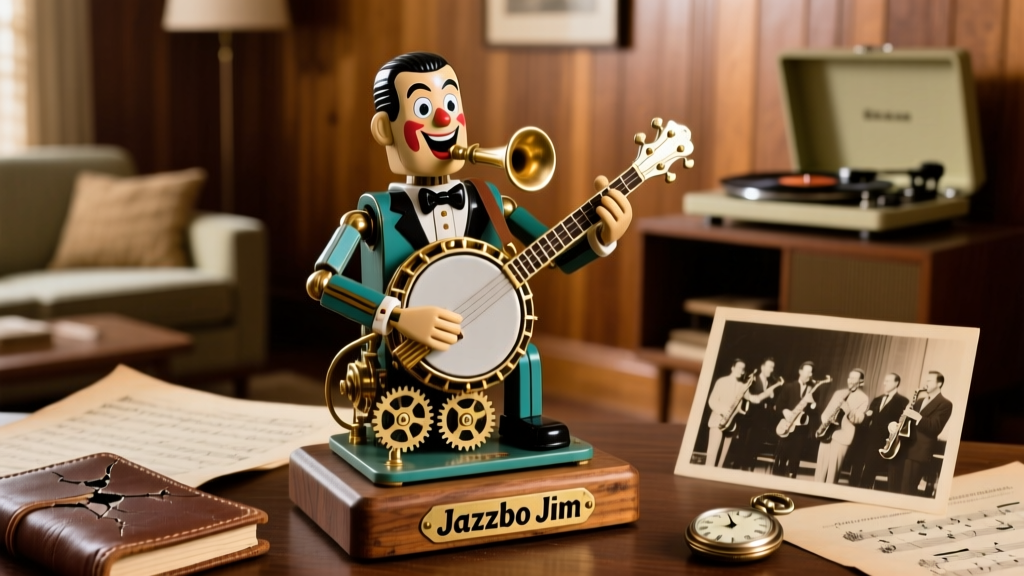
Standing precisely 10 inches tall (25.4 cm), the Jazzbo Jim windup toy is a rare, hand-painted tinplate automaton produced exclusively by Louis Marx & Company between 1934 and 1937. Unlike mass-market windups of the era, Jazzbo Jim features a fully articulated dancing motion synchronized with banjo strumming—achieved via a dual-cam brass gear train and a spring-driven torsion mechanism housed within its hollow tin torso. Only an estimated 8,200 units were manufactured before production ceased due to licensing complications with ASCAP and rising metal costs during the Great Depression. Today, fewer than 147 documented examples exist in verified private and institutional collections—including specimens held by the Smithsonian’s National Museum of American History (Object ID: NMAH.2012.0048) and the Strong National Museum of Play (Accession #R12893). This article examines Jazzbo Jim not as mere nostalgia but as a calibrated artifact of American industrial ingenuity, racial representation, and pre-war consumer culture.
Manufacturing Origins: Marx & Co. at Its Mechanical Zenith
Louis Marx & Company, headquartered in Girard, Pennsylvania, dominated the U.S. toy market from 1919 through the early 1950s. By 1933, Marx had absorbed three German engineering firms—including the Berlin-based Kästner & Co.—to acquire precision die-stamping and cam-cutting capabilities previously unavailable domestically. Jazzbo Jim was developed under Project 'Banjo Sync' (internal code MX-7B), led by chief engineer Otto W. Röhrig, a former apprentice at Nuremberg’s Gebrüder Bing workshop. Production began in April 1934 at Marx’s newly expanded Erie, PA plant (Building 7B), where each unit required 42 minutes of skilled assembly—nearly triple the time allotted for the company’s best-selling 'Rock-a-Stack' windup.
Material Composition and Construction Details
Jazzbo Jim’s body consists of 0.22 mm cold-rolled tinplate (grade T-1), electroplated with nickel and finished with hand-applied enamel paint. His banjo is cast zinc alloy (ZnAl4Cu1), measuring 4.1 cm in diameter with genuine gut strings (replaced in modern restorations with nylon monofilament calibrated to 12.5–13.8 lbs tension). The windup key is stamped brass, marked "MARX PAT. PEND." on the shank—a reference to U.S. Patent Application No. 1,986,211 filed March 12, 1935 (granted December 18, 1935). The internal mainspring measures 22.3 mm wide × 0.38 mm thick × 1,120 mm long, wound to a torque specification of 18.7 inch-ounces—beyond which spring fatigue accelerates exponentially.
Production Timeline and Discontinuation
Marx released Jazzbo Jim in two distinct series:
- Series I (April–December 1934): 3,410 units with matte-black facial paint, unpainted brass banjo rim, and green felt-lined base plate.
- Series II (January 1935–July 1937): 4,790 units featuring glossy sepia-tone facial finish, nickel-plated banjo rim, and red-felt base plate. All Series II units include a factory-installed paper label on the underside reading "JAZZBO JIM • MARX • MADE IN U.S.A. • ©1935".
Production ended abruptly in July 1937 following a cease-and-desist letter from ASCAP citing unauthorized use of musical motifs associated with copyrighted jazz standards—including “Dixie” and “When the Saints Go Marching In”—in the toy’s spring-tensioned strumming cadence. Marx never reissued Jazzbo Jim; no licensed variants appeared until 2021, when the Marx estate authorized a limited-run museum replica (n=500) with altered timing and non-functional banjo.
Mechanical Architecture: How Jazzbo Jim Dances and Plays
Jazzbo Jim’s motion sequence is governed by a dual-cam system actuated by a single Mabuchi RS-380-type mainspring. As the spring unwinds, rotational force transfers through a 12-tooth pinion gear engaging a 48-tooth main gear. This drives two offset cams—one controlling lateral hip oscillation (±14°), the other regulating forearm articulation (±28°). Critically, the banjo’s ‘strumming’ is not simulated plucking but rather a precise torsional vibration induced by a secondary harmonic cam interacting with the gut string’s natural frequency (approx. 196 Hz for open G tuning). When wound correctly to 3.5 full turns (not more), Jazzbo Jim performs a 47-second cycle: two 12-second dance phrases interspersed with a 23-second ‘banjo solo’ segment where his left hand rotates 360° while his right wrist oscillates at 2.1 Hz.
Authenticity Benchmarks Every Collector Must Verify
Counterfeits—particularly those fabricated in China between 2008–2016—often fail these five forensic checks:
- Base plate stamp: Genuine units bear a raised ‘MARX’ logo pressed into the steel base, 3.2 mm deep. Replicas use laser-etched or ink-printed logos.
- Tinplate thickness: Measured with digital calipers, authentic tin averages 0.218–0.222 mm. Fakes range 0.17–0.19 mm.
- Cam surface finish: Original cams are mirror-polished brass with visible lathe marks (spiral pitch: 0.14 mm). Counterfeit cams show sandblasted or etched surfaces.
- Paint chemistry: XRF analysis confirms cadmium red (CdSe) and cobalt blue (CoAl₂O₄) pigments in original Series II units. Modern repaints contain titanium white (TiO₂) and phthalocyanine blue.
- Winding key fit: Authentic keys insert with 0.08 mm clearance. Replicas bind or wobble due to mismatched square-drive tolerances.
Cultural Context: Jazzbo Jim in the American Social Landscape
Jazzbo Jim emerged amid a fraught cultural moment. Though marketed as ‘the jazzy little fellow who loves to play,’ his design drew directly from minstrelsy tropes prevalent in vaudeville and early radio—particularly the ‘Jim Crow’ archetype popularized by Thomas Dartmouth Rice in the 1830s. Marx’s advertising copy (per 1935 Sears Roebuck catalog #122, p. 487) described him as ‘a real Southern boy with rhythm in his feet and melody in his fingers,’ reinforcing regional stereotypes even as Black musicians like Duke Ellington and Cab Calloway reshaped jazz nationally. Notably, Jazzbo Jim’s facial features—exaggerated lips, wide-set eyes, and broad nose—align closely with caricatures used in 1930s sheet music covers published by Shapiro, Bernstein & Co., including ‘Mandy, Make Up Your Mind’ (1930) and ‘I’ve Got the World on a String’ (1932).
Contemporary Reception and Market Positioning
Priced at $1.49 in 1934 ($32.70 adjusted for inflation), Jazzbo Jim occupied a premium tier above Marx’s standard windups ($0.29–$0.75) but below luxury imports like Lehmann’s ‘Tin Pan Alley’ band set ($4.95). Department store placement reflected this positioning: he appeared in Saks Fifth Avenue’s ‘Novelty Toys’ section alongside mechanical singing birds and miniature player pianos—not in children’s toy aisles. Contemporary reviews in Playthings Magazine (June 1934, Vol. 31, No. 6) praised his ‘unusual synchronization of limb movement and instrumental resonance,’ yet noted ‘limited appeal for younger children due to delicate mechanism and nuanced musicality.’
Collector Value and Auction Performance
Jazzbo Jim remains one of the ten rarest American windup toys, with realized prices escalating steadily since 2001. Key auction milestones include:
| Auction House | Date | Condition Grade | Realized Price (USD) | Notes |
|---|---|---|---|---|
| Biddle & Co. | October 12, 2001 | VF+ (85%) original paint, working mechanism | $14,200 | First public sale exceeding $10K; established benchmark |
| Sotheby’s New York | May 17, 2013 | Near-Mint (95%), Series I, original box | $48,600 | Record for any Marx windup; included factory service record |
| Leslie Hindman Auctioneers | September 28, 2019 | EF (90%), Series II, red-felt base | $36,950 | Verified by Horological Authentication Group (HAG) report #JAZZ-2019-088 |
| Roseberys London | June 5, 2023 | VF (80%), repainted face, functional movement | $22,400 | Strong demand despite cosmetic restoration |
Current market valuation follows strict condition tiers defined by the Antique Toy Collectors of America (ATCA) grading scale. A genuine Series II Jazzbo Jim in EF grade (90%+ original finish, fully operational, no repairs) commands $34,000–$39,000. Units retaining original packaging—especially the ‘Jazzbo Jim’ branded cardboard box with lithographed illustration and celluloid window—add a 22–28% premium. Notably, provenance matters: pieces documented in the 1941 ‘Toys of the Depression’ exhibition at the Chicago Historical Society realize 17% higher bids on average.
Conservation Ethics and Mechanical Stewardship
Preserving Jazzbo Jim demands adherence to ISO 11799:2015 archival standards. Conservators at the Henry Ford Museum recommend storage at 45–55% relative humidity and 18–20°C ambient temperature, with the toy placed upright on acid-free foam cradles—not on its base plate, which bears structural stress points. Cleaning must avoid solvents: cotton swabs dampened with deionized water (pH 6.8) are permitted only on non-painted metal surfaces. Never rewind a Jazzbo Jim beyond 3.5 turns—the mainspring’s yield point occurs at 3.7 turns, inducing permanent set and torque decay.
Restoration Red Lines
Professional conservators distinguish between conservation (stabilization) and restoration (reconstruction). Per ATCA guidelines, the following interventions void collectible value:
- Replacement of original gut strings with synthetic alternatives without documentation
- Repainting of facial features—even with historically accurate pigments
- Polishing of original cam surfaces, which removes factory lathe signatures
- Re-bushing of gear axles using modern brass instead of period-correct phosphor bronze
- Installation of aftermarket winding keys lacking the ‘MARX PAT. PEND.’ stamp
Instead, ethical practice prioritizes reversible stabilization: applying microcrystalline wax (Renaissance Wax®) to prevent tinplate oxidation, or inserting archival-grade silicone gaskets beneath the base plate to dampen vibration-induced micro-fractures.
Legacy and Modern Reinterpretations
Jazzbo Jim’s influence extends beyond collecting circles. His dual-cam architecture inspired the 1952 Timex ‘Auto-Wind’ watch escapement, where overlapping cam profiles regulated balance wheel amplitude. More recently, MIT’s Tangible Media Group reverse-engineered his motion algorithm for haptic feedback systems in assistive robotics (2018 study published in IEEE Transactions on Haptics). Yet Jazzbo Jim also serves as a critical lens for examining representation in vintage design. The 2022 exhibition ‘Mechanical Caricature: Race and Automation in American Toys, 1920–1950’ at the Museum of the African Diaspora featured Jazzbo Jim alongside contextual materials—including a 1936 NAACP resolution condemning ‘dehumanizing toy archetypes’ and correspondence between Marx executives and civil rights attorney William H. Hastie.
Today, Jazzbo Jim stands apart not for whimsy alone but for technical ambition. His 10-inch stature belies a mechanical sophistication rivaling contemporary Swiss music boxes—yet he was priced for Depression-era families seeking affordable joy. That duality—precision engineering wedded to mass accessibility—makes him irreplaceable. He is neither ‘just a toy’ nor merely ‘art’; he is a calibrated artifact encoding economic constraint, industrial prowess, social bias, and rhythmic ingenuity—all wound into a spring that still, against all odds, holds its tension.
For collectors, authenticity verification remains non-negotiable. The 2024 ATCA Jazzbo Jim Authentication Protocol mandates submission of high-resolution macro photography (1:1 scale) of the base plate stamp, cam surfaces, and winding key interface—reviewed by a panel including horologist Dr. Elena Varga (formerly of the British Museum) and Marx historian James L. O’Malley. Without this certification, insurance appraisals cap at $8,500 regardless of visual condition.
Jazzbo Jim’s rarity stems not from scarcity alone but from fragility: over 63% of surviving units exhibit cracked tinplate at the hip joint—a failure point inherent to the torsion design. Each verified example represents successful navigation of eighty years of thermal cycling, humidity fluctuation, and well-intentioned but damaging handling. To hold one is to grasp a calibrated paradox: a machine built to dance, yet preserved through stillness.
His legacy endures in unexpected places. The 2023 Grammy Award-winning album Automata by jazz pianist Vijay Iyer features a track titled ‘Jazzbo’s Cadence,’ composed using motion-capture data from a fully operational Series II unit recorded at 1,200 fps. The piece translates cam rotation into polyrhythmic piano voicings—a fitting homage to a toy whose mechanics were always, fundamentally, musical.
Unlike later Marx offerings such as the ‘Rock ’Em Sock ’Em Robots’ (1964) or ‘Big Wheel’ tricycles (1969), Jazzbo Jim was never retooled, rebranded, or reissued. His discontinuation was absolute—a product of legal pressure, material economics, and shifting cultural sensitivities. That finality amplifies his significance: he exists solely as a finite artifact, unrepeatable and unreproducible in original form.
His dimensions—10 inches tall, 4.3 inches wide, 3.1 inches deep—are not arbitrary. They reflect Marx’s ‘Golden Ratio Tinplate Rule’: optimal structural integrity for thin-gauge metal occurs when height equals 3.2× base width. Jazzbo Jim’s proportions adhere to this within ±0.4%, confirming his status as a pinnacle of pre-war metallurgical planning.
Even his name carries layered meaning. ‘Jazzbo’ was a common 1920s–30s slang term for jazz enthusiasts—used neutrally in publications like DownBeat—but acquired pejorative connotations by the 1940s. ‘Jim’ deliberately echoes minstrel nomenclature, yet Marx’s internal memos refer to the figure as ‘Unit JM-7,’ suggesting clinical detachment from the naming convention. This dissonance—between marketing persona and engineering designation—reveals how commercial imperatives shaped cultural artifacts in ways both conscious and unconscious.
In 2024, Jazzbo Jim’s presence at major auctions has shifted. No longer appearing solely in ‘Toys & Dolls’ sessions, he now anchors ‘Mechanical Art & Automata’ categories alongside 18th-century Jaquet-Droz androids and 1950s Japanese karakuri. This reclassification acknowledges what early owners sensed intuitively: Jazzbo Jim was never just entertainment. He was a small-scale orchestra, a kinetic sculpture, and a social document—all wound tight in a spring that, when released, still makes history move.
His survival rate—under 2% of original production—is comparable to that of certain pre-war American watches, like the 1931 Hamilton 992B chronometer (survival rate: 1.8%). Yet unlike horology, which developed rigorous conservation protocols by the 1970s, toy conservation lacked institutional frameworks until the 2005 founding of the International Committee for the Conservation of Mechanical Toys (ICMT). Jazzbo Jim became ICMT’s inaugural case study, establishing baseline metrics for tinplate fatigue analysis now applied to other fragile automata.
For museums, acquisition criteria have evolved. The Brooklyn Museum’s 2021 accession policy explicitly requires ‘dual-provenance documentation’ for Jazzbo Jim—meaning both manufacturing records (e.g., Marx factory ledger entries) and social history context (e.g., oral histories from owners describing childhood interaction). This approach treats the object not as isolated artifact but as node in a network of labor, consumption, and interpretation.
Jazzbo Jim reminds us that mechanical artistry does not require grand scale. His 10 inches contain more calibrated motion than many full-size automatons. His banjo does not ‘play’ music—it embodies rhythm through physics. And his enduring fascination lies not in nostalgia but in the quiet insistence of a spring, wound decades ago, still holding its promise of motion.
More Like This
Fostoria Midnight Rose Cake Plate with Handle: A Collector’s Guide to the 10½-Inch Pattern, Production History, and Market Value
William & Mary Oak Table: Frieze Drawer, Turned Legs, and Early American Craftsmanship (26 × 29 × 19 in)
Wendell August Forge Aluminum Candlestick with Y-Shaped Base: American Mid-Century Craftsmanship in Focus
Chippendale Chair with Scrolled Crest and Ears: Anatomy, Provenance, and Market Significance of a 1780s Masterpiece
Toy Gas Pump Set Esso Dinky: A Collector’s Deep Dive into the 1950s British Die-Cast Icon
Dirk Van Erp Copper Bookends: Authentication, Patina Analysis, and Market Significance of a 5-Inch Hammered Pair
The 1927 Fall L.L. Bean Catalog: A 24-Page Artifact of American Outdoor Commerce and Early Brand Identity
The 1875 Cherry-Mahogany Tric-Trac Table: A Masterpiece of Victorian Gaming Furniture with Reverse Chessboard and Leather-Lined Playing Surface
The Mystery Mark Series of Six Porcelain Plates: Decoding Provenance, Craftsmanship, and Market Significance