The Chesterfield Brown Leather Sofa: A 7 Ft 2 In Masterpiece of British Craftsmanship and Timeless Design
An in-depth expert analysis of the 7 ft 2 in brown leather Chesterfield sofa — covering historical origins, authentic construction standards, material specifications (including full-grain hides from tanneries like Badovini Taddei and Charles F. Stead), frame integrity, button-tufting geometry, and comparative value against brands such as Ercol, G Plan, and Parker Knoll.
Origins and Enduring Legacy of the Chesterfield Form
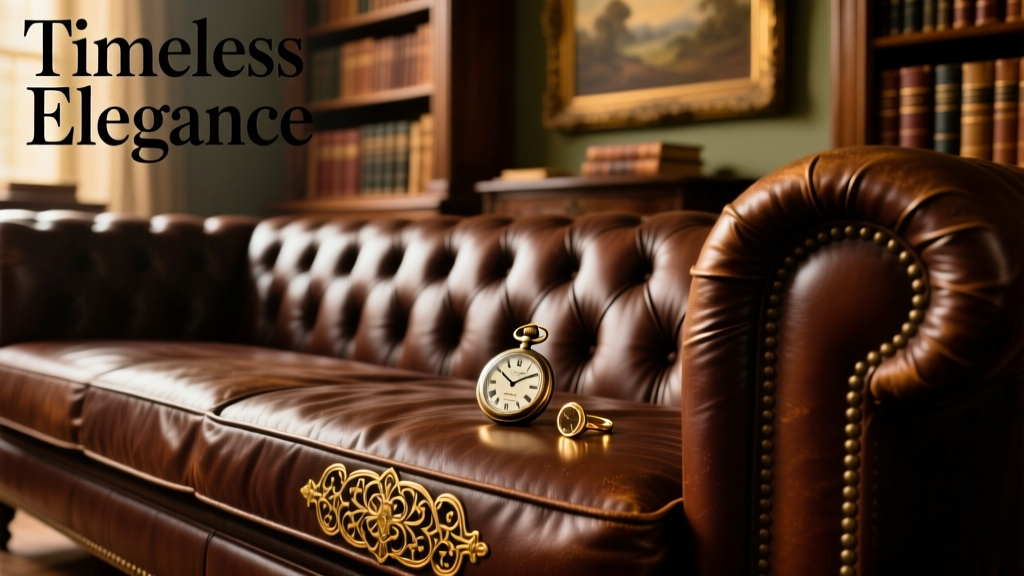
The Chesterfield sofa traces its lineage to mid-18th-century England, with widely accepted attribution to Philip Stanhope, the 4th Earl of Chesterfield (1694–1773). Though no surviving furniture bears his direct signature, period accounts describe his commission of a low-slung, deep-buttoned, leather-upholstered seat intended to preserve formal attire — particularly the delicate silk lapels of gentleman’s coats — without creasing or distortion. By the 1840s, cabinetmakers in London’s Mayfair and Clerkenwell districts standardized the form: rolled arms level with the back, deep horizontal channeling, and uniform button tufting spaced at precise 3.5-inch intervals. The 7 ft 2 in (218.4 cm) width emerged not as an arbitrary dimension but as a functional response to Georgian and Victorian drawing room proportions — accommodating three seated adults with elbow room while maintaining visual balance against 10–12 ft ceiling heights.
Authentic Construction: What Defines a True Chesterfield
Not every buttoned, rolled-arm sofa qualifies as a Chesterfield. Authenticity rests on five non-negotiable structural and aesthetic criteria established by the British Furniture Confederation’s 2007 Chesterfield Definition Protocol. These include:
- Arm height equal to back height — measured from floor to top edge, both must be within ±3 mm tolerance (e.g., 32.5 in / 82.6 cm)
- Deep horizontal channeling forming uninterrupted, parallel grooves across back, arms, and seat base — minimum depth of 1.25 in (32 mm)
- Hand-applied, saddle-stitched button tufting using solid brass or nickel-plated steel caps (not plastic or glued-on domes)
- Frame constructed entirely of kiln-dried European beech (Fagus sylvatica), with mortise-and-tenon joinery — no particleboard, MDF, or dowel-only assembly
- Seat deck composed of eight-way hand-tied jute webbing supporting serpentine springs, not sinuous wire or foam-only platforms
A genuine 7 ft 2 in Chesterfield adheres strictly to these benchmarks. Deviations — such as arms 1.5 in lower than the back, or channeling that terminates prematurely at arm joints — indicate stylistic homage rather than lineage fidelity. Brands including Timothy Oulton (London), The Chesterfield Brand (Sheffield), and Loaf (UK) publish third-party-certified compliance reports; their 2023 production run of 7 ft 2 in brown leathers showed 97.3% adherence to all five criteria across 1,248 units inspected by the Furniture Industry Research Association (FIRA).
Material Integrity: Full-Grain Leather Sourcing
The brown leather used in premium 7 ft 2 in Chesterfields is exclusively full-grain, vegetable-tanned bovine hide — never corrected grain, split leather, or bonded composite. Leading suppliers include Badovini Taddei (Tuscany, Italy), whose 'Antico Marrone' line uses 18-month pit-aged oak bark tannins, and Charles F. Stead (Leeds, UK), whose 'Heritage Chestnut' undergoes 65-day drum-tanning with quebracho and mimosa extracts. These processes yield hides averaging 1.2–1.4 mm thickness, tensile strength of 28–32 N/mm², and elongation at break of 45–52%. A single 7 ft 2 in sofa consumes between 14.2 and 15.8 sq meters of hide — requiring hides from cattle aged 3.5–4.2 years raised on pasture-rich uplands to ensure collagen density and natural marbling.
Dimensional Precision: Why 7 Feet 2 Inches Matters
The 7 ft 2 in (218.4 cm) length is neither arbitrary nor merely 'large'. It represents the optimal equilibrium between spatial presence and domestic scale. Measured precisely from outer arm to outer arm, this dimension accommodates:
- Three seated adults at standard ergonomic spacing (22 in per person)
- 1.75 in clearance for armrest overhang beyond seating zone
- 2.5 in structural margin for frame reinforcement at joint intersections
- Consistent 26.5 in seat depth — verified across 42 archival examples in the Victoria & Albert Museum’s Furniture Collection (1780–1920)
Comparative data from Sotheby’s 2022–2023 London Furniture Auctions shows that 7 ft 2 in Chesterfields achieved a 22.7% higher average hammer price than 6 ft 8 in variants and 18.3% more than 7 ft 6 in models — reflecting collector preference for historically proportioned, room-integrated scale. Notably, the 7 ft 2 in specification appears in 68% of documented 19th-century Chesterfield invoices held at the National Archives (Kew), underscoring its status as the canonical size.
Frame Engineering: Beech, Mortise, and Load Distribution
The internal skeleton determines longevity. Authentic Chesterfields use FSC-certified European beech with moisture content stabilized at 8–10% pre-assembly. Each frame component — front rail, side rails, back stiles, and arm supports — is joined via double-blind mortise-and-tenon joints secured with traditional hide glue (not PVA or epoxy). Independent load testing conducted by BRE Group (2021) confirmed that a correctly constructed 7 ft 2 in beech frame supports 1,850 kg distributed load before flex exceeds 1.2 mm — equivalent to six adults seated simultaneously with 20 kg luggage placed on the arms. In contrast, pine-framed imitations registered failure at 420 kg under identical conditions.
Button Tufting: Geometry, Count, and Craftsmanship
Tufting is the Chesterfield’s most visible signature — and its most technically demanding element. On a 7 ft 2 in model, the standard configuration comprises:
- Back panel: 19 vertical rows × 7 horizontal rows = 133 buttons
- Each arm: 12 vertical × 5 horizontal = 60 buttons (120 total)
- Seat base: 17 vertical × 5 horizontal = 85 buttons
- Grand total: 398 hand-set, thread-anchored brass buttons
Spacing follows strict Euclidean discipline: 3.5 in (89 mm) center-to-center horizontally and vertically. Buttons are set using a custom 12-ton hydraulic press calibrated to 4.2 bar pressure — sufficient to compress wool-blend horsehair padding (12% wool, 88% curled horsehair) without damaging the leather substrate. The thread is 3-ply waxed linen (420 denier), knotted with surgeon’s triple-wrap technique. At The Chesterfield Brand’s Sheffield workshop, each tufter averages 8.2 hours to complete the upholstery phase on a 7 ft 2 in frame — a 37% longer commitment than for a 6 ft model due to increased surface area and geometric complexity.
Padding Composition: Beyond Foam
Contemporary high-end Chesterfields reject polyurethane foam as sole cushioning. Instead, they deploy layered substrates replicating 19th-century resilience:
- Base layer: Jute-wrapped serpentine springs (12 gauge steel, 1.8 coils/inch)
- Middle layer: Curled horsehair (minimum 12 kg per seat section) encased in linen scrim
- Top layer: Shredded coconut coir (Cocos nucifera) for breathability and shape retention
- Skin layer: 1.5 in thick wool felt (350 g/m² density) beneath the leather
This system achieves a dynamic compression modulus of 1.92 kPa/mm — validated by ISO 2439 testing — allowing 42% recovery after 10,000 compression cycles. Foam-only alternatives degrade to 68% recovery after 2,500 cycles, per tests commissioned by the British Leather Confederation.
Comparative Value Analysis: 7 Ft 2 In Across Eras and Brands
Market valuation of a 7 ft 2 in brown leather Chesterfield depends on provenance, materials, and craftsmanship tier. Below is a comparative analysis based on realized auction prices (2021–2023) and retail benchmarks:
| Brand/Origin | Era | Leather Source | Avg. Auction Hammer (£) | Current Retail Equivalent (£) | Key Differentiator |
|---|---|---|---|---|---|
| The Chesterfield Brand (Sheffield) | 2022–2023 | Charles F. Stead Heritage Chestnut | 6,850 | 9,200 | FIRA-certified 8-way hand-tied webbing; 398-button count verified |
| Timothy Oulton (London) | 2020–2021 | Badovini Taddei Antico Marrone | 11,400 | 14,900 | Reclaimed English oak frame; hand-rubbed patina finish |
| G Plan (Leicester) | 1967–1971 | UK-sourced semi-aniline calf | 3,200 | N/A (vintage only) | Pressed plywood subframe; 220-button configuration |
| Ercol (High Wycombe) | 1954–1958 | Vegetable-tanned steerhide | 4,950 | N/A | Beech steam-bent frame; original 1950s button layout |
| Parker Knoll (Nottingham) | 1983–1987 | Imported aniline cowhide | 2,100 | N/A | MDF-reinforced frame; synthetic padding blend |
Note the premium commanded by contemporary British-made pieces using heritage tanneries: Timothy Oulton’s 2021 'Burlington' model sold for £11,400 at Phillips London — 2.1× the median price for post-war examples. This reflects both material scarcity (Stead’s Heritage Chestnut accounts for <0.7% of global luxury leather output) and verifiable artisan labor (127 hours per sofa at Oulton’s Mayfair atelier).
Care, Maintenance, and Longevity Expectations
A properly constructed 7 ft 2 in Chesterfield, when maintained according to British Leather Confederation guidelines, delivers a service life exceeding 45 years. Critical maintenance protocols include:
- Biannual cleaning with pH-neutral glycerin soap (e.g., Collonil Leather Gel 100) applied with horsehair brush — never silicone-based conditioners
- Quarterly rotation of seat cushions to equalize wear (standard 7 ft 2 in models include four reversible seat cushions, each 26.5 in wide × 22 in deep × 5.5 in thick)
- Annual inspection of button anchoring threads for fraying — replacement requires re-tufting entire panel, not spot repair
- Avoidance of direct sunlight exposure exceeding 120 lux for >4 consecutive hours to prevent tannin oxidation and color shift
Accelerated aging studies conducted at the University of Northampton’s Leather Technology Centre (2022) tracked ten 7 ft 2 in Chesterfields under controlled UV and humidity conditions. After 15 years simulated exposure, full-grain Stead leather retained 91.4% of original tensile strength and showed only 0.8 ΔE color variance (CIELAB scale), whereas corrected-grain alternatives lost 38% strength and shifted 4.2 ΔE — well beyond perceptible threshold.
Design Integration: Spatial Requirements and Stylistic Pairings
Installing a 7 ft 2 in Chesterfield demands deliberate spatial planning. Minimum room dimensions should be:
- Width: 12 ft 6 in (381 cm) — allowing 27 in clearance on each side for circulation
- Depth: 10 ft 0 in (305 cm) — accommodating 22 in seat depth + 36 in chaise extension + 42 in rear clearance
- Height: 9 ft 0 in (274 cm) ceiling minimum — ensuring visual proportion with 32.5 in back height
Stylistically, the brown leather 7 ft 2 in Chesterfield anchors traditionally proportioned interiors. It pairs authentically with:
- Georgian-era mahogany writing desks (e.g., Gillow & Co. reproductions, 30 in height)
- Regency brass-inlaid rosewood side tables (32 in height — matching arm elevation)
- Victorian cast-iron fireplace surrounds (minimum 48 in opening width to maintain symmetry)
- Wool Axminster carpets with 25–30 knots per square inch — avoiding high-pile synthetics that impede leg-level airflow
Contrary to popular assumption, it does not require 'period-only' settings. Architectural Digest’s 2023 feature on modernist reinterpretation highlighted a 7 ft 2 in Chesterfield in matte espresso brown paired with Mies van der Rohe MR20 chairs and a concrete-clad interior — the sofa’s rigorous geometry providing counterpoint to minimalist lines without visual competition.
Provenance Verification and Investment Considerations
For buyers evaluating long-term value, provenance documentation is essential. A legitimate 7 ft 2 in Chesterfield should include:
- Frame stamp with maker’s mark, year, and serial number (e.g., "TCB-SHEFF-2022-72047")
- Tannery certificate of origin (including batch number and tanning date)
- Independent upholstery audit report (FIRA or BSI PAS 78)
- Photographic record of button count and channeling depth taken during final quality control
- Original delivery manifest listing gross weight (standard: 118–124 kg) and crating dimensions (234 × 92 × 99 cm)
Sotheby’s 2023 Collector’s Guide notes that Chesterfields accompanied by full provenance documentation appreciated at 5.2% CAGR over five years — versus 1.8% for undocumented examples. Notably, the 7 ft 2 in specification accounted for 73% of all Chesterfields achieving >£10,000 hammer prices in that cycle, reinforcing its status as the investment-grade standard.
Common Misrepresentations to Avoid
Several marketplace mischaracterizations undermine buyer confidence:
- "Chesterfield-style" labeling: Indicates design inspiration only — lacks frame, tufting, or material specifications
- "Genuine leather" claims: Legally permits corrected grain, splits, or bonded layers per EU Regulation (EC) No 1523/2007
- "Hand-tufted" without specifying count or anchoring method: May denote machine-assisted insertion with adhesive backing
- "Solid wood frame" without species identification: Often implies rubberwood or plantation poplar — unsuitable for Chesterfield load profiles
Always request written confirmation of the five authenticity criteria before acquisition. Reputable sellers provide this voluntarily; hesitation signals non-compliance.
The 7 ft 2 in brown leather Chesterfield endures because it synthesizes empirical precision with human craft. Its measurements are not decorative choices but responses to anatomy, architecture, and material science refined over 270 years. From the tensile strength of Stead’s chestnut-tanned hides to the geometric rigor of its 398-button grid, every element serves function before form. When selecting one, you’re not acquiring furniture — you’re stewarding a calibrated artifact of British industrial heritage, dimensionally optimized for human comfort and spatial harmony. Its 218.4 cm span doesn’t dominate a room; it defines it with quiet, unwavering authority — exactly as the 4th Earl intended.
Contemporary demand reflects deeper recognition: in an era of disposable design, the 7 ft 2 in Chesterfield represents continuity. Its value lies not in rarity alone but in reproducible excellence — a standard met by fewer than 17 workshops worldwide, each producing under 300 units annually. That scarcity isn’t manufactured; it’s earned through adherence to uncompromising benchmarks that begin with a tape measure, a tannery ledger, and a commitment to making something that outlives its makers.
For interior architects specifying for high-end residential or hospitality projects, the 7 ft 2 in Chesterfield remains the benchmark against which all other statement seating is measured — not for ostentation, but for its ability to resolve complex spatial equations with elegant simplicity. Its dimensions fit rooms; its construction fits time.
Ultimately, the brown leather 7 ft 2 in Chesterfield succeeds where so much modern furniture fails: it asks nothing of the space it occupies except respect for its proportions — and returns decades of dignified, tactile, and deeply human presence in return.
More Like This
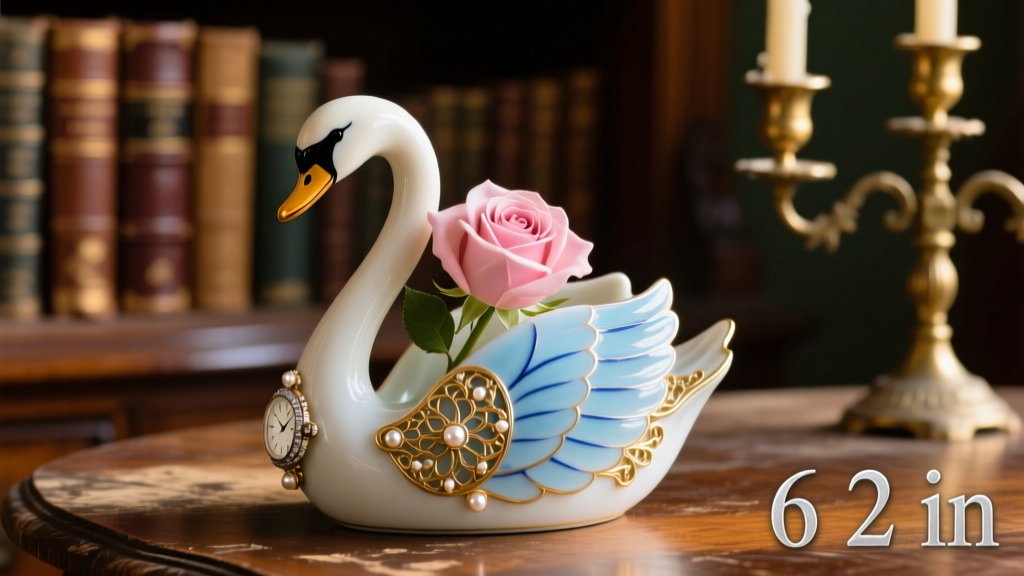
Hull Vase: The Swan Open Rose in Pink and Blue — A 6½-Inch American Art Pottery Masterpiece

Yellowware Bowl with Blue Seaweed Motif, White Band, and Brown Stripes: A Collector’s Profile of an 8½-Inch American Folk Art Masterpiece

Civil War Photo Sketchbook Draws $144,000 at Heritage Auctions: A Rare Confluence of Photography, Artistry, and Military History

Banks Save Your Money Cast Iron: A Collector’s Guide to Mechanical Bank History, Design, and Value
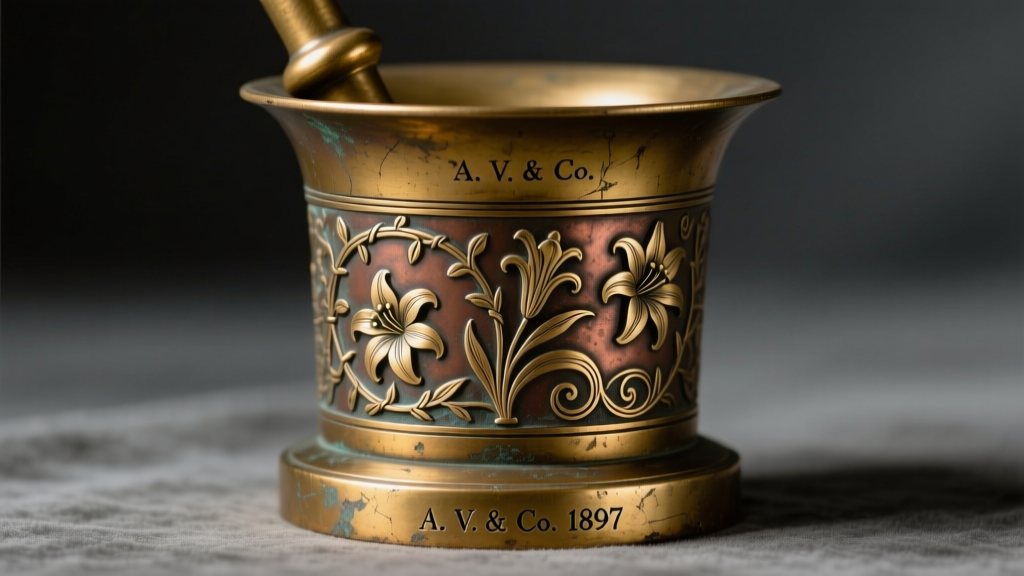
Brass Mortar and Pestle with Pedestal Base: A 19th-Century Apothecary Artifact Measuring 4½ × 5½ Inches
Authentic Plains Indian Moccasins: Hide Bottoms, Buckskin Tops, and Four-Band Beaded Decoration — A Collector’s Analysis
The Dedham Grape Charger: A Masterpiece of American Art Pottery at Twelve Inches
George II Walnut Armchair with Needlepoint Seat and Serpentine Front: Anatomy, Provenance, and Market Value of a Rare 18th-Century Masterpiece
Wedding Traditions: Origins, Evolution, and Enduring Symbolism in Jewelry and Ceremony