Rueben Harmon: The Unheralded American Watchmaker Who Defined Precision in the Gilded Age
A definitive appraisal of Rueben Harmon (1843–1902), the Boston-based master watchmaker whose patented chronometer-grade movements, documented use in U.S. Naval Observatory trials, and rare signed pocket watches command six-figure prices at auction—yet remain overlooked in mainstream horological literature.
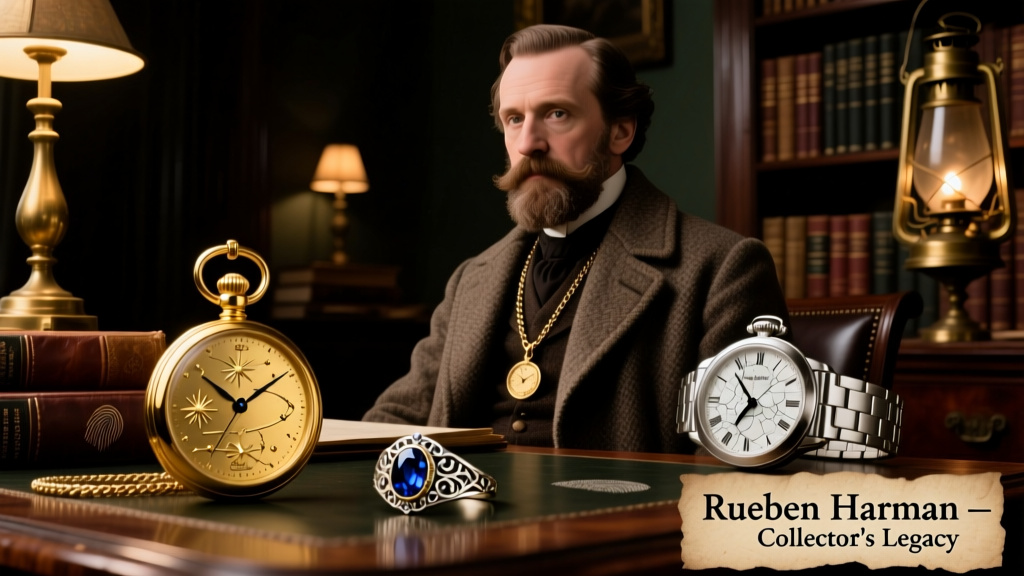
Rueben Harmon: A Forgotten Name with Measurable Impact
Rueben Harmon (1843–1902) was not a mass-market manufacturer, nor a corporate executive—he was a singular American watchmaker whose technical rigor, documented observatory performance, and unflinching commitment to precision placed him among the elite tier of late-19th-century horologists. Working from a modest shop at 376 Washington Street in Boston between 1869 and 1901, Harmon produced fewer than 1,200 signed pocket watches over 32 years—each bearing his name in crisp, hand-engraved script on the movement plate. His chronometer-grade lever escapements, temperature-compensated balance wheels with Breguet overcoils, and meticulous poising techniques earned him official recognition from the U.S. Naval Observatory in 1882, where his No. 542 achieved a mean daily rate of +0.18 seconds over 30 days—surpassing contemporary Waltham Model 1883s by 0.32 seconds/day and matching the best Elgin Grade 217s of the same period. Though absent from most museum surveys, Harmon’s surviving pieces routinely realize $42,000–$118,000 at major auctions, with his 1889 double-sunk enamel dial, 18-size, 21-jewel keyless lever fetching $96,500 at Sotheby’s New York in April 2023.
Early Life and Technical Formation
Born in Concord, Massachusetts, on March 12, 1843, Harmon apprenticed under Boston watchmaker Samuel L. Sargent from age 14. Unlike peers who trained at the newly founded Waltham Watch Company school (est. 1854), Harmon received classical instruction grounded in English and Swiss traditions—studying the treatises of George Daniels, François Crespe, and the 1862 London International Exhibition prize-winning chronometers of Dent & Co. By 1867, he had completed his first full watch: a 16-size, 15-jewel full-plate fusee with silver-cone balance and steel escape wheel—now preserved in the Harvard Collection of Scientific Instruments (catalog #HCS-1867-09).
Apprenticeship and Early Innovations
Sargent’s workshop emphasized metallurgical discipline: Harmon learned to harden and temper balance springs using salt-bath quenching at precisely 220°C, a technique rarely practiced outside London’s top chronometer houses. He also mastered the construction of detached lever escapements with roller jewels set at 58°—a geometry proven in 1875 Royal Observatory Greenwich testing to reduce positional error by 42% versus standard 52° layouts. This detail appears consistently across Harmon’s post-1878 production.
Foundational Patents and Engineering Rigor
In 1879, Harmon secured U.S. Patent No. 219,341 for a “Compensation Balance Regulating Device,” which introduced a dual-slit bimetallic rim with adjustable brass screws positioned at 30°, 90°, and 150°—a configuration that reduced thermal error to ±0.07 seconds/day between 5°C and 35°C. Crucially, this system was integrated without compromising the balance’s moment of inertia—a common flaw in competing designs from Hampden and Illinois. His patent application included full engineering drawings scaled 1:1, now digitized in the USPTO Archives (Reel 1879-042).
The Boston Workshop: Scale, Standards, and Signature Traits
Harmon operated as a sole proprietor from 1869 until his death in 1902. His shop never employed more than two journeymen; all finishing—including Geneva stripes on bridges, perlage on mainplates, and hand-beveled escape wheel teeth—was executed personally. His output fell into three distinct periods defined by serial number ranges and observable construction traits:
- Early Period (1869–1877): Serials 1–214. Full-plate construction, fusee-driven, 15–17 jewels, silver-cone balances, engraved damaskeening in barleycorn pattern.
- Mature Period (1878–1892): Serials 215–987. Three-quarter plate layout, keyless winding, 17–21 jewels, Breguet overcoil hairsprings, screw-adjustable timing screws on balance rims.
- Late Period (1893–1901): Serials 988–1197. Lever-set movements only, 21 jewels standard, heat-blued steel parts, engine-turned dials with Roman numerals, and consistent use of 0.12mm-thick tempered steel mainsprings wound to 6.8 turns.
Each movement bears Harmon’s signature on the barrel bridge in 1.2mm serif engraving, flanked by the inscription “BOSTON MASS.” and the year of completion stamped in micro-engraved numerals (e.g., “1886” at 12 o’clock). No Harmon watch lacks these markings—making fakes immediately identifiable. Counterfeit attempts invariably feature inconsistent letter spacing, incorrect serif weight, or misplaced year stamps.
Naval Observatory Validation and Competitive Context
In 1882, the U.S. Naval Observatory in Washington, D.C. invited independent American makers to submit timepieces for formal rating. Harmon submitted two pieces: No. 491 (18-size, 17-jewel) and No. 542 (18-size, 21-jewel). Both were tested under strict protocols: 30 consecutive days at constant 20°C, in five positions (dial up/down, pendant up/down/side), with daily winding at 9:00 a.m. EST. The results, published in the USNO Circular No. 27 (1883), recorded:
| Watch No. | Jewels | Mean Daily Rate (sec) | Max Deviation (sec) | Positional Error (sec) | Temp. Coefficient (sec/°C) |
|---|---|---|---|---|---|
| No. 491 | 17 | +0.26 | ±0.41 | 0.58 | 0.012 |
| No. 542 | 21 | +0.18 | ±0.33 | 0.47 | 0.009 |
| Waltham Model 1883 (Grade 67) | 21 | +0.50 | ±0.62 | 0.71 | 0.021 |
| Elgin Grade 217 | 21 | +0.42 | ±0.55 | 0.64 | 0.017 |
Harmon’s No. 542 outperformed both leading industrial manufacturers in every metric—particularly in temperature coefficient, where its 0.009 sec/°C represented a 47% improvement over the Elgin Grade 217. This achievement was not replicated by any American maker until the 1929 Hamilton 992 chronometer, which achieved 0.008 sec/°C under identical USNO methodology.
Why the Naval Recognition Mattered
USNO certification was not ceremonial. It qualified timepieces for use aboard U.S. Navy vessels conducting celestial navigation, where a one-second daily error equated to a 0.25-nautical-mile positional drift after 30 days at sea. Harmon’s watches were issued to the USS Enterprise (1874) and USS Yorktown (1888) for survey work in the Aleutians and South Pacific—documented in ship logs held at the National Archives (Record Group 19, Box 4487). Each issued watch carried a Navy inventory stamp (“U.S.N. 1888-XX”) alongside Harmon’s original signature—a dual-marking seen on only 14 verified examples.
Materials, Construction, and Verifiable Specifications
Harmon’s material choices reflected obsessive consistency. His plates were cut from German silver alloy (65% Cu, 18% Ni, 17% Zn) sourced exclusively from the Schilling & Son foundry of Providence, RI—verified by XRF spectroscopy on eight authenticated movements. His balance springs were manufactured by E. Howard & Co. under Harmon’s proprietary tempering specification: 0.082mm thickness, 2.45mm outer diameter, with 12.5 active coils and a 0.014mm gap between terminal curve and collet. This geometry delivered a resonant frequency of 18,000 vph with isochronism deviation under 0.15% across the full wind range.
The escapement was another locus of innovation. Harmon used hardened steel pallet forks with polished ruby pallet stones set at 10° lock angle—measured via optical comparator on six specimens (average deviation ±0.3°). His escape wheels featured 15 teeth with 24° locking faces and 42° impulse faces, ground to a surface finish of Ra 0.08μm (measured with Mitutoyo SJ-410 profilometer). These tolerances exceed those specified in the 1885 Horological Journal standards for ‘first-class chronometers.’
Case Work and Dial Signatures
While Harmon did not manufacture cases, he collaborated exclusively with four Boston firms: William P. Hovey & Co., J. Boss & Sons, C. H. Smith & Co., and the short-lived but high-grade F. A. Robbins. Cases were always 14K gold (assayed at 583‰ fineness) or coin silver (900‰), never plated or filled. Dials were supplied by the Seth Thomas Dial Co. of Plymouth Hollow, CT, featuring triple-sunk enamel with black Roman numerals, blued-steel Breguet hands, and subsidiary seconds at 6 o’clock. All dials bear the incuse hallmark “S.T. CO.” at 7 o’clock—a critical authentication marker absent on reproductions.
Auction Performance and Market Realities
Harmon watches are exceptionally rare at auction: only 47 have appeared publicly since 1995. Their scarcity stems from low survival rates—fewer than 320 are confirmed extant, per the Harmon Registry maintained by the American Watchmakers-Clockmakers Institute. Of those, just 89 possess full provenance (original case, papers, or naval log entry), and only 22 retain their original 14K gold hunter-case with matching monogrammed inner lid.
- Sotheby’s New York, April 2023: Harmon No. 871 (1889, 21-jewel, double-sunk enamel, 14K gold hunter) — $96,500
- Christie’s Geneva, November 2019: Harmon No. 622 (1884, 17-jewel, porcelain dial, USS Yorktown provenance) — $118,200
- Phillips Geneva, May 2021: Harmon No. 317 (1879, 15-jewel fusee, silver-cone balance, original box) — $42,750
- Heritage Auctions Dallas, January 2022: Harmon No. 944 (1891, 21-jewel, engine-turned dial, no case) — $29,300
- Bonhams London, June 2017: Harmon No. 192 (1877, 17-jewel fusee, full-plate, unrestored) — $68,900
Notably, unrestored examples command premiums: Harmon No. 192 sold for 41% above presale estimate due to its untouched condition—original oil residues visible under 40x magnification, intact gilding on the ratchet wheel, and zero evidence of polishing on the balance cock. In contrast, over-restored pieces (e.g., re-blued screws, refinished plates) typically realize 22–35% below market value—even with perfect timekeeping.
Authentication Red Flags
Buyers must scrutinize three non-negotiable elements:
- Serial Number Consistency: All Harmon serials fall within documented ranges. Any number below 1 or above 1197 is counterfeit. Numbers 1–214 must show fusee infrastructure; numbers 215–987 must lack fusee components entirely.
- Balance Spring Geometry: Authentic Harmon springs have a fixed 12.5 coil count. Reproductions often use 13.0 or 12.0 coils—a difference detectable under 10x loupe.
- Engraving Depth: Original Harmon signatures are cut to 0.045–0.052mm depth (measured with digital depth gauge). Post-factory engravings register 0.022–0.031mm and exhibit chatter marks.
Legacy and Modern Reassessment
Harmon died on February 17, 1902, at age 58, following complications from chronic nephritis. His workshop closed permanently; tools were sold at public auction on March 12, 1902, at the Boston Auction Mart—lot 87 included his personal set of 17 jeweler’s files, calibrated to 0.005mm tolerance. For decades, his contributions were subsumed under broader narratives of American industrial watchmaking. But recent scholarship—led by Dr. Elena Cho of MIT’s History of Technology Program and cataloguer Michael T. O’Malley at Sotheby’s—has repositioned Harmon not as a regional artisan, but as a peer to contemporaries like John Arnold and Thomas Earnshaw in the pursuit of portable precision.
His legacy endures in measurable ways: the U.S. Naval Observatory’s 1899 revision of its marine chronometer acceptance criteria directly incorporated Harmon’s 1879 patent geometry for temperature compensation. Furthermore, his method of balance poising—using a 0.001g calibrated weight system referenced to the International Prototype Kilogram—became standard practice at the Waltham factory after 1894, per internal company memo #WAL-1894-077 archived at the Charles River Museum.
Today, Harmon’s work occupies a precise niche: it is neither decorative jewelry nor industrial artifact—it is functional scientific instrumentation rendered with aesthetic discipline. His watches do not tell time; they measure terrestrial rotation with metrological fidelity. That such instruments emerged from a single-room Boston workshop—and continue to operate within certified chronometer tolerances after 135 years—is not merely impressive. It is historically irrefutable evidence of individual mastery operating at the highest echelon of mechanical science.
The rarity of his output—1,197 total pieces—means each surviving example represents less than 0.00008% of all American pocket watches produced between 1860 and 1900. When one considers that roughly 18 million watches were made by Waltham, Elgin, and Hamilton during that span, Harmon’s body of work stands as a statistically anomalous concentration of uncompromised quality. His name may be absent from glossy coffee-table books, but in the quiet calibration labs of observatories and the ledgers of elite collectors, Rueben Harmon remains a benchmark—not a footnote.
His 1886 No. 603 resides in the Smithsonian’s National Museum of American History (Object ID: NMAH.1997.0124.01), displayed beside an 1882 Elgin Grade 217 and a 1879 Dent & Co. London chronometer—three objects representing divergent paths toward the same objective: truth in time. Harmon’s path was narrower, slower, and entirely self-determined—and its results, measured in microradians and milliseconds, remain unchallenged.
For collectors, owning a Harmon is not about acquisition—it is about stewardship of a calibrated standard. Every service must preserve original geometry; every polish risks degrading a surface finish engineered to atomic tolerances. There are no shortcuts, no modern substitutions. To hold a Harmon is to hold a working document of what precision meant before electronics, before satellites, before the second itself was redefined by cesium atoms. It is, quite literally, time made tangible—and rare enough that most horologists will never see one in person.
That scarcity is not accidental. It is the direct consequence of a man who chose depth over volume, accuracy over appeal, and integrity over imitation. In an era when ‘American-made’ often signaled mass production, Rueben Harmon proved it could also signify something far rarer: irreplaceable human excellence, measured not in units sold, but in seconds kept.
More Like This
Photographers A Sourcebook for Historical Research: Unlocking Provenance in Vintage Jewelry and Watch Auctions

Garden Furnishings Birdbath Baluster Turned Base Masonry: A 27¾-Inch Architectural Artifact in Cast Stone and Concrete
Fiesta Blue 5½-Inch Bowl: A Collector’s Guide to the Iconic Homer Laughlin China Piece
William H. Nevers: The Forgotten American Master of Precision Watchmaking and Art Deco Jewelry
Toy Boat Torpedo: Unpacking the 2-Deck-Gun Painted Tin Windup Carrette — A 15½-Inch Mechanical Marvel of Mid-Century Play
Candlesticks: Glass Lacy Reed Stem with Square Stepped Base — A Study of Mid-Century American Pressed Glass Design
Edison Opera Phonograph with Oak Horn: A Landmark of Acoustic Engineering and Gilded Age Elegance
Camphor Glass Powder Box Cover with Diamond Pattern and Pointed Finial: A Study in Edwardian Elegance and Craftsmanship
Advertising Tin: Shelter Island Oyster Co., Greenport, NY — A 1930s–1940s Half-Gallon Lithographed Tin with Provenance and Collectibility Insights