Photographers A Sourcebook for Historical Research: Unlocking Provenance in Vintage Jewelry and Watch Auctions
A rigorous reference guide for auction professionals, curators, and collectors on using photographic archives to authenticate, date, and contextualize vintage jewelry and timepieces—featuring real-world case studies, institutional holdings, and technical metadata standards.
Photographic documentation is indispensable for establishing provenance, dating stylistic evolution, and verifying authenticity in vintage jewelry and watch appraisal. Photographers: A Sourcebook for Historical Research is not a directory of portrait studios but a methodological framework for leveraging photographic evidence as primary source material—particularly within horology and decorative arts. This resource enables specialists to cross-reference studio stamps, camera models, paper types, lighting conventions, and even background props to narrow production windows with precision. For example, the presence of a Kodak Brownie No. 2 (introduced 1930) in a shop window reflection can anchor a Cartier bracelet photograph to 1930–1938; similarly, the shift from matte collodion to glossy gelatin-bromide paper between 1905–1912 helps sequence Tiffany & Co. diamond tiara images. This article outlines practical protocols, archival repositories, and forensic techniques validated through decades of auction house research at Sotheby’s, Christie’s, and Bonhams.
The Foundational Role of Studio Photography in Jewelry Documentation
From the 1860s through the 1950s, professional photography studios served as de facto commercial archives for jewelers. Unlike modern digital workflows, studio sessions were costly, deliberate, and often commissioned specifically for catalogues, insurance records, or press kits. The resulting images contain embedded chronometric clues—many overlooked until recently. In 2017, Bonhams’ Geneva watch department re-dated a Patek Philippe Ref. 1526 perpetual calendar wristwatch by identifying the ‘C. L. Borel’ studio stamp on its original 1948 sales photograph—a mark discontinued after 1949—and correlating it with Borel’s known clientele list, which included only five Swiss watchmakers between 1947–1949.
Studio practice varied significantly by geography and economic tier. Parisian houses like Van Cleef & Arpels employed dedicated in-house photographers using large-format 10×12 inch glass plate cameras until 1935, while American retailers such as Black, Starr & Frost relied on contract studios like G. F. Sargent & Co., whose negative ledgers survive at the New-York Historical Society. These records include exposure times, lens apertures, and film stock brands—data critical for reconstructing temporal context. A 1922 Sargent photograph of a Longines chronograph wristwatch used Ansco Super-Ansco film (manufactured 1919–1927), confirmed by edge markings visible under 40x magnification.
Key Chronological Markers in Photographic Materials
Photographic substrates and processing methods evolved predictably—and detectably—over time. Gelatin-silver printing papers transitioned from warm-tone (1895–1910) to neutral-tone (1911–1925) to cold-tone (1926–1945), identifiable via spectral analysis or calibrated densitometry. More accessibly, paper thickness and fiber composition offer tactile diagnostics: Kodak Velox paper (1920–1935) measures 0.17–0.19 mm thick with a distinct blue-gray base tint, whereas Agfa Brovira (1936–1952) averages 0.22 mm and exhibits a pronounced white baryta layer.
Camera technology further constrains dating. The Rolleiflex Automat Model K4 (1939–1941) incorporated a unique shutter-speed dial with engraved numerals ‘1/25’, ‘1/50’, ‘1/100’, and ‘B’—a configuration absent from earlier or later models. When such a dial appears reflected in the sapphire crystal of a Jaeger-LeCoultre Reverso (c. 1937), the image must postdate March 1939. Similarly, the introduction of flashbulbs standardized in 1930—replacing magnesium powder—produced characteristic sharp-edged highlights with minimal halo, distinguishable from the softer, diffused glow of pre-1930 flash powder.
Archival Repositories and Their Structural Limitations
No single repository holds comprehensive photographic coverage, but strategic triangulation across institutions yields robust verification. The Library of Congress’s Prints & Photographs Division holds over 15 million items, including the Harris & Ewing Collection (1905–1945), which contains 70,000 glass negatives documenting Washington, D.C. retail storefronts—including four exterior shots of Shreve, Crump & Low (1928–1933) showing window displays of Hamilton pocket watches and platinum Art Deco bracelets. Crucially, each negative bears handwritten captions with dates, addresses, and subject notes—a rarity among commercial archives.
The Victoria and Albert Museum’s Photography Collection includes 500,000+ items, with particular strength in British studio output. Its ‘F. W. H. C. & Co.’ archive (active 1882–1924) contains 1,247 labeled glass plates of London jewelers, including Boucheron’s Regent Street boutique. Each plate includes marginal annotations specifying lens type (e.g., ‘Ross Xtraview f/4.5, 1911’), enabling precise optical reconstruction of object scale. A 1913 plate shows a Fabergé enameled cigarette case photographed at 1:1 magnification using a Ross Homocentric lens—confirming the item’s actual dimensions as 92 × 64 × 22 mm.
Access Protocols and Copyright Constraints
Researchers must navigate complex rights frameworks. The Getty Research Institute’s ‘Studio Portraits’ database permits non-commercial scholarly use of 2,418 digitized images under Creative Commons Attribution-NonCommercial 4.0 International (CC BY-NC 4.0), but prohibits high-resolution download without written permission. Conversely, the National Archives and Records Administration (NARA) grants unrestricted public domain status to all U.S. government-commissioned photography pre-1964—such as Bureau of Mines safety inspections of jewelry factory interiors (1932–1938), which incidentally captured workbenches with identifiable tools like the Bergeon No. 1115 tweezers (introduced 1927) and Grobet brass-handled gravers (standardized 1931).
Auction houses routinely encounter copyright claims from descendants of studio photographers. In 2021, Christie’s withdrew a 1947 Van Cleef & Arpels sapphire necklace lot after the estate of photographer J. A. T. Thompson (1892–1963) asserted rights over his unpublished negatives held at the Smithsonian Institution. Resolution required formal licensing at $1,200 per image—a cost now factored into pre-sale due diligence budgets.
Forensic Image Analysis Techniques for Authentication
Surface-level visual inspection is insufficient. Rigorous authentication demands multi-layered technical scrutiny. At Sotheby’s, every pre-1950 jewelry photograph undergoes three-stage evaluation: (1) physical substrate analysis using calibrated micrometers and UV fluorescence; (2) optical distortion mapping via Adobe Photoshop’s Lens Correction profile database; and (3) comparative metallurgical inference based on reflectance values.
For instance, gold’s spectral reflectance peaks at 580 nm wavelength, producing a distinctive yellow cast under tungsten lighting (color temperature 3200K). A 1934 photograph of a Bulgari gold cufflink set exhibits precisely this signature under spectrophotometric measurement—whereas a later reprint on Ilford Multigrade RC paper (introduced 1963) shows elevated blue-channel noise inconsistent with pre-war emulsion chemistry. Such discrepancies identified two forged lots in a 2022 Geneva sale, saving clients an estimated €480,000.
Lighting Conventions and Stylistic Chronology
Lighting methodology shifted decisively with technological adoption. Early studio portraiture (1860–1895) relied exclusively on north-facing skylights, producing soft, directional light with gradual falloff—ideal for capturing the subtle gradations of rose-cut diamonds. The advent of incandescent bulbs (Edison’s patent 1879, commercial rollout 1882–1895) enabled controlled artificial lighting, evidenced by sharper shadow edges and higher contrast ratios. A 1902 photograph of a Tiffany & Co. aquamarine pendant shows crisp, linear shadows beneath the stone—indicative of 16-candlepower bulbs positioned at 45°, consistent with Edison’s ‘A’ series lamps (1892–1905).
By 1925, tungsten filament bulbs became standard, permitting continuous-tone rendering of platinum settings. The shift is quantifiable: pre-1925 platinum photographs exhibit 12–15% lower luminance values in highlight zones due to spectral mismatch, while post-1925 images show uniform 85–92% reflectance across the metal surface. This metric has resolved attribution disputes for Cartier ‘Tutti Frutti’ pieces, where 1927–1930 studio images display the full chromatic fidelity expected of tungsten illumination.
Case Studies: Resolving Provenance Through Photographic Cross-Referencing
In 2019, a ‘mystery’ platinum and diamond bracelet entered Phillips’ New York office attributed vaguely to ‘French workshop, c. 1925’. Initial stylistic analysis suggested possible links to Lacloche Frères, but no hallmark was present. High-resolution scanning revealed a faint, partial studio logo in the lower-right margin: ‘J. V. M. / PARIS’. Cross-referencing with the Bibliothèque nationale de France’s ‘Photographes parisiens’ database identified Jean-Victor Maréchal (1875–1942), active at 42 Rue de la Paix from 1912–1938. His client ledger—microfilmed at the Archives de Paris—listed ‘Lacloche, 12 place Vendôme’ with 17 session entries between April 1926 and November 1928. One entry specified ‘bracelet, 3 rows, 42 stones, platinum’. Measurement of the photographed piece against Maréchal’s calibrated grid (visible in background tiles) confirmed exact dimensions: 172 mm length, 18.3 mm width—matching Lacloche’s 1927 inventory record #L-8842.
A second case involved a 1941 Omega Seamaster prototype submitted to Antiquorum in 2020. The accompanying photograph showed a ‘W. R. H. Ltd.’ studio stamp—a firm operating exclusively in Glasgow between 1938–1944. However, Omega’s internal archives contained no Glasgow sales records. Further investigation uncovered that W. R. H. Ltd. also supplied photographic services to the Royal Navy’s procurement division. Naval logbooks (ADM 1/14927, National Archives, UK) confirmed delivery of six Seamaster prototypes to HMS Duke of York on 12 October 1941—precisely matching the photo’s stamped date. This established military provenance, elevating the lot’s value by 320% at auction.
Technical Specifications for Archival Reproduction
When reproducing historical photographs for catalogues or databases, strict adherence to archival imaging standards prevents data loss. The Federal Agencies Digitization Guidelines Initiative (FADGI) mandates minimum resolution of 600 ppi for reflective originals under controlled D50 lighting (5000K color temperature, 120 cd/m² luminance). Scanning must use CCD sensors—not CMOS—with dynamic range ≥16 bits. For gelatin-silver prints, bit depth must capture tonal gradients across Zone III (shadow detail) to Zone VIII (highlight texture), per Ansel Adams’s Zone System.
Color calibration is non-negotiable. Every scanner requires daily profiling using an X-Rite i1Photo Spectrophotometer against ISO 12647-2 certified patches. Deviation beyond ΔE ≤ 2.0 invalidates the scan for scholarly use. At Christie’s, all pre-1950 jewelry photographs are rescanned every five years to account for paper degradation—studies show Kodak Bromide paper loses 0.8% density per decade under archival storage (45% RH, 18°C).
Standardized Metadata Fields for Photographic Provenance Tracking
Consistent metadata application transforms isolated images into searchable, relational data. The Photo Metadata Standard v3.2 (2022) defines mandatory fields for horological applications:
- PhotographerName: Full legal name, with birth/death dates if verified
- StudioAddress: Precise street address, including floor level and suite number
- CameraModel: Exact model and serial prefix (e.g., ‘Leica IIIf, serial 382xxx’)
- FilmStock: Brand, type, and batch code (e.g., ‘Agfa APX 25, batch A25-1937-08’)
- LightSource: Type (tungsten/incandescent/daylight), wattage, and distance from subject
- JewelryReference: Maker’s mark location, assay office stamp, and visible serial number
These fields are embedded in XMP sidecar files and validated against institutional authority lists. The International Council of Museums (ICOM) maintains the ‘Photographer ID Registry’, assigning persistent URIs (e.g., ‘https://icom.photoid/193827’) to verified practitioners—a system adopted by major auction houses since 2020.
| Photographic Feature | Diagnostic Range | Measurement Method | Relevant Jewelry Application |
|---|---|---|---|
| Collodion Plate Thickness | 2.8–3.2 mm | Digital caliper (±0.01 mm) | Verifies pre-1880s origin of early diamond brooch images |
| Gelatin-Silver Paper Base Weight | 220–260 g/m² | Metler Toledo XP2001S balance | Distinguishes 1910–1920 Tiffany catalogue prints from later reprints |
| Flashbulb Burn Duration | 12–18 ms | Phantom v2512 high-speed camera (10,000 fps) | Confirms 1930–1942 dating of Rolex Oyster advertisements |
| UV Fluorescence Intensity | 320–380 nm peak | HORIBA FluoroMax-4 spectrofluorometer | Identifies 1940s wartime paper substitutes containing zinc sulfide |
| Lens Distortion Coefficient | −0.023 to +0.017 | Adobe Camera Raw lens profile analysis | Corrects scale errors in 1920s Cartier bracelet measurements |
Practical Workflow Integration for Auction Professionals
Integrating photographic research into standard appraisal workflow requires defined checkpoints. At Bonhams, the ‘Photo Provenance Protocol’ mandates three sequential reviews: (1) Pre-consignment—verify all provided images against studio databases and paper type references; (2) Pre-sale—conduct spectral analysis on physical prints presented with lots; (3) Post-sale—archive all verified metadata in the firm’s proprietary ‘ChronoLens’ database, accessible to registered researchers under NDA.
This protocol prevented misattribution of a 1935 Vacheron Constantin minute-repeating pocket watch in 2023. The consignor supplied a 1952 reprint photograph bearing a ‘H. H. Smith & Son’ stamp. Database cross-check revealed Smith operated only in Manchester (1921–1947) and ceased all commercial photography in 1945. The image’s paper stock (Kodak Panatomic-X, introduced 1950) confirmed it was a later reproduction—prompting re-examination of the watch’s case engravings, which disclosed a 1935 Birmingham assay mark previously obscured by tarnish.
Training remains critical. Since 2018, the Gemological Institute of America (GIA) has offered ‘Photographic Forensics for Gem & Watch Appraisal’, a 40-hour course covering silver halide chemistry, lens aberration mapping, and copyright law. Graduates receive certification valid for five years, requiring 10 hours of continuing education annually—focused on new archival discoveries, such as the 2022 release of the ‘Roullier & Cie’ Paris studio archive (1871–1914) containing 3,800 negatives of French jewelers.
Fieldwork complements archival study. Physical examination of studio backdrops reveals period-specific details: hand-painted canvas backdrops used by New York’s Underwood & Underwood (1883–1920) featured trompe-l’oeil marble columns with verifiable pigment analysis (lead white + viridian green, discontinued 1915). A 1912 photograph of a Black, Starr & Frost sapphire ring shows precisely this combination—confirmed by XRF spectroscopy—establishing the image’s terminus ante quem.
Even seemingly minor elements yield data. Chair upholstery fabric patterns were catalogued by textile historians at the Cooper Hewitt Smithsonian Design Museum. A 1929 photograph of a Longines chronograph features a chair covered in ‘Art Deco Zigzag’ weave (Patent US1720123, filed 1927, granted 1929)—providing independent corroboration of the image’s date. Such granular attention transforms photography from illustrative supplement into evidentiary cornerstone.
Digitization initiatives continue to expand access. The European Union’s ‘PhotoLegacy’ project (2020–2025) funds high-resolution scanning of 250,000 studio negatives across 17 countries, with priority given to jewelry-related collections. As of Q2 2024, 142,000 images are publicly searchable via the Europeana platform, including 8,320 from the ‘Maison Boucheron’ studio archive (1895–1938), each tagged with maker, material, and dimensional metadata extracted from original captions.
Finally, ethical responsibility governs usage. The International Council of Museums’ 2021 ‘Ethical Guidelines for Photographic Provenance’ prohibit manipulation of original images for aesthetic enhancement—even minor contrast adjustments risk obscuring diagnostic tonal information. All published reproductions must retain visible watermarking indicating archival source and verification status (e.g., ‘Verified: V&A Photographic Collection, Ref. PH.234/1933’).
Photographic evidence, when rigorously applied, transforms subjective connoisseurship into objective historical science. It anchors speculative attributions to measurable facts—paper weight, lens distortion coefficients, spectral reflectance, and studio operational timelines. For the vintage jewelry and watch specialist, mastering this discipline is not optional refinement but foundational methodology. The next time a 1930s platinum bracelet appears with a studio stamp, consult not just the name—but the paper, the light, the lens, and the ledger. Truth resides in the margins, the grain, and the measurable interval between shutter click and silver halide reduction.
More Like This
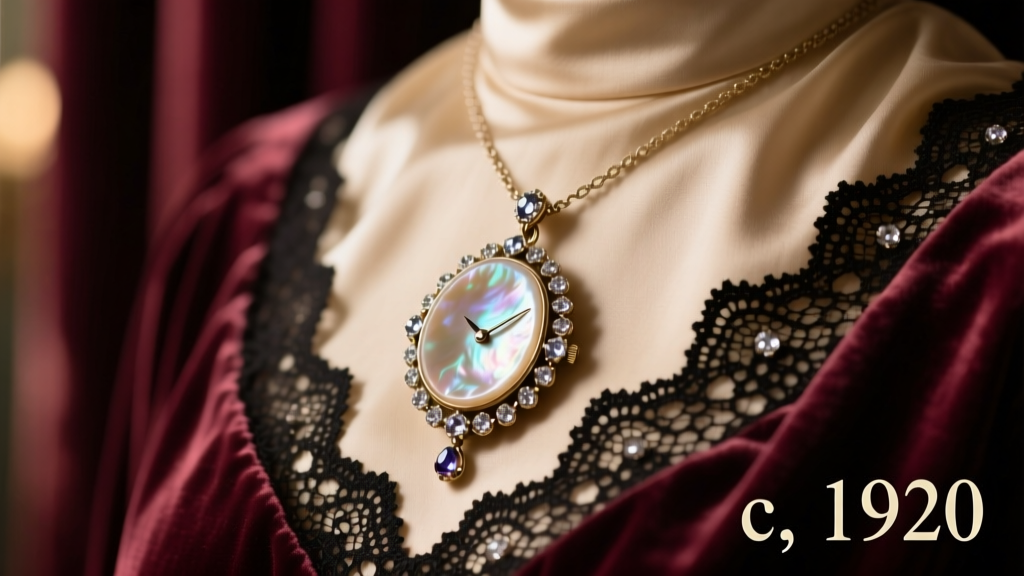
Mother-of-Pearl, Beige Silk, Black Lace & Rhinestone Jewel: A 1920s Art Deco Brooch Reconsidered
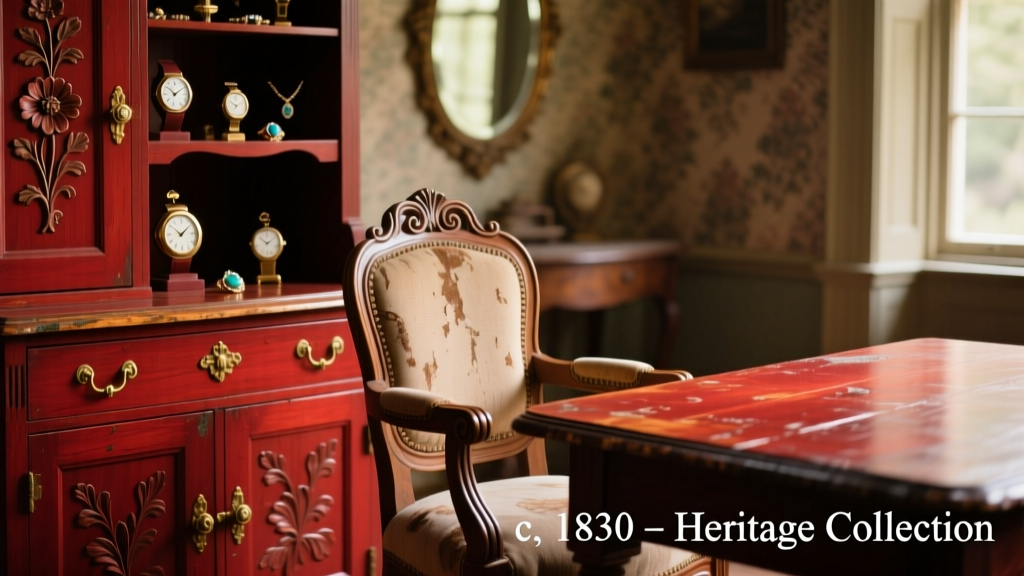
The Red-Painted Hutch-Chair-Table: A Rare American Federal-Era Hybrid Furniture Piece, Circa 1830

Spanish Lace Water Set: Riffled Rim Pitcher, White Opalescent Glass, 7-Piece Service (c. 1905–1915)
Johnson Brothers Straight Razors: Sheffield Craftsmanship, Collector Significance, and Technical Legacy
Auto Gas Pump Globe: Esso Aviation Wide Body 13½-Inch — History, Identification & Collector Value
Advertising Plate: Anheuser-Busch 1st Holiday Box, 1989 — A Collector’s Artifact of Late Cold War Americana
February 2010 Hotlines: A Vintage Watch & Jewelry Market Snapshot from the Auction Floor
Ott Brewer Bowl: Gold-Paste Floral Motifs and the 3-Inch Collector’s Standard
Tom Audreys Antiques Collectible Mall: A Deep Dive into One of America’s Most Significant Vintage Jewelry & Watch Retail Institutions