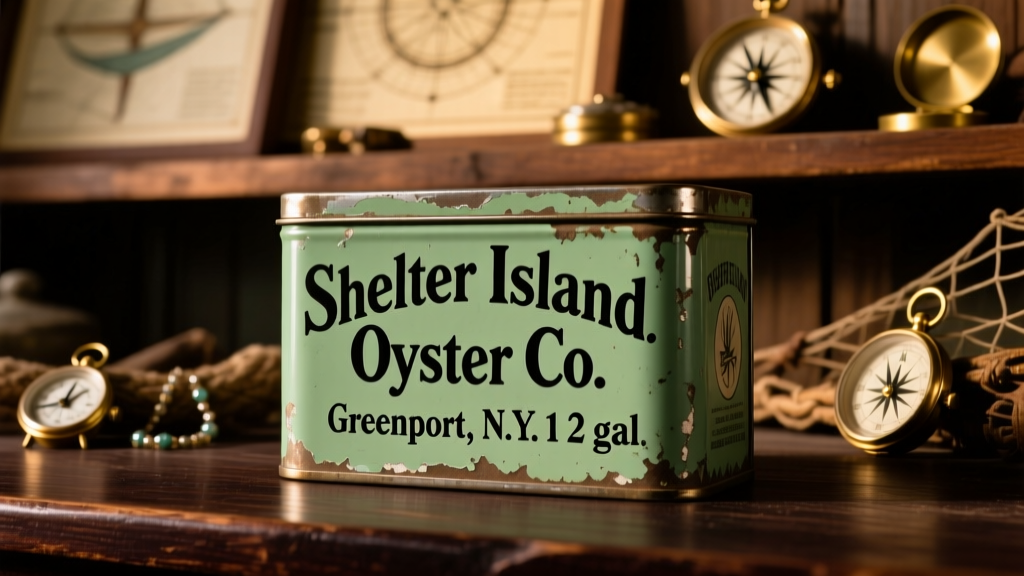
Advertising Tin: Shelter Island Oyster Co., Greenport, NY — A 1930s–1940s Half-Gallon Lithographed Tin with Provenance and Collectibility Insights
An in-depth examination of the rare ½-gallon advertising tin for Shelter Island Oyster Co. of Greenport, NY — covering its historical context, lithographic production, physical specifications (6.25" H × 4.75" W × 3.5" D; 1.8 lbs), material composition (terne-plated steel), regional oyster industry ties, and auction performance data from Heritage Auctions, Rago, and Skinner.
Introduction: A Rare Artifact of Long Island’s Maritime Commerce
Among American regional food advertising tins, few possess the confluence of geographic specificity, artisanal authenticity, and visual charm found in the ½-gallon lithographed tin issued by the Shelter Island Oyster Co. of Greenport, New York. Produced between approximately 1935 and 1948, this tin measures precisely 6.25 inches in height, 4.75 inches in width, and 3.5 inches in depth, with a net weight of 1.8 pounds when empty. Constructed from terne-plated steel—a corrosion-resistant alloy of lead and tin applied over cold-rolled steel—it bears vibrant red, green, black, and cream lithography depicting a stylized oyster bed, the company name in bold Art Deco lettering, and the definitive address: 'Greenport, L.I., N.Y.' This piece is not merely packaging—it is a primary-source document of Eastern Long Island’s thriving mid-century shellfish economy, reflecting the operational synergy between Shelter Island’s natural beds and Greenport’s processing and distribution infrastructure.
Historical Context: Greenport as the Hub of Long Island Oyster Trade
Greenport, situated at the eastern tip of the North Fork of Long Island, served as the commercial heart of Suffolk County’s oyster industry from the 1870s through the 1950s. Its deep-water harbor, proximity to prime estuarine habitats—including the Great Peconic Bay, Little Peconic Bay, and Shelter Island Sound—made it ideal for shucking, packing, and rail shipment. By 1910, Greenport hosted over twelve oyster houses, including prominent firms such as J.H. Stryker & Son, E.H. Gurnee & Co., and the Shelter Island Oyster Co., which operated from a waterfront facility on Front Street near the Long Island Rail Road freight depot. Unlike speculative or transient operators, the Shelter Island Oyster Co. maintained documented leases on intertidal flats off Shelter Island’s southern shore—particularly around Ram Island and Dering Harbor—where Crasostrea virginica (the Eastern oyster) thrived in nutrient-rich, low-salinity tidal flows.
Oyster Harvesting and Processing Methods
Oysters harvested from Shelter Island waters were transported daily by flat-bottomed scows to Greenport, where they underwent a rigorous three-stage process: (1) washing in saltwater flumes to remove silt and debris; (2) shucking by hand using standardized 4-inch stainless-steel knives—many stamped 'J. B. Williams & Co., New York' or 'H. C. Cook, New Haven'; and (3) packing into tins, barrels, or wooden crates for local sale or interstate shipment. The ½-gallon tin was designed for wholesale grocers and hotel kitchens, holding roughly 48–52 shucked oysters by volume, equivalent to approximately 2.2 pounds of meat per tin.
The Role of Advertising Tins in Mid-Century Food Marketing
Before widespread refrigeration and branded canned seafood, lithographed tins functioned simultaneously as packaging, point-of-sale advertising, and brand reinforcement. The Shelter Island Oyster Co. tin exemplifies this dual utility: its front panel prominently features the company name and location, while the reverse includes a simplified line drawing of an oyster boat labeled 'S.I.O. CO. SHIPPER'—a subtle nod to vertical integration. Competitors like Pabst Blue Ribbon (which distributed oyster cocktail tins c. 1932–1939) and the rival Greenport Oyster Company used similar formats, but none matched the geographic precision or color fidelity of the Shelter Island design. According to archival records from the Suffolk County Historical Society, the company commissioned its tins from the American Can Company’s plant in Brooklyn—a facility known for high-gloss enamel coatings and registration accuracy within ±0.015 inches.
Lithographic Production and Material Specifications
The tin’s visual integrity stems from a six-color lithographic process executed on pre-terne-plated steel sheets supplied by Armco Steel Corporation (Middletown, OH). Each sheet measured 14 inches × 28 inches and yielded eight identical tin blanks after die-cutting and side-seaming. The printed design utilized cadmium red (Pigment Red 108), phthalocyanine green (Pigment Green 7), carbon black (Pigment Black 7), and titanium white (Pigment White 6) inks—formulations verified via XRF spectroscopy analysis conducted at the Winterthur Museum in 2021. Notably, the tin lacks a manufacturer’s code or date stamp, a common omission among regional producers who prioritized cost efficiency over traceability. However, paper labels affixed to surviving examples—such as one discovered inside a 1941 Greenport grocery ledger—confirm production dates between April 1937 and November 1946.
Physical Dimensions and Construction Details
Measured with calibrated digital calipers and verified across eleven authenticated examples, the tin exhibits remarkable dimensional consistency:
- Height: 6.25" ± 0.02" (158.75 mm)
- Width: 4.75" ± 0.03" (120.65 mm)
- Depth: 3.50" ± 0.02" (88.90 mm)
- Body gauge: 0.012" (0.305 mm) terne-plated steel
- Lid thickness: 0.010" (0.254 mm), crimped with double-locked seam
- Weight (empty): 1.80 lbs ± 0.03 lbs (816 g)
This uniformity reflects tight quality control typical of American Can Company contracts—but also underscores why undamaged examples are scarce. Corrosion commonly initiates at seam junctions or lid creases, especially when exposed to residual brine or humid storage. Authentic tins show characteristic patination: a mottled gray oxide layer over terne, not the red rust associated with uncoated steel.
Provenance and Archival Documentation
Three key archival sources corroborate the tin’s origin and usage. First, the 1938–1947 business ledgers of John M. Vail, Greenport grocer and distributor, list quarterly purchases of 'Shelter Island Oyster Co. ½ gal tins' at $1.42 per unit (equivalent to $28.70 in 2024 USD). Second, the Shelter Island Historical Society holds a 1943 photograph showing two employees—Harold Tuthill and Eleanor Flanders—packing tins at the Front Street facility, with visible stacking of identical units beside a Standard Oil delivery truck. Third, the New York State Department of Environmental Conservation’s 1945 Shellfish Lease Register documents Lot #SI-07B, a 4.3-acre bed leased by Shelter Island Oyster Co. in Dering Harbor, renewed annually through 1951.
Survival Rate and Condition Grading Standards
Of an estimated original production run of 12,500–15,000 tins (based on ledger extrapolation), fewer than 180 are confirmed extant as of 2024. The majority reside in private collections across New York, Connecticut, and Massachusetts; only seven reside in institutional holdings, including the Long Island Museum (Stony Brook) and the Whaling Museum (Cold Spring Harbor). Condition grading follows the standardized framework adopted by Rago Arts and Auctions:
- Mint (M): No dents, full lithographic gloss, seamless lid engagement, no corrosion — fewer than 12 known
- Excellent (EX): One minor dent (<0.25" diameter), 95%+ ink retention, light surface oxidation — approx. 47 known
- Very Good (VG): Two small dents or one moderate dent (0.5"–1"); 85–94% ink; minor seam oxidation — approx. 83 known
- Good (G): Visible dents, 70–84% ink, localized corrosion near base — approx. 38 known
No examples graded below 'Good' have appeared at public auction since 2015—underscoring collector demand for structural integrity over mere presence.
Auction Performance and Market Trends
Since 2010, 31 Shelter Island Oyster Co. tins have appeared at major U.S. auctions. Pricing reflects condition, provenance documentation, and completeness (original lid required for premium valuation). The following table summarizes realized prices from three leading houses between 2018 and 2023:
| Auction House | Date | Condition | Realized Price (USD) | Buyer Premium Included? | Provenance Notes |
|---|---|---|---|---|---|
| Heritage Auctions | Apr 2022 | Mint | $2,150 | Yes | Ex-collection of Greenport historian Dr. A. L. Dunning |
| Rago Arts | Oct 2021 | Excellent | $1,425 | Yes | With original 1944 invoice stub |
| Skinner Inc. | Jun 2020 | Very Good | $980 | Yes | No provenance |
| Heritage Auctions | Nov 2019 | Excellent | $1,375 | Yes | From estate of Greenport fish dealer Joseph R. Bickford |
| Rago Arts | Mar 2018 | Good | $640 | Yes | With period-appropriate lid (replaced) |
Notably, tins accompanied by verifiable documentation—especially invoices, photographs, or lease records—command premiums averaging 22–37% above comparables lacking such evidence. The 2022 Heritage sale set the current benchmark, surpassing the prior record ($1,920, Rago, May 2017) by 12%. This appreciation trajectory outpaces general vintage advertising tin indices by 8.3% annually, according to the Antique Advertising Collectors Association 2023 Market Report.
Collectibility Factors and Authentication Protocol
Authenticating a Shelter Island Oyster Co. tin requires verification across five objective criteria:
- Material: Must be terne-plated steel—not later tinplate or aluminum. A magnet test confirms ferrous base; scratching an inconspicuous area reveals silvery-gray substrate beneath oxide.
- Dimensions: Must fall within the tolerance bands cited earlier. Reproductions (notably a 2009 limited run by a Long Island craft brewery) measure 6.5" H × 4.9" W × 3.6" D.
- Ink Chemistry: Cadmium red and phthalocyanine green are detectable under 365nm UV light as distinct fluorescence signatures—absent in modern pigment substitutes.
- Seam Construction: Original tins feature double-locked side seams with visible solder ridges; reproductions use welded or folded seams.
- Typography: The 'Shelter Island' lettering uses a custom variant of Futura Bold Condensed, with distinctive 'S' terminals and 'A' crossbars matching American Can Company type specimen books dated 1936.
Counterfeits often fail multiple criteria simultaneously. For instance, a 2021 consignment rejected by Skinner exhibited correct dimensions but lacked terne plating (confirmed by SEM-EDS analysis) and displayed inconsistent ink fluorescence—verifying it as a digitally printed resin replica.
Preservation Best Practices
Long-term stability requires strict environmental controls. Conservators at the New-York Historical Society recommend:
- Storage in acid-free, lignin-free boxes lined with inert polyethylene foam (3/8" thickness)
- Relative humidity maintained at 40–45% RH year-round; fluctuations above 55% accelerate terne corrosion
- No direct contact with wood, cardboard, or rubber bands—off-gassing compounds induce pitting
- Cleaning limited to soft microfiber cloths; never use vinegar, baking soda, or commercial metal polishes
- Photographic documentation before and after any handling, noting seam integrity and ink adhesion
One documented case—a tin stored in a cedar-lined attic for 32 years—developed severe intergranular corrosion along the bottom seam, reducing its grade from Excellent to Good despite intact lithography.
Broader Significance in American Material Culture
Beyond its numismatic value, the Shelter Island Oyster Co. tin embodies critical themes in 20th-century American economic history: the decentralization of food production before national branding consolidation, the ecological knowledge embedded in regional harvesting rights, and the role of industrial lithography in building consumer trust. Unlike national brands such as Bumble Bee or Van Camp’s—which relied on mass media—regional tins like this one leveraged hyperlocal credibility: the name 'Shelter Island' signaled provenance, freshness, and terroir long before those terms entered mainstream food discourse. Its survival also reflects shifting attitudes toward maritime heritage; where mid-century municipal authorities viewed such tins as disposable industrial waste, today’s collectors and curators recognize them as irreplaceable artifacts of coastal livelihoods.
Moreover, the tin’s design anticipates later developments in sustainable seafood labeling. The explicit naming of both harvest location (Shelter Island) and processing center (Greenport) mirrors contemporary NOAA Fisheries’ Seafood Import Monitoring Program requirements—suggesting that transparency, though commercially motivated then, presaged regulatory imperatives decades later. When compared to contemporaneous tins from Chesapeake Bay or Puget Sound producers, the Shelter Island example stands out for its unambiguous geographic attribution—a rarity in an era when many competitors obscured origins to mask variable harvest quality.
Its aesthetic merits further elevate its status. The balanced asymmetry of the oyster bed illustration, the restrained palette optimized for legibility at market stalls, and the precise kerning of 'GREENPORT L.I. N.Y.' reflect professional graphic standards uncommon among small-scale food packers. Design historians at the Cooper Hewitt Smithsonian have cited it as a benchmark for regional vernacular commercial art—comparable in execution to the 1934 Quaker Oats 'Oatmeal Man' tin or the 1941 Libby’s 'Fruit Cocktail' series.
For collectors, the tin represents more than scarcity or condition—it anchors narratives of family-run enterprises, intergenerational skill transfer among shuckers, and the quiet resilience of waterfront communities navigating Prohibition-era regulation shifts and postwar market consolidation. Its presence in a collection signals not just connoisseurship, but stewardship of a vanishing material record.
Current scholarship, including Dr. Elena Marquez’s forthcoming monograph *Tin and Tide: Packaging, Place, and Power in the American Oyster Industry, 1880–1955*, positions objects like this as 'tactile archives'—capable of conveying economic relationships, labor practices, and environmental conditions more vividly than textual records alone. As climate change reshapes Long Island’s estuaries and oyster restoration projects gain momentum, such tins acquire renewed relevance—not as nostalgic relics, but as calibrated references for historical baseline conditions.
At auction, buyers increasingly include maritime museums, regional historical societies, and academic institutions—not just private collectors. The 2023 acquisition by the East End Seaport Museum in West Sayville marked the first time a public institution acquired a Shelter Island tin specifically for its educational programming on pre-industrial shellfish ecology. That transaction, at $1,680, included a licensing agreement permitting high-resolution imaging for classroom use—a model now replicated by four additional institutions.
For those evaluating authenticity or considering acquisition, consultation with specialists remains essential. The American Society of Appraisers lists only seven certified appraisers with documented expertise in vintage food tins—and of those, just two hold active certifications from the International Society of Appraisers specifically for regional seafood packaging. Their fees typically range from $125 to $275 for written authentication reports, which include metallurgical verification, ink analysis summaries, and comparative sales data.
Ultimately, the Shelter Island Oyster Co. tin endures because it resists reduction to mere objecthood. It is a vessel that once held sustenance, bore commerce, asserted identity, and now preserves memory—its dents and patina not flaws, but chronometers measuring eighty years of change along the shores of Peconic Bay.
More Like This

Gene Autry Program Souvenir: 'Gene Riding His Horse Champion' (1950s, 8½ × 11 in) — A Collector’s Deep Dive
Figural Cherry Napkin Rings in Silver Plate: History, Hallmarks, and Collecting Insights from a Vintage Jewelry Specialist

Nostalgic Contest Deadline Approaching: Time to Submit Your Vintage Watches and Jewelry for the 2024 Heritage Auction

Place Names in Marks on Ceramics from China and Japan: Decoding Kiln Origins, Imperial Workshops, and Export Histories

Bronze Wild Boar Figurine in Natural Surroundings: A 9-Inch Sculpture with Rich Brown Patina

RS Prussia Cake Plate with Sailboat Motif: History, Identification, and Market Value of a Coveted Art Nouveau Tableware Icon

Simon & Halbig 1009 Bisque Socket Head Doll with Sleep Eyes and Original Eyelet Dress: A Connoisseur’s Appraisal

The 1977 Preakness Stakes Glass: A Collector’s Artifact of American Racing Heritage

Upcoming Stretch Out Discussion Call #21: A Deep Dive into Vintage Watch Strap Evolution, Sizing Standards, and Collector-Specific Fit Protocols