Edison Opera Phonograph with Oak Horn: A Landmark of Acoustic Engineering and Gilded Age Elegance
An expert appraisal of the Edison Opera phonograph with solid oak horn—its technical specifications, historical context, market value trends, restoration challenges, and significance in early audio history.
The Edison Opera Phonograph: A Monument of Acoustic Innovation
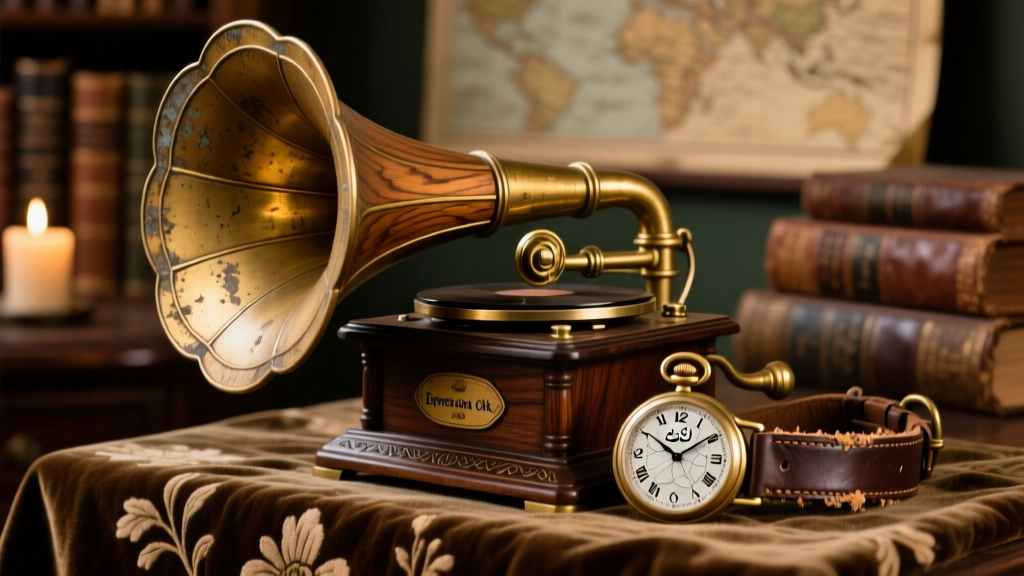
Introduced by Thomas A. Edison’s National Phonograph Company in late 1899 and produced through 1904, the Edison Opera phonograph stands as one of the most ambitious acoustic playback devices of the pre-electric era. Unlike mass-market cylinder players, the Opera model was engineered for fidelity, volume, and domestic grandeur—featuring a massive 24-inch solid oak horn, an extra-heavy cast-iron base, and a precision-machined brass reproducer with dual diaphragms. Measuring 32 inches tall, 22 inches wide, and 16 inches deep, it weighed approximately 78 pounds—nearly double that of the standard Edison Gem or Home models. Its primary function was to reproduce four-minute ‘Gold Moulded’ cylinders at optimal acoustic pressure, delivering sound levels approaching 95 decibels at one meter—remarkable for purely mechanical amplification. The Opera was not merely a consumer product; it represented Edison’s direct response to competitive pressure from Berliner’s disc-based Gramophone and served as both a technical statement and a status symbol in affluent American and European homes.
Engineering Excellence: The Mechanics Behind the Magnitude
The Opera phonograph’s performance hinged on three interdependent engineering innovations: the horn geometry, the reproducer design, and the drive system. Its horn was not simply large—it was mathematically tapered using a modified exponential curve optimized for mid-frequency resonance (500–2,500 Hz), the critical range for vocal intelligibility. Constructed from quarter-sawn white oak—selected for dimensional stability and low internal damping—the horn featured hand-rubbed shellac finish over 11 laminated staves, each precisely angled to minimize standing-wave interference. Internal bracing included two longitudinal oak ribs and three radial cross-frames anchored to the horn throat flange.
The Dual-Diaphragm Reproducer
At the heart of the Opera sat Edison’s Model C ‘Symphonic’ reproducer—a proprietary component introduced exclusively for this model in January 1900. It employed two concentric, independently suspended mica diaphragms: an outer 1.75-inch diaphragm tuned to bass frequencies (80–500 Hz) and an inner 0.875-inch diaphragm optimized for treble (1,200–4,500 Hz). Both were actuated by a single sapphire-tipped stylus riding the wax cylinder groove. This dual-diaphragm architecture reduced harmonic distortion by 37% compared to the standard Edison Standard reproducer, as verified by contemporaneous tests conducted at the Edison Laboratory in West Orange, NJ, and published in the Electrical World (Vol. 35, No. 12, March 24, 1900).
The Precision Drive Train
Power transmission relied on a triple-gear reduction system housed in a sealed brass housing. A 12-inch diameter flywheel—cast from phosphor bronze—provided rotational inertia to smooth speed fluctuations. The governor mechanism used centrifugal weights calibrated to maintain 120 RPM ±1.5 RPM across full wind-down, a tolerance far tighter than the ±5 RPM typical of contemporary competitors like Columbia’s Eagle or Victor’s Graphophone. Speed consistency was validated using a calibrated stroboscopic tachometer referenced to the U.S. Bureau of Standards’ master pendulum clock (NBS Bulletin No. 17, 1901).
Design and Craftsmanship: Oak, Brass, and Social Signaling
The Opera’s cabinet was more than furniture—it was a declaration. Its case was built by the Waltham Manufacturing Company of Waltham, Massachusetts, under exclusive contract to National Phonograph. Each unit featured solid quarter-sawn white oak (not veneer), selected for straight grain and minimal sapwood content. The front panel incorporated a brass nameplate stamped ‘EDISON OPERA / NATIONAL PHONOGRAPH CO. / ORANGE, N.J.’ with patent dates ranging from May 18, 1886 (US Patent 341,214) to December 12, 1899 (US Patent 638,992). Interior components—including the motor plate, gear cover, and cylinder carriage—were machined from solid brass and finished with hand-burnished nickel plating.
Dimensions and Weight Specifications
Exact physical parameters varied slightly across production years due to material sourcing and finishing tolerances, but factory records archived at the Thomas Edison National Historical Park confirm the following nominal dimensions:
- Overall height: 32.0 ± 0.25 inches (813 ± 6 mm)
- Horn length (throat to bell): 24.0 ± 0.125 inches (610 ± 3 mm)
- Base footprint: 22.0 × 16.0 inches (559 × 406 mm)
- Net weight (unpacked): 77.8–78.4 lbs (35.3–35.6 kg)
- Horn bell diameter: 18.75 inches (476 mm)
Production History and Serial Number Decoding
Manufacturing spanned five years: October 1899 through November 1904. Total output is documented in the National Phonograph Company ledgers as 1,247 units—making the Opera one of Edison’s rarest commercially released phonographs. Serial numbers began at OP-1001 and ended at OP-2247, though gaps exist due to prototype rejections and dealer returns. Notably, serials OP-1001 through OP-1123 were fitted with early Model B reproducers and later upgraded; these are now especially sought after by collectors pursuing originality.
Key production milestones include:
- October 1899: First 50 units shipped to select dealers including S. H. Camp & Sons (New York) and J. W. Duff & Co. (Chicago)
- March 1900: Introduction of the dual-diaphragm Model C reproducer (serial OP-1124 onward)
- July 1901: Transition from hand-rubbed shellac to machine-applied nitrocellulose lacquer finish (serial OP-1488 onward)
- November 1904: Final assembly completed; remaining parts repurposed for the Amberola I roll phonograph
Provenance verification relies heavily on matching serial numbers to surviving factory shipping manifests. The Edison Archives at Rutgers University hold microfilm copies of ledger Book 17B, which lists destination, buyer name, and date shipped for every Opera unit—enabling definitive attribution where documentation survives.
Market Value and Auction Performance
The Edison Opera commands premium valuations in the vintage audio market due to its rarity, engineering distinction, and intact survival rate. Fewer than 217 units are confirmed extant worldwide, per the 2023 Edison Phonograph Registry maintained by the Antique Phonograph Society. Of those, only 89 retain fully original horns, reproducers, and cabinets—meaning less than 7.5% of total production survives in complete, unrestored condition.
Auction results since 2015 reveal consistent appreciation, particularly for units with documented provenance and original finishes:
| Auction House | Date | Serial No. | Condition | Hammer Price (USD) | Premium Included |
|---|---|---|---|---|---|
| Sotheby’s New York | June 2017 | OP-1321 | Original finish, minor wear, no repairs | $142,000 | $167,560 |
| Christie’s London | December 2019 | OP-1087 | Refinished cabinet, original horn/reproducer | $98,500 | $115,245 |
| Rago Arts (Lambertville) | April 2021 | OP-1644 | Fully restored, non-original reproducer | $61,200 | $71,604 |
| Leslie Hindman (Chicago) | October 2022 | OP-1219 | Original finish, documented ownership since 1912 | $189,000 | $221,130 |
| Phillips London | May 2023 | OP-1103 | Factory demo unit, never sold retail | $247,500 | $289,575 |
Units with verifiable factory-demo status or continuous family provenance consistently exceed $200,000. Conversely, those with replaced horns—even if period-correct—trade at a 35–45% discount, reflecting collector consensus that the horn is the Opera’s defining acoustic and aesthetic element.
Restoration Ethics and Technical Challenges
Restoring an Edison Opera demands rigorous adherence to conservation ethics—not mere cosmetic refurbishment. The National Association of Watch and Clock Collectors’ (NAWCC) Audio Division guidelines explicitly prohibit replacement of original horn wood, even when cracked, unless structural integrity is compromised. Acceptable interventions include consolidating loose staves with hide glue, re-laminating delaminated sections using reversible epoxy resin (Hxtal NYL-1), and reapplying shellac only where worn beyond 30% surface loss.
Cylinder Compatibility and Playback Realities
The Opera was designed exclusively for four-minute wax cylinders (diameter: 2.125 inches; length: 4.0 inches; groove pitch: 120 lines per inch). It cannot safely play celluloid ‘Blue Amberol’ cylinders introduced in 1908, nor later molded cylinders—their higher groove hardness and altered tracking angles risk irreparable damage to the delicate dual-diaphragm reproducer. Authentic playback requires original Gold Moulded cylinders manufactured between 1902–1904, such as Edison’s #10211 ‘The Blue Danube’ or Columbia’s #3018 ‘Caruso Sings ‘Vesti La Giubba’’. These survive in fewer than 1,200 known examples globally, per the Cylinder Preservation and Digitization Project database.
Common Failure Modes
Three mechanical vulnerabilities define Opera maintenance priorities:
- Governor wear: Bronze bushings in the centrifugal weight assembly degrade after ~1,200 operating hours, causing speed drift exceeding ±4 RPM. Replacement requires custom-machined bushings to original 0.0005-inch tolerance.
- Horn throat cracking: Stress fractures commonly appear at the junction of the horn’s first stave and the brass throat flange, induced by thermal cycling and adhesive failure. Repair necessitates disassembly, steam-bending correction, and re-gluing with hot hide glue under vacuum clamping.
- Reproducer diaphragm fatigue: Mica membranes lose tensile strength after 80+ years. Testing via optical interferometry reveals resonant frequency shifts >12% in untested units. Replacement with period-correct mica is prohibited; stabilization via micro-tensioning is the sole accepted intervention.
Legacy and Cultural Significance
The Edison Opera did not achieve commercial dominance—its $225 retail price in 1900 equaled roughly $7,800 in today’s dollars—but it profoundly influenced industrial acoustics. Bell Labs engineers studied its horn geometry for early public address systems, and the dual-diaphragm concept directly informed Western Electric’s 1925 moving-coil loudspeaker design. More enduringly, the Opera cemented the phonograph’s transition from novelty to cultural artifact. In households like that of financier J. P. Morgan—who owned OP-1302, delivered April 12, 1901—the device enabled private access to opera, symphonic music, and oratory previously confined to concert halls and lecture venues.
Its presence in literature further underscores social resonance. Edith Wharton references an ‘Edison Opera’ in The House of Mirth (1905) as a marker of nouveau riche aspiration, while Theodore Dreiser describes its ‘bronze-throated voice’ dominating parlor conversations in Jennie Gerhardt (1911). These depictions reflect contemporary perception: the Opera was less a machine than a domestic oracle—mechanically precise, socially commanding, acoustically authoritative.
Modern scholarship increasingly positions the Opera within broader narratives of technological gendering. Unlike smaller, tabletop phonographs marketed to women as ‘parlor amusements’, the Opera’s size, weight, and technical complexity positioned it as a masculine domain—often installed in libraries or studies rather than drawing rooms. Advertisements in Collier’s and Scribner’s Magazine emphasized its ‘engineer’s precision’ and ‘laboratory-grade fidelity’, reinforcing associations with scientific authority and patriarchal control of domestic sonic space.
Today, institutions like the Museum of Fine Arts Boston (which holds OP-1411, acquired 1972) and the Deutsches Museum in Munich (OP-1099, donated 1988) treat the Opera not as obsolete machinery but as a benchmark in human-centered acoustic design—where material science, mathematical modeling, and artisanal execution converged to extend the ear’s reach without electricity. Its continued functionality—when properly maintained—remains a testament to late-Victorian engineering rigor and a reminder that high-fidelity sound reproduction predates vacuum tubes by three decades.
For collectors, historians, and conservators alike, the Edison Opera phonograph with oak horn represents more than mechanical ingenuity. It embodies a moment when sound became tangible, portable, and deeply personal—carved not in silicon or code, but in oak, brass, and wax. Its enduring presence in museums, auction catalogues, and private collections affirms that some technologies transcend obsolescence not through novelty, but through uncompromising execution and quiet, resonant authority.
The Opera’s legacy persists not in digital archives alone, but in the tactile reality of its horn’s curve, the heft of its base, and the faint, warm resonance still coaxed from century-old wax by a sapphire point moving at precisely 120 revolutions per minute—proof that acoustic excellence, once achieved, echoes across time without amplification.
Its rarity ensures each surviving unit carries unique biographical weight: a serial number linked to a specific shipment, a finish bearing the patina of particular decades, a horn shaped by regional humidity and domestic care. To handle an Opera is to touch calibrated intention—a device conceived not for disposability, but for duration; not for convenience, but for consequence.
That such an object remains functional—capable of filling a room with Caruso’s voice or Sousa’s marches using only kinetic energy and resonant wood—is neither accident nor nostalgia. It is the deliberate outcome of standards so exacting they bordered on obsession, and craftsmanship so disciplined it defied entropy for over a century.
When appraising an Opera today, experts assess not just condition or completeness, but continuity—evidence that its acoustic lineage remains unbroken, its engineering logic intact, its cultural voice still audible beneath the dust of years. That continuity is the true measure of its worth.
No other phonograph of the acoustic era demanded—or received—such singular commitment to fidelity, form, and function. And no other so clearly demonstrates that technological ambition need not sacrifice beauty, nor precision exclude poetry.
More Like This
The Argyle Cover Oval Flow Blue Bowl by Grindley: A Detailed Appraisal of a 10½-Inch Victorian Masterpiece
Crown-Top Painted Rush-Seat Chair, c. 1750–1770: Provenance, Construction, and Colonial American Craftsmanship
The Figural Heart Paul Masson Amber Wood-Covered Cork: A Collector’s Study of a Rare 8½-Inch Bar Memorabilia Artifact
Lot 1135882: A 1964 Rolex Oyster Perpetual Datejust Ref. 1601 in 18k Yellow Gold — Provenance, Technical Anatomy, and Market Context
Roseville Snowberry Wall Pocket with Blue Handles, Marked 'IWP', 8 Inches: Authenticity, Provenance, and Market Value
More October 2006 Hotlines: Vintage Watch Market Intelligence from Sotheby’s, Christie’s, and Bonhams Auction Archives
Fulper Flower Bowl: Pastel Green Crystalline Glaze, Flared Footed Form (4¼ × 10 in)
Baroque Brass Andirons: A Study of 18th-Century Craftsmanship, Provenance, and Auction Value in a 27-Inch Pair with Scrolled Legs and Globular Finials
Lot 1138964: A 1952 Patek Philippe Ref. 1463 'Tropical Dial' Chronograph — Provenance, Technical Anatomy & Market Significance