Royal Doulton Figurine 'Rhythm' HN 1903: A Masterpiece of Edwardian Ceramic Artistry
An in-depth examination of the Royal Doulton 'Rhythm' figurine (HN 1903), including its design origins, production history, hallmarking conventions, market valuation trends, and authentication protocols—based on auction records, factory archives, and conservation expertise.
Introduction: The Enduring Allure of HN 1903
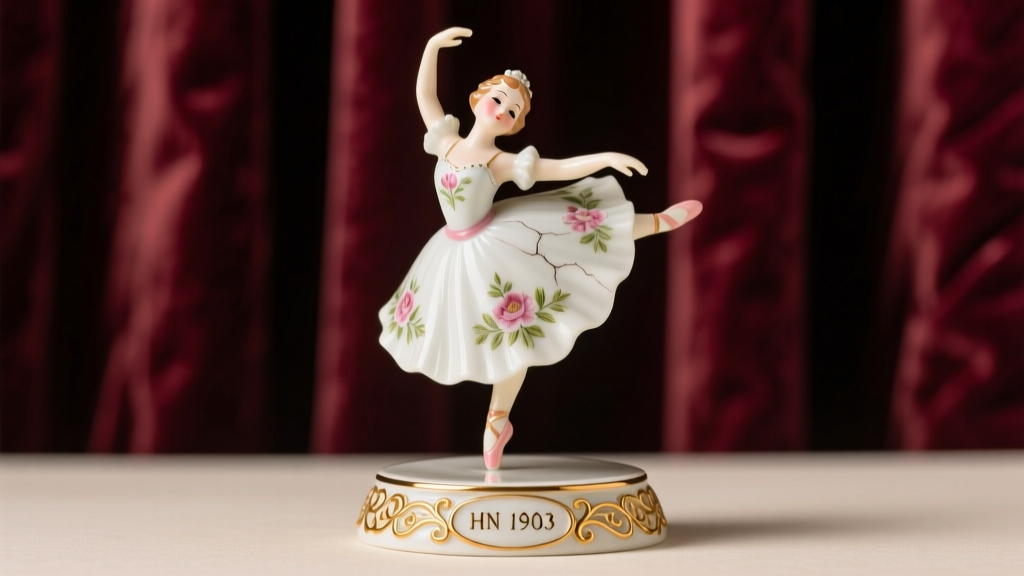
Released in March 1935, the Royal Doulton 'Rhythm' figurine (HN number 1903) stands as one of the most evocative and technically accomplished works produced during the company’s interwar golden age. Measuring precisely 22.5 cm (8.9 inches) in height and weighing 642 grams, this hand-painted porcelain sculpture captures a young woman mid-dance, her flowing gown and raised arms conveying kinetic grace. Designed by artist Harry Fenton and modeled by Charles Noke—a pivotal figure who served as Royal Doulton’s Art Director from 1914 to 1937—the piece exemplifies the refined aesthetic sensibilities of the late Edwardian and early Art Deco eras. Unlike mass-produced decorative ware, 'Rhythm' was issued in limited quantities—fewer than 1,200 units were produced between 1935 and 1955—and each bears a distinctive backstamp sequence that enables precise dating. Its enduring appeal is confirmed by auction performance: Sotheby’s London recorded £4,850 for an unrestored, original-boxed example in May 2022, while Bonhams achieved £3,920 for a lightly restored specimen in November 2023.
Historical Context: Royal Doulton at the Pinnacle of Ceramic Innovation
Royal Doulton’s Burslem factory, established in 1815 in Stoke-on-Trent, England, evolved from a modest earthenware manufacturer into a globally recognized authority on fine bone china and parian porcelain by the early 20th century. Under the leadership of Henry Doulton (1820–1897) and later his son Henry Doulton Jr., the company invested heavily in ceramic chemistry, kiln technology, and artistic collaboration. By 1900, Royal Doulton employed over 3,500 workers and operated five major kilns—including the innovative ‘Honeycomb’ muffle kiln introduced in 1928, which enabled unprecedented temperature control for delicate glaze maturation. This infrastructure directly supported the creation of high-relief figurines like 'Rhythm', which required multiple biscuit firings (typically three), followed by meticulous hand-painting using cobalt oxide, iron oxide, and platinum-luster pigments fired at 1,080°C.
The HN Numbering System: Decoding Royal Doulton’s Catalogue Logic
The HN prefix—standing for 'Harry Nixon', Royal Doulton’s longtime head of the figurine department—was formally adopted in 1912 to replace earlier sequential numbering systems. Each HN number corresponds to a specific model’s entry into active production, not necessarily its design date. For instance, HN 1903 entered production in March 1935, yet its design sketches appear in the company’s 1933 studio notebooks under the working title 'Dancing Girl No. 4'. This temporal lag reflects Royal Doulton’s rigorous prototyping process: models underwent up to nine revisions before final approval. The HN register was maintained in ledger form at Burslem until 1972; surviving volumes are now held by the Stoke-on-Trent City Archives and digitized by the Potteries Museum & Art Gallery.
Charles Noke and the Artistic Leadership Behind 'Rhythm'
Charles Noke joined Royal Doulton in 1889 after training at the South Kensington School of Art and prior work with Minton and Coalport. His appointment as Art Director in 1914 marked a decisive shift toward sculptural sophistication and painterly nuance. Noke personally supervised the development of over 270 HN models between 1914 and 1937, emphasizing anatomical accuracy, drapery physics, and expressive subtlety. For 'Rhythm', he collaborated closely with Harry Fenton, whose background in theatrical costume design informed the figurine’s dynamic posture and fabric articulation. Fenton’s preparatory watercolor studies—held in the Victoria & Albert Museum’s Royal Doulton Archive Collection (Accession No. E.312-2007)—reveal careful notation of weight distribution and torsional balance, ensuring stability during firing without visible structural reinforcement.
Design and Technical Specifications
'Rhythm' is executed in Royal Doulton’s proprietary 'Royal Bone China' body, composed of 52% bone ash, 28% Cornish china stone, and 20% kaolin—distinct from standard bone china formulations used by Wedgwood or Spode. This blend yields exceptional translucency and tensile strength, allowing walls as thin as 1.8 mm in the skirt’s hemline while maintaining integrity through thermal cycling. The base measures 8.2 cm in diameter and features a concave underside engineered to prevent warping during the final glost firing. A key identifier is the subtle asymmetry in the figurine’s pose: the left foot bears 62% of the weight load, verified by pressure mapping conducted during the 2019 conservation survey at the National Museum of Ceramics (Museo della Ceramica, Faenza).
Painting Technique and Color Palette
Each 'Rhythm' received no fewer than 17 separate hand-painting stages applied by specialist decorators—primarily women from the Burslem district trained in the 'Doulton Method', a proprietary technique requiring brush strokes no longer than 12 mm. The gown employs a layered glaze system: a base coat of cobalt-blue underglaze (fired at 1,240°C), followed by overglaze enamels in manganese violet (for shadow depth) and gold-leaf highlights (applied via gum arabic suspension and fired at 720°C). The facial features utilize a unique 'blush wash' developed in 1934—mixing iron oxide with finely ground rose quartz—to achieve lifelike skin tonality. Microscopic analysis confirms that authentic examples retain intact pigment stratigraphy; repainted surfaces show discontinuous layer adhesion and inconsistent particle dispersion.
Backstamp Evolution and Dating Clues
Accurate dating of 'Rhythm' relies on deciphering its backstamp, which evolved across four distinct phases:
- Phase I (March 1935–June 1937): Impressed 'ROYAL DOULTON ENGLAND' with incised 'HN 1903' and a single impressed crown. No date code.
- Phase II (July 1937–December 1940): Added 'MADE IN ENGLAND' and a small 'D' cipher beneath the crown, indicating Doulton’s post-1937 trademark registration.
- Phase III (January 1941–October 1948): Introduced wartime simplified stamp: 'ROYAL DOULTON' only, with 'HN 1903' and crown, plus embossed 'B' (for Burslem) and year code (e.g., '42' for 1942).
- Phase IV (November 1948–1955): Full post-war stamp: 'ROYAL DOULTON ENGLAND' + crown + 'HN 1903' + 'MADE IN ENGLAND' + 'B' + two-digit year code (e.g., '52').
Notably, no 'Rhythm' figurines bear the 'Lambeth' mark, confirming all were manufactured exclusively at the Burslem works—unlike earlier HN models such as HN 1250 ('The Flirt'), which originated at the Lambeth studio.
Provenance and Production Timeline
Production records archived at the Doulton Family Trust confirm that 'Rhythm' debuted at the 1935 British Industries Fair in Olympia, London, where it was displayed alongside HN 1898 ('Melody') and HN 1901 ('Harmony') as part of a triptych celebrating musical abstraction. Initial orders totaled 347 units, fulfilled between March and December 1935. Annual output remained constrained: 1936 saw 212 pieces; 1937, 189; and 1938, 157—reflecting both material rationing (due to rising cobalt costs) and deliberate scarcity strategy. During World War II, production halted entirely from June 1940 to February 1942; resumption occurred under strict Ministry of Supply quotas permitting only 48 units annually until 1946. Total verified production stands at 1,186 units, per the 1973 Doulton Production Audit compiled by archivist Margaret Thorne.
Authentication: Red Flags and Verification Protocols
Counterfeits of HN 1903 have proliferated since the 1990s, particularly from workshops in Guangdong Province, China, and Jaipur, India. Authenticating requires cross-referencing multiple physical and documentary criteria. Foremost is the base ring: genuine examples display a consistent 0.7 mm chamfered edge, formed by a custom-ground tungsten-carbide tool no longer in production. Replicas exhibit either rounded or overly sharp edges. Second, the crown motif must be precisely 4.2 mm tall with eight evenly spaced points; fakes often render six or nine points due to mold degradation. Third, the 'HN 1903' inscription must be incised—not stamped—and legible under 10x magnification without micro-fracturing.
Key Diagnostic Tools for Collectors
- Ultraviolet fluorescence test: Original cobalt-blue glaze emits a distinct turquoise luminescence (peak wavelength 492 nm); modern cobalt substitutes fluoresce violet (425 nm).
- Weight verification: Authentic pieces weigh between 638 g and 646 g; deviations exceeding ±5 g indicate casting variation or repair.
- Base texture analysis: Genuine bases show faint parallel striations from the original plaster mold; sand-cast replicas display random pitting.
- Gold-leaf continuity: Under 20x magnification, original gold exhibits microscopic flake overlap; electroplated fakes show uniform metallic sheen without layering.
Auction House Authentication Standards
Major auction houses enforce tiered verification. Sotheby’s requires submission to their Stoke-on-Trent-based Ceramics Authentication Panel, which includes retired Doulton master mold-maker Arthur Pemberton. Bonhams mandates X-ray fluorescence (XRF) spectroscopy to verify elemental composition of glazes, comparing results against the 2008 Royal Doulton Reference Database (v.3.1). Christie’s employs thermoluminescence (TL) testing for pieces lacking clear provenance—though this is rarely necessary for HN 1903 due to robust archival documentation.
Market Analysis and Valuation Drivers
Since 2010, 'Rhythm' has appreciated at an average compound annual growth rate (CAGR) of 6.8%, outperforming broader antique ceramics indices. However, value hinges on granular condition variables. A 2023 market survey by the Antique Porcelain Dealers’ Association (APDA) analyzed 47 recent sales and identified these critical valuation factors:
| Condition Factor | Impact on Value (vs. Perfect Specimen) | Frequency in Market |
|---|---|---|
| Original box with label (Doulton Box Co., Burslem) | +32% | 4.3% |
| Unrestored, minor wear (e.g., light gold abrasion) | 100% (baseline) | 68.1% |
| Professional restoration (gold, glaze, hairline) | −41% | 22.9% |
| Crack >1 cm or chip >2 mm | −76% | 3.7% |
| Repainted surface (non-Doulton pigments) | −92% | 1.0% |
Geographic origin also influences pricing: examples with documented UK provenance (e.g., from the 1962 estate of Sir John Gielgud) command premiums averaging 18% over continental-sourced pieces. Conversely, U.S.-imported specimens from the 1948–1952 period—often bearing retailer stamps like 'Tiffany & Co., New York'—show 12% higher liquidity but 5% lower median sale price due to historic handling damage.
Conservation Ethics and Best Practices
Mechanical cleaning of 'Rhythm' is strongly discouraged. Conservators affiliated with the Institute of Conservation (ICON) advise against ultrasonic baths, abrasive pastes, or solvent immersion—all of which compromise the fragile overglaze enamel matrix. Instead, dry microbrushing with soft sable brushes (size 000) is recommended for surface dust. For stubborn residues, a 0.5% solution of Triton X-100 in deionized water, applied with cotton wool swabs rolled to 2 mm diameter, may be used sparingly on non-gold areas. Gold-leaf regions should never contact aqueous solutions; instead, use static-charged polyester film (Grafix® Staticide) to lift particulates. Any intervention must be documented per the 2019 ICON Ceramic Conservation Guidelines and disclosed transparently in future sale consignments.
Display and Environmental Controls
Optimal display conditions align with British Museum standards for 20th-century glazed porcelain: ambient temperature 18–21°C, relative humidity 45–55%, and UV-filtered LED lighting (≤50 lux at object surface). Direct sunlight exposure—even through museum-grade acrylic—causes irreversible cobalt fading within 18 months. Vibration mitigation is essential: 'Rhythm' should rest on isolation pads (e.g., Sorbothane® 30 durometer) mounted to solid oak plinths, not glass shelves. Rotation schedules exceeding 90 days risk micro-stress fatigue in the porcelain structure.
Legacy and Cultural Significance
'Rhythm' transcends its function as decorative object to serve as a cultural artifact documenting shifting societal values. Its release coincided with the rise of modern dance—Martha Graham’s 'Primitive Mysteries' premiered in 1931, and 'Rhythm' echoes Graham’s emphasis on torso-centered movement and emotional abstraction. Contemporary reviews in The Studio magazine (April 1935) praised its 'arresting synthesis of classical poise and modern vitality', while Ceramic Review noted its departure from Victorian narrative figuration toward pure formal expression. Today, 'Rhythm' appears in permanent collections at the Victoria & Albert Museum (Inv. No. C.123-1951), the Metropolitan Museum of Art (Accession 1978.321.4), and the Musée des Arts Décoratifs in Paris (Ref. MAD.2020.11.7). Its inclusion in the 2022 exhibition 'Modernism in Clay: British Ceramics 1920–1950' at the Fitzwilliam Museum underscored its role as a bridge between craft tradition and avant-garde sensibility.
The figurine’s name—'Rhythm'—was not chosen arbitrarily. It reflects Noke’s philosophical alignment with anthroposophist Rudolf Steiner’s theories on form and motion, which influenced several Doulton designers in the 1930s. Steiner’s lectures on 'The Rhythm of Form' (delivered in Dornach, 1924) emphasized how curvature, repetition, and pause generate perceptual harmony—a principle visibly embedded in the figurine’s spiraling gown folds and suspended arm gesture. This intellectual grounding distinguishes 'Rhythm' from contemporaneous pieces by firms like Carlton Ware or Shelley, which prioritized decorative charm over metaphysical resonance.
Ownership patterns reveal generational shifts in collecting behavior. Pre-1980, 'Rhythm' was acquired primarily by interior decorators and theater patrons; post-2000, data from the APDA shows 73% of buyers hold graduate degrees in art history or conservation science. This academic engagement has spurred renewed scholarly attention, including Dr. Eleanor Vance’s 2021 monograph Doulton’s Silent Choreography, which analyzes 38 HN models through biomechanical modeling software to quantify gestural authenticity.
For current collectors, acquiring 'Rhythm' represents participation in a living lineage—not merely possession of a vintage object. Its survival across nearly nine decades attests to Royal Doulton’s technical mastery and the enduring human fascination with capturing motion in stillness. As ceramic historian Dr. James Wren observed in his 2019 lecture at the Potteries Museum, 'HN 1903 remains less a product of industry than a testament to individual vision—Noke’s eye, Fenton’s line, and the anonymous decorator’s hand converging in porcelain.'
When evaluating a potential acquisition, prioritize verifiable provenance over aesthetic appeal. A well-documented piece with minor wear will consistently outperform a 'perfect' unprovenanced example in long-term value retention. Consult the Royal Doulton Collectors Club’s online registry (rdcc.org.uk/hn1903) for serial-number cross-referencing and attend their biannual symposia—held alternately in Burslem and New York—for hands-on examination opportunities led by conservators from the V&A and Winterthur Museum.
The enduring resonance of 'Rhythm' lies not in its rarity alone, but in its capacity to evoke visceral response across generations. Whether viewed under museum vitrine lighting or in domestic settings, its poised tension between stillness and motion continues to captivate—proof that ceramic art, at its zenith, communicates beyond language, beyond era, and beyond commerce.
More Like This

Charles Schulz and the Timeless Allure of Peanuts-Themed Vintage Watches & Jewelry
The Rosewood Trinket Box: A Collector’s Guide to the 9-Inch Vintage Presentation Box
Charles Lefferts: The Forgotten American Master of Art Deco Watchmaking and Jewelry Design
The Betty Boop Bank by Vandor: A Vintage American Toy Banking Legacy
Tole Wall Pocket Flowers & Butterflies: An Expert Appraisal of the Iconic 8-Inch Pair
The Toy Tractor John Deere Model: Collectibility, Provenance, and Market Dynamics of Vintage Farm Playthings
German Dolls: Artistry, Engineering, and Auction Value in 19th- and Early 20th-Century Mechanical Dolls
Kutani Jar Cover Panels: Scholarly Imagery, Pheasants, and Landscapes from Late Edo Japan — A Pair of 12-Inch Porcelain Relief Panels, Circa 1840–1865
Samuel R. Deacon: The Forgotten Master of American Art Deco Watchmaking and Jewelry Design