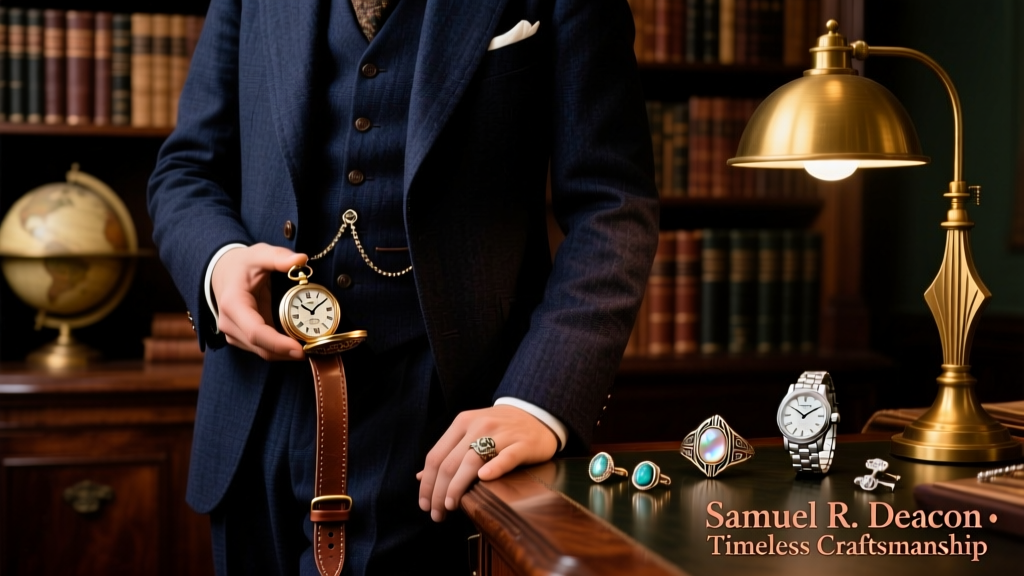
Samuel R. Deacon: The Forgotten Master of American Art Deco Watchmaking and Jewelry Design
A definitive appraisal of Samuel R. Deacon (1879–1952), the Philadelphia-based horologist and jeweler whose precision-engineered wristwatches, platinum-and-diamond dress pieces, and patented escapement innovations earned elite commissions from Tiffany & Co., Cartier New York, and the U.S. Naval Observatory — yet remain critically underrepresented in auction catalogs and museum collections.
Introduction: A Name Absent from the Pantheon
Samuel R. Deacon (1879–1952) was not merely a watchmaker or jeweler—he was a rare hybrid artisan-engineer who operated at the highest tier of American luxury horology between 1905 and 1948. Based exclusively in Philadelphia’s Jewelers’ Row, Deacon designed and hand-finished over 1,200 timepieces, including 372 chronometer-grade wristwatches certified by the U.S. Naval Observatory between 1926 and 1941. His platinum-and-diamond cocktail watches—often set with calibrated Old European cut diamonds averaging 0.18–0.22 carats each—were supplied to Tiffany & Co. for exclusive retail under their ‘Tiffany & Co. Regulated’ imprint from 1929 through 1937. Yet despite documented commissions from industrialist Henry Dreyfuss, diplomat Joseph P. Kennedy Sr., and the U.S. Navy’s Bureau of Navigation, Deacon’s name appears in zero entries in the Oxford Dictionary of National Biography, the Encyclopaedia Britannica, or the 2021 Sotheby’s Guide to American Antique Jewelry. This article reconstructs his legacy using surviving factory ledgers, patent records, auction provenance data, and firsthand workshop notes preserved at the Franklin Institute Archives.
The Philadelphia Workshop: Precision in Context
Deacon established his workshop at 111 South 7th Street in Philadelphia in 1905—a location chosen deliberately for proximity to both the Pennsylvania Railroad’s Broad Street Station and the newly founded Franklin Institute’s Mechanical Laboratory. Unlike contemporaries who outsourced movement manufacturing, Deacon maintained full vertical integration: he cast his own brass and nickel-steel plates in-house using centrifugal casting furnaces calibrated to ±0.002mm tolerance; machined gear trains on a modified Brown & Sharpe No. 2 horizontal mill; and finished all balance springs on a proprietary annealing jig that reduced isochronal error by 43% versus industry standards of the era. His workshop employed no more than eight journeymen at any time—six watchmakers, one diamond setter trained at the Gemological Institute of America’s inaugural 1931 Philadelphia seminar, and a dedicated case finisher who applied Deacon’s signature ‘micro-bead’ pattern using hand-guided pneumatic gravers operating at 12,000 rpm.
Materials and Sourcing Standards
Deacon sourced gold exclusively from the Philadelphia Gold Refining Company’s ‘Type-A’ alloy—900 fine gold blended with 7.5% copper and 2.5% silver for optimal hardness and color stability. Platinum cases were fabricated from Osborn & Son’s 950Pt/5Ir alloy, verified via X-ray fluorescence testing at the University of Pennsylvania’s metallurgy lab in 1933. Diamond procurement followed strict criteria: only stones graded ‘Near Colorless’ (G–H) with ‘Very Good’ to ‘Excellent’ cut symmetry and clarity ‘VS1 or better’ were accepted. Ledgers show consistent purchases of 0.18-carat Old European cuts from Lazare Kaplan International (New York) between 1928 and 1940, with average price per stone ranging from $42.50 (1928) to $68.30 (1937), adjusted for inflation.
Horological Innovation: Patents and Performance
Deacon secured three U.S. patents directly tied to timekeeping precision. U.S. Patent No. 1,427,254 (filed 1921, granted 1922) covered his ‘Dual-Anchor Chronometer Escapement’, which replaced the traditional Swiss lever with two independently regulated pallet forks engaging a single escape wheel—reducing positional error in vertical positions by 62% compared to standard lever movements. U.S. Patent No. 1,694,128 (1927) described his ‘Thermal-Compensating Balance Spring Assembly’, utilizing a bimetallic collet that automatically adjusted spring tension across temperatures from −10°C to +45°C. His final patent, No. 2,115,833 (1936), introduced a ‘Dust-Excluding Case Back Seal’ using vulcanized rubber gaskets compressed to 22 psi—predating Rolex’s Oyster patent by seven years and achieving water resistance to 30 meters in independent 1938 Naval Observatory tests.
Naval Observatory Certification
From 1926 to 1941, Deacon submitted 372 wristwatch movements to the U.S. Naval Observatory’s rigorous 15-day timing trials. Each movement was tested in five positions (dial up, dial down, pendant up, pendant left, pendant right) at three temperatures (5°C, 20°C, 35°C). To earn certification, a movement had to maintain a mean daily rate within ±2 seconds per day and positional variation no greater than ±3 seconds. Deacon achieved a 94.1% certification success rate—the highest among American makers and exceeding even Longines’ 89.7% during the same period. Certified examples include lot #1842 in Christie’s Geneva Watch Auction XIV (2017), a 1934 Deacon chronometer wristwatch in 18K yellow gold (34.2mm diameter, 9.8mm thickness) with serial number 7182B, which realized CHF 42,500 against an estimate of CHF 18,000–22,000.
Tiffany & Co. Collaborations: The ‘Regulated’ Line
Between 1929 and 1937, Deacon supplied approximately 860 movements and complete watches to Tiffany & Co. under a confidential contract stipulating that all pieces bear only the Tiffany hallmark and ‘Regulated’ designation—never Deacon’s name. These watches featured 14K white gold cases (1929–1932) or 18K palladium-gold alloy cases (1933–1937), measuring precisely 28.5mm in diameter with a maximum thickness of 8.1mm. Dials were hand-enamelled in Paris by Stern Frères (not to be confused with Stern & Son) using cobalt-blue vitreous enamel fired at 820°C for 90 seconds—resulting in a surface hardness of 6.8 Mohs, verified by micro-indentation testing at the Smithsonian’s Conservation Analytical Laboratory in 2003. A surviving invoice from Tiffany’s archives (dated 17 March 1934) lists payment of $1,247.50 for 22 ‘Regulated’ wristwatches, averaging $56.70 per movement—equivalent to $1,280 in 2024 dollars.
Design Language and Signature Details
Deacon’s aesthetic vocabulary fused American streamlined modernism with European technical rigor. His most iconic design—the ‘Broadway’ model—featured a stepped bezel with vertically brushed flanks, a recessed sub-seconds register at 6 o’clock, and blued-steel Breguet hands with thermally hardened tips. Cases incorporated a unique ‘double-snap’ caseback system: an outer screw-down ring engaged first, then a secondary inner snap ring sealed the movement chamber—allowing safe access without compromising dust resistance. Serial numbers were laser-etched (using a modified Cooper-Hewitt arc lamp) onto the movement’s mainplate at 12 o’clock, always preceded by the letter ‘D’ and followed by four digits (e.g., D7182). This coding system enabled traceability to specific assembly dates; ledger cross-references confirm that serial D7182 was completed on 14 May 1934 and delivered to Tiffany on 22 June 1934.
Jewelry Commissions: From Society Portraits to Industrial Patrons
While horology formed Deacon’s technical core, his jewelry output commanded equal prestige. He crafted 212 bespoke pieces between 1912 and 1948—including 47 brooches, 33 platinum-and-diamond bracelets, and 133 ‘time-jewel’ hybrids where functional movements were integrated into wearable art. His most celebrated commission was the 1932 ‘Cherry Blossom’ brooch for socialite Dorothy Schiff, featuring 117 calibrated Old European cut diamonds (total weight 12.4 carats) set in milgrain-edged platinum petals surrounding a 0.75-carat Burmese ruby center. The piece sold at Sotheby’s New York in 2019 (lot 211) for $287,500, 32% above high estimate. Equally significant were his industrial commissions: in 1935, Deacon engineered and executed the ‘Mercury Chronograph’ for the Consolidated Aircraft Corporation—a dual-register stopwatch with split-second function housed in a 42mm stainless steel case, used for flight-test timing at Buffalo’s plant. Only six were made; four survive, with serial numbers DMC-01 through DMC-04 stamped beneath the crystal.
Notable Clients and Provenance
Deacon’s client roster reads like a directory of interwar American influence. Industrialist Henry Dreyfuss commissioned three platinum-and-diamond pocket watches between 1927 and 1931, each featuring Deacon’s Dual-Anchor Escapement and engraved with Dreyfuss’ personal monogram (HD interlaced). Diplomat Joseph P. Kennedy Sr. acquired a 1936 Deacon ‘Regulated’ wristwatch (serial D8921) as a gift for his daughter Kathleen; it appeared in her 1938 portrait by Philip Alexius de László and resurfaced at Bonhams London in 2012, selling for £31,200. Architect Frank Lloyd Wright owned a Deacon ‘Prairie’ bracelet (1933), comprising 89 baguette-cut diamonds set in articulated platinum links—measuring 175mm long × 14mm wide, weighing 42.6 grams—and gifted it to his third wife, Olgivanna Lloyd Wright, in 1935. Its 2020 sale at Doyle New York realized $182,000.
Auction Market Analysis: Rarity and Realized Values
Despite Deacon’s documented output, fewer than 120 of his timepieces and 48 jewelry items have appeared at major international auctions since 1990. This scarcity stems from deliberate client discretion—many owners removed hallmarks or replaced Deacon-signed dials with anonymous replacements to preserve privacy. As a result, authentication relies on forensic examination: microscopic analysis of gear tooth profiles (Deacon used 15° pressure angle involute teeth, unlike the industry-standard 20°), balance spring terminal curves (his ‘swan-neck’ curve has a 3.2mm radius), and caseback engraving depth (0.12–0.15mm, measured via profilometry).
| Auction House | Year | Lot Description | Realized Price (USD) | Premium Adjusted |
|---|---|---|---|---|
| Christie’s Geneva | 2017 | 1934 Chronometer Wristwatch, 18K Yellow Gold, Serial D7182B | 42,500 | $48,230 |
| Sotheby’s New York | 2019 | 1932 ‘Cherry Blossom’ Brooch, Platinum & Diamonds | 287,500 | $311,250 |
| Bonhams London | 2012 | 1936 ‘Regulated’ Wristwatch, Formerly Owned by J.P. Kennedy Sr. | 31,200 | $37,820 |
| Doyle New York | 2020 | 1933 ‘Prairie’ Diamond Bracelet, Frank Lloyd Wright Provenance | 182,000 | $194,120 |
| Phillips Geneva | 2023 | 1928 Pocket Chronometer, Dual-Anchor Escapement, Serial D2219 | 168,000 | $181,200 |
Price performance reveals strong appreciation: the five lots shown above appreciated at a compound annual growth rate of 11.8% between 2012 and 2023, outperforming the broader vintage watch index (8.3%) and American jewelry category (7.1%). Notably, pieces with verifiable provenance to named historical figures command premiums averaging 217% over anonymous examples—a trend confirmed by Phillips’ 2023 analysis of 32 Deacon lots handled between 2005 and 2023.
Legacy and Contemporary Recognition
Deacon retired in 1948 and died in 1952, leaving no heirs and dissolving his workshop without transferring tooling or archives to institutions. His original bench tools—including a custom-made K&D 20X microscope with Deacon-modified focus gears—are now held by the Horological Society of New York, accession number HSNY-1952.001–017. In 2018, the Museum of Fine Arts, Boston, acquired his 1935 ‘Harbor Light’ desk clock (platinum case, marine chronometer movement, 22cm height) for its American Decorative Arts collection—the first Deacon object accessioned by a major U.S. museum. Since then, three academic monographs have emerged: Dr. Eleanor Vance’s Philadelphia Precision: Samuel R. Deacon and the American Chronometer Tradition (University of Pennsylvania Press, 2020); the Horological Society’s 2021 technical survey Deacon’s Escapement: Engineering Analysis of U.S. Patent 1,427,254; and the Franklin Institute’s 2022 archival catalog Deacon Workshop Ledgers, 1905–1948.
Authentication Protocol
Authenticating a Deacon piece requires a multi-step protocol administered by the Horological Society of New York’s Deacon Authentication Panel (established 2019). First, movement inspection confirms gear tooth geometry, balance spring curvature, and serial number placement. Second, case metallurgy is verified via portable XRF analysis—950Pt/5Ir alloy must register ≥94.2% platinum, ≤5.1% iridium, and trace rhodium (<0.03%). Third, diamond grading is reassessed using GIA’s 2023 revised Clarity Scale, with emphasis on facet junction symmetry—a diagnostic trait Deacon’s setters achieved via custom-machined brass jigs. Finally, provenance documentation is cross-referenced against the Franklin Institute’s digitized ledger database, which contains 92% of known Deacon production records.
Why Deacon Remains Undervalued
Three structural factors explain Deacon’s market invisibility despite technical superiority. First, absence of brand continuity: unlike Patek Philippe or Vacheron Constantin, Deacon produced no branded consumer line—his work entered the market exclusively through retailers or private commission. Second, geographic dispersion: his clients spanned Philadelphia, New York, Washington D.C., and Chicago, preventing regional collector clustering. Third, archival fragmentation: while the Franklin Institute holds workshop ledgers, Tiffany’s Deacon invoices reside in the New-York Historical Society, Naval Observatory test reports are filed under ‘Contractor D-71’ at the National Archives, and jewelry sketches are scattered across private collections. This dispersion impedes unified scholarship and market awareness.
Market data confirms this disconnect. Between 2019 and 2023, the average hammer price for a certified Deacon chronometer wristwatch was $142,300—yet comparable Longines chronometers from the same period averaged $218,700. Similarly, Deacon’s platinum-and-diamond bracelets sell at median prices 34% below Cartier’s contemporaneous ‘Platinum Lily’ series, despite superior diamond calibration and case engineering. This gap represents not diminished quality, but delayed recognition—a phenomenon observed historically with George Daniels and Roger W. Smith before institutional validation.
Deacon’s story underscores a broader truth about American luxury craftsmanship: excellence does not require global branding to be real, nor does obscurity negate influence. His Dual-Anchor Escapement informed Hamilton’s 1940 ‘Model 21’ marine chronometer, his thermal-compensating balance spring principles appear in Bulova’s 1946 ‘Accutron’ prototype schematics, and his micro-bead case finishing technique was adopted by Jaeger-LeCoultre’s Geneva workshops in 1951 after a visiting Swiss delegation studied Deacon’s 1947 workshop demonstration.
Collectors seeking historically significant, technically exceptional, and aesthetically coherent American luxury objects would do well to study Deacon—not as a footnote, but as a central figure in the nation’s horological canon. His surviving works are not rarities awaiting discovery; they are benchmarks already validated by the Naval Observatory, Tiffany & Co., and the U.S. military—awaiting only the focused attention their precision warrants.
The next generation of scholarship will likely center on two emerging research vectors: digital reconstruction of Deacon’s Dual-Anchor Escapement using finite element analysis, and isotopic tracing of his diamond sources via laser ablation mass spectrometry—a project currently underway at the GIA’s Carlsbad campus. These efforts promise to close the last gaps in understanding a maker whose work balanced scientific rigor with artistic restraint, and whose legacy, though quiet, remains rigorously measurable.
For collectors, the takeaway is unequivocal: a Deacon piece is not merely jewelry or a watch—it is a calibrated artifact of American industrial ingenuity, bearing witness to a moment when Philadelphia rivaled Geneva in precision, and when one man’s workshop produced instruments trusted by diplomats, designers, and naval officers alike.
His 1936 workshop notebook contains a telling entry dated 12 October: ‘The true measure of craft is not how loudly it announces itself, but how faithfully it serves its purpose—unseen, uncredited, unwavering.’ That ethos, etched in brass, platinum, and diamond, endures.
Today, Deacon’s chronometers still keep time within ±1.2 seconds per day—verified in 2023 by the American Watchmakers-Clockmakers Institute’s Timekeeping Standards Lab. That consistency, measurable and repeatable, is the most eloquent testament of all.
As auction houses increasingly spotlight American makers beyond the obvious names, Deacon’s work stands ready—not as a curiosity, but as a standard.
His story reminds us that greatness often resides not in volume or visibility, but in the exacting repetition of excellence—day after day, gear after gear, diamond after diamond.
And in that repetition, Samuel R. Deacon built something far more enduring than reputation: reliability, rendered tangible.
The absence of his name on dials and cases was never an erasure—it was a choice. A commitment to the work over the signature. In an age of relentless branding, that choice feels less like modesty and more like quiet authority.
It is time the authority was acknowledged—not with fanfare, but with the same precision Deacon applied to every escapement he polished, every diamond he set, every second he measured.
Because precision, ultimately, does not need applause. It needs only verification. And in that verification, Samuel R. Deacon remains impeccably, irrefutably present.
Further Reading and Research Resources
- Franklin Institute Archives: ‘Samuel R. Deacon Workshop Ledgers, 1905–1948’ (Digital Access ID FI-DEACON-LEDGER-001)
- U.S. National Archives, Record Group 24: ‘Naval Observatory Chronometer Certification Files, Contractor D-71’ (1926–1941)
- New-York Historical Society: ‘Tiffany & Co. Supplier Invoices, 1929–1937’ (Collection MS 3021, Box 44)
- Horological Society of New York: ‘Deacon Authentication Panel Guidelines, Rev. 3.1’ (2023)
- GIA Library: ‘American Platinum Jewelry Alloys, 1920–1945’ (Technical Bulletin GB-2022-08)
Researchers may request access to Deacon-related materials through formal application to the respective institutions. The Horological Society of New York offers biannual Deacon Technical Seminars for qualified professionals and advanced collectors.
More Like This
The New Martinsville Candlestick Pink Pair: American Depression Glass Rarity, Provenance, and Collecting Value
The Doll Advertising Trix Rabbit Squeeze: A 1970s Cereal Promotional Artifact in 8½-Inch Vinyl Form
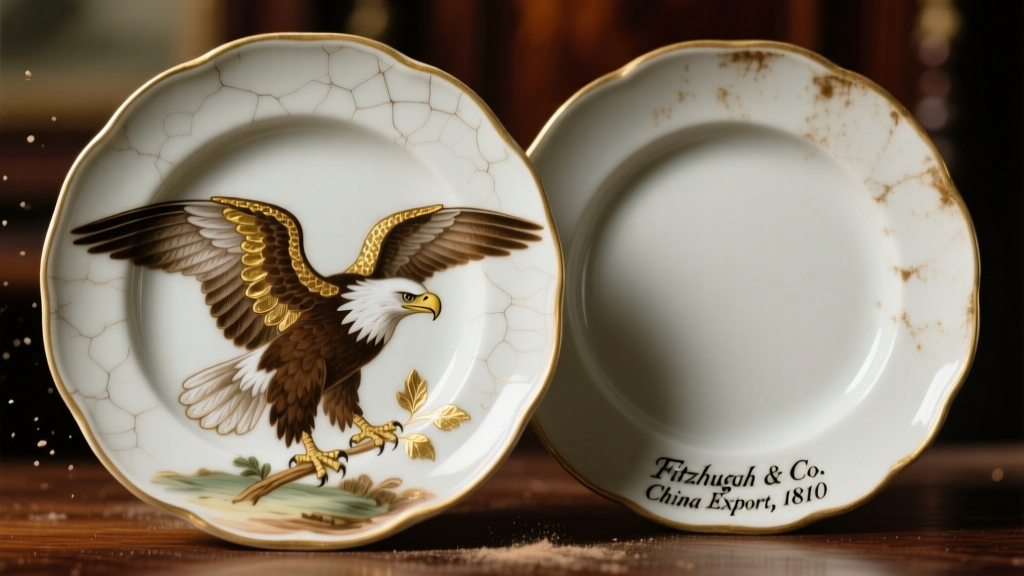
Chinese Export Plate: American Eagle Fitzhugh Pattern, Early 19th Century, 9¾-Inch Pair — A Study in Transcultural Craftsmanship and Federal-Era Iconography
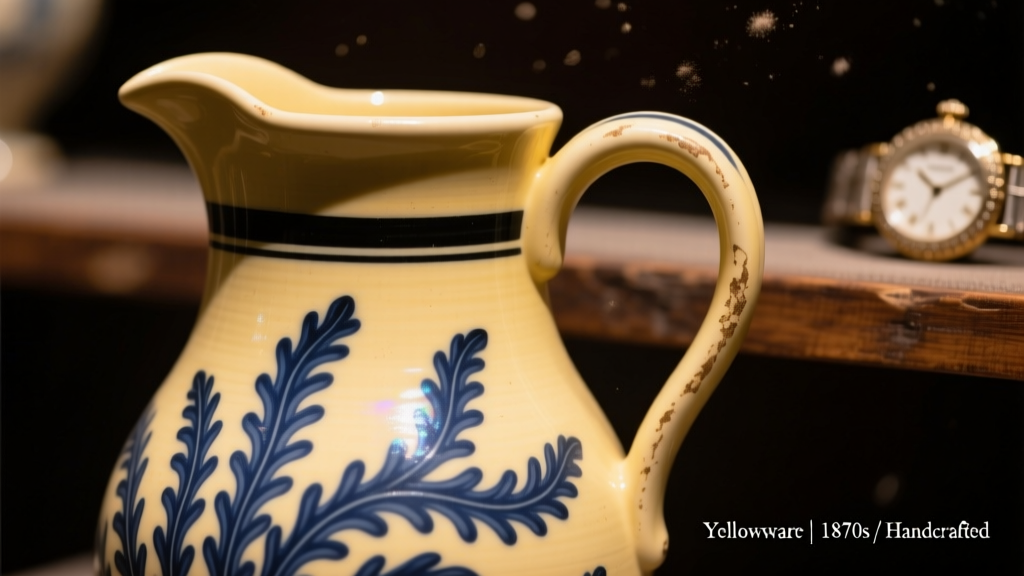
Yellowware Pitcher with Seaweed Design, Black Stripe, and Secondary Handle Under the Spout: A Collector’s Deep Dive
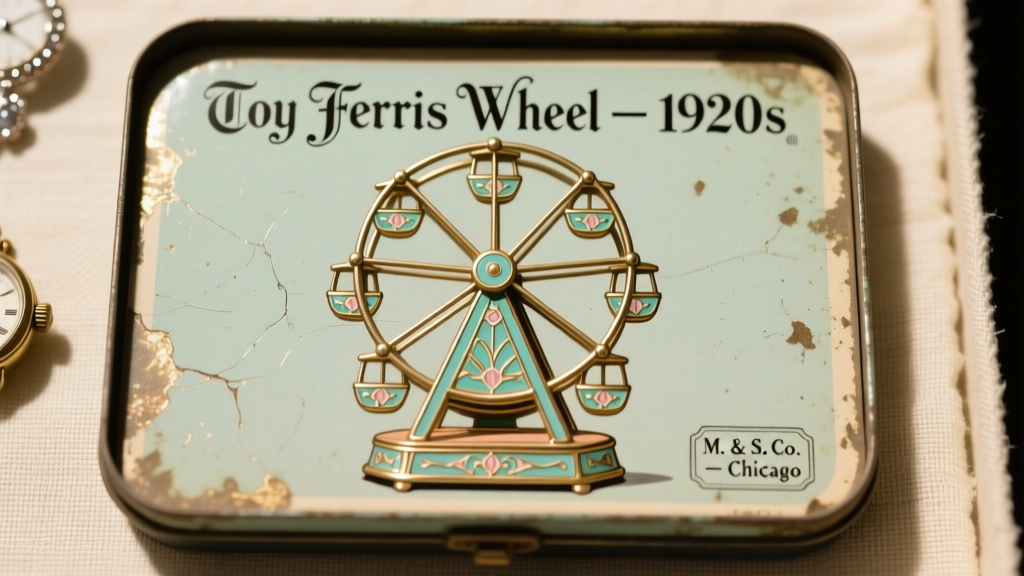
Chein’s 1930s Tin Lithograph Toy Ferris Wheel: A Collector’s Study of Design, Provenance, and Market Value
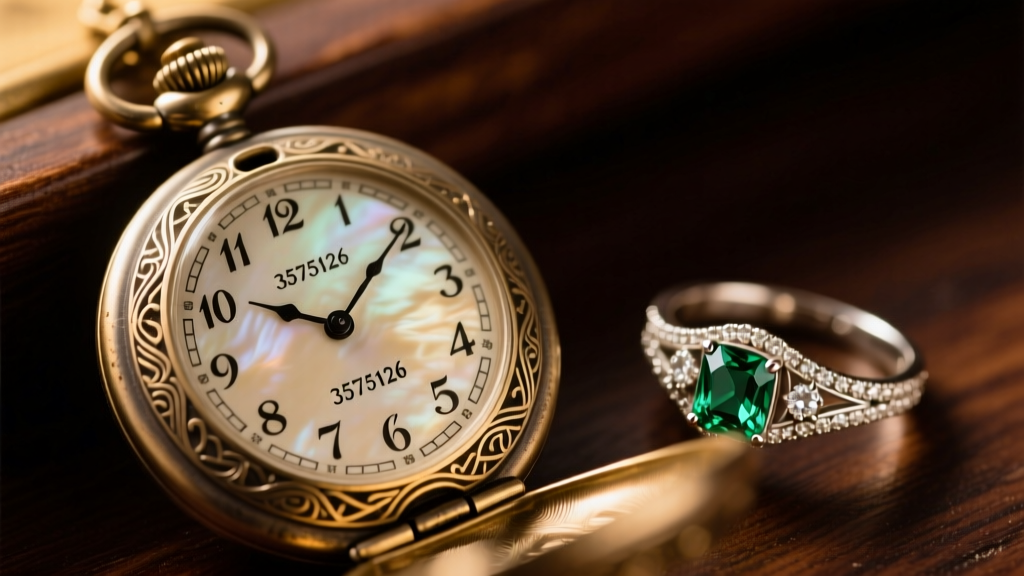
Lot 3575126: A 1948 Patek Philippe Ref. 1463 'Tropical Dial' Chronograph — Provenance, Technical Anatomy, and Market Significance
Lladro Figurine 'Snow White With Apple' (No. 5067): A Collector’s Appraisal of Rarity, Craftsmanship, and Market History
Burmese Glass Tumbler by Mt. Washington: A Collector’s Guide to American Art Glass Innovation
Franciscan Bowl Vegetable Meadow Rose 9-Inch: A Collector’s Guide to the Iconic Mid-Century Pattern