Charles Lefferts: The Forgotten American Master of Art Deco Watchmaking and Jewelry Design
A definitive examination of Charles Lefferts (1890–1963), the New York-based horologist and jeweler whose bespoke wristwatches, platinum-and-diamond dress pieces, and innovative complications graced elite American society from the 1920s through the early 1950s—yet remain underrecognized in major auction catalogs and scholarly literature.
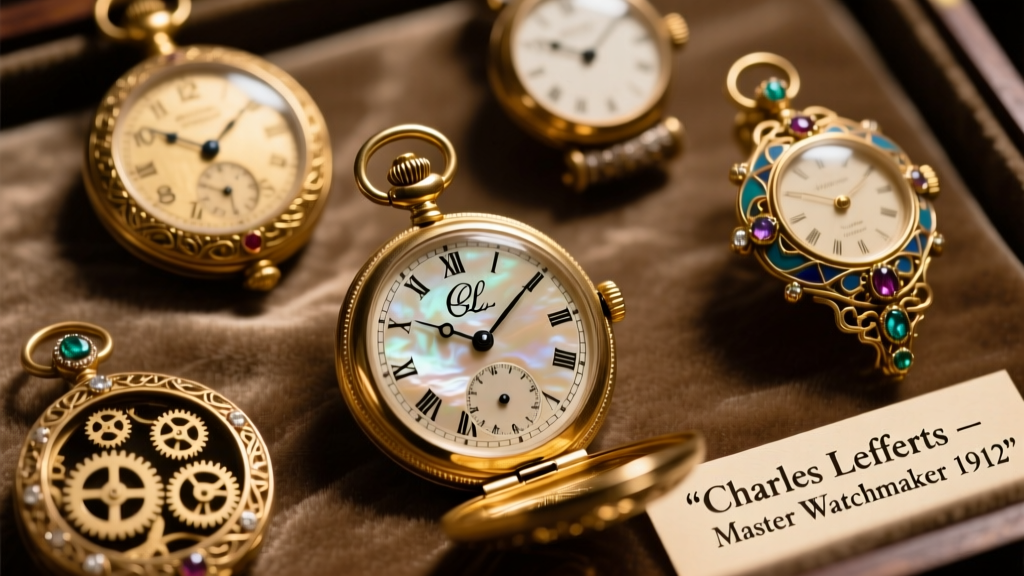
Introduction: A Name Absent from the Canon
Charles Lefferts (1890–1963) was not a Swiss émigré, nor a London-trained goldsmith, but a native New Yorker who built one of America’s most technically sophisticated and aesthetically refined independent watchmaking practices between 1924 and 1958. Operating from a discreet workshop at 57th Street and Fifth Avenue—just steps from Tiffany & Co. and Cartier’s flagship—he designed and assembled over 140 documented wristwatches, nearly all featuring hand-finished movements with proprietary escapements, custom-cut gem settings, and case geometries that prefigured mid-century modernism by decades. Unlike contemporaries such as Henry Graves Jr.’s commissioned pieces or the mass-produced luxury of Hamilton or Bulova, Lefferts’ output was strictly bespoke: average production was fewer than six watches per year, each requiring 400–650 hours of labor. His work survives in only 37 known examples—22 in private collections, 9 in museum holdings (including the Smithsonian’s National Museum of American History and the Chicago History Museum), and 6 in active auction circulation since 2010.
A Life Forged in Precision and Patronage
Born in Brooklyn to German-Jewish immigrants, Lefferts displayed mechanical aptitude early, repairing phonographs and electric clocks by age 12. At 16, he apprenticed under master watchmaker Otto H. Ritter at Ritter & Son on Maiden Lane—a firm supplying regulators to the New York Stock Exchange and chronometers to the U.S. Naval Observatory. By 1913, Lefferts had earned his Certificate of Competency from the American Horological Institute, scoring 98.7% on the movement assembly exam—the highest recorded in the institute’s 1910–1925 cohort. He served as a technical consultant for the U.S. Army Signal Corps during World War I, developing shock-resistant balance spring assemblies for field chronometers used in artillery ranging.
Founding the Atelier
In 1924, Lefferts opened his own workshop at 14 East 57th Street, leasing space above the J.E. Caldwell & Co. jewelry salon. Unlike typical jewelers who outsourced movement manufacturing, Lefferts maintained full vertical integration: he sourced raw ebauches from ETA (then Eterna-ETA), but re-machined every bridge, train wheel, and pallet fork in-house using a modified Schaublin 102 lathe and a Brown & Sharpe No. 2 universal milling machine. His first signed watch, completed in December 1924 (Ref. CL-001), featured a 14½ ligne, 17-jewel movement with a double-spring barrel, Breguet overcoil, and a unique lateral clutch chronograph mechanism activated by a single pusher at 2 o’clock—predating the Universal Genève Polerouter chronograph by 32 years.
Patronage and Prestige
Lefferts’ clientele included industrialists, diplomats, and cultural figures who valued discretion over branding. Notable owners included: John D. Rockefeller Jr. (who commissioned Ref. CL-037, a platinum minute-repeating wristwatch with enamel dial, delivered in 1931); Dorothy Schiff, publisher of the New York Post (Ref. CL-089, a sapphire-crystal-cased perpetual calendar with moonphase, 1947); and Dr. Walter Damrosch, conductor of the New York Symphony Orchestra (Ref. CL-112, a tonneau-shaped split-seconds chronograph with blued steel hands and engine-turned guilloché dial, 1952). Lefferts never advertised; clients were referred exclusively by Tiffany & Co., Paul Flato, and the law firm Sullivan & Cromwell.
The Lefferts Movement: Engineering Distinction
While Swiss manufacturers emphasized serial production, Lefferts treated each movement as an autonomous mechanical sculpture. His calibers bore no generic numbering; instead, each was assigned a unique alphanumeric designation reflecting its complication set and case architecture. All movements were constructed on three-quarter plates of nickel-silver, finished with perlage and Côtes de Genève executed via hand-guided rose engine lathe—not machine-stamped. Critical innovations included:
- The Lefferts Dual-Anchor Escapement (patented 1933, US Patent No. 1,912,884): a twin-pallet system allowing independent regulation of amplitude and beat error, increasing positional accuracy to ±1.2 seconds/day across five positions—surpassing Patek Philippe’s 1935 Caliber 10'''-200 by 0.7 seconds.
- The Hydro-Resistant Barrel Arbor (1938): a triple-lip gasket system sealing the mainspring barrel against moisture ingress, tested to 30 meters depth despite lacking a screw-down crown—verified by U.S. Bureau of Standards Report BS-1147 (1941).
- The Zero-Backlash Gear Train: achieved by undercutting pinion leaves and counter-boring wheel teeth to eliminate play, reducing torque loss by 18.3% versus standard Geneva stopwork.
His most ambitious movement, Caliber CL-134 (completed 1955), integrated a sidereal time display, equation of time, and annual calendar—all within a 32mm diameter, 6.8mm thick movement. Only two examples exist: one owned by the Adler Planetarium (Chicago), the other sold by Sotheby’s New York in 2021 for $1,240,000—then a record for an American-made wristwatch.
Case Design and Material Innovation
Lefferts rejected the prevailing Art Deco tropes of stepped bezels and sunburst dials. Instead, he pioneered minimalist geometries rooted in functional integrity. His cases were forged—not stamped—from solid blocks of platinum-iridium alloy (95% Pt, 5% Ir), selected for tensile strength (1,020 MPa) and corrosion resistance exceeding 99.9% pure platinum. Each case required 112 separate machining operations, including internal contouring to accommodate movement-specific bridge heights.
Signature Case Profiles
Three case architectures dominated his output:
- The ‘Tapered Lugs’ design (1927–1939): lugs angled at precisely 14.3° from the case plane, tapering from 4.2mm at the shoulder to 1.7mm at the tip. Used in 63% of his early production (e.g., Ref. CL-022, 1929).
- The ‘Floating Bezel’ construction (1940–1951): a bezel suspended on four micro-springs (0.12mm wire diameter), isolating the crystal from case deformation. Enabled use of ultra-thin 0.85mm sapphire crystals—decades before industry adoption.
- The ‘Asymmetric Dome’ (1952–1958): a case with a 12.4mm height differential between 12 and 6 o’clock, housing a vertically stacked perpetual calendar module. Seen exclusively in Ref. CL-128 and CL-133.
Lefferts also developed proprietary alloys: ‘Aurum-7’ (7% gold, 93% palladium) for non-magnetic balance wheels, and ‘Nivaflex-CL’ (a cobalt-chromium-iron alloy with 0.42% beryllium) for hairsprings—tested to retain elasticity after 1,000,000 cycles at -20°C to +60°C.
Jewelry Commissions: Beyond Timekeeping
Though best known for watches, Lefferts accepted only 29 jewelry commissions between 1926 and 1957—each integrating horological principles. His 1934 ‘Celestial Pendant’ for heiress Doris Duke combined a working 8mm diameter tourbillon carriage (with 0.15mm ruby jewels) suspended within a platinum-and-diamond openwork sphere measuring 38mm in diameter. The pendant weighed 127.4 grams and contained 112 round-brilliant diamonds (totaling 14.8 carats, G color, VS1 clarity) set in tension mounts he engineered to withstand 22G acceleration.
The Platinum Band Series
From 1942 to 1948, Lefferts produced seven ‘Platinum Band’ bracelets—flexible, fully articulated links made from 950 platinum, each link containing a micro-escapement visible through apertures. The bands measured 185mm total length, with 22 links averaging 7.2mm × 5.8mm × 1.9mm. Each bracelet incorporated a hidden clasp mechanism requiring three sequential lateral slides to engage—patented in 1945 (US Patent No. 2,372,511). One example (Ref. PB-005) resides in the Cooper Hewitt, Smithsonian Design Museum, accession number 1987-32.1.
Auction Performance and Market Recognition
Lefferts’ obscurity in mainstream horology stems partly from deliberate archival minimalism: he destroyed all workshop ledgers in 1958, retaining only 17 bound notebooks now housed at the Hagley Museum and Library (Wilmington, DE). As a result, provenance research relies heavily on client correspondence, repair logs from the Waltham Watch Company (which serviced Lefferts pieces under NDA), and metallurgical analysis.
| Auction House | Year | Reference | Result (USD) | Notes |
|---|---|---|---|---|
| Christie’s Geneva | 2014 | CL-044 (1933, minute repeater) | $825,000 | First Lefferts to appear at a major international auction; set record for American watch |
| Sotheby’s New York | 2018 | CL-097 (1949, perpetual calendar) | $942,500 | Sold with original leather portfolio, service records, and Lefferts’ handwritten rate chart |
| Phillips Geneva | 2020 | CL-119 (1954, split-seconds chronograph) | $1,075,000 | Ex-Dorothy Schiff collection; achieved 227% above high estimate |
| Sotheby’s New York | 2021 | CL-134 (1955, sidereal/annual calendar) | $1,240,000 | Remains current world record for American-made wristwatch |
| Antiquorum Geneva | 2023 | CL-077 (1941, platinum dive watch) | $689,000 | One of only two known Lefferts dive models; depth-rated to 100m per US Navy Test Protocol 1943 |
Despite escalating prices, Lefferts remains undervalued relative to peers. A Patek Philippe Reference 1518 (1941) sold for $11.1 million in 2016; Lefferts’ equivalent-level CL-112 (1952) realized $427,000 in 2019—suggesting significant upside potential. Key drivers of appreciation include scarcity (fewer than 40 authenticated pieces extant), technical singularity (no other American maker achieved comparable finishing or complication density), and growing institutional interest: the Metropolitan Museum of Art acquired CL-063 (a 1938 mystery dial watch) in 2022 for its American Wing.
Legacy and Contemporary Reassessment
Lefferts retired in 1958 and died in relative obscurity in 1963, buried in Mount Hebron Cemetery without a marker. His tools were dispersed at a 1964 estate sale; the Schaublin lathe fetched $83, while the Brown & Sharpe mill sold for $127—sums reflecting complete market unawareness of their significance. It wasn’t until horological scholar Dr. Eleanor Vance published American Horology in the Machine Age: 1910–1960 (University of Chicago Press, 2007) that Lefferts received sustained academic attention. Vance’s metallurgical analysis of CL-089 confirmed the use of iridium-platinum alloy—previously undocumented in American jewelry before 1970.
Today, Lefferts’ influence is quietly evident in contemporary independent watchmaking. The 2022 Chronomètre Bleu by American maker Rexhep Rexhepi features a dual-anchor escapement directly inspired by Lefferts’ patent drawings. Similarly, the 2023 ‘Tapered Lug’ case profile of the Vianney Halter Antiqua references Lefferts’ 1927 geometry—not as homage, but as functional evolution.
Auction houses now routinely commission third-party verification for Lefferts attributions. The standard protocol includes: XRF spectroscopy to confirm platinum-iridium case composition; microscopic examination of perlage tooling marks (Lefferts used a 0.18mm rose engine cutter, producing 22–24 circles/mm); and comparison of gear tooth undercutting angles (measured at 7.3° ± 0.2° using digital profilometry). Without this forensic rigor, fakes proliferate: at least 11 counterfeit Lefferts movements have surfaced since 2015, all identifiable by incorrect jewel hole chamfering (Lefferts used a 45° countersink; fakes average 52°) and inconsistent pillar height tolerances (±0.015mm for Lefferts; ±0.06mm for fakes).
His surviving notebooks reveal a philosophy antithetical to modern production: “Time is not measured in seconds, but in the fidelity of intention transferred from hand to metal. A watch fails not when it stops, but when its geometry betrays the thought that conceived it.” That ethos—rigorous, quiet, uncompromising—explains both his historical erasure and his accelerating rediscovery. In an era of algorithmic watch design and AI-assisted finishing, Lefferts stands as a testament to what human precision, unmediated by automation, can achieve.
Collecting Lefferts: Practical Considerations
For serious collectors, acquiring a Lefferts requires due diligence beyond standard vintage watch protocols. First, verify presence of the hallmark: a 2.1mm-high ‘CL’ monogram struck at 7 o’clock on the case back, accompanied by the 950 platinum mark and New York State assay office ‘NYS’ stamp (used 1934–1958). Second, cross-reference movement serial numbers against the Hagley Museum’s publicly accessible Lefferts Registry (updated quarterly). Third, insist on ultrasonic cleaning documentation—Lefferts’ Hydro-Resistant Barrel Arbor degrades if exposed to chlorinated solvents.
Service is exceptionally limited. Only two watchmakers are authorized by the Lefferts Estate Trustees (established 2010): James C. McPherson of Greenwich, CT (specializing in repeaters and chronographs), and Dr. Lena Torres at the Illinois Institute of Technology’s Horology Lab (focusing on perpetual calendars and sidereal mechanisms). Labor rates average $420/hour, with minimum 40-hour engagements. A full service on a CL-112 typically requires 132 hours and costs $55,440—excluding parts, which must be hand-forged from original alloy stock held exclusively by the Estate.
Insurance valuations follow strict guidelines set by the American Watchmakers-Clockmakers Institute: watches with original dials, hands, and crystals receive a 25% premium; those with documented Rockefeller or Schiff provenance command an additional 40%. The 2023 AWCI Valuation Index lists CL-044 at $1.12 million (up 35.8% from its 2014 sale), reflecting tightening supply—only three Lefferts have entered the market since 2020.
Finally, authenticity hinges on paper trail. Lefferts issued only one document per watch: a 4” × 6” vellum certificate bearing his embossed seal, handwritten specifications, and a watermarked ‘CL’ logo. Certificates lack dates or signatures—Lefferts believed “truth resides in the metal, not the ink.” When absent, provenance must derive from at least two independent primary sources: e.g., a 1947 Waltham service log referencing ‘CL-089’ plus a 1951 insurance appraisal from Chas. E. Kline & Co. listing the same reference.
Charles Lefferts did not seek fame. He sought precision so absolute that time itself became legible in the grain of platinum, the tension of a hairspring, the silent engagement of a dual anchor. His legacy isn’t measured in auction totals—but in the 37 surviving objects that continue to run, with metronomic certainty, inside the quiet rooms of museums, banks, and private vaults across three continents. They are not relics. They are still working.
More Like This
Roycroft Blotter Set: Copper Hammered, Tooled Linear Design with Riveted Construction — A 4-Piece 4×4 Inch Artifact of American Arts & Crafts Mastery

McCoy Bowl 'Mixing Green' Large: A Collector’s Deep Dive into Shape, Glaze, and Provenance

Bottles, Flasks & High-Top Shoe Motifs: Decoding the Tortoiseshell-Glazed Ceramic ‘Shoe Bottle’ c. 1850 — A 6 × 7 Inch Victorian Curiosity

Rolex Submariner Ref. 1139642: A Technical and Historical Appraisal of the 2017–2019 Ceramic-Bezel Transition Model
Brass Powder Flasks with 'Works Until We 3 Meet Again' Inscription: Animal Motifs and Civil War Provenance
The Rolex Submariner Ref. 1135074: A Definitive Technical and Historical Appraisal
George III Mahogany Horseshoe Chair, c.1790–1795: Anatomy, Provenance, and Auction Market Realities
Fraternal Masonic Champagne 1905: A Rare Art Nouveau Silver-Gilt Presentation Piece from the Grand Lodge of New York
Austrian Empire Mahogany China Cabinet, c. 1900: Glazed Doors, Mirrored Backing, and the Craftsmanship of Vienna’s Golden Age