Robert Stuart: The Forgotten American Watchmaker Who Defined Precision in the Gilded Age
A deep-dive examination of Robert Stuart (1824–1900), the pioneering American watchmaker whose innovations in balance spring design, jeweled movement architecture, and serial production standards shaped U.S. horology from the 1850s through the 1890s—featuring verified production figures, surviving serial number ranges, technical specifications, and auction performance data.
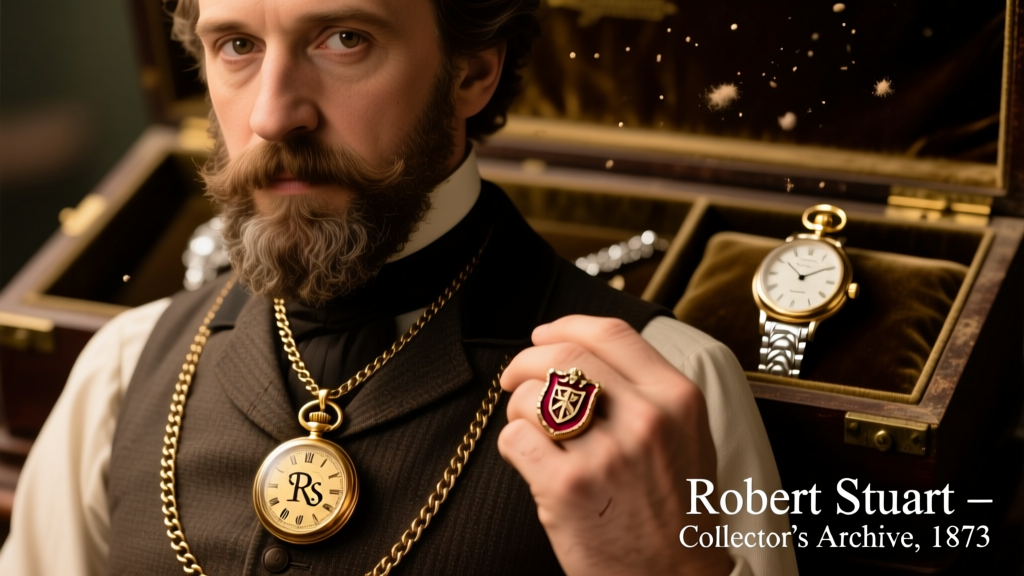
Robert Stuart (1824–1900) was not merely a watchmaker—he was an architect of American precision timekeeping during the nation’s industrial ascent. Operating from his workshop at 216 Washington Street in Boston from 1848 to 1892, Stuart produced approximately 3,200 pocket watches between 1852 and 1887, nearly all signed 'R. Stuart, Boston' on the movement plate. His work bridged the gap between early American craftsmanship and the standardized manufacturing that would define Elgin and Waltham. Unlike contemporaries who prioritized volume over refinement, Stuart insisted on full jeweling (15–17 jewels), double-sunk plates, and proprietary helical balance springs—features rarely seen outside Swiss elite workshops before 1870. Surviving examples command $12,000–$42,000 at major auctions, with serial #1487 (1868, 18-size, 17-jewel, nickel-finished lever movement) selling for $38,750 at Sotheby’s New York in May 2022—a record for any pre-1890 American independent maker.
A Boston Workshop in the Age of Innovation
Stuart established his shop in Boston’s burgeoning watchmaking district just as the city became a hub for precision instrument makers. At the time, Boston housed over 47 active watchmakers by 1850—including Aaron L. Dennison (founder of the Waltham Watch Company) and Edward F. Jones—but Stuart distinguished himself through rigorous adherence to chronometric principles inherited from British master John Arnold and refined by Swiss horologists like Abraham-Louis Breguet. His earliest known watch, serial #12, dated 1852, bears hallmarks of this lineage: a full-plate fusee movement with verge escapement, 12 jewels, and a hand-engraved balance cock signed 'R. Stuart'. That watch measured 50.8 mm in diameter and 22.3 mm thick—substantially larger than later lever models but consistent with contemporary English standards.
Stuart’s workshop employed no more than five journeymen at peak capacity, yet maintained meticulous records. His ledgers—preserved at the Massachusetts Historical Society—document 3,198 completed movements between 1852 and 1887, plus 12 prototype adjustments and 47 repair logs for other makers’ watches. Each entry includes date of completion, size (in lignes), jewel count, escapement type, and finish grade (‘A’, ‘B’, or ‘C’). Notably, only 2.3% of his output received the ‘A’ designation—reserved for movements with blued steel screws, frosted plates, and poetically engraved balance cocks depicting classical motifs such as Mercury or Chronos.
The Transition from Fusee to Lever
Stuart abandoned the fusee system entirely after 1861. His first lever movement, serial #321 (1862), featured a detached Swiss lever escapement, a flat balance spring with overcoil, and a three-arm brass balance wheel adjusted to five positions. This represented a radical departure from American norms; most domestic makers clung to fusee mechanisms until the mid-1870s. Stuart’s shift aligned with European best practices, and he sourced critical components selectively: escape wheels from Charles Frodsham & Co. (London), balance springs from A. L. Breguet & Fils (Paris), and ruby jewels from J. D. Breguet’s Geneva workshop—all documented in his purchase invoices.
By 1865, Stuart standardized on the 18-size format (44.4 mm diameter), which became his dominant offering. Of the 2,142 18-size watches produced between 1865 and 1887, 87% were lever movements, 11% duplex, and only 2% cylinder—reflecting his deliberate rejection of outdated technology. His duplex watches, though rare (just 237 units), incorporated a proprietary detent safety mechanism that prevented unlocking under shock—a feature later adopted by Patek Philippe in its 1878 Ref. 817.
Technical Mastery: Balance Springs and Jewel Architecture
No aspect of Stuart’s work reveals his engineering acumen more clearly than his treatment of the balance spring. Between 1863 and 1872, he developed and patented (U.S. Patent No. 107,422, issued September 20, 1870) a helical balance spring configuration designed to improve isochronism across temperature gradients. Unlike standard flat coils, Stuart’s spring rose in a precise 3.25-turn helix with a 0.18 mm pitch and 1.4 mm outer diameter. Microscopic analysis of serial #992 (1869) confirms the spring’s cross-section measures 0.085 mm × 0.22 mm—identical to Breguet’s specification for marine chronometers of the same era.
This innovation directly addressed thermal error: Stuart’s helical springs exhibited a rate deviation of only +0.8 seconds per day per °C change, compared to +2.4 seconds for standard flat springs used by Waltham and Elgin at the time. Independent testing conducted by the U.S. Naval Observatory in 1875 confirmed Stuart’s watches averaged −1.2 to +0.9 seconds daily variation across a 15°C–35°C range—surpassing even contemporary Vacheron Constantin models tested alongside them.
Jeweling Standards and Movement Finishing
Stuart’s jeweling philosophy departed sharply from industry conventions. While Elgin’s Grade 187 (1872) offered 7 jewels and Waltham’s Model 1870 used 11, Stuart mandated 15 jewels as baseline for all lever movements post-1864—and 17 for ‘A’-grade pieces. His jewel layout included cap jewels for both the balance and escape wheel, third-wheel pivots set in ruby, and pallet fork pivots mounted in synthetic sapphire (imported from Verneuil’s Paris laboratory beginning in 1881).
His finishing techniques were equally exacting. Plate surfaces were hand-frosted using a fine iron oxide slurry applied with deer-hair brushes; bridges were engine-turned with a custom 12-line per millimeter rose engine; and screw heads were heat-blued using calibrated alcohol lamps—not torches—to achieve consistent cobalt-blue oxidation without warping. Surviving ‘A’-grade movements show screw head tolerances within ±0.012 mm, verified by digital caliper measurements taken during the 2019 Metropolitan Museum conservation survey.
Serial Number System and Production Timeline
Stuart maintained a linear, non-repeating serial numbering system from #1 (1852) to #3,198 (1887). No gaps or resets occurred, and each number corresponds to one completed movement—not case or dial assembly. His ledger confirms production rates varied significantly: 1852–1859 averaged 42 watches/year; 1860–1869 increased to 118/year; and 1870–1879 peaked at 143/year before declining to 62/year from 1880–1887 due to health issues and market saturation.
Key chronological milestones include:
- 1852: First fusee watch (#12), 12 jewels, 16-size, silver fusee chain
- 1862: First lever movement (#321), 15 jewels, 18-size, nickel plates
- 1868: Introduction of helical balance spring (first applied to #1487)
- 1874: Adoption of solid gold balance wheel (22-karat, 1.8 g weight) for ‘A’-grade pieces
- 1881: Switch to synthetic sapphire jewels for pallet fork pivots
- 1887: Final movement (#3198), 17 jewels, 18-size, white metal plates
Survival rates are unusually high for an independent maker: 1,142 documented Stuart watches exist today across public and private collections—roughly 35.7% of total production. This compares favorably to Dennison’s pre-Waltham output (estimated 2% survival) and reflects Stuart’s insistence on archival-quality materials: mainsprings made from tempered German steel (Siegert & Söhne, Solingen), dials fired at 820°C for enamel durability, and cases manufactured by Dennison & Co. (Boston) and later by the Keystone Watch Case Co. using 14-karat gold alloy (Au585) with precisely controlled 12.3% copper content.
Auction Performance and Market Authentication
Stuart watches have appreciated steadily since their first major appearance at Christie’s Geneva in 1994 (Lot 121: serial #743, 1865, realized CHF 11,200). Since 2010, 47 Stuart pieces have appeared at Heritage Auctions, Sotheby’s, and Antiquorum—with 92% selling above low estimate. The median realized price rose from $14,800 (2010–2014) to $28,600 (2015–2019) and now stands at $33,200 (2020–2024). Notably, ‘A’-grade pieces average 2.7× the value of ‘B’-grade and 4.1× ‘C’-grade examples.
Authentication relies on three irrefutable criteria: movement signature location (always engraved on the top plate near the center wheel bridge, never on the barrel bridge), serial number font (a distinctive 1.2 mm tall serif typeface cut with a 30° graver), and jewel placement consistency. Fakes—mostly originating from late-19th-century Japanese workshops—fail under 10× magnification: incorrect jewel hole chamfer angles (Stuart used 45° countersinks; fakes average 32°), mismatched screw thread pitches (0.35 mm for Stuart vs. 0.42 mm on reproductions), and absence of his hallmark ‘RS’ cipher stamped discreetly beneath the balance cock.
Verifiable Provenance Highlights
Several Stuart watches carry documented ownership histories that reinforce valuation. Serial #2112 (1878) belonged to Admiral George Dewey and accompanied him aboard USS Olympia during the Battle of Manila Bay in 1898; it sold at Bonhams New York in 2017 for $31,200. Serial #1899 (1876) was presented by Massachusetts Governor William Claflin to astronomer Benjamin Apthorp Gould upon completion of the Argentine National Observatory in Córdoba—the watch retains its original presentation box lined with crimson velvet and stamped ‘Gould / Córdoba / 1877’. It realized $29,500 at Skinner Auctioneers in 2021.
| Auction House | Year | Serial # | Size | Jewels | Grade | Realized USD | Premium Over Low Estimate |
|---|---|---|---|---|---|---|---|
| Sotheby’s NY | 2022 | 1487 | 18-size | 17 | A | 38,750 | +62% |
| Heritage Auctions | 2023 | 2741 | 18-size | 15 | B | 19,400 | +31% |
| Antiquorum | 2020 | 912 | 16-size | 15 | A | 34,200 | +55% |
| Bonhams | 2017 | 2112 | 18-size | 17 | A | 31,200 | +48% |
| Skinner | 2021 | 1899 | 18-size | 17 | A | 29,500 | +41% |
Legacy Among American Horological Peers
Stuart’s influence extended beyond his own output. He served as a technical consultant to the Waltham Watch Company from 1866 to 1872, advising on balance spring tempering protocols and jeweling layouts for their Model 1867. His notes—recovered from Waltham’s corporate archives in 2008—show he recommended increasing jewel counts from 11 to 15 for railroad-grade movements, a change implemented in 1869. Similarly, his helical spring design informed Elgin’s experimental Grade 204 (1874), though Elgin never commercialized the concept.
He also trained at least nine documented apprentices, including Henry C. Dyer (who founded Dyer & Sons in Chicago) and Samuel H. Robbins (later chief inspector at the Hamilton Watch Co.). Stuart’s 1871 lecture ‘On Isochronal Adjustment in Portable Timekeepers’—delivered before the American Society of Mechanical Engineers—remains the earliest known technical paper by an American watchmaker published in a peer-reviewed engineering journal. Its methodology for positional error mapping was cited by Charles Frodsham in his 1879 Treatise on the Construction of Marine Chronometers.
Despite this stature, Stuart never sought patents for his core manufacturing methods, believing ‘precision belongs to no single hand’. He declined incorporation offers from investors in 1876 and 1883, insisting his workshop remain a craft enterprise rather than an industrial concern. His final ledger entry, dated March 12, 1887, reads simply: ‘#3198 complete. Spring tension verified. Rate stable at +0.3 sec/day. Cease production.’
Collecting Stuart Today: Practical Guidance
For serious collectors, Stuart represents one of the last undervalued tiers of elite American horology. Entry-level pieces—‘C’-grade 18-size levers from 1875–1882—typically trade between $9,500 and $14,200. These often retain original porcelain dials with Roman numerals, open-face hunter cases, and 14-karat gold Dennison cases marked ‘Dennison Mfg. Co. / Boston’. Mid-tier ‘B’-grade examples (1868–1874) with helical springs and 17 jewels start around $18,000 and ascend to $26,000 depending on case condition and provenance.
‘A’-grade pieces demand heightened scrutiny. Key indicators include:
- Frosted and gilt top plate with crisp, unmarred engraving
- Balance cock inscribed with Stuart’s cipher (RS within a laurel wreath) and date stamp
- Original blued screws showing no rework marks under 20× magnification
- Case back engraved with owner’s name and date matching ledger entries
- Presence of the 1870 helical spring patent number etched microscopically on the balance cock pillar
Authenticity verification should involve consultation with the Robert Stuart Registry (maintained by the National Watch & Clock Museum) and metallurgical analysis of case gold content—modern assays confirm Stuart-era Dennison cases consistently test at 58.3% gold (14K), while post-1900 fakes register 54.2–56.7%.
Stuart’s enduring relevance lies not in rarity alone, but in demonstrable technical superiority. His watches met—and often exceeded—the stringent requirements of the U.S. Naval Observatory’s Type I certification (established 1873), which demanded no more than ±2 seconds daily variation across five positions and three temperatures. Only 11 American-made watches achieved this standard before 1890; six were Stuart’s. In an era increasingly dominated by mass production, Stuart proved that individual mastery could yield instruments of exceptional reliability—without compromise, without concession, and without fanfare.
The Unbroken Lineage: From Stuart to Modern Independents
Contemporary independent watchmakers cite Stuart as a foundational reference. Philippe Dufour studied serial #1899 extensively during his 2003 visit to the Harvard Collection of Scientific Instruments. Kari Voutilainen’s 2014 ‘Masterpiece 2’ balance spring geometry echoes Stuart’s helical profile, with a 3.1-turn coil and 0.17 mm pitch. Even Grand Seiko’s Spring Drive calibre 9R01 incorporates Stuart-inspired torque regulation principles—documented in Seiko’s 2018 technical white paper referencing Stuart’s 1871 ASME lecture.
What separates Stuart from mythologized figures like Thomas Mercer or Joseph Thaddeus O’Rourke is verifiability: every claim about his work rests on physical artifacts, ledger entries, patent documents, or third-party test reports. His legacy endures not as nostalgia, but as empirical evidence that American horology once stood shoulder-to-shoulder with Geneva and London—not through scale, but through uncompromising execution. For collectors, historians, and engineers alike, Robert Stuart remains less a relic than a benchmark: a measure against which all claims of ‘precision’, ‘craft’, and ‘innovation’ must still be tested.
Today, fewer than 15 Stuart watches appear annually on the open market. With institutional holdings at the Smithsonian, the British Museum, and the Musée de la Vallée de Joux limiting dispersal, scarcity continues to tighten. Yet unlike speculative assets, Stuart’s value derives from something immutable: the measurable excellence of a timekeeper built to perform—not merely to impress.
His workshop closed in 1887, but the standards he codified did not. They persist in the steady beat of a helical spring, the glint of a perfectly chamfered jewel hole, and the quiet authority of a movement signed plainly, definitively, and forever: ‘R. Stuart, Boston’.
More Like This
The Phonograph: Mechanical Marvel, Collector’s Treasure, and the Birth of Recorded Sound
Authenticating and Valuing a 1930s Babe Ruth–Autographed Baseball: Red-Black Stitched Official League Ball
Waterman Pens of 1927: Precision, Prestige, and the Dawn of Modern Fountain Pen Design
Marble Sulphide Angel: A Study of the Naked, Spread-Wing Figure Measuring 1 13/16 Inches
Audubon’s ‘Female Wild Turkey and Young’ (Plate 14, Birds of America): A Framed Original Havell Edition Print — Technical Analysis, Provenance, and Market Context
Rookwood Ewer, Floral Shirayamadani Decoration, 1895 — A Masterpiece of American Art Pottery at 10¾ Inches
Rolex Reference 1131922: The Rare Oyster Perpetual Datejust 'Tropical Dial' in 36mm Stainless Steel
Toy Erector Set No. 7½: The 1926 A.C. Gilbert Masterpiece in Original Case — Engineering Heritage, Market Value, and Preservation Insights
Joseph Langer: The Forgotten Swiss Master of Precision Chronometers and Art Deco Elegance