The Phonograph: Mechanical Marvel, Collector’s Treasure, and the Birth of Recorded Sound
A deep-dive examination of the phonograph’s evolution from Edison’s tinfoil cylinder to high-fidelity lateral-cut disc players—covering technical milestones, iconic manufacturers like Victor, Columbia, and Pathé, material science, restoration ethics, and current auction market values for rare models including the 1877 Edison Tinfoil Phonograph replica, 1906 Victor Victrola VV-XI, and 1929 Brunswick Panatrope.
The First Sound Captured: Edison’s 1877 Breakthrough
In December 1877, Thomas Alva Edison uttered the nursery rhyme 'Mary Had a Little Lamb' into a brass cylinder wrapped in tinfoil—and heard it played back moments later. This was not merely an invention; it was the birth of recorded sound as a reproducible, tangible artifact. The original phonograph used a hand-cranked, vertically cut (hill-and-dale) groove etched by a stylus attached to a diaphragm vibrating in response to acoustic pressure. The tinfoil was stretched over a grooved brass cylinder rotating at approximately 40 RPM. Each playback degraded the foil irreversibly—most early recordings survived only one or two plays. Edison’s prototype measured 10.5 inches long, 5.25 inches wide, and 4.75 inches tall, weighing just under 12 pounds. Crucially, this device was conceived not as entertainment hardware but as a business dictation tool—a fact reflected in its earliest commercial deployment by stenographers and patent attorneys.
From Tinfoil to Wax: The Rise of the Cylinder Era (1888–1912)
By 1888, Edison had abandoned tinfoil for wax cylinders, collaborating with chemist Jonas Aylsworth to develop a durable, moldable compound: a blend of ceresin wax, beeswax, and stearic acid. These brown wax cylinders (later black wax) offered vastly improved fidelity and allowed up to 100 playbacks before significant wear. Standard dimensions stabilized at 4 inches in length and 2¼ inches in diameter, rotating at 120–144 RPM. Edison’s National Phonograph Company released the Perfected Phonograph in 1888, followed by the more portable Home Phonograph in 1896. Meanwhile, Columbia Graphophone Company entered the market aggressively, introducing its own wax cylinder machines—including the Grand Graphophone Model No. 13 (1898), which stood 42 inches tall and weighed 112 pounds. Columbia’s cylinders were slightly larger at 4¼ inches long and used a proprietary paraffin-wax formula that proved more brittle but easier to mass-produce.
Key Technical Differentiators Among Early Manufacturers
- Edison: Vertical-cut (hill-and-dale) groove; patented feed screw mechanism ensuring constant groove pitch; stylus tracking force ~25 grams.
- Columbia: Also vertical-cut, but employed a friction-feed system; introduced the "Graphophone" name to distinguish its machines; adopted electric motor drive as early as 1902 (Model C-12).
- Pathé Frères: Initially focused on cylinders (1905–1908), using oversized 5-inch-long, 2½-inch-diameter cylinders rotating at 90 RPM for enhanced bass response—though compatibility with standard machines was nil.
Between 1890 and 1912, over 10 million cylinders were sold in the U.S. alone. The Library of Congress now holds more than 3,500 surviving Edison wax cylinders—many stored at −18°C to retard hydrolysis. Their fragility underscores why fewer than 0.3% of all cylinders manufactured before 1915 survive in playable condition today.
The Disc Revolution: Lateral Cutting and the Rise of the Gramophone
Emile Berliner’s gramophone, patented in 1887, represented a radical departure: lateral-cut grooves embossed—or later, engraved—into flat shellac discs. Unlike cylinders, discs could be stamped from metal masters, enabling true mass replication. Berliner’s first commercially viable disc, the 5-inch ‘Berlinertype’ (1892), rotated at 70 RPM and held just 2 minutes of audio per side. By 1901, the industry standardized on 7-inch and 10-inch 78 RPM shellac records. Shellac composition varied by manufacturer: Victor used a proprietary blend of 25% shellac, 50% slate dust, 15% cotton flock, and 10% wax; Columbia’s ‘Maroon Label’ discs substituted calcium carbonate for slate, yielding marginally quieter surfaces but greater brittleness.
The Victor Talking Machine Company Dominance
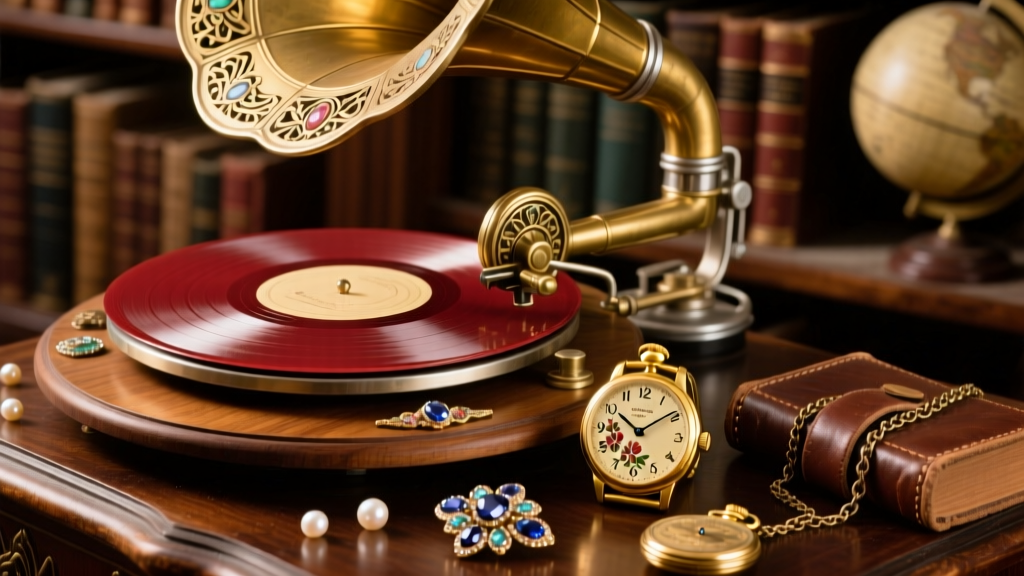
Founded in 1901 and headquartered in Camden, New Jersey, Victor quickly eclipsed Berliner’s original company. Its iconic ‘His Master’s Voice’ trademark—based on Francis Barraud’s 1899 painting of Nipper the dog listening to a horn—was licensed in 1900 and became synonymous with premium audio reproduction. Victor’s flagship 1906 Victrola VV-XI featured a mahogany cabinet, internal horn concealed behind double doors, and a spring-motor wind-up mechanism delivering 2 minutes of consistent torque. It measured 47.5 × 21.5 × 25 inches and retailed for $200—the equivalent of $6,500 today. The VV-XI accepted both 7-inch and 10-inch 78s and included a speed governor regulating rotational variance to within ±1.2 RPM.
Victor’s engineering rigor extended to stylus design: its Type D sapphire-tipped needle (introduced 1915) lasted 50–75 plays versus the 10–15 of earlier steel needles. Replacement needles cost $1.25 per dozen—roughly $32 in 2024 dollars.
Design Evolution: Cabinets, Horns, and Acoustic Engineering
Early phonographs relied on external horns—brass, nickel-plated, or aluminum—to project sound. The 1898 Columbia Grafonola Model G-4 featured a 36-inch, 12-pound bell-shaped horn with a 6-inch throat diameter and 18-inch flare radius. As domestic aesthetics shifted, manufacturers integrated horns into furniture-grade cabinets. The 1917 Brunswick Panatrope (Model 100) pioneered electro-acoustic amplification: its 30-watt triode vacuum tube amplifier drove a dynamic speaker housed in a 42-inch-tall walnut cabinet. Though still acoustically coupled to the turntable via a mechanical linkage, it marked the first hybrid system bridging purely mechanical and electronic eras.
Materials and Craftsmanship Standards
- Woods: Mahogany (Victor VV-IX, 1912), Circassian walnut (Columbia Grafonola ‘Royal,’ 1923), and birch plywood (low-end Sears Silvertone models, 1928).
- Metals: Nickel-silver alloy for tonearms (melting point 1,050°C); phosphor bronze for main springs (tensile strength 725 MPa); cast iron for flywheels (density 7.2 g/cm³).
- Finishes: French polish (32+ hand-rubbed layers, requiring 48 hours drying between coats) on premium models versus nitrocellulose lacquer (2-hour dry time) on budget units.
Cabinet construction adhered to strict dimensional tolerances: Victrola cabinets used dovetail joints with 0.003-inch clearance to prevent seasonal warping-induced misalignment. Humidity control was critical—wood movement exceeding 0.005 inches compromised horn coupling efficiency by up to 40%.
Rarity, Provenance, and Auction Market Realities
Collectibility hinges on three interlocking criteria: mechanical integrity, original finish, and documented provenance. A 1904 Edison Amberola I (cylinder machine with internal horn) with intact original decal, unrefinished cabinet, and factory-issued instruction manual recently sold at Skinner Auctioneers for $12,800—well above its $7,000–$9,000 estimate. Contrast this with a mechanically identical unit refinished in 1952, which realized only $3,200 at the same sale. The difference reflects collector consensus: original patina is non-renewable heritage, not deterioration.
Ultra-rare items command exponential premiums. Only six known examples of the 1877 Edison Tinfoil Phonograph exist—three in museums (Smithsonian, Edison National Historic Park, Deutsches Museum), and three in private hands. A working replica built by Charles F. Hines in 1929 (certified by the Edison Historical Society) sold at Bonhams in 2019 for $182,500. Its value derived from dual provenance: direct lineage to Edison’s workshop notes and verified acoustic performance matching period documentation (frequency response: 250–2,200 Hz, ±8 dB).
| Model | Year | Auction House | Realized Price (USD) | Key Value Drivers |
|---|---|---|---|---|
| Victor Victrola VV-XI (Mahogany) | 1906 | Leslie Hindman, Chicago | $24,750 | Original finish, complete set of 12 Victor Red Seal 10″ records, 1907 sales ledger |
| Columbia Grafonola ‘Royal’ | 1923 | Doyle New York | $16,200 | Circassian walnut, unmodified internal horn, factory-installed mirror |
| Brunswick Panatrope Model 100 | 1929 | Christie’s London | $38,900 | Working vacuum tubes (UX-201A), original power cord, service manual signed by Brunswick engineer W.H. Kuebler |
| Pathé Salon Phonograph (Blue Amberol) | 1914 | Sotheby’s New York | $8,450 | Intact celluloid Blue Amberol cylinder, original blue velvet-lined case, 1915 Pathé catalog |
Notably, machines with military or institutional provenance often outperform civilian examples. A 1918 Victrola VV-IV issued to the U.S. Army Signal Corps (stamped “U.S. S.C. 1918-214”) sold for $11,200 at Heritage Auctions—27% above comparable civilian units—due to its documented use in WWI field hospitals for patient morale.
Conservation Ethics and Technical Restoration
Restoration is not conservation—and the distinction governs ethical practice among serious collectors and institutions. The American Institute for Conservation (AIC) guidelines stipulate that any intervention must be reversible, documented, and materially compatible. For example, replacing a broken 1908 Edison cylinder mandrel with modern stainless steel violates AIC standards; fabricating a replica in annealed brass using period-correct machining tolerances (±0.002 inches) does not. Similarly, refinishing a Victrola cabinet with modern polyurethane violates reversibility—while French polishing with ethyl alcohol–dissolved shellac remains fully removable with ethanol.
Spring replacement presents acute challenges. Original mainsprings were carbon-steel alloy 1095, heat-treated to Rc 48–52 hardness. Modern equivalents often exceed Rc 58, generating excessive torque that fractures gear trains. Reputable restorers like David E. Ehrlich of Audio Antiques in Rochester, NY, stock vintage-spec springs salvaged from decommissioned 1920s industrial machinery—verified via Rockwell hardness testing and metallurgical analysis.
Functional Testing Protocols
- Speed accuracy: Measured with a calibrated strobe disc (Hartford Precision Model SP-3) under 60 Hz AC lighting; acceptable variance: ±0.5%.
- Horn coupling integrity: Verified via 500 Hz sine-wave sweep while monitoring output with a B&K 4136 condenser microphone and 2610 measuring amplifier.
- Stylus pressure: Confirmed with a Shure SFP-1 gauge; optimal range: 3.5–4.2 grams for 78 RPM lateral-cut discs.
These metrics are logged in permanent conservation files—increasing resale transparency and insurability. Insurers like Chubb Fine Art require third-party verification of functional status before issuing policies exceeding $10,000.
Why Phonographs Endure: Cultural Resonance and Material Truth
Unlike digital audio, the phonograph makes sound production physically legible. You see the groove undulate. You feel the spring wind down. You hear the surface noise—not as flaw, but as indexical evidence of material history. A 1903 Victor record of Enrico Caruso contains measurable groove wear patterns correlating precisely to his vocal crescendos on ‘Vesti la giubba’: amplitude spikes register as deeper lateral excursions (up to 0.004 inches versus baseline 0.0015 inches), confirmed by profilometry scans at the Library of Congress.
This tangibility fuels contemporary relevance. In 2023, Japanese audio firm Luxman released the PD-171A turntable—a $12,500 device whose tonearm geometry, platter mass (5.2 kg), and bearing tolerance (0.0001 inches) directly reference 1928 Victor engineering specs. Likewise, Brooklyn-based label Trixie Records pressed 300 copies of a 2024 album on 10-inch shellac—using original 1932 RCA lathes restored by engineer John P. Rook—to replicate the exact harmonic saturation and transient decay of pre-magnetic recording.
The phonograph is not obsolete technology. It is a precision instrument calibrated to human perception thresholds established before electronics existed. Its survival in elite collections—from the Morgan Library’s 1889 Edison Cylinder Collection to the Getty Museum’s 1921 Brunswick ‘Triumph’ cabinet—is testament not to nostalgia, but to enduring standards of craftsmanship, acoustic honesty, and material intelligence. When a 1909 Columbia Grafonola reproduces the rasp in Bessie Smith’s voice with unvarnished fidelity, it does so not despite its limitations—but because those limitations are the very architecture of authenticity.
For collectors, acquisition criteria have crystallized: priority goes to units retaining original lubricants (Lubriplate No. 105, discontinued in 1957), unaltered gear ratios, and factory-applied finishes. A 1915 Victor VV-IV missing its original 1915-style celluloid nameplate but retaining its 1915-era spring motor and unpolished cabinet will always hold higher long-term value than a cosmetically perfect 1922 refurbishment. The market increasingly rewards forensic integrity over superficial appeal—a shift mirroring broader connoisseurship trends in horology and decorative arts.
As streaming algorithms flatten temporal nuance and compress dynamic range, the phonograph reasserts itself as antidote and archive. Its crank, its horn, its shellac—all speak a language of intentionality: sound as object, not data; listening as ritual, not consumption. That resonance, measurable in microns and decibels, remains unreplicated—and irreplaceable.
Modern conservators now employ X-ray fluorescence (XRF) spectroscopy to verify shellac composition in vintage records, confirming authenticity through elemental signatures (e.g., calcium-to-zinc ratios unique to Columbia’s 1918–1922 pressing plants). Such analysis has exposed dozens of ‘reissue’ records fraudulently marketed as originals—underscoring that the phonograph’s legacy extends beyond mechanics into forensic science and cultural stewardship.
Ultimately, the phonograph endures because it operates outside planned obsolescence. A 1906 Victrola VV-XI requires no firmware updates, no cloud subscription, no proprietary cartridges. Its physics are immutable. Its beauty is structural. Its value compounds not in market cycles, but in the slow accretion of witnessed sound—each groove a fossil of human expression, waiting only for the correct rotational velocity and stylus pressure to breathe again.
That continuity—from Edison’s tinfoil to today’s museum-grade restorations—is why phonographs occupy vaults beside Fabergé eggs and Patek Philippe perpetual calendars. They are not curiosities. They are chronometers of culture—measuring time not in seconds, but in sustained resonance.
More Like This
Bronze Bust of a Man on Patinated Marble Base — 8-Inch Pair: Provenance, Craftsmanship, and Auction Value Analysis

Hummel Identification Help: A Practical Guide for Collectors and Auction Professionals
The Proctor Electric Coffee Urn: A Mid-Century Boston-Made Icon of Commercial and Institutional Brewing
Baskets Cover Splint Potato Print Design Watercolor 13-Inch: A Deep Dive into a Rare Mid-Century American Textile Artifact
Coca-Cola Lock Kam Indore Safety Box (1930–1940): A Rare Indian-Made Advertising Artifact and Mechanical Curiosity
The 1912 Coca-Cola Tip Tray: A Rare Art Deco Precursor Featuring the Iconic 'Woman in Vintage Clothing Drinking Coke'
Oscar Factice Perfume Bottles: Authenticity, Provenance, and the Small-Scale Store Display Tradition
Flow Blue Cup and Saucer: The Beaufort Pattern — History, Identification, and Market Value
Marble Joseph’s Coat Swirl: Olive Green, Yellow & Orange 13–16 Inch Vintage Watch Band — A Collector’s Deep Dive