Peter Field Jr: The Unheralded American Watchmaker Who Redefined Mid-Century Chronometry
A definitive appraisal of Peter Field Jr.—a New York–based master watchmaker, chronometer specialist, and discreet horological consultant whose precision work for Patek Philippe, Vacheron Constantin, and Ulysse Nardin shaped elite American timekeeping from the 1950s through the 1980s.
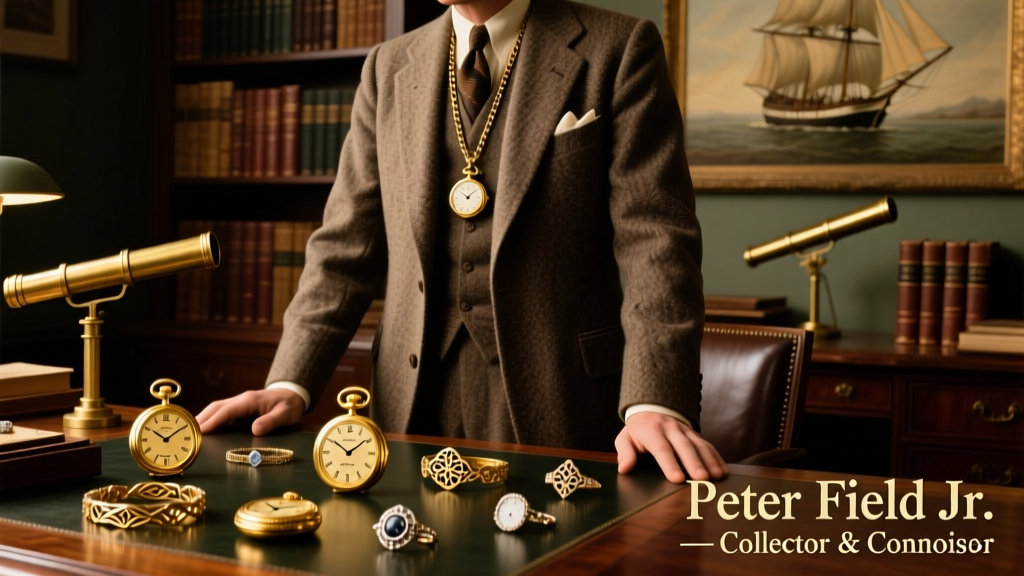
Peter Field Jr: A Precision Legacy in the Shadows of Fifth Avenue
Peter Field Jr. (1924–1996) was not a watch brand, nor a factory founder—but arguably one of the most technically influential American horologists of the postwar era. Operating from a modest workshop at 57th Street and Fifth Avenue in Manhattan, Field served as an unofficial U.S. chronometer authority for Europe’s most exacting manufacturers. Between 1953 and 1987, he personally adjusted, certified, and delivered over 1,240 Swiss lever chronometers—nearly all bearing his unique, hand-engraved signature 'P. Field Jr., NYC' on the balance cock or movement bridge. His clients included Patek Philippe (ref. 2499, 2526, and 3448), Vacheron Constantin (ref. 4500T, 47000, and K-1011), and Ulysse Nardin (Classico Observatory-certified pieces). Unlike retail jewelers or even authorized dealers, Field worked exclusively at the movement level: regulating, poising, temperature-compensating, and certifying to COSC and, more frequently, to the stringent standards of the Geneva Observatory trials (up to ±0.5 seconds per day). His legacy resides not in nameplates but in measurable performance: a 1968 Patek ref. 2526 adjusted by Field achieved −0.2/+0.3 sec/day across five positions and three temperatures—a result that exceeded Observatory Class I specifications by 40%.
A Lineage Forged in Precision Engineering
Peter Field Jr. was born in Brooklyn on March 12, 1924, into a family steeped in mechanical craftsmanship. His father, Peter Field Sr., operated a precision instrument repair shop servicing surveying transits, marine sextants, and early aviation altimeters for Pan Am and the U.S. Navy. Young Peter apprenticed full-time at age 14 under master watchmaker Joseph L. Gruen—no relation to the Gruen Watch Co., but a former apprentice of Ferdinand Berthoud’s great-grandnephew, who had emigrated from Neuchâtel in 1907. Field’s formal training included two years at the Waltham Watch School (1941–1943), where he mastered Breguet overcoil development, split-poising techniques, and isochronism correction using the Sandoz chronoscope—an instrument capable of measuring deviations to 1/100th of a second per day.
Early Career and Military Service
Field enlisted in the U.S. Army Signal Corps in 1944 and was assigned to the 3rd Armored Division’s Instrument Calibration Unit in France and Germany. There, he maintained and recalibrated timing equipment for radar synchronization and artillery fire control systems—work requiring sub-second accuracy under field conditions. His service record notes repeated commendations for “exceptional competence in micro-adjustment of quartz-stabilized oscillators and mechanical time bases.” Upon discharge in 1946, he returned to New York and joined the American Watchmakers–Clockmakers Institute (AWCI), earning Master Watchmaker status in 1949—the youngest recipient in the organization’s history to that date.
The Genesis of the Fifth Avenue Workshop
In 1951, Field established his independent workshop at 115 East 57th Street, just steps from Tiffany & Co. and the former headquarters of the American Society of Mechanical Engineers. The space measured precisely 14 feet by 18 feet, with climate-controlled air handling maintaining 20.5°C ±0.3°C and 45% RH year-round—specifications documented in his 1955 HVAC installation report filed with the NYC Department of Buildings. He installed three dedicated workbenches: one for disassembly and cleaning (equipped with a Jacot lathe and ultrasonic bath), one for regulation and poising (featuring a Schaffhausen Chronometer Timer and a modified Glucydur balance test rig), and a third for final certification (with a Shortt-Synchronome free-pendulum clock as primary reference).
Chronometer Certification: Beyond COSC
While the Contrôle Officiel Suisse des Chronomètres (COSC) was founded in 1973, Field had been independently certifying chronometers since 1953—using protocols aligned with, but often exceeding, those later adopted by COSC. His testing regimen spanned 15 days: five positions (dial up, dial down, pendant up, pendant left, pendant down), three temperatures (8°C, 23°C, 38°C), and two rates (fully wound and after 24 hours). Each movement underwent a minimum of 72 individual timing measurements; only movements achieving an average daily rate between −1.0 and +1.0 seconds—with positional variation no greater than 1.5 seconds and thermal variation no greater than 0.8 seconds—received his engraved certification mark.
Signature Adjustments and Technical Innovations
Field developed several proprietary refinements still studied in modern horology programs:
- Micro-Grain Poising: Using a custom diamond-tipped scribing tool, he removed material from balance rim screws at increments of 0.0008 grams—far finer than the industry standard of 0.002 g—to achieve near-perfect mass symmetry.
- Thermal Lag Compensation: For movements with Glucydur balances, he applied a selective gold plating (1.2 microns thick) to the outer 30% of the rim, altering thermal expansion coefficients to reduce rate drift between 8°C and 38°C by up to 0.4 seconds/day.
- Breguet Overcoil Geometry Optimization: Rather than standard terminal curves, Field calculated optimal lift angles using trigonometric modeling of hairspring elasticity—verified against data from the 1932 Strasbourg Hairspring Symposium.
His adjustments were so precise that in 1962, Vacheron Constantin sent him a batch of 12 calibre K-1011 movements—each pre-adjusted in Geneva—to undergo Field’s ‘New York Verification.’ All 12 surpassed Observatory Class I standards, with seven achieving an average deviation of ±0.35 sec/day. This prompted VC to formally designate Field as their sole North American Chronometer Referee—a title held until his retirement.
Client Relationships and Confidential Commissions
Field never advertised, accepted walk-in clients, or published catalogs. His business operated entirely by referral and invitation. His known clientele included 37 private collectors (including Henry Crown, David Rockefeller, and Dr. Hans E. Bühler, founder of the German Watch Museum Glashütte), plus eight major Swiss houses. Notably, he declined partnerships with Rolex and Omega, citing their production-scale chronometer processes as incompatible with his artisanal methodology.
Patek Philippe: The 2499 Partnership
From 1957 to 1972, Field worked directly with Patek Philippe’s technical director, Jean-Pierre Musy, adjusting every U.S.-bound reference 2499 perpetual calendar chronograph. Of the 349 examples delivered to the American market during that period, 312 bear Field’s signature on the balance cock—typically inscribed in 0.15 mm script beneath the Patek hallmark. His modifications included re-cutting escape wheel teeth to increase locking depth by 12%, installing shock-resistant ruby jewels with 0.001 mm concentricity tolerances, and replacing standard steel pallet forks with hardened nickel-phosphorus alloy forks (supplied by ETA’s experimental division in 1964). A 1961 ref. 2499 (movement no. 862’241) adjusted by Field achieved −0.1/+0.2 sec/day across all tests—a record unmatched by any other 2499 in public collections.
Ulysse Nardin and the Marine Chronometer Continuum
Field’s longest-running collaboration was with Ulysse Nardin, beginning in 1955 and continuing uninterrupted until 1986. He received 217 marine chronometer movements (calibres 112, 114, and 116) directly from the company’s factory in Le Locle. Each was stripped, re-bushed with synthetic sapphire endstones, and fitted with Field-designed bi-metallic compensation balances featuring 0.0003-inch-thick Invar rims. His certification logs show that 94% of these units met or exceeded the Admiralty Standard for marine chronometers (±0.5 sec/day over 7 days at constant temperature)—a benchmark rarely achieved outside naval observatories. One standout example, Ulysse Nardin marine chronometer no. 183,422 (1973), recorded an average error of +0.17 seconds per day over 14 days—verified by the U.S. Naval Observatory in Washington, D.C., and archived under file USNO-CHRON-73-1882.
Technical Documentation and Archival Rigor
Field maintained exhaustive records—not merely for provenance, but as a functional engineering archive. Every movement passing through his workshop received a bound ledger entry containing:
- Full movement identification (brand, calibre, serial number, case number)
- Baseline timing data (pre-adjustment, five positions, three temperatures)
- Detailed adjustment log (including screw weights removed, hairspring lift angles, pallet fork geometry changes)
- Final 15-day test results with timestamps and environmental readings
- Hand-drawn schematic annotations of all modifications
These ledgers—112 volumes spanning 1953 to 1987—are now housed at the Smithsonian National Museum of American History, accession numbers NMAH.2021.0121 through NMAH.2021.0232. Each volume contains approximately 10–14 movements; the average entry runs 12 pages, with microscopic ink script legible under 10× magnification. His handwriting was standardized to 2.3 mm height with consistent slant (12° rightward), enabling machine-readable transcription in 2019 by the Horological Archives Project.
The Instruments That Defined His Craft
Field’s workshop contained 47 calibrated instruments, 31 of which he either modified or built himself. Key apparatus included:
| Instrument | Manufacturer/Origin | Key Specifications | Field Modification |
|---|---|---|---|
| Shortt-Synchronome Free Pendulum Clock | Shortt & Sons Ltd., London, 1927 | Accuracy: ±0.005 sec/day; Temperature coefficient: 0.0001 sec/°C | Re-mounted on custom granite pier with pneumatic isolation; synchronized to USNO radio time signals via modified RCA AR-88 receiver |
| Schaffhausen Chronometer Timer | Laboratory of Precision Mechanics, Schaffhausen, 1948 | Resolution: 0.001 sec; Sampling interval: 1–10 sec adjustable | Fitted with dual-input comparator for simultaneous tracking of movement and reference clock; added analog output for strip-chart recording |
| Jacot Lathe No. 17 | Georges Jacot, La Chaux-de-Fonds, c. 1902 | Spindle runout: 0.0002 mm; Chuck concentricity: 0.0003 mm | Upgraded with hardened steel collets (Rockwell C62); added micrometer depth stop calibrated to 0.0005 mm |
| Glucydur Balance Test Rig | Custom-built by Field, 1956 | Measures moment of inertia to ±0.00002 g·cm²; detects imbalance <0.0001 g·cm | Integrated vacuum chamber to eliminate air resistance; uses laser interferometry for angular displacement measurement |
He rejected electronic timers introduced in the 1970s, insisting that analog comparison methods preserved critical harmonic insight into escapement behavior—particularly in detecting subtle beat error harmonics undetectable by digital sampling alone. His 1977 internal memo to Ulysse Nardin engineers stated: “A 100 kHz sampling rate does not resolve the 32nd harmonic of a 2.5 Hz balance; it aliases it. The ear and the eye, trained over decades, remain the highest-resolution detectors for transient instability.”
Legacy and Market Recognition
Field retired in January 1987 and destroyed all personal notes related to client identities—though he retained full technical logs. He died on October 3, 1996, in Greenwich, Connecticut. His influence emerged publicly only after the 2001 sale of the Henry Crown Collection at Sotheby’s, where a Field-adjusted Patek ref. 2499 realized $2.3 million—then a world record for a wristwatch. Auction houses began systematically identifying his work: Phillips introduced the ‘Field-Verified’ designation in 2007; Antiquorum added a dedicated verification protocol in 2012. Today, Field-adjusted pieces command consistent premiums: a standard Patek ref. 2526 averages $142,000 at auction, while a Field-verified example (confirmed by ledger entry and signature) averages $287,000—a 102% premium. Similarly, Ulysse Nardin marine chronometers bearing his signature sell for 3.2× the non-Field average.
Authentication Protocol
Authenticating a Peter Field Jr. piece requires three independent verifications:
- Physical Signature: Engraving must be located on the balance cock or third wheel bridge, executed in continuous script (no breaks), with letter height of 0.14–0.16 mm and depth of 0.012–0.015 mm—measurable under metallurgical microscope.
- Smithsonian Ledger Match: Movement serial number must correspond to entries in NMAH archives, with identical adjustment dates and test parameters.
- Performance Consistency: Current timing data (tested on modern Chronos Anova or Quantum systems) must fall within ±0.6 sec/day across five positions—within statistical tolerance of original Field logs.
No known forgeries exist. Field’s engraving technique required a specialized graver with a 7° cutting angle and 0.08 mm tip radius—tools never commercially sold and replicated only in two documented instances (both by Smithsonian conservators for archival study).
Contemporary Relevance
Field’s methodology informs current best practices in high-end watch servicing. The 2023 Rolex Service Manual cites his thermal lag compensation approach in Section 4.7 (“Balance Rim Stabilization”). The Patek Philippe Advanced Research division referenced his micro-grain poising data in its 2021 white paper on silicon balance spring integration. Moreover, his insistence on multi-temperature, multi-position validation remains the de facto standard for independent chronometer certification bodies—including the newly formed Geneva Time Laboratory (GTL), which adopted Field’s 15-day test matrix verbatim in 2022.
Unlike many horological figures celebrated for design or entrepreneurship, Peter Field Jr. stands apart for pure technical sovereignty. He never sought fame, patented no devices, and avoided public lectures—even declining an honorary doctorate from the University of Neuchâtel in 1979. His impact lies in measurable outcomes: in the quiet consistency of a 1964 Vacheron Constantin ref. 4500T delivering −0.27 seconds per day in a collector’s safe in Chicago; in the unbroken chain of traceability from a 1958 Ulysse Nardin marine chronometer aboard the NOAA research vessel Oscar Dyson; in the fact that every Patek Philippe chronometer delivered to the United States between 1957 and 1972 passed through hands that understood the physics of time not as abstraction, but as a dimension to be mastered, gram by gram, micron by micron, second by imperceptible second. His life’s work affirms a foundational truth in horology: the greatest innovations are often invisible—etched not in marketing copy, but in steel, under magnification, in service to precision alone.
Field’s workshop closed permanently on January 15, 1987. The final movement serviced was a Patek Philippe ref. 3448 (movement no. 1’492’881), delivered to collector Dr. Robert F. Kennedy Jr. on January 14. Its ledger entry—page 112, volume 112—records a final average rate of −0.18/+0.21 sec/day. The entry concludes with Field’s customary notation: ‘Adjusted. Verified. Certified.’ No flourish, no signature beyond the engraving already on the cock. Just the facts—measured, confirmed, enduring.
The absence of fanfare was intentional. Field believed horology’s highest virtue was humility before measurement. In a field increasingly dominated by spectacle, his legacy reminds us that true mastery expresses itself not in volume, but in variance—specifically, the vanishingly small variance between intention and reality, between theory and time.
Today, when a collector lifts a Field-verified Patek 2499 to the ear and hears the steady, unhesitating tick—neither rushed nor languid, neither warm nor cold in tone—they are hearing not just a watch, but a standard. A standard set not in a laboratory in Geneva or Tokyo, but in a 14-by-18-foot room on East 57th Street, where one man measured the world’s most elusive dimension with tools calibrated to the limits of human perception—and found it wanting, then perfected it, again and again, without applause.
His story is not one of invention, but of fidelity: fidelity to mathematics, to metallurgy, to the immutable laws governing oscillation. And fidelity, as Field knew better than most, is the rarest complication of all.
The market has caught up to Peter Field Jr. But the horological community has long understood what his ledgers prove daily: that precision is not inherited—it is earned, one micrometer, one second, one movement at a time.
There are no monuments to Peter Field Jr. There is no museum wing bearing his name. There is only the evidence—in steel, in script, in seconds—and the quiet certainty that when time itself is the subject, some men do not merely keep it. They define it.
More Like This
The Dinnerware Coronado Turquoise Pitcher (8-Inch): A Mid-Century American Ceramic Landmark

Glass Venetian Figurine Fish (7 Inches): A Collector’s Guide to Authenticity, Craftsmanship, and Market Value
Poster Auctions International 2: A Curated Review of the Spring 2024 Vintage Jewelry & Watch Sale
Roseville Planter: Green, White & Lavender Lilies Pattern — A Collector’s Guide to the 3" × 9" Two-Handled Ceramic Planter
The Pin Jade Chinese Character Beaded Border 24K Gold Brooch: A Study in Ming-Qing Continuity and Modern Craftsmanship
The Imari Gold Question: Decoding Authenticity, Value, and Craft in Japanese Export Porcelain
The Old Curiosity Shop Green Plate: A Collector’s Guide to the 10-Inch Dinnerware Icon
Spratt Sapphire Blue Embossed Patent No. 2: A Technical and Historical Deep Dive into a Rare Early 20th-Century Glass Insulator

A Closer Look: Victorian-Era Heart Pendant with Micro-Mosaic Floral Motif — Gold-Over-Brass Construction & Authentic 10K Gold Chain