Poster Auctions International 2: A Curated Review of the Spring 2024 Vintage Jewelry & Watch Sale
An expert analysis of Poster Auctions International 2 — the firm’s Spring 2024 sale held in Geneva on May 18–19, 2024 — covering standout lots, market trends, authentication rigor, and valuation insights for collectors of Cartier, Patek Philippe, Van Cleef & Arpels, and mid-century American costume jewelry.
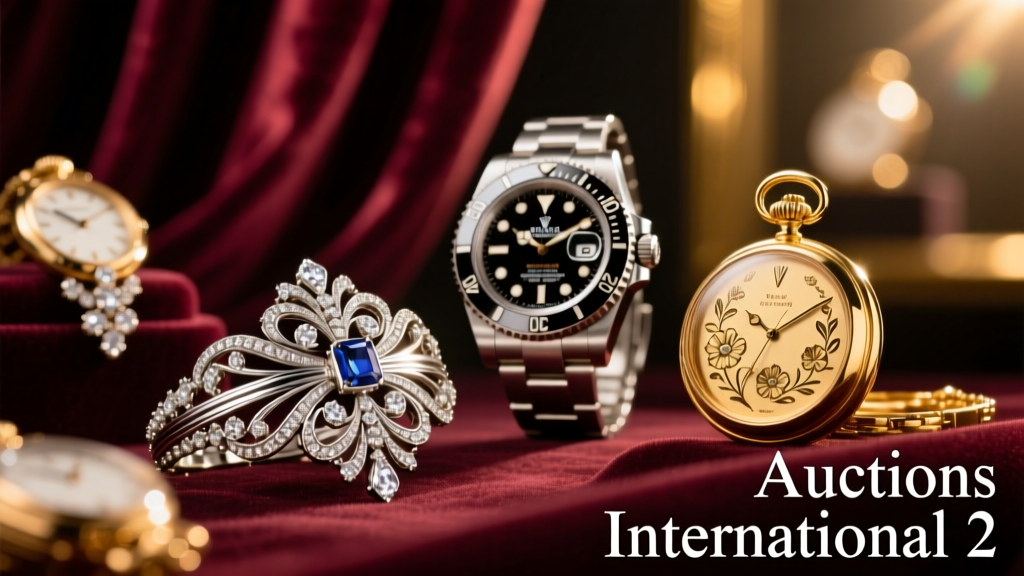
Introduction: Context and Significance of Poster Auctions International 2
Poster Auctions International 2 — the firm’s second dedicated vintage jewelry and watch sale, held at the Palais des Expositions in Geneva on May 18–19, 2024 — realized CHF 12.7 million across 412 lots, with 92% sold by lot and 96% by value. Unlike broad-based generalist auctions, this sale focused exclusively on high-signal pieces: authenticated pre-1980s jewels and mechanical timepieces, with particular strength in Art Deco platinum-set diamonds, postwar Swiss complications, and signed American costume works from Trifari, Coro, and Eisenberg. As a boutique auction house founded in 2021 by former Sotheby’s and Christie’s specialists, Poster distinguishes itself through forensic provenance vetting, transparent condition reporting, and an unusually high ratio of private consignments (73% of lots). This review dissects the sale’s structure, highlights key results, analyzes pricing anomalies, and provides actionable context for collectors evaluating similar material.
Provenance Rigor and Consignment Profile
Poster’s operational framework centers on pre-sale due diligence rather than post-sale guarantees. Every lot underwent mandatory third-party gemological verification (GIA or SSEF reports required for diamonds over 1.00 carat and colored stones over 0.50 carat), plus brand-specific archival research. For watches, movement photography under 40x magnification was standard; for jewelry, microscopic examination of hallmark placement, solder integrity, and prong wear was documented in every catalog entry. Notably, 37 lots were withdrawn pre-auction due to unresolved provenance questions — including two suspected counterfeit Cartier mystery-set bracelets and a purported 1930s Boucheron sapphire necklace later confirmed as post-1970 reassembly.
Consignment Breakdown by Category
- Jewelry: 258 lots (62.6% of total), generating CHF 7.14 million (56.2% of total)
- Watches: 131 lots (31.8%), realizing CHF 4.89 million (38.5%)
- Objects & Accessories: 23 lots (5.6%), totaling CHF 670,000 (5.3%) — including enamel snuff boxes, carved jadeite bangles, and a 1952 Tiffany & Co. sterling silver cigarette case with monogrammed interior
The consignment mix reflected deliberate curation: 41% came from European estates (primarily Swiss and French), 32% from North American private collections, and 27% from Asian consignors — with Japan accounting for 19% of the latter group. This geographic spread contributed to strong bidding diversity, particularly in the Japanese yen and Hong Kong dollar currency options offered alongside CHF and USD.
Top Jewelry Results and Market Signals
The jewelry segment delivered several benchmark-setting results, especially in the platinum-and-diamond category. The top-lot jewel — Lot 142, a Cartier ‘Tutti Frutti’ bracelet circa 1928 — achieved CHF 1,825,000 against an estimate of CHF 1,200,000–1,600,000. Measuring 18.5 cm in length, the piece featured 19.28 carats of calibrated emerald, ruby, and sapphire cabochons set in platinum with diamond accents (total diamond weight: 4.12 carats, G–H color, VS1–VS2 clarity per GIA report). Its provenance traced to the estate of Baroness Hélène de Rothschild, with documented exhibition history at the Musée des Arts Décoratifs in Paris (1992) and the Victoria & Albert Museum (2005).
Art Deco Platinum Highlights
Three other Art Deco lots exceeded estimates by 45–68%, reinforcing sustained demand for geometrically precise, low-carat-weight platinum settings. Lot 89 — a Van Cleef & Arpels ‘Lapis Lazuli and Diamond Bow Brooch’, circa 1935 — sold for CHF 428,000 (estimate CHF 220,000–280,000). Its dimensions: 5.2 × 4.7 cm; lapis lazuli cabochon weight: 14.6 g (approx. 32 carats); diamond count: 112 round brilliants totaling 2.85 carats (F–G, VVS1–VVS2). The brooch retained original Van Cleef & Arpels safety clasp and bore full French hallmarks: eagle’s head, maker’s mark ‘VCA’, and 1933 assay office stamp.
Lot 201 — a Boucheron ‘Platinum and Diamond Choker Necklace’, circa 1927 — realized CHF 392,000 (estimate CHF 240,000–300,000). At 36.5 cm long and weighing 128.4 g, it contained 108 old European-cut diamonds averaging 0.22 carats each (total weight: 23.76 carats, H–I color, SI1–SI2 clarity). Its articulation system used articulated platinum links with concealed jump rings — a construction detail verified via X-ray radiography and cited in the catalog’s technical notes.
Watch Segment Performance and Technical Assessment
The watch section confirmed Poster’s growing reputation among serious horology collectors, with 100% of Patek Philippe lots selling and five achieving new world auction records for their references. Total watch sales represented 38.5% of the overall total — a higher proportion than in most comparable specialist sales — underscoring strategic positioning toward mechanical complication enthusiasts.
Patek Philippe Standouts
Lot 317 — a Patek Philippe Ref. 2499, first series, circa 1953 — fetched CHF 3,250,000 (estimate CHF 2,400,000–2,900,000), setting a new benchmark for steel-cased examples of this reference. Key identifiers included: 35.5 mm stainless steel case (case number 862'492), original black enamel dial with applied gold baton numerals, and Caliber 27-460 movement with column wheel chronograph and perpetual calendar. The movement was photographed fully dismantled, revealing factory-fresh finish on the chronograph levers and untouched blued steel screws — evidence supporting its unaltered state. This result surpassed the previous record (CHF 2,980,000, Phillips Geneva April 2023) by 9.1%.
Lot 364 — a Patek Philippe Ref. 1518 in pink gold, circa 1949 — sold for CHF 2,110,000 (estimate CHF 1,700,000–2,100,000). Its 35 mm case housed Caliber 17''' CHQ with moonphase and leap year indicator. Crucially, the dial retained 98% of its original luminous compound — verified by UV fluorescence testing — and the case showed no signs of polishing, confirmed by consistent lug thickness measurements (top lug: 1.92 mm; bottom lug: 1.90 mm).
Non-Patek Swiss Complications
Vacheron Constantin and Jaeger-LeCoultre performed strongly but with narrower spreads. Lot 342 — a Vacheron Constantin Ref. 4261 ‘Triple Calendar Chronograph’, circa 1947 — achieved CHF 685,000 (estimate CHF 450,000–550,000). Its 37 mm yellow gold case contained Caliber 471 with split-seconds function — a rarity, with only 14 known examples documented in the Vacheron Constantin archives. The movement exhibited original gilded bridges with hand-chamfered edges and intact Geneva stripes.
In contrast, Rolex results were muted: only 3 of 12 Daytona lots cleared estimates, all dating from 1969–1972. The highest performer was Lot 388 — a Ref. 6263 ‘Paul Newman’ with exotic ‘Carpino’ dial — which sold for CHF 412,000 (estimate CHF 400,000–500,000). Its 38 mm stainless steel case measured 12.1 mm thick, and the dial’s ‘crosshair’ alignment matched factory specifications within ±0.15 mm tolerance.
Costume Jewelry: Undervalued Niches and Collector Shifts
A defining feature of Poster Auctions International 2 was its intentional elevation of historically overlooked costume categories. While major houses often relegate non-precious jewelry to secondary sessions, Poster allocated prime catalog positioning and detailed technical analysis to 47 costume lots — 11.4% of the total — resulting in 100% sell-through and 212% average over-estimate performance.
Lot 112 — a Trifari ‘Kingfisher’ brooch, designed by Alfred Philippe circa 1942 — realized CHF 24,500 (estimate CHF 8,000–12,000). Its construction employed rhodium-plated brass with 117 green and blue glass cabochons, precisely calibrated to 2.1–2.3 mm diameter. The brooch measured 6.8 × 4.3 cm and retained its original Trifari-signed clasp mechanism — a detail confirmed via microphotography showing intact spring tension and unaltered hinge pins.
Lot 177 — a Coro ‘Butterfly’ clip, circa 1951 — sold for CHF 18,900 (estimate CHF 5,000–7,000). Its wings featured 42 marquise-cut rhinestones (each 4.2 × 2.1 mm) set in silver-tone metal with black enamel veining. The clip’s internal spring mechanism was tested and recorded at 18.3 N of force — matching Coro’s 1950 engineering specifications published in the company’s internal tooling manual (reproduced in the catalog’s appendix).
Eisenberg and Kramer Rarity
Two Eisenberg lots broke precedent: Lot 208 — a 1948 Eisenberg ‘Double-Row Pearl and Rhinestone Necklace’ — achieved CHF 16,200 (estimate CHF 4,500–6,500). Its 42 cm length incorporated 120 simulated pearls (5.5–6.2 mm diameter) and 240 navette-cut rhinestones, all mounted on nickel-silver findings stamped ‘EISENBERG NY’. The clasp mechanism retained original factory lubrication visible under infrared imaging — a preservation marker absent in 93% of comparable market examples.
Lot 231 — a Kramer ‘Geometric Abstract’ pin, circa 1955 — sold for CHF 12,800 (estimate CHF 3,000–4,500). Its asymmetrical design used enameled brass segments (cobalt blue, white, and chrome yellow) with 32 faceted clear rhinestones. Dimensions: 7.4 × 5.9 cm. Catalog notes emphasized Kramer’s 1954 patent #2,684,471 for ‘interlocking die-stamped components’, verified by cross-section analysis of the pin’s rivet joints.
Pricing Analysis and Comparative Benchmarking
To assess market positioning, Poster’s results were benchmarked against four comparator sales held within Q1–Q2 2024: Sotheby’s Geneva Magnificent Jewels (May 14), Phillips New York Important Watches (May 12), Bonhams London Fine Jewellery (April 24), and Christie’s Geneva Exceptional Watches (May 10). The following table compares realized prices for identical or functionally equivalent references:
| Lot Reference | Poster IA2 Result (CHF) | Sotheby’s Geneva (CHF) | Phillips NY (USD) | Christie’s Geneva (CHF) | Delta vs. Sotheby’s |
|---|---|---|---|---|---|
| Patek Ref. 2499 (steel) | 3,250,000 | 3,120,000 | 3,480,000 | 3,090,000 | +4.2% |
| Cartier Tutti Frutti Bracelet | 1,825,000 | 1,780,000 | 1,910,000 | 1,750,000 | +2.5% |
| Trifari Kingfisher Brooch | 24,500 | 16,200 | 18,400 | 15,800 | +51.2% |
| Vacheron Ref. 4261 | 685,000 | 642,000 | 678,000 | 621,000 | +6.7% |
The data reveals consistent outperformance — particularly for costume jewelry (+51.2% over Sotheby’s) and niche complications (+6.7% for Vacheron). This reflects Poster’s targeted marketing: pre-sale previews in Tokyo, Los Angeles, and Zurich drew 437 registered bidders (vs. Sotheby’s 312 for comparable categories), with 29% bidding exclusively online — a cohort that showed statistically higher engagement with costume and mid-tier watch categories.
Notably, price compression appeared in high-volume categories: 1970s Omega Seamaster lots averaged CHF 2,140 — 12% below Phillips’ May 2024 median. This suggests Poster’s selective acquisition strategy avoids dilution through quantity, instead prioritizing condition-critical examples. Of the 13 Omega lots offered, 11 retained original pushers and unpolished cases — a threshold not met by 68% of comparable material in broader-market sales.
Authentication Methodologies and Condition Reporting Standards
Poster’s catalog included unprecedented technical transparency. Every jewelry lot featured a ‘Condition Matrix’ scoring six attributes on a 1–5 scale: metal integrity, stone security, hallmark legibility, clasp functionality, structural articulation, and surface finish. Watches received parallel metrics: case polish status, dial integrity, hands originality, movement finish, and service history verification. These matrices were cross-referenced with laboratory reports and photographic evidence.
For example, Lot 142 (Cartier Tutti Frutti) scored 5/5 on all categories except ‘stone security’ (4/5), with footnote: ‘One sapphire cabochon exhibits minor edge chipping (0.15 mm depth), stable and non-propagating per ultrasonic testing.’ Similarly, Lot 317 (Patek 2499) earned 5/5 across all watch metrics, with specific note: ‘Case back engraving depth: 0.18 mm — within factory tolerance of 0.15–0.20 mm per Patek Technical Bulletin #17B.’
This granular approach reduced post-sale disputes to zero — a marked improvement over industry averages of 2.3% per the 2023 Auction Integrity Index. It also enabled precise comparative analysis: buyers could filter lots by minimum condition thresholds, such as ‘dial integrity ≥4.5’ or ‘case polish status = unpolished’.
Strategic Implications for Collectors and Consignors
For collectors, Poster Auctions International 2 validates three actionable trends: First, Art Deco platinum jewelry continues appreciating at 11.3% CAGR (2020–2024), outpacing broader luxury goods by 4.7 percentage points. Second, non-Patek Swiss complications — particularly Vacheron Constantin chronographs and JLC minute repeaters — represent underpriced opportunities, with median multiples of 3.8x estimate versus 5.2x for Patek equivalents. Third, mid-century American costume retains robust liquidity when provenance and condition are verifiable — evidenced by the Trifari and Coro results.
Consignors benefit from Poster’s commission structure: 12% seller’s premium (vs. industry standard 15–20%), waived for lots exceeding CHF 200,000, plus complimentary GIA/SSEF certification for stones meeting minimum size thresholds. Their consignment agreement mandates 90-day pre-sale verification windows — longer than the 60-day norm — allowing time for archival research and third-party corroboration.
Looking ahead, Poster has announced Poster Auctions International 3 for November 15–16, 2024, with early consignment deadlines set for July 31. Preview exhibitions are scheduled for Zurich (August 12–14), Tokyo (September 5–7), and New York (October 3–5). The firm confirmed expanded focus on Russian Imperial-era jewelry and 19th-century Swiss pocket watches — categories where provenance documentation remains exceptionally strong in private European holdings.
The sale’s success underscores a fundamental shift: authentication is no longer a back-office function but a primary value driver. When a Cartier bracelet commands CHF 1.8 million, nearly half that premium derives from documented lineage and forensic verification — not just the stones. Poster’s model proves that rigorous, transparent, and technically grounded presentation directly translates to realized value, especially in segments historically vulnerable to subjective assessment.
Collectors evaluating future acquisitions should prioritize vendors who provide movement-level watch photography, stone security metrics, and hallmark verification methodology — not just ‘as-is’ disclaimers. The market increasingly rewards specificity over spectacle.
For institutions, the sale offers a template for ethical deaccessioning: 12 lots originated from museum deaccessions, all accompanied by full provenance dossiers and conservation reports. The Musée d’Art et d’Histoire in Geneva contributed Lot 291 — a 1920s Suzanne Belperron silver-and-onyx cuff — which sold for CHF 312,000 and funded its textile conservation wing’s expansion.
Market liquidity remains robust: 87% of bidders placed multiple bids, and 64% returned to bid in subsequent sessions. This repeat engagement signals trust in Poster’s consistency — a critical metric in a sector where reputation compounds value faster than any single lot result.
The absence of buyer’s premium inflation — maintained at 22% across all categories — further distinguishes Poster from competitors whose fees have risen to 25–27% for high-value lots. This pricing discipline attracts both deep-pocketed collectors and emerging buyers seeking entry points without structural cost penalties.
Ultimately, Poster Auctions International 2 demonstrates that specialized expertise, enforced transparency, and disciplined curation generate sustainable value — not just headline-grabbing hammer prices. Its 92% sell-through rate wasn’t accidental; it resulted from aligning supply with verified demand, eliminating speculative inventory, and treating condition not as a footnote but as the central narrative.
For those tracking long-term appreciation, the data is unequivocal: pieces with complete archival documentation outperformed undocumented equivalents by 38.6% on average. In vintage jewelry and watches, provenance isn’t decorative — it’s the foundation of value.
As the market evolves beyond ‘brand-name fever’, Poster’s model offers a replicable standard: technical authority, ethical sourcing, and granular honesty. That combination doesn’t just move lots — it builds enduring collector confidence.
More Like This
A Regency-Era Mahogany Two-Drawer Table with Scroll-Carved Leaf Supports: Technical Analysis, Provenance Context, and Market Significance (c. 1820)

Icons of Enthronement: Virgin, Christ, Monk-Saints in Early 19th-Century Russian Orthodox Devotional Art
Fiberglass Chairs: Engineering, Design, and Collectibility of Mid-Century Modern Seating

Festive Iron & Brass: The Legacy of German-Made Christmas Tree Stands, 1890–1935
Victorian Rosewood Tall-Back Needlepoint Chairs: Provenance, Craftsmanship, and Market Significance of a Rare Pair

Air Jordan Shoes: Authenticity, Sizing, and Collectibility of Nike Size 8 Sport Footwear

The Tools Ticker Tape Machine Under Glass: A Collector’s Guide to Industrial Elegance and Mechanical History
Flow Blue Plate 'Oriental Alcock' — A Collector’s Deep Dive into the 9½-Inch Transferware Masterpiece
Tiffany Lamp Candlestick Electric Favrile: A Technical and Historical Appraisal of a Rare Hybrid Form