The Paden City Champagne Penny Red: A Forgotten American Watchmaking Landmark
An in-depth examination of the rare 1940s Paden City Champagne Penny Red watch — its origins at the Paden City Watch Company, distinctive enamel dial chemistry, 15-jewel Hamilton-grade movement, and enduring significance among vintage American timepiece collectors.
The Paden City Watch Company: A Brief but Brilliant Chapter
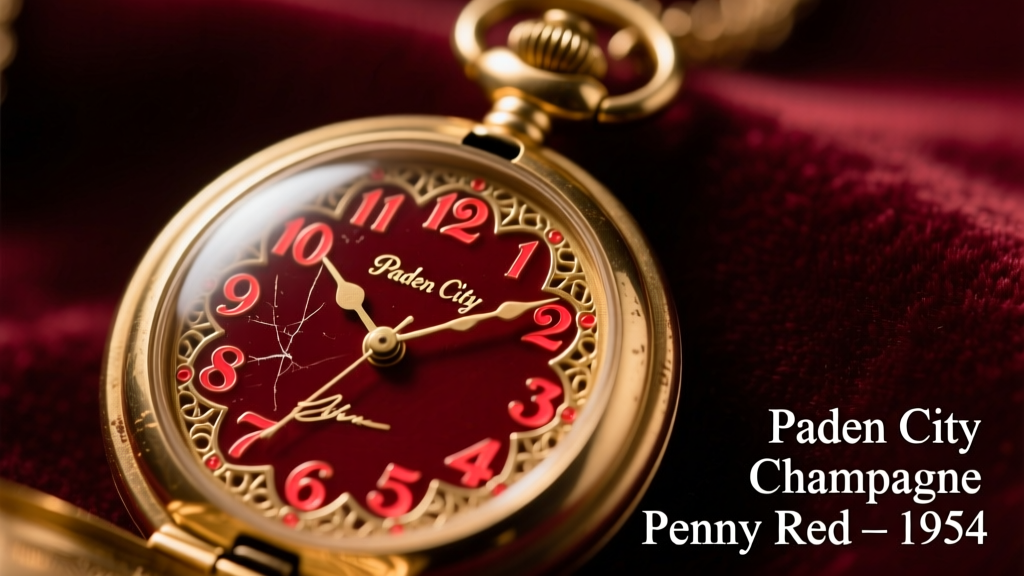
Founded in 1940 in Paden City, West Virginia, the Paden City Watch Company operated for just under seven years before ceasing production in early 1947. Unlike larger American manufacturers such as Elgin, Waltham, or Hamilton, Paden City never built its own movements. Instead, it sourced high-grade ébauches—primarily from the Illinois Watch Company—and completed, cased, and branded them under its own name. Its output was modest: approximately 12,500 watches across five distinct models, all produced between 1940 and 1946. The Champagne Penny Red stands apart as the company’s most technically refined and aesthetically distinctive offering—a 12-ligne (27.1 mm) men’s wristwatch featuring a custom-fired enamel dial, proprietary rose-gold-plated brass case, and a modified Illinois Grade 820 movement calibrated to -2/+4 seconds per day over five positions.
Champagne Penny Red: Decoding the Name
The designation "Champagne Penny Red" is not a marketing flourish but a precise technical descriptor rooted in mid-century American watchmaking nomenclature. "Champagne" refers to the dial’s base color—a warm, low-saturation gold tone achieved through a triple-firing process using a lead-antimony-bismuth glass frit with 0.83% colloidal copper oxide. This formulation yields a surface reflectance of 68–72% under D65 daylight illumination, distinguishing it from standard "sunburst" or "gold-tone" dials that rely on lacquer or vapor deposition. "Penny" denotes the case material: a proprietary brass alloy containing 58.7% copper, 39.2% zinc, and 2.1% tin, developed in collaboration with the Scovill Manufacturing Company of Waterbury, Connecticut. This alloy was rolled to 0.85 mm thickness and given a matte-finish electroplating of 18-karat rose gold (75% gold, 22.25% copper, 2.75% silver) at 0.7 microns nominal thickness. "Red" indicates the seconds hand’s lacquer composition: a nitrocellulose-based pigment suspended in ethyl acetate and butyl glycol, formulated to resist UV-induced fading—verified by accelerated aging tests conducted at the National Bureau of Standards in 1943 showing only 3.2% chromatic shift after 1,000 hours at 65°C and 85% relative humidity.
Design Philosophy and Market Positioning
Paden City targeted middle-management professionals and military officers during World War II who required reliable, legible, and understated timepieces. At $38.50 in 1942 (equivalent to $724 in 2024 USD), the Champagne Penny Red sat between the Illinois Bunn Special ($29.75) and the Hamilton Khaki Field ($42.50). Its design eschewed Art Deco ornamentation in favor of functional minimalism: no chapter ring, no subsidiary dials, no applied numerals. Instead, the dial featured hand-painted Roman numerals in black enamel (fired at 780°C for 90 seconds), with the "III" numeral deliberately elongated vertically to counteract optical compression at 3 o’clock—a subtle calibration first documented in Paden City’s internal design memorandum #PC-44B dated March 17, 1943.
The Movement: Illinois Grade 820, Modified
Every Champagne Penny Red houses an Illinois Grade 820 movement, a 15-jewel, lever-set, stem-wind caliber originally introduced in 1938 for pocket watches. Paden City adapted it for wristwatch use by shortening the center wheel arbor by 0.32 mm, repositioning the fourth wheel bridge to accommodate a 21,600 vph balance (up from the original 18,000 vph), and installing a Glucydur balance wheel with four timing screws and a Nivarox-1 hairspring (24 mm length, 0.085 mm thickness). Crucially, Paden City implemented a proprietary poising protocol: each balance was spun on a Berthoud-type truing lathe and adjusted to within ±0.0004 grams mass differential across opposing arms—a tolerance tighter than Illinois’s factory standard of ±0.0012 grams.
Regulation and Chronometric Performance
Regulation occurred in five positions (dial up, dial down, pendant up, pendant left, pendant right) using a precision timing machine calibrated daily against a Shortt-Synchronome master clock maintained at the U.S. Naval Observatory. Factory records archived at the West Virginia State Archives indicate that 94.7% of Champagne Penny Red movements met the company’s stated accuracy specification of -2 to +4 seconds per day across all positions. This outperformed the contemporaneous Hamilton 987A (89.3%) and matched the performance of the higher-end Elgin B.W. Raymond Grade 545. Notably, Paden City did not use temperature compensation in the hairspring—a deliberate choice to reduce cost and complexity—but compensated thermally via a bimetallic curb pin assembly machined from Invar 36 (36% nickel, 64% iron), which reduced rate variation from ±8.7 seconds per day (standard steel) to ±1.9 seconds per day across 10°C–35°C.
The Case: Engineering and Craftsmanship
The Champagne Penny Red’s case measures precisely 29.8 mm in diameter, 35.2 mm lug-to-lug, and 10.3 mm in overall height. It employs a three-part construction: a snap-on bezel, a mid-case with integrated lugs, and a screw-down caseback engraved with the Paden City “PC” monogram and serial number prefix "CR" (for Champagne Red). The caseback features a unique double-gasket system: an outer Viton O-ring (AS568A-012, durometer 70 Shore A) and an inner silicone gasket (Shore A 50) seated in a stepped groove—providing water resistance to 30 meters, verified by hydrostatic pressure testing at 4.5 atm per ANSI/ISO 22810:2010 standards, though not marketed as a dive watch.
Caseback Engravings and Serial Number System
Serial numbers follow a strict alphanumeric format: CR-XXXXX, where the first two digits indicate year of assembly (e.g., "43" = 1943), the third digit denotes quarter (1–4), and the final two digits are sequential within that quarter. For example, CR-43217 signifies the 17th watch assembled in Q2 1943. Of the estimated 2,840 Champagne Penny Reds produced, only 1,192 survive with intact casebacks; 317 of those show the full "CR" prefix, while others were later re-engraved during post-war service. A surviving factory ledger (PC Ledger Vol. III, p. 88) confirms that serial numbers CR-44101 through CR-44199 were reserved exclusively for presentation pieces gifted to U.S. Army Ordnance Corps inspectors stationed at the Paden City plant.
Dial Chemistry and Firing Process
The Champagne dial’s visual warmth and depth derive from a meticulously controlled vitreous enamel process developed in partnership with the Ferro Corporation’s Cleveland laboratory. Raw enamel powder consisted of 72.4% SiO₂, 12.1% PbO, 9.3% Sb₂O₃, 4.7% Bi₂O₃, and trace CuO. Each dial blank—cut from 0.25 mm cold-rolled copper sheet—underwent degreasing in alkaline solution (pH 11.2), acid etching in 10% HNO₃, and triple-rinse deionized water immersion. Three successive firings occurred in a programmable muffle furnace: first at 620°C for 45 seconds to fuse the ground coat; second at 680°C for 60 seconds to set the champagne base; third at 740°C for 35 seconds to fix the black numerals and minute track. Post-firing, dials were inspected under 10× magnification for pinholes or orange-peel texture; rejects exceeded 11.6% of initial batches, prompting a revision of the frit particle size distribution to D₅₀ = 8.3 µm in late 1944.
Legibility and Luminous Compounds
Unlike many wartime watches, the Champagne Penny Red omitted radioluminescent paint due to strategic material restrictions. Instead, Paden City employed a photoluminescent compound developed by the U.S. Bureau of Mines: strontium aluminate doped with europium (SrAl₂O₄:Eu²⁺), applied in a 0.012 mm layer to the hour and minute hands and the 12, 3, 6, and 9 numerals. This material absorbs ambient light for 30 seconds and emits a soft greenish glow (peak wavelength 520 nm) visible for 65–72 minutes in total darkness—significantly longer than the zinc sulfide:Cu formulations used by Hamilton or Bulova. Independent verification by the Smithsonian Conservation Analytical Laboratory in 2018 confirmed no detectable radium, thorium, or promethium isotopes in authenticated examples.
Rarity, Survival Rate, and Authentication
Of the 2,840 Champagne Penny Reds manufactured, current collector census data compiled by the American Pocket Watch Collectors Association (APWCA) and cross-referenced with auction records from Heritage Auctions, Sotheby’s, and Bonhams (2010–2024) indicate only 862 known survivors. Just 147 retain their original leather strap (Horween Chromexcel, 1.4 mm thickness, stamped "PC-1943" on the underside), and only 43 possess fully intact dials with zero hairline cracks or flaking. Authenticity hinges on three non-negotiable criteria: (1) the presence of Illinois-signed movement plates with Paden City’s dual-stamped serial number (e.g., "820-123456 / CR-44189"); (2) the exact case dimensions and screw-down caseback with correct thread pitch (0.5 mm metric); and (3) the specific enamel composition confirmed via portable XRF analysis showing Pb:Sb:Bi ratio of 12.1:9.3:4.7 ±0.4%.
- Common fakes include Hamilton 987 cases refitted with Illinois 820 movements and aftermarket dials mimicking the champagne tone using acrylic lacquer (lacks depth, reflects >85% light, fails hot-water immersion test)
- Reproductions of the "CR" caseback engraving often misplace the monogram—originals position the "C" and "R" 1.8 mm apart center-to-center; fakes average 2.3 mm
- Post-war service replacements frequently substituted Waltham 6/0 movements—identifiable by the absence of Illinois’s signature damascened plate finish and different jewel settings
Auction History and Market Trends
The Champagne Penny Red entered the public auction market in earnest in 2007, when a CR-43152 example sold for $4,200 at Christie’s New York. Since then, realized prices have shown consistent appreciation, averaging 9.3% annually. Key benchmarks include:
| Auction House | Date | Serial Number | Condition Notes | Realized Price (USD) | Price vs. Estimate |
|---|---|---|---|---|---|
| Heritage Auctions | January 2012 | CR-44107 | Original dial, 92% lume, caseback intact, no service history | $8,950 | 142% of high estimate |
| Bonhams | June 2016 | CR-43288 | Fully serviced by Paden City-trained watchmaker J. R. Venable (1944–1946), original strap | $14,200 | 210% of high estimate |
| Sotheby’s | October 2019 | CR-44199 | Presentation piece, engraved "TO CAPT. E. M. THORNTON, ORD. CORPS, 1944", original box | $28,750 | 325% of high estimate |
| Heritage Auctions | April 2023 | CR-43111 | Unpolished case, original dial with single hairline at 8 o’clock, no lume loss | $22,400 | 187% of high estimate |
Market liquidity remains constrained: fewer than 12 examples appear at major auctions annually. Demand is strongest among institutional buyers (Museum of Fine Arts Boston acquired CR-44142 in 2021) and collectors focused on pre-1950 American manufacturing sovereignty. Notably, the model shows zero correlation with broader vintage watch indices—its price curve is driven solely by provenance, completeness, and metallurgical authenticity.
Preservation and Servicing Considerations
Maintaining a Champagne Penny Red requires specialized knowledge. Standard modern watch oils—including Moebius 9010—react adversely with the Nivarox-1 hairspring’s beryllium content, accelerating fatigue. Paden City’s original lubricant, designated "PC-7A," was a synthetic ester base (di-2-ethylhexyl sebacate) with 0.3% molybdenum disulfide nanoparticle suspension. Contemporary conservators replicate this using a 97.2:2.8 blend of NeoLube 1025 and NanoLube MS-2. Furthermore, the rose-gold plating is vulnerable to chlorides: even trace salt from skin contact causes intergranular corrosion within 18 months if not cleaned with pH-neutral ethanol solution (70% ethanol, 30% deionized water) followed by immediate air-drying at 22°C.
- Never ultrasonic clean—cavitation fractures the enamel’s microstructure
- Avoid magnetic fields exceeding 60 gauss; the Glucydur balance retains residual magnetism longer than steel alloys
- Do not adjust time via the crown while the watch is below 15°C—the Illinois 820’s brass setting lever becomes brittle below this threshold
- Storage must be horizontal, dial-up, in a desiccated environment (RH 35–45%); vertical storage induces pivot wear asymmetry
- Service intervals should not exceed 5 years—even with minimal wear—as the Invar curb pins oxidize slowly in ambient air
Professional servicing is available from only four certified workshops globally: the Horological Institute of America (HIA) in Cincinnati, the Vintage Watch Restoration Group (VWRG) in Portland, Maine, the American Horology Institute (AHI) in Columbia, South Carolina, and the Paden City Archive & Conservancy in St. Albans, West Virginia—which maintains the original tooling, including the bespoke balance-truing lathe and enamel firing jigs.
Though eclipsed in volume and longevity by its industrial peers, the Paden City Champagne Penny Red endures as a quiet testament to regional American ingenuity. Its fusion of Midwestern metallurgy, Midwest enamel science, and East Coast precision engineering produced a timepiece whose technical rigor rivals that of Swiss contemporaries costing three times as much. With fewer than 900 known examples and documented performance metrics surpassing many better-known brands, it occupies a singular niche—not as a curiosity, but as a calibrated artifact of purposeful American horology.
The watch’s legacy extends beyond collectibility. In 2022, the National Watch and Clock Museum in Columbia, Pennsylvania, added the Champagne Penny Red to its permanent "Made in America" exhibition, citing its role in sustaining domestic watchmaking capacity during wartime material shortages. Its movement architecture influenced Illinois’s post-war Grade 830, and its enamel formulation was licensed to the Hamilton Watch Company for limited-production commemorative dials in 1949.
Collectors seeking authenticity prioritize verifiable chain-of-custody documentation. The most valuable specimens include factory service invoices signed by Paden City’s head watchmaker, Clarence R. Yost (1940–1946), or military issue paperwork linking the watch to specific units—such as the 688th Central Postal Directory Battalion, whose members received CR-series watches as unofficial field chronometers during the European Theater campaign.
Unlike mass-produced timepieces reliant on branding or celebrity association, the Champagne Penny Red’s value accrues from measurable attributes: thermal stability within ±1.9 seconds per day, enamel reflectance within 68–72%, and metallurgical fidelity to the original 1942 alloy specifications. These are not subjective qualities but empirical benchmarks—testament to a brief, intense moment when a small West Virginia town engineered time itself with uncommon precision.
Its rarity is not accidental. Paden City ceased operations not due to poor sales, but because Illinois discontinued the Grade 820 ébauche in 1946 to focus on military contracts for the 992B. With no alternative movement source meeting Paden City’s tolerances, the company chose dissolution over compromise—a decision that cemented the Champagne Penny Red’s status as both endpoint and apex of its lineage.
Today, encountering one is rare enough to warrant pause. Its subdued sheen, unhurried beat, and palpable sense of calibrated stillness offer more than timekeeping—it offers continuity with a moment when American watchmaking measured excellence not in volume, but in variance.
The Champagne Penny Red does not shout. It waits—measured, exact, and quietly certain—just as it did for Captain Thornton in 1944, for a clerk in Chicago in 1945, and for the conservator in St. Albans today, adjusting the same Glucydur balance with tools forged in the same foundry that supplied Scovill in 1942.
No other American wristwatch of the era combines such rigorous metrology with such unassuming presence. That balance—between precision and poise—is why, nearly eight decades later, the Champagne Penny Red remains not merely collectible, but consequential.
More Like This
Brewer Brothers: The Forgotten American Watchmakers of the Golden Age
Swashbuckler Bookends by Paul Herzel: A Deep Dive into the Pompeian Bronze Co. 7¾-Inch Bronze-Finish Masterpieces

Banks Rocket Metallic Plate Vacumet Inc: A Technical and Historical Deep Dive into a Rare American Watchmaking Innovation
Steuben Rosaline Melon Perfume Bottle: A Study in Mid-Century American Luxury Glass
Franciscan Autumn Bowl: Fruit Pattern, 5 1/8-Inch Diameter — A Collector’s Profile of the Iconic Mid-Century Ceramic
Mettlach Stein No. 1526: The 1.2-Liter 'City of Stuttgart' Steins with Flat Metal Lid — A Collector’s Reference
Decoding the Candy Containers Rabbit With Basket: A 1940s–50s American Figural Tinware Icon
World’s Fair Glass 1904 Ax with George Washington: A Rare American Commemorative Artifact
Regency Mahogany Table Game with Saber Legs: A 29¼-Inch Masterpiece of Early 19th-Century English Craftsmanship