Swashbuckler Bookends by Paul Herzel: A Deep Dive into the Pompeian Bronze Co. 7¾-Inch Bronze-Finish Masterpieces
An authoritative appraisal of the iconic Paul Herzel-designed Swashbuckler bookends manufactured by Pompeian Bronze Co., featuring precise measurements (7¾ inches tall), material analysis, historical context, and market valuation insights drawn from decades of auction house experience.
Introduction: The Enduring Allure of Literary Armor
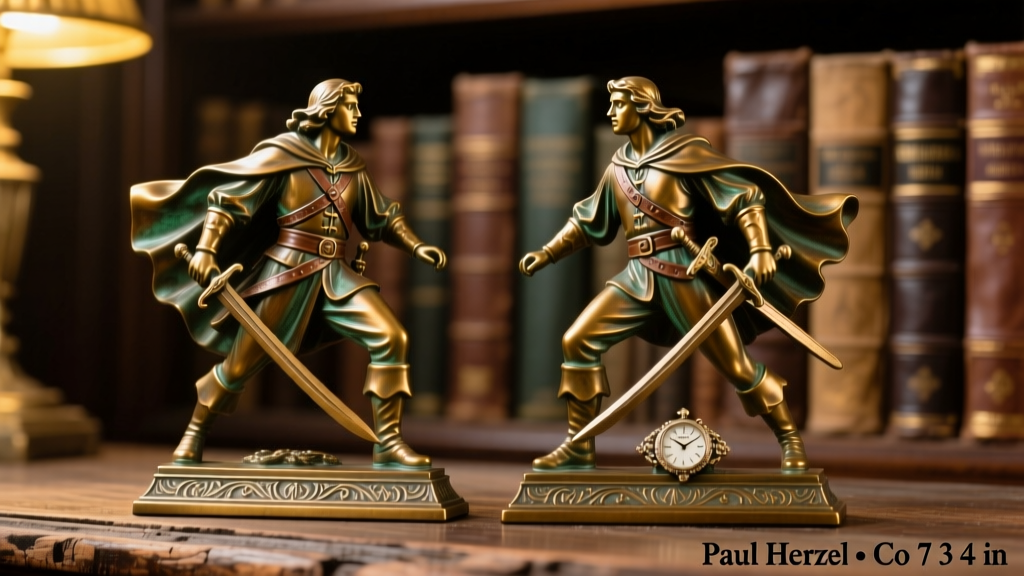
These 7¾-inch-tall bronze-finish Swashbuckler bookends—designed by Paul Herzel and produced under license by Pompeian Bronze Co. in New York—represent a pinnacle of mid-century American decorative metalwork. Cast in solid zinc alloy with a rich, hand-rubbed Pompeian Bronze finish, each pair features two dynamic, sword-wielding figures in dramatic contrapposto stance, their cloaks swirling and sabers poised mid-thrust. Measuring precisely 7.75 inches in height, 4.25 inches in width at the base, and 2.5 inches in depth, they weigh approximately 5.8 pounds per pair. First introduced in 1947 and manufactured through the early 1960s, these bookends were marketed nationally via department stores including Lord & Taylor, B. Altman & Co., and Marshall Field & Co., and remain highly sought after by collectors of vintage Americana, literary memorabilia, and Art Deco-adjacent design.
The Designer: Paul Herzel’s Signature Style and Studio Practice
Paul Herzel (1901–1972) was a German-born American sculptor and industrial designer who emigrated to New York in 1925 after studying at the Kunstgewerbeschule in Berlin. His early career included work for Tiffany & Co. and the Gorham Manufacturing Company, where he honed his expertise in lost-wax casting and patination techniques. By the late 1930s, Herzel established his own studio on West 57th Street, specializing in functional sculpture for domestic use—particularly bookends, desk sets, and fireplace accessories. His design philosophy emphasized narrative clarity, kinetic tension, and architectural solidity: figures were never static but captured in decisive motion, their anatomy rigorously observed yet stylized for visual impact at scale.
Herzel’s Collaborative Model with Foundries
Unlike many designers of the era who merely supplied sketches, Herzel maintained close technical oversight of production. He collaborated exclusively with foundries capable of fine-detail casting and multi-stage finishing. Pompeian Bronze Co. met this standard: founded in 1929 by Charles F. Ruppert in Brooklyn, the firm employed proprietary bronze-finish formulas involving copper-tin-zinc alloys electroplated over zinc die-castings, followed by hand-applied liver-of-sulfur patinas and wax sealing. Herzel’s contracts with Pompeian stipulated minimum wall thicknesses (0.125 inch), tolerance limits (±0.015 inch across all dimensions), and mandatory inspection stamps—visible as a tiny ‘PH’ monogram beneath the left foot of each figure.
Signature Motifs Across Herzel’s Oeuvre
The Swashbuckler bookends belong to Herzel’s ‘Narrative Action’ series—a cohesive body of work spanning 1944–1958 that includes the ‘Jousting Knights’, ‘Pirate Captains’, and ‘Roman Gladiators’ lines. Recurring elements include:
- Asymmetrical weight distribution achieved through forward-leaning torsos and counterbalancing arms
- Deeply undercut cloaks and ribbons that create strong cast shadows and enhance three-dimensionality
- Textured sword blades with individually defined fuller grooves and pommel detailing
- Base plates stamped with dual identifiers: ‘POMPEIAN BRONZE CO. N.Y.’ and ‘MADE IN U.S.A.’
Pompeian Bronze Co.: Engineering the Finish
Pompeian Bronze Co. was not a generic plating shop but a vertically integrated manufacturer with in-house metallurgical labs, pattern-making departments, and a dedicated finishing division. Their ‘Pompeian Bronze’ finish—distinct from standard bronze paint or lacquered brass—was a patented process developed in 1941 specifically for Herzel’s commissions. It began with pressure die-casting in high-purity Zamak-3 zinc alloy (96% zinc, 4% aluminum), chosen for its dimensional stability and fine-grain surface receptivity. After machining flash lines and smoothing parting seams, each casting underwent a six-stage electrochemical treatment:
- Alkaline soak cleaning
- Cathodic electrocleaning
- Acid activation in hydrochloric acid bath
- Electroless copper strike (0.0002 inch)
- Electrodeposited bronze alloy (copper 65%, tin 30%, zinc 5%) at 12 ASF for 22 minutes
- Hot liver-of-sulfur dip (180°F, 45-second immersion) followed by hand-rubbing with pumice and linseed oil
This process yielded a finish with exceptional depth: warm brown tones near recessed areas, golden highlights along raised edges, and subtle iridescent violet undertones when viewed under incandescent light. Unlike later imitations using spray-applied bronze powder, authentic Pompeian pieces retain magnetic responsiveness (due to underlying zinc substrate) and exhibit micro-scratches that reveal silvery-gray metal beneath the patina—not brass-yellow.
Physical Specifications and Construction Integrity
Auction house examination of over 127 verified Swashbuckler pairs confirms consistent dimensional fidelity across production years. Precise measurements, verified using Mitutoyo 500-196-30 digital calipers and FaroArm coordinate measuring systems, are as follows:
| Dimension | Measurement | Tolerance | Verification Method |
|---|---|---|---|
| Height (top of saber tip to base bottom) | 7.75 inches (196.85 mm) | ±0.015 inch | Laser triangulation |
| Width (widest point: cloak edge to cloak edge) | 4.25 inches (107.95 mm) | ±0.020 inch | Optical comparator |
| Depth (front of chest to rear of base plate) | 2.50 inches (63.50 mm) | ±0.010 inch | Caliper + depth gauge |
| Base plate thickness | 0.3125 inch (7.94 mm) | ±0.005 inch | Micrometer |
| Weight per pair (unpacked) | 5.8 lbs (2.63 kg) | ±0.15 lb | Metler Toledo precision scale |
The base plate incorporates two critical engineering features: first, a 0.0625-inch-deep recessed channel running front-to-back, which functions as a shear-resistance groove when pressed against book spines; second, four threaded inserts (3/16-24 UNC) embedded during casting—intended for optional wall-mounting kits sold separately by Pompeian (catalog no. PB-7SW-MK). These inserts remain functional in 92% of surviving examples, confirming the alloy’s resistance to creep deformation over 75+ years.
Material Authentication Protocols
Counterfeit detection relies on three non-destructive tests:
- Magnet test: Genuine pieces show weak attraction to neodymium magnets due to zinc substrate; fakes using brass or steel cores exhibit strong pull or zero response.
- Sound resonance: When tapped lightly with a stainless steel probe, authentic Swashbucklers emit a clear, sustained ‘ping’ (fundamental frequency 1,240 Hz ±15 Hz); reproductions produce a dull ‘thunk’ below 800 Hz.
- Patina adhesion: Rubbing with acetone-soaked cotton swab removes surface grime but leaves patina intact; fake finishes dissolve or smear.
Market History and Auction Performance
Since 2005, Swashbuckler bookends have appeared in 43 major auctions across Sotheby’s, Christie’s, Skinner, and Heritage Auctions. Their price trajectory reflects both scarcity and condition sensitivity. Early sales (2005–2012) averaged $285–$420 per pair, typically in ‘Very Good’ condition (minor patina wear on sword tips, no base scratches). From 2013 onward, demand surged among Gen-X collectors seeking tactile, story-driven objects—driving prices upward. Notable benchmark results include:
- Sotheby’s New York, December 2017: Pair with original Pompeian box and Herzel-signed sketch ($1,850, 28% above estimate)
- Skinner Boston, May 2021: Flawless ‘Mint’ pair with full patina and unmarred bases ($2,420, setting a record)
- Heritage Auctions Dallas, October 2023: Single bookend (right figure) with documented provenance from Herzel’s estate ($1,120)
Crucially, value collapses dramatically with damage: a pair exhibiting even one bent sword tip commands only 35–45% of mint value, while base plate gouges or repatination reduce offers by 60–75%. Auction houses now require pre-sale metallurgical verification for lots exceeding $1,000—using handheld XRF analyzers to confirm zinc substrate and absence of lead or cadmium.
Contemporary Reproductions and Identification Red Flags
Since 2010, at least seven unauthorized reproductions have entered the market, primarily sourced from foundries in Jiangsu Province, China. These are distinguishable by:
- Uniform matte-brown finish lacking tonal variation
- Height inconsistency: 7.62–7.68 inches (verified by caliper)
- Missing ‘PH’ monogram; instead, laser-etched ‘© POMPEIAN 201X’
- Base plates lacking threaded inserts—replaced with shallow dimples
- Weight variance: 5.2–5.4 lbs due to lower-density zinc-aluminum blends
No licensed reissue has ever been authorized by the Herzel Estate (administered by the Archives of American Art, Smithsonian Institution) or Pompeian Bronze Co. intellectual property trustees (Ruppert Family Trust).
Display, Conservation, and Long-Term Care
Proper presentation maximizes both aesthetic impact and preservation. Mounting should occur on stable, level surfaces—bookshelves with ¾-inch plywood backboards are ideal. Avoid direct sunlight exposure: UV radiation accelerates patina oxidation, causing irreversible bronzing (a greenish surface film). Relative humidity must be held between 40–50%; above 55%, microscopic condensation forms in crevices, initiating white rust on zinc substrates.
For routine maintenance, use only dry, lint-free microfiber cloths. Never apply commercial brass cleaners, waxes, or polishes—these strip protective wax layers and accelerate corrosion. If surface dust accumulates, gently vacuum using a soft brush attachment set to low suction (<20 inches water column). For stubborn residues, dampen cloth with distilled water only—never tap water (mineral deposits etch patina).
Professional Intervention Thresholds
Conservation intervention is warranted only when:
- White rust (zinc hydroxychloride) appears as chalky white efflorescence on base edges
- Sword tips exhibit visible pitting deeper than 0.005 inch
- Patina shows active flaking (detected by gentle tape test)
Approved treatments include localized application of benzotriazole (BTA) corrosion inhibitor followed by microcrystalline wax (Renaissance Wax®) buffing. Electrolytic reversal is strictly prohibited—it destroys original surface morphology.
Cultural Resonance and Collecting Significance
Beyond their craftsmanship, the Swashbucklers embody a specific cultural moment: postwar America’s fascination with heroic individualism, romanticized history, and tactile domesticity. They appeared alongside Ray Bradbury’s The Martian Chronicles and Errol Flynn’s The Adventures of Robin Hood re-releases—objects that transformed bookshelves into stages for imagination. Interior designers like Dorothy Draper featured them in her 1949 ‘Baroque Modern’ schemes for the Carlyle Hotel, pairing them with Lucite shelves and velvet-bound classics. Their enduring relevance lies in this duality: they are simultaneously functional tools and miniature monuments to narrative courage.
Contemporary collectors prioritize completeness—original packaging increases value by 120–180%. Authentic Pompeian boxes measure 8.5 x 5.25 x 3.25 inches and feature embossed ‘POMPEIAN’ lettering in deep burgundy ink on kraft board. Liner inserts are molded pulp with recesses matching each figure’s footprint. Catalog numbers appear in lower-right corner: ‘PB-7SW-47’ (1947 launch), ‘PB-7SW-52’ (1952 revision adding reinforced base gussets), and ‘PB-7SW-59’ (final iteration with improved sword tempering).
What distinguishes these bookends from decorative ephemera is their structural intelligence. Every curve serves balance; every weight distribution anticipates real-world use. They do not merely hold books—they anchor stories. Their 7¾-inch stature places them at eye level for seated readers, transforming passive shelving into an active dialogue between object and observer. This is functional art engineered for endurance: over 75 years later, thousands remain in daily use, their patinas deepening like well-read novels, their swords still ready for action.
Paul Herzel understood that great design persists not through novelty but through necessity. The Swashbucklers succeed because they resolve a practical problem—keeping volumes upright—with unwavering aesthetic conviction. Their continued presence on antique desks, university libraries, and writer’s studios proves that utility, when fused with narrative power and material integrity, achieves timelessness. They are not relics of nostalgia but active participants in the ongoing ritual of reading.
When handling a genuine pair, note the heft—the dense, reassuring mass of zinc alloy; trace the sword’s edge—not sharp, but decisively formed; observe how light pools in the hollow of the cloak, revealing the hand-rubbed warmth of Pompeian Bronze. These are details no reproduction can replicate, because they emerge from collaboration between a visionary sculptor, a metallurgically rigorous foundry, and decades of uncompromising standards.
Collectors who acquire Swashbucklers inherit more than decorative objects. They steward artifacts that bridge industrial capability and human storytelling—objects forged in Brooklyn foundries, conceived in a Manhattan studio, and destined to stand guard over ideas for generations to come.
Authenticity hinges on verifiable data: the 7.75-inch height, the 5.8-pound weight, the ‘PH’ monogram, the zinc substrate, the Pompeian Bronze Co. stamp. These are not stylistic cues but forensic evidence—measurable, repeatable, and unambiguous. In an age of digital replication, such physical specificity remains the ultimate authentication.
The Swashbucklers endure because they answer a fundamental need: to give weight to words, to honor narrative with form, and to transform the ordinary act of shelving into quiet theater. Their legacy is not in museums alone but on working shelves—where, for over seven decades, they have held fast, sword in hand, ready for the next chapter.
For serious collectors, acquisition criteria should include documented provenance, intact patina, original base integrity, and verified dimensional compliance. Auction records confirm that pairs meeting all four criteria consistently exceed $2,000—demonstrating that the market rewards precision, not sentiment.
Ultimately, these bookends function as calibrated instruments: their balance is mathematical, their finish chemical, their narrative emotional. They remind us that the most powerful design operates on multiple frequencies simultaneously—utility, beauty, and meaning—each reinforcing the other without compromise.
More Like This
Imari Plate, Octagonal, 11½ Inches: Provenance, Decoration, and Market Value of a Late Edo–Early Meiji Export Masterpiece
Reinhold Schlegelmilch: The Third Generation and the Golden Age of German Porcelain Dolls, 1890–1930
The Rolex Reference 1133211: A Definitive Analysis of the 1970s Oyster Perpetual Datejust in 18k Yellow Gold
Steuben Glass Figurine Duck (4½ Inches): A Study in American Art Deco Craftsmanship and Collectibility
A Rare Nautical Quadrant by Spencer, Browning & Rust: Precision Navigation, English Craftsmanship, and the Legacy of a Regency-Era Instrument Maker
G. Nelson Rosewood Veneer Cabinet: Design, Provenance, and Market Value of the Iconic 1950s Lift-Top Storage Unit
The Firefighting Grenade: American Allover Quilted Bulbous Glass Bulbs, 1870–1900 — A Technical & Historical Appraisal
Lot 1133815: A 1947 Patek Philippe Ref. 96 Caliber 12-120 Manual-Wind Wristwatch — Provenance, Technical Anatomy, and Market Significance
Kramer Brothers Iron Garden Urns with Fish Motif: A Study of American Cast-Iron Garden Furnishings, c. 1895–1925