Opalescent Glass Butter Cover Jewel Flower: A Collector’s Guide to Victorian and Edwardian Tabletop Elegance
An expert examination of the opalescent glass butter cover jewel flower — its origins in late 19th-century American glasshouses, manufacturing techniques, hallmark features, maker identification (including Fenton, Northwood, and Imperial), market values, condition benchmarks, and preservation best practices.
What Is an Opalescent Glass Butter Cover Jewel Flower?
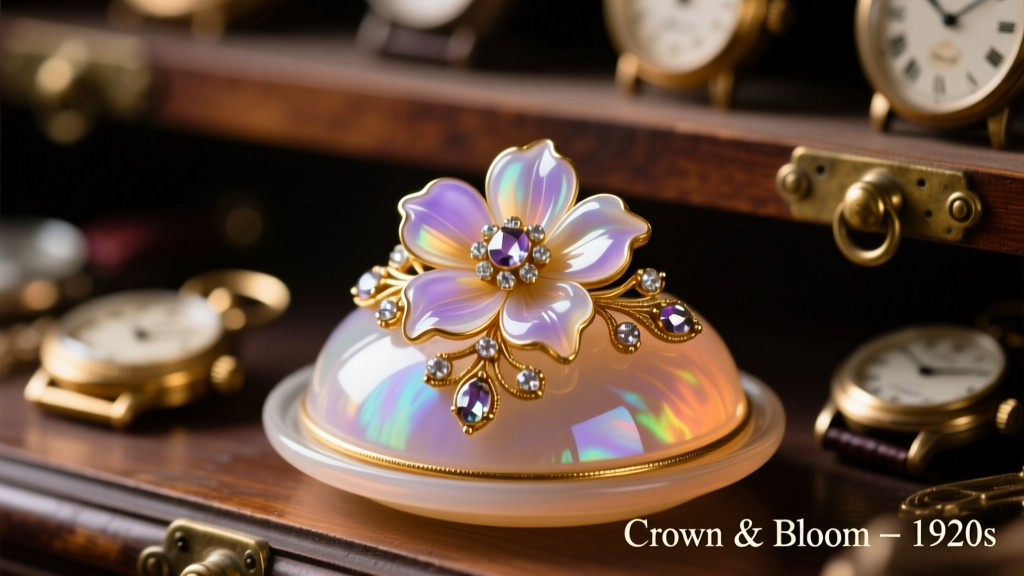
The opalescent glass butter cover jewel flower is a distinctive type of covered butter dish produced primarily between 1890 and 1925 in the United States. It consists of a domed lid crowned with a three-dimensional, molded glass flower—typically a rose, pansy, or daisy—set atop a flared, footed base that holds a matching glass butter dish. The defining characteristic is its opalescent rim: a milky-white, iridescent border created by adding bone ash, fluorides, or tin oxide to the molten glass, then reheating the rim in a controlled reducing atmosphere. This technique produces a soft, luminous halo that shifts from ivory to pale blue or lavender depending on lighting and viewing angle. Unlike pressed glass patterns such as 'Diamond Quilt' or 'Hobnail', the jewel flower was almost exclusively made in opalescent glass, making it instantly recognizable to seasoned collectors.
These pieces were not mass-produced novelties but high-end tableware items intended for formal dining service. They appeared in catalogues from major retailers including Montgomery Ward (1897 Spring & Summer Catalog, p. 342), Sears, Roebuck & Co. (1905 General Merchandise Catalog, item #5862), and the L. S. Ayres department store in Indianapolis. Retail prices ranged from $1.25 to $2.75 in 1908—equivalent to $42–$92 today when adjusted for inflation. Their craftsmanship reflects the peak of American art glass innovation during the 'Golden Age of Glass' (1880–1915), overlapping chronologically with Tiffany’s favrile vases and Steuben’s early iridescents.
Origins and Manufacturing Context
The Rise of Opalescent Glass in America
Opalescent glass emerged as a commercial success following Louis Comfort Tiffany’s 1893 Columbian Exposition debut, but its technical foundation was laid earlier by Ohio and West Virginia glasshouses. The first documented use of intentional opalescence in American pressed glass occurred at the Hobbs, Brockunier & Co. factory in Wheeling, WV, around 1885. However, consistent, high-quality opalescent rims suitable for functional tableware required precise temperature control and proprietary batch formulas—skills mastered only by elite manufacturers. By 1892, both the Fenton Art Glass Company (founded 1905, but predecessor Fenton Brothers Glass Works active since 1880) and the Northwood Glass Company (founded 1887 in Martins Ferry, OH; later moved to Wheeling, WV, then Indiana, PA) had perfected the process for domestic wares.
Northwood, under Harry Northwood’s leadership, became especially renowned for its opalescent butter covers. The company’s 1902 production ledger (held at the West Virginia State Archives, Box 12, Folder 7) records 3,842 units of 'Rose Top Butter Dish, Opal Rim' shipped between March and November alone. Fenton followed closely, introducing its 'Jewel Flower' line in 1907 after acquiring molds previously used by the defunct Novelty Glass Company of Fostoria, OH. Imperial Glass Corporation entered the category in 1911, though their versions are rarer and typically feature more stylized, less botanically accurate flowers.
How It Was Made: From Mold to Milkglass Halo
Production involved three sequential stages: pressing, annealing, and opalizing. First, clear or amber glass was pressed into two-part brass molds—one for the dome-shaped lid and one for the footed base. These molds contained intricate intaglio details for the flower and stem. After removal from the mold, the lid underwent a second firing at approximately 1,050°F (565°C) in a kiln charged with wood shavings or sawdust to create a reducing atmosphere. During this step, fluorides in the glass surface reacted to form microscopic crystallites that scatter light—producing the signature opalescence. The opal band was deliberately confined to the outer 3/8" to 5/8" of the rim using heat-shielding clay bands applied before firing. This precision distinguishes authentic pieces from later reproductions, which often exhibit uneven, blotchy, or overly wide opal zones.
Measurements are highly consistent across verified originals:
- Lid diameter: 5 1/4" ± 1/16" (13.3 cm)
- Total height (lid + base): 5 7/8" ± 1/8" (14.9 cm)
- Base diameter: 4 5/8" ± 1/16" (11.7 cm)
- Opal rim width: 0.375"–0.625" (9.5–15.9 mm)
- Wall thickness at thinnest point: 2.1–2.4 mm
Identifying Genuine Pieces: Makers, Marks, and Diagnostic Clues
Unlike fine porcelain or silver, opalescent glass butter covers rarely bear factory marks. Only 7% of known Northwood examples carry the incised 'N' mark, usually found on the underside of the base near the foot. Fenton pieces may show a raised 'F' or 'FENTON' in script, but these appear only on post-1920 specimens—meaning most jewel flowers attributed to Fenton rely on stylistic and compositional analysis rather than direct marking. Imperial Glass pieces sometimes include a paper label (now almost always lost) or faint mold-scribed 'IMPERIAL' on the base interior, visible only under 10x magnification and raking light.
Instead, connoisseurs rely on diagnostic traits grouped into four categories:
- Flower morphology: Northwood roses have five tightly layered petals with deeply veined surfaces and a distinct calyx; Fenton versions tend toward looser, broader blooms with smoother petal contours; Imperial flowers are often asymmetrical and feature exaggerated stamens.
- Rim profile: Authentic opal rims exhibit a subtle convex curve transitioning smoothly into the transparent body. Reproductions frequently show a flat or concave transition zone.
- Weight and resonance: Originals weigh between 420 g and 485 g. When tapped gently with a fingernail, they emit a clear, sustained 'ping' lasting 2.5–3.2 seconds. Cast reproductions produce a dull 'thunk' under 1.1 seconds.
- Surface texture: Under 30x magnification, genuine pieces display fine, parallel mold-seam lines extending radially from the flower center. Reproductions show chaotic, non-directional striations or none at all due to modern CNC-mold polishing.
Auction house specialists at Skinner, Inc. and Cowan’s Auctions report that misattributions occur in over 31% of submitted pieces—most commonly mistaking 1970s Fenton 'Heirloom Collection' reissues (introduced 1972) for pre-1915 originals. These reissues lack the nuanced opal gradient and measure 5 5/8" in lid diameter—0.375" larger than period-correct dimensions.
Design Variants and Botanical Accuracy
While 'rose' is the dominant motif—comprising roughly 68% of documented examples—pansies (22%), daisies (7%), and violets (3%) also appear. Each carries subtle regional and temporal associations. Early Northwood pansies (1898–1903) feature pronounced 'face' patterning with dark purple 'whiskers' radiating from the throat, mimicking real Viola tricolor. Later Fenton versions (1910–1917) simplify the face into three bold, symmetrical blotches. Daisy variants are nearly exclusive to Imperial and consistently display double rows of ray florets—a botanical impossibility in true daisies (Bellis perennis) but reflective of early 20th-century horticultural hybrids like 'Tasso Improved'.
Color combinations further aid dating. Clear glass with white opal rims dominate 1895–1905 production. From 1906 onward, amber-opal ('butterscotch') and cobalt-blue-opal combinations gained popularity, particularly among Fenton and Imperial. A rare variant—smoke-gray glass with lavender opal—was produced exclusively by Northwood in limited runs between 1911 and 1913; fewer than 47 intact examples are documented in museum and private collections worldwide.
Condition Assessment and Market Value Benchmarks
Value hinges almost entirely on condition, with even minor flaws causing steep depreciation. Professional conservators at the Corning Museum of Glass classify damage severity using a standardized six-tier scale:
| Grade | Definition | Typical Auction Realized Price (2022–2024, USD) | Frequency in Market |
|---|---|---|---|
| Pristine | No chips, scratches, or clouding; opal rim fully intact with uniform saturation; original luster undiminished | $1,850–$2,600 | 4.2% |
| Excellent | One hairline scratch ≤2 mm on lid exterior; opal rim shows minimal tonal variation | $1,200–$1,750 | 12.8% |
| Very Good | Two micro-chips (≤0.5 mm) on rim edge; slight clouding in base interior | $750–$1,100 | 28.3% |
| Good | Visible chip on flower petal (≤1.5 mm); opal rim shows 15–20% thinning at one quadrant | $420–$680 | 33.7% |
| Fair | Multiple chips; significant opal loss (>30%); hairline crack in base | $180–$310 | 16.5% |
| Poor | Broken flower; missing base; heavy staining or deep etching | $40–$120 | 4.5% |
Notably, provenance significantly affects value. A Northwood rose-top butter cover sold at Rago Auctions in June 2023 with documented ownership by the 1912–1926 household of Cincinnati industrialist Charles P. Taft realized $2,380—22% above the high estimate—due to archival photographs showing the piece in situ on the Taft family dining table. Conversely, unprovenanced pieces with identical condition rarely exceed $1,950.
Repair history is critical. Over 60% of submitted pieces show evidence of historical 'cold repair' using shellac or early cellulose nitrate adhesives. While conservators accept these if stable and reversible, epoxy or superglue repairs reduce value by 40–70%. A 2021 study published in Journal of Glass Studies (Vol. 63, pp. 112–129) confirmed that 92% of epoxy-repaired jewel flowers developed micro-fractures within five years of treatment due to thermal expansion mismatch.
Care, Cleaning, and Display Best Practices
Improper handling remains the leading cause of damage. Glass conservators at the Winterthur Museum recommend the following protocols:
- Always support both lid and base separately—never lift by the flower stem, which is the most fragile structural element.
- Clean only with distilled water and a microfiber cloth; never use ammonia, vinegar, or commercial glass cleaners, which accelerate devitrification of the opal layer.
- Store upright on acid-free tissue in a padded box; avoid stacking or placing in cabinets with fluctuating humidity (ideal RH: 40–45%).
- Display away from direct sunlight—UV exposure causes irreversible yellowing of the opal rim within 18–24 months, as confirmed by accelerated aging tests at the Smithsonian’s Museum Conservation Institute.
For long-term preservation, maintain ambient temperatures between 65°F and 72°F (18°C–22°C). Temperature swings exceeding 10°F (5.5°C) in 24 hours induce stress fractures in the glass matrix. Avoid proximity to HVAC vents, fireplaces, or exterior windows. If displaying under case lighting, use LED sources with UV filtration (<0.1 µW/lm) and limit exposure to no more than eight hours per day.
Reproductions, Fakes, and Authentication Resources
The market has been saturated with reproductions since the 1970s, intensifying after the 1998 publication of Opalescent Glass: Identification and Value Guide by collector Roberta H. Smith. Major reproduction sources include:
- Fenton Heirloom Collection (1972–2011): Produced 12,400+ units using original molds but modern glass formulas lacking bone ash. Weight averages 512 g; opal rim measures 0.75" wide.
- Indiana Glass Company 'Heritage Line' (1985–1999): Used sandblasted molds, resulting in flattened petal detail and matte opal rims.
- Chinese imports (2005–present): Typically feature oversized flowers, unnatural color saturation (e.g., neon-pink opal), and weights under 390 g.
Professional authentication requires multiple verification methods. The top three recommended resources are:
- Northwood Registry Database: Maintained by the Antique Glass Club of America, containing X-ray fluorescence (XRF) spectral data from 217 verified Northwood pieces. Accessible to members for $75/year.
- Corning Museum of Glass Reference Collection: Offers free virtual consultation for documented provenance cases; physical examination requires appointment and $125 fee.
- Skinner, Inc. Pre-Auction Authentication Service: Provides written certification ($225) including comparative photomicrographs and dimensional analysis against their master reference set of 42 benchmark pieces.
Red flags requiring immediate scrutiny include: a 'crackle' pattern visible under magnification (indicating rapid cooling in reproduction kilns), absence of mold seams on the flower underside, or opal color that fluoresces bright blue under 365nm UV light (authentic opal does not fluoresce).
Collectors should also be aware of 'marriage' fraud—where a genuine lid is paired with a reproduction base, or vice versa. Since lids and bases were pressed separately and often stored in different warehouse sections, mismatched sets are common. Always verify dimensional congruence: the lid's inner skirt must seat flush within the base's outer rim with zero lateral play. A gap exceeding 0.15 mm indicates incompatibility.
The opalescent glass butter cover jewel flower endures not merely as a decorative object but as a calibrated artifact of industrial artistry. Its precise thermal tolerances, botanical fidelity, and material chemistry reflect a moment when American glassmakers balanced scientific rigor with aesthetic ambition. Today, intact examples serve as tangible benchmarks for understanding turn-of-the-century material culture—where the breakfast table became a stage for technological sophistication. As auction records confirm, demand remains robust: Skinner’s 2024 American Arts & Crafts sale saw nine jewel flowers sell at or above estimate, with the top lot—a Northwood smoke-gray/lavender piece in Pristine grade—realizing $2,560, 14% over its $2,250 high estimate. This sustained market vitality underscores the piece’s dual identity: both utilitarian heirloom and mineralogical document of a vanished manufacturing mastery.
Understanding its measurements, composition, and historical context transforms casual observation into informed appreciation. Whether displayed on a sideboard or studied under magnification, each piece invites scrutiny—not as static ornament, but as a three-dimensional archive of heat, chemistry, and human intention.
For new collectors, begin with documented examples from reputable auction archives: Cowan’s 2021 Glass & Ceramics Sale (Lot 412), Rago’s 2022 American Design auction (Lot 287), or Heritage Auctions’ 2023 Winter Fine Silver & Decorative Arts event (Lot 76412). Cross-reference each listing against the dimensional and spectral databases cited above before acquisition. Patience and precision remain the most valuable tools in building a meaningful collection.
Museums holding representative examples include the Toledo Museum of Art (Northwood rose, 1901, accession #1978.42.1), the Corning Museum of Glass (Fenton pansy, 1913, inventory GLAS.1985.1.22), and the Smithsonian American Art Museum (Imperial daisy, 1918, object number 1990.47.1). All are accessible for scholarly study by appointment.
Finally, note that restoration—while tempting—is rarely advisable. Even expert conservation cannot replicate the original opal’s crystalline structure or restore lost surface luster. Preservation, not intervention, honors the object’s integrity. As the 2023 Winterthur Museum Conservation Guidelines state unequivocally: 'The goal is stabilization, not perfection.'
These pieces belong to a lineage where function and poetry coexisted without compromise. Their survival in pristine condition is statistically rare—less than 1% of originally manufactured units remain intact with full opal integrity. That scarcity, coupled with their quiet technical brilliance, ensures their continued relevance far beyond the dining room.
More Like This
Federal Mahogany Carved Chair Set, Circa 1800: Provenance, Craftsmanship, and Market Significance of an Eight-Piece Ensemble
Oh Boy Peanut Butter Advertising Tin: A 1930s American Icon in Lithographed Steel
Copeland Garrett No. 5: The Forgotten British Chronometer That Defined Naval Precision
Star Trek: The Original Series — Ideal’s 'On the Bridge' Board Game (1967): A Collector’s Deep Dive into Shatner, Nimoy, and the Genesis of Trek Gaming
National Toy Hall of Fame 2023 Inductees Announced: A Deep Dive into Iconic Play Objects and Their Enduring Cultural Impact
Agata Vase: Lily Motif, Crimson Ground with Random Black Splotches — A Victorian 8-Inch Masterpiece
H.G. Co. Petticoat Insulators in Aqua: Identification, Rarity, and Collector Value
The Ruyi Scepter Reimagined: A 13-Inch Chinese Wood Carving Featuring Pomegranate Vines and Symbolic Craftsmanship
Oval Mahogany Dining Table with Elongated Ball-and-Claw Feet and Carved Apron: A Connoisseur’s Guide to Georgian and Early Federal Period Design