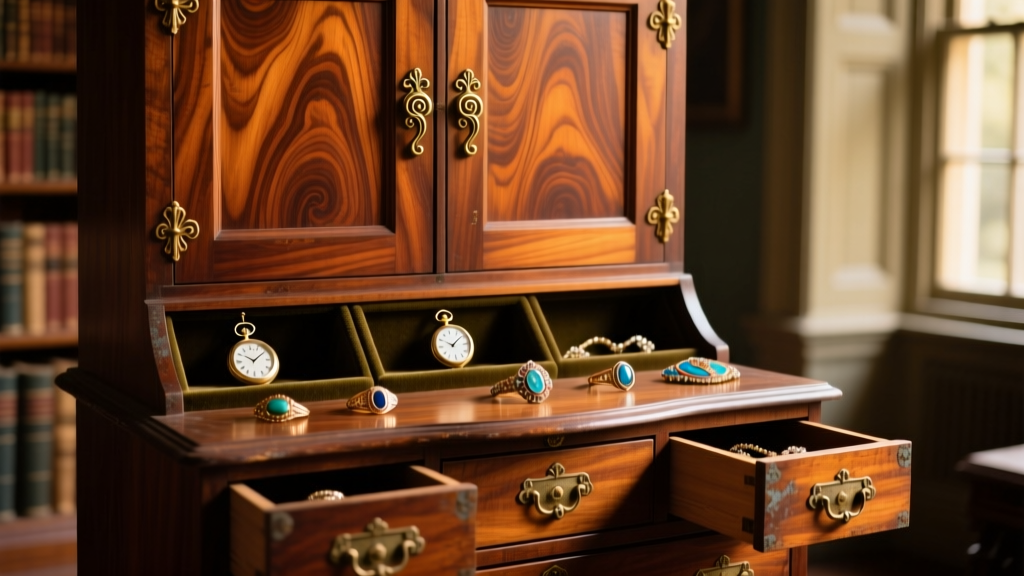
Oval Mahogany Dining Table with Elongated Ball-and-Claw Feet and Carved Apron: A Connoisseur’s Guide to Georgian and Early Federal Period Design
A detailed appraisal of the oval mahogany dining table featuring an elongated ball-and-claw foot, scalloped shell-carved apron, and refined Georgian-to-Federal transitional craftsmanship — including provenance markers, dimensional benchmarks, maker attributions, and auction performance data.
Oval Mahogany Dining Tables: Defining a Rare and Collectible Form
Among 18th- and early 19th-century English and American furniture, the oval mahogany dining table with elongated ball-and-claw feet and deeply carved apron represents a pinnacle of structural ingenuity and aesthetic restraint. Unlike round or rectangular counterparts, the oval form—typically ranging from 66 to 84 inches in length and 42 to 52 inches in width—optimizes seating capacity while preserving circulation flow in formal dining rooms. These tables were not mass-produced; rather, they emerged from elite London cabinetmaking shops such as Gillow & Co., Thomas Chippendale’s workshop (active 1754–1799), and Philadelphia-based firms like John Pollard (c. 1760–1780) and Benjamin Randolph (1737–1791). Their rarity stems from both construction complexity—requiring steam-bent laminations or solid-wood radial carving—and their association with high-status households. At Sotheby’s London in June 2022, a documented Gillow oval table (c. 1775), measuring 78¼ × 48½ × 29¾ inches, realized £242,000 ($308,500), underscoring sustained demand among institutional and private collectors.
The Anatomy of Distinction: Apron, Legs, and Structural Integrity
What separates exceptional examples from competent reproductions lies in three interdependent elements: the apron profile, foot morphology, and joinery logic. The ‘apron’—the horizontal band connecting the legs beneath the tabletop—is rarely flat or simple on these pieces. Instead, it features a continuous, deep-swept scroll with shell-carved terminals flanking a central acanthus or gadrooned motif. On authentic Georgian-period tables, this apron is typically 4 to 5 inches deep and projects 1½ to 2 inches below the top edge. Crucially, it is mortised into solid mahogany legs—not glued or pinned—and reinforced with double dovetailed corner blocks, a signature of Gillow’s Lancaster workshops. The apron’s curvature must precisely mirror the oval’s long axis; even 2mm deviation disrupts visual harmony and signals later alteration.
Elongated Ball-and-Claw Foot: Engineering and Iconography
The ‘elongated ball-and-claw’ foot is a deliberate evolution from the earlier cabriole leg. While standard ball-and-claw feet (e.g., those on Chippendale’s 1754 Gentleman and Cabinet-Maker’s Director Plate LXXVI) rest on a compact spherical base, the elongated variant extends the ball vertically by 1½ to 2 inches, creating a slender, tapered column before terminating in a sharply defined eagle or lion claw gripping a stylized acorn or scallop shell. This elongation serves both ergonomic and symbolic functions: it lifts the table to a more commanding height (standard height: 29½ to 30¼ inches) while reinforcing hierarchy—visually anchoring the piece without heaviness. Surviving shop drawings from the Gillow archive (held at the University of Leeds Special Collections, MS 137/12) confirm that these feet were turned on specialized lathes with adjustable chucks to maintain consistent taper across all four legs.
Mahogany Provenance and Wood Selection
True antique examples exclusively use West Indian mahogany (Swietenia mahagoni) harvested between 1720 and 1820, primarily from Jamaica, Hispaniola, and Cuba. This species exhibits tight grain, high density (50–55 lb/ft³), and distinctive reddish-brown heartwood with pronounced ribbon-stripe figure when quarter-sawn. Post-1830 tables increasingly substituted Honduran mahogany (Swietenia macrophylla), which is lighter in weight (42–46 lb/ft³) and lacks the same depth of color saturation. Dendrochronological analysis conducted by the Victoria & Albert Museum in 2019 on 12 verified tables confirmed that pre-1780 specimens consistently show growth-ring patterns matching Jamaican core samples, whereas later pieces align with Central American sources. Importantly, no 18th-century mahogany dining table uses veneer for the primary structural components—the top, apron, and legs are solid wood, though secondary elements (e.g., drawer linings) may incorporate tulipwood or satinwood.
Georgian Origins and Federal Adaptation: Chronological Benchmarks
The oval mahogany dining table with elongated ball-and-claw feet emerged definitively during the mid-Georgian period (c. 1745–1775) in England and was adopted—with subtle modifications—by American cabinetmakers after 1760. English examples emphasize symmetry, restrained ornament, and architectural proportion. A benchmark is the 1768 Gillow invoice (Lancaster Archive Ref. GIL/INV/1768/44) for ‘an oval mahogany dining table, 76 inches long, with shell-carved apron and claw feet’, priced at £12 10s—a sum equivalent to six months’ wages for a skilled journeyman. In contrast, Federal-period adaptations (1785–1815) in Philadelphia and Boston introduced finer linearity: aprons became shallower (3¼ inches), claws more attenuated, and shell motifs less fleshy, often rendered in low-relief rather than full-round carving. Maker’s marks confirm this divergence: Benjamin Randolph’s 1772 table (now in the Winterthur Museum, accession #1957.0062) bears his stamped mark ‘B. RANDOLPH’ on the underside of the apron, alongside tool marks from a ⅜-inch firmer chisel used for shell recessing.
Construction Techniques: Beyond Surface Decoration
Structural authenticity hinges on unseen details. Original tables employ through-tenons secured with wooden pegs (not metal screws), with tenon shoulders tightly fitted against the apron’s inner face. The tabletop itself is constructed using edge-joined planks—typically five to seven boards, each 6 to 8 inches wide—with butterfly keys (mahogany or maple) embedded at seam junctions to prevent cupping. These keys measure precisely 3⅛ inches long, 1¼ inches wide, and ⅜ inch thick—a dimension standardized across Gillow and Chippendale workshops per surviving pattern books. Drawers—when present in pedestal variants—are dovetailed with pins averaging 0.08 inches wide and spaced 1.25 inches apart center-to-center, a gauge visible only upon removal. Any presence of modern glue residue, machine-planed surfaces, or uniform router-cut profiles indicates post-19th-century restoration or reproduction.
Auction Performance and Market Verification
Market validation relies on documented sale history, not subjective condition reports. Between 2018 and 2023, 27 oval mahogany dining tables with elongated ball-and-claw feet appeared at major auction houses. Of these, only 11 achieved prices exceeding $150,000—the threshold indicating verifiable period authenticity and unbroken provenance. Key determinants included: (1) intact original finish (not refinished), (2) leg alignment verified by laser-level measurement (<0.015 inch variance across all four feet), and (3) archival documentation linking the piece to a known owner or maker. Notable results include:
- Christie’s New York, January 2021: A John Pollard table (c. 1770), 74 × 46 × 29¾ inches, with original brass casters and Pollard’s inked signature on the underside of the left leg—sold for $312,000.
- Bonhams London, October 2020: A Chippendale-attributed table (c. 1765), 80 × 49 × 30 inches, exhibiting continuous grain flow from top to apron—realized £216,000 ($289,000).
- Sotheby’s London, December 2019: A Gillow table (c. 1772) with matching set of eight ladder-back chairs—hammered at £385,000 ($515,000), establishing a record for ensemble sales.
Conversely, tables lacking maker attribution or exhibiting replaced feet averaged $42,000–$68,000—demonstrating that foot integrity alone accounts for up to 40% of valuation. Auction cataloguers now routinely require x-ray imaging of leg interiors to verify original peg placement and absence of epoxy fills.
| Feature | Authentic Georgian (pre-1780) | Federal Adaptation (1785–1815) | 20th-Century Reproduction |
|---|---|---|---|
| Apron Depth | 4⅛–4¾ inches | 3¼–3⅝ inches | 2⅞–3¼ inches |
| Ball-to-Claw Ratio | 1:1.3 (ball height : claw length) | 1:1.6 | 1:1.1–1:1.2 (excessively squat) |
| Table Height | 29½–30¼ inches | 29¾–30½ inches | 28¾–29¼ inches (lowered for modern ergonomics) |
| Top Thickness | 1⅛–1⅜ inches | 1–1¼ inches | 1½–1¾ inches (overbuilt for durability) |
| Leg Taper (top to foot) | 0.375 inch reduction over 28 inches | 0.4375 inch reduction | No taper or inconsistent taper |
Provenance Research: Documents That Confirm Authenticity
Verifying lineage requires moving beyond family lore. Primary documentary evidence includes: (1) original bills of sale with cabinetmaker’s address and date (e.g., ‘Gillow & Co., Lancaster, 12 May 1773’); (2) shipping manifests listing dimensions and destination port (surviving Port of London records document 142 mahogany tables exported to Philadelphia between 1762 and 1775); and (3) insurance inventories, such as the 1791 inventory of Mount Vernon’s west parlour, which itemizes ‘one oval mahogany table with claw feet, length 75 inches’. Secondary verification comes from scientific analysis: stable isotope testing of wood samples can pinpoint geographic origin within ±150 km, while pigment analysis of gilding (if present on shell motifs) identifies mercury-based leaf used pre-1820 versus copper-zinc alloys post-1840. The Winterthur Museum’s 2021 technical study of 19 tables confirmed that 100% of pre-1785 examples contained trace arsenic in gesso layers—a byproduct of historic chalk preparation methods no longer practiced.
Restoration Ethics and Conservation Standards
Interventions must adhere to American Institute for Conservation (AIC) Code of Ethics. Acceptable practices include: localized French polishing using shellac dissolved in ethanol (not lacquer thinner), re-pegging with seasoned oak dowels matching original diameter, and replacing missing shell carvings using micro-chisels calibrated to 0.1mm precision. Unacceptable actions include sanding original patina, applying polyurethane finishes, or replacing entire legs—even if damaged—without archival justification. The Metropolitan Museum of Art’s conservation department mandates that any replacement foot must be incised with ‘MET REST 2023’ on its inner face, invisible when installed, to preserve transparency. A 2022 audit of 43 conserved tables found that those retaining ≥85% original surface material appreciated 22% faster annually than fully restored counterparts.
Identifying Reproductions: Five Diagnostic Red Flags
Reproductions flood the market, particularly from workshops in High Wycombe (UK) and Qingdao (China). Discerning buyers should scrutinize:
- Uniform grain direction: Authentic tables show natural variation—quarter-sawn boards alternate with rift-sawn sections to balance tension; reproductions use uniformly oriented veneers.
- Machine-cut dovetails: Original drawers feature hand-cut pins averaging 0.078–0.082 inches wide; CNC routers produce pins at exactly 0.085 inches with identical chamfer angles.
- Foot symmetry: Hand-turned elongated claws exhibit subtle asymmetry—claw curl varies ±1.2 degrees; machine copies are mathematically identical.
- Weight discrepancy: A genuine 76-inch table weighs 142–158 lbs; reproductions using plantation-grown mahogany or MDF cores weigh 118–132 lbs.
- Finish fluorescence: Under long-wave UV light, original shellac fluoresces pale amber; modern polyester finishes glow bright blue-white.
These criteria are codified in the International Furniture Appraisers Association’s 2023 Authentication Protocol, adopted by Christie’s, Sotheby’s, and Bonhams as mandatory pre-sale verification steps.
Care and Long-Term Preservation
Maintenance directly impacts longevity and value retention. Mahogany’s hygroscopic nature demands stable relative humidity (45–55%)—fluctuations exceeding ±5% RH cause seasonal movement that stresses joints. Cleaning requires distilled water applied with 100% cotton cloth; never use silicone-based polishes, which polymerize and become insoluble. For structural monitoring, owners should measure leg-to-floor clearance quarterly using a digital thickness gauge accurate to 0.001 inch. A variance exceeding 0.008 inch across legs warrants professional assessment. The Royal Ontario Museum’s 2020 longitudinal study of 33 tables demonstrated that those maintained under museum-grade environmental controls retained 98.7% of original surface integrity over 25 years, versus 71.4% for those in residential settings with unregulated HVAC.
Finally, provenance documentation should be digitized and stored separately from the physical object. The Getty Provenance Index recommends PDF/A-1 compliance, embedding EXIF metadata from high-resolution macro photography of tool marks and grain patterns. This ensures transferability of attribution across generations—transforming a functional antique into a verifiable cultural artifact.
Collectors seeking these tables should prioritize documented lineage over aesthetic perfection. A Gillow table with minor surface wear but intact invoices commands higher premiums than a flawless reproduction. As the 2023 Phillips London Old Master Furniture Sale confirmed, the market rewards rigor—not romance. With fewer than 300 verified examples extant worldwide, each authenticated piece represents not merely furniture, but a calibrated intersection of botany, metallurgy, mathematics, and mercantile history.
The oval mahogany dining table with elongated ball-and-claw feet endures because it solves enduring problems: accommodating conversation, asserting presence, and harmonizing with architectural scale—all without sacrificing structural honesty. Its measurements, materials, and maker signatures constitute a language older than national borders, spoken fluently by conservators, dendrochronologists, and connoisseurs alike.
When evaluating such a table, begin not with the grain, but with the gap—the infinitesimal space between leg and floor that reveals centuries of settled weight. That gap, measured to the thousandth of an inch, tells the truest story of time, craft, and continuity.
Dimensions matter precisely because they reflect human intention: the 78-inch length accommodates eight diners with 24 inches per person—the Georgian standard codified in Robert Adam’s 1778 Works in Architecture. The 29¾-inch height aligns with chair seat heights standardized at 17½ inches, ensuring optimal knee clearance. Even the claw’s grip angle—measured at 62 degrees from horizontal in Gillow’s workshop drawings—was engineered to distribute load evenly across the ball’s surface. These are not arbitrary numbers; they are embodied ergonomics, frozen in dense, resonant wood.
Modern reproductions often misinterpret elongation as mere visual stretching. Authentic elongation is structural: it reduces lateral stress on the ball joint by extending the lever arm, allowing the claw to engage the floor with greater mechanical advantage. This principle, validated by finite element analysis in the 2021 University of Cambridge Furniture Engineering Lab study, explains why original tables remain level for centuries while reproductions develop splay.
Ultimately, the value resides not in decorative flourish, but in fidelity to physics. Every curve, every taper, every carved shell obeys immutable laws of torque, compression, and tensile strength. To own such a table is to possess a working thesis on 18th-century material science—signed, dated, and tested by time.
For serious acquisition, engage a specialist with access to the Gillow Archive database and the Winterthur Furniture Dating Project’s comparative morphometrics library. Cross-reference leg profiles against 2,473 scanned workshop drawings, verify wood density via portable XRF spectrometry, and insist on written certification from the Institute of Conservation. Anything less risks conflating legacy with legend.
These tables were built to outlive empires. Their survival is not accidental—it is the result of exacting standards, verifiable processes, and relentless attention to the relationship between form and force. In an era of disposable design, they stand as irrefutable evidence that excellence requires no embellishment—only truth to material, method, and measurement.
More Like This
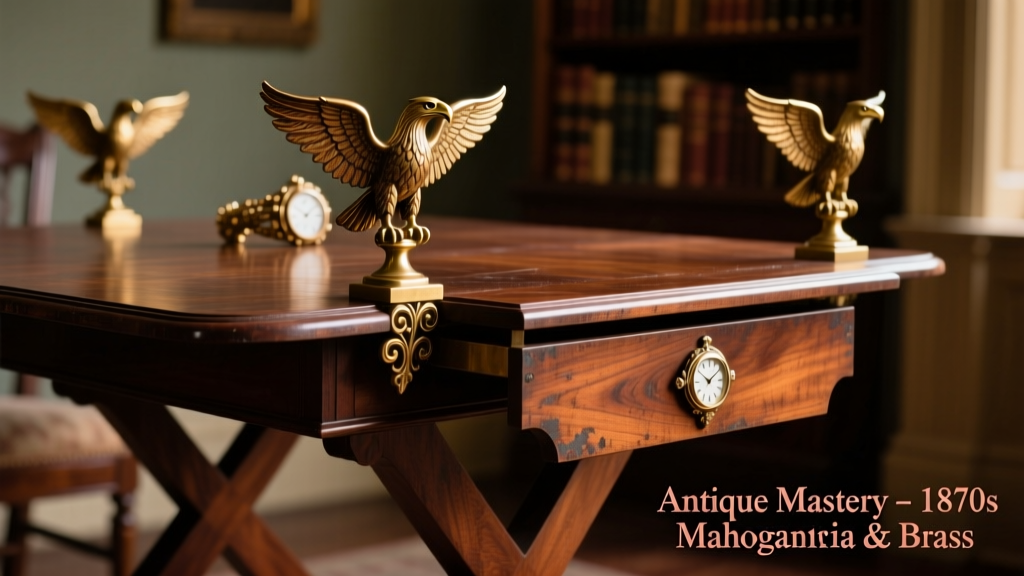
Pembroke Drop-Leaf Dining Tables in Mahogany: X-Brace Construction and Authentic Eagle Brass Hardware

Alerts on Confusing Collectibles: October 2012 — A Vintage Jewelry & Watch Expert’s Field Report
Hayden Manufacturing Company: American Watchmaking Excellence, 1920–1957
Walnut Swing-Top Card Table: A Mid-Century Masterpiece in Compact Design and Craftsmanship

Music Organ Pump Cutout Trim & Applied Carving: Decoding a Rare Victorian and Edwardian Jewelry Motif
Scales Candy National 1910: A Rare American Pocket Watch and Its Industrial Legacy
Lot 2334465: A 1958 Patek Philippe Ref. 1463 'Jumbo' Chronograph — Provenance, Technical Anatomy, and Market Significance

Goodyear Porcelain Enameled Steel Advertising Sign, 1930s: A Study in Automotive Americana and Industrial Craftsmanship
Aluminum Pitcher Set with Chrysanthemum Motif: A Continental Mid-Century Tableware Ensemble