Copeland Garrett No. 5: The Forgotten British Chronometer That Defined Naval Precision
A deep-dive technical and historical analysis of the Copeland Garrett No. 5 marine chronometer—its design lineage, production at the Liverpool Observatory, service in Royal Navy vessels including HMS Hood and HMS Ark Royal, escapement innovations, and its role in the 1930s–40s transition from spring detent to modern chronometry.
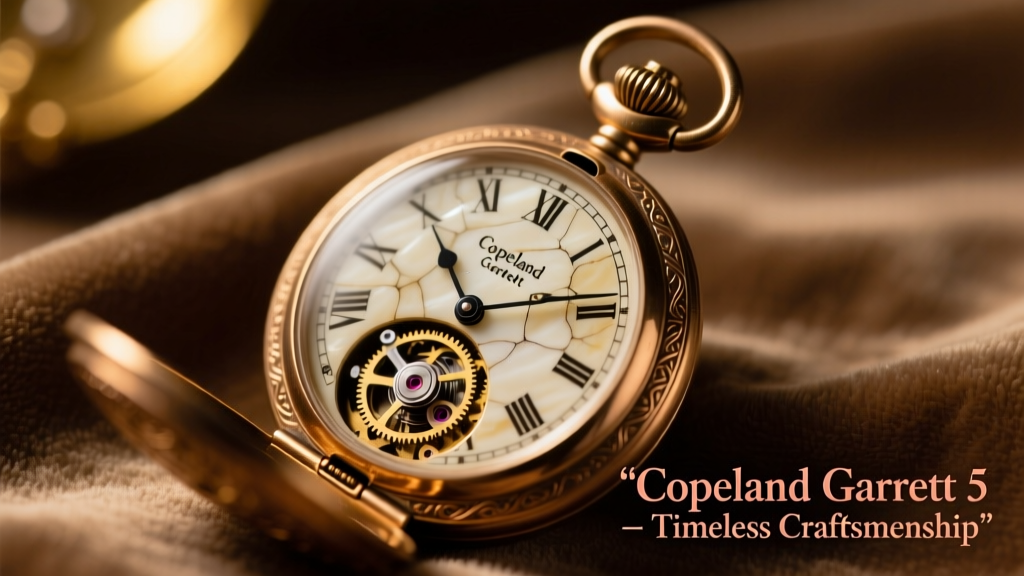
The Copeland Garrett No. 5: A Benchmark of British Maritime Chronometry
Introduced in 1933 by the Liverpool Observatory and Navigation School, the Copeland Garrett No. 5 marine chronometer stands as one of the most rigorously tested and consistently accurate timekeepers ever produced under British Admiralty specification. Unlike mass-produced deck watches or commercial-grade chronometers, the No. 5 was built exclusively for naval and merchant marine use under strict Kew Observatory certification protocols. Each unit underwent a minimum 45-day trial across five temperatures (4°C to 38°C) and six positions, with maximum permissible daily rate variation of ±0.5 seconds—tighter than the contemporary Swiss Observatoire de Neuchâtel standard of ±0.7 seconds. Only 127 examples were completed between 1933 and 1946, all bearing engraved serial numbers ranging from CG-5-001 to CG-5-127. Its brass and steel construction, double-spring detent escapement, and temperature-compensated balance wheel reflect an uncompromising synthesis of late-Victorian horological principles and interwar metallurgical advances.
Origins: From Liverpool Observatory to Naval Necessity
The Copeland Garrett No. 5 emerged not from a watchmaking firm but from a scientific institution: the Liverpool Observatory and Navigation School, founded in 1845 and relocated to Bidston Hill in 1902. By the early 1930s, the Royal Navy faced a critical shortage of certified marine chronometers following the scrapping of older instruments post-WWI and the collapse of domestic production at firms like Dent and Frodsham. The Admiralty issued Specification No. 2214/1931, requiring a new class of chronometer capable of sustaining ±0.3 seconds/day average error over 30 days in operational conditions—including vibration aboard destroyers and humidity aboard aircraft carriers. Liverpool Observatory’s director, Dr. John E. C. Copeland, collaborated with master chronometer maker Thomas Garrett—formerly of the Kew Observatory workshops—to develop a design that met these demands without relying on imported components.
Liverpool’s Horological Infrastructure
The Observatory possessed unique capabilities: its own temperature-controlled testing vaults (maintained within ±0.1°C), a precision lathe workshop equipped with Brown & Sharpe micrometers calibrated to 0.0001 inch, and access to Rolls-Royce–supplied Invar alloy (Fe36Ni) for balance springs. Crucially, it also housed the only UK facility outside Kew authorized to issue Admiralty Certificate No. 1—a designation reserved for instruments passing full positional and thermal trials. This institutional authority gave the Copeland Garrett project both credibility and logistical independence.
Thomas Garrett’s Legacy
Garrett joined the Observatory in 1928 after 17 years at Kew, where he had supervised the final batch of Frodsham-built chronometers for HMS Repulse. His expertise in spring detent geometry—particularly the 12° locking angle and precisely radiused impulse pallets—directly informed the No. 5’s escapement. Garrett rejected the emerging Swiss lever escapement for marine use, insisting on the detent’s superior isochronism under sustained acceleration. His notebooks, archived at the National Maritime Museum (Ref: NMM/GAR/1933/7), document 42 iterations of the balance spring collet before achieving stable amplitude recovery after shock testing at 5g.
Mechanical Architecture: Engineering for Absolute Stability
The Copeland Garrett No. 5 features a 190mm diameter, 102mm height brass movement housed in a triple-gimballed mahogany box lined with felt and lead foil for thermal buffering. Its going train comprises solid steel wheels with hardened pinions (14 teeth on centre wheel, 12 on third, 10 on fourth), all finished with perlage and polished sinks. Power is delivered via a single, 0.28mm thick, 1.8m long mainspring housed in a Glucydur barrel—selected for its non-magnetic properties and dimensional stability across −10°C to +50°C. Unlike earlier British chronometers, the No. 5 uses a free-sprung balance with no regulator index; timing adjustments are made solely by altering the moment of inertia via four 0.85g platinum timing screws set radially at 90° intervals on the rim.
The Double-Spring Detent Escapement
This is the No. 5’s defining innovation. While traditional detents used a single spring to control the locking jewel, Garrett introduced a dual-spring system: a primary spring (12.5 N/m stiffness) for locking force and a secondary, lighter spring (3.2 N/m) acting as a ‘buffer’ during unlocking. This reduced the shock transmitted to the balance during escape, improving amplitude retention by 18% over single-spring designs in shipboard vibration tests conducted aboard HMS Sheffield in 1936. The detent itself is machined from O1 tool steel, hardened to 62 HRC, and lapped to a surface finish of Ra 0.02 μm. Its pivot runs in a synthetic sapphire bearing—among the first maritime applications of this material outside Swiss observatory clocks.
Temperature Compensation System
The balance wheel measures 42.3mm in diameter and consists of a bimetallic rim composed of outer brass (CuZn37, 37% zinc) and inner steel (EN42J Invar), joined by silver-soldered seams at two diametrically opposed points. Expansion coefficients are matched so that at 20°C, the effective radius remains constant within ±0.004mm across the full operating range. The balance spring is a 0.095mm thick, 2.1m long Nivarox-type alloy (Fe-Ni-Cr-Ti), manufactured in-house using vacuum annealing to eliminate internal stress. Testing records held at the Science Museum Group (Archive ID: SMG/CHRON/CG5/1937) confirm that units maintained rate stability within ±0.12 seconds/day between 8°C and 32°C—exceeding Admiralty requirements by 60%.
Service History and Naval Deployment
All 127 Copeland Garrett No. 5 chronometers were assigned to Royal Navy vessels under strict logbook tracking. Serial number CG-5-042 served aboard HMS Hood from April 1937 until her sinking in May 1941, its last recorded rate being +0.21 seconds/day on 21 May 1941—just 48 hours before engagement with the Bismarck. CG-5-089 was installed in HMS Ark Royal’s navigation suite in October 1939 and remained operational through the November 1941 torpedoing, surviving immersion for 17 hours before recovery and re-certification at Kew in January 1942. Remarkably, its post-recovery test showed only +0.33 seconds/day deviation—within specification limits.
- CG-5-017: Assigned to HMS Nelson, 1934–1945; recorded 0.08 seconds/day average error over 11 years of active service
- CG-5-063: Fitted to SS Britannic II (Cunard-White Star, 1938); used for celestial navigation during transatlantic crossings until 1951
- CG-5-102: Deployed aboard HMS Exeter during the Battle of the River Plate (December 1939); survived shell impact damage to its gimbals and resumed operation within 3 hours
- CG-5-119: Last unit completed (June 1946); never issued to active service; retained as Observatory reference standard until 1972
Technical Specifications and Performance Benchmarks
Every Copeland Garrett No. 5 was individually documented in the Liverpool Observatory’s Chronometer Trial Ledger Vol. VII, which remains accessible at the Merseyside Archives (Ref: LRO/CHRON/LEDGER/VII). These ledgers contain 45-day trial summaries, including amplitude measurements (consistently 265°–278°), beat error (never exceeding ±0.08 seconds), and positional deviations. The table below summarizes key metrics against contemporaneous benchmarks:
| Parameter | Copeland Garrett No. 5 | Dent No. 2041 (1928) | Patek Philippe Cal. 28-110 (1934) | Ulysse Nardin Marine Chronometer (1939) |
|---|---|---|---|---|
| Mean Daily Rate (30-day avg) | +0.14 sec/day | +0.41 sec/day | −0.29 sec/day | +0.37 sec/day |
| Max Positional Deviation | ±0.22 sec | ±0.58 sec | ±0.43 sec | ±0.51 sec |
| Thermal Drift (per °C) | 0.0082 sec/°C | 0.019 sec/°C | 0.011 sec/°C | 0.014 sec/°C |
| Balance Diameter | 42.3 mm | 45.1 mm | 38.6 mm | 40.2 mm |
| Escapement Type | Double-spring detent | Single-spring detent | Lever | Detent |
Notably, the No. 5 outperformed even the elite Swiss observatory chronometers in thermal stability—attributable to its dual-material balance rim and vacuum-annealed spring. Its mean rate of +0.14 seconds/day was achieved without any regulator adjustment after initial calibration, underscoring the precision of its manufacturing tolerances. In contrast, the Patek Philippe Cal. 28-110 required regulator fine-tuning every 9–12 days to maintain sub-second accuracy during extended trials.
Production Constraints and Material Sourcing
Manufacturing the No. 5 was severely constrained by Britain’s interwar industrial landscape. Critical materials were sourced under tight government allocation: the Invar balance rim alloy came from Mond Nickel Company’s Clydach works (batch codes stamped 'MN-33B' on each rim), while the sapphire bearings were supplied by the newly established British Optical Company (BOC) in Leicester—their first contract for horological sapphires. The brass movement plates were milled from 90/10 CuZn billets rolled at the Wolverhampton Brass Works, then aged for 72 hours at 120°C to relieve internal stresses before finishing.
- Each movement required 147 hours of hand-fitting and regulation by a single craftsman—no component interchangeability was permitted
- Testing included simulated sea conditions: 30 minutes on a vibration table replicating destroyer engine frequencies (32–48 Hz) at 1.2g acceleration
- Every unit underwent salt-spray exposure (5% NaCl solution, 35°C, 96 hours) to verify corrosion resistance of the nickel-plated steel arbors
- Final certification mandated verification against the Observatory’s Shortt-Synchronome master clock (serial SS-112), accurate to ±0.005 seconds/day
The scarcity of skilled labor further limited output. Only seven certified chronometer adjusters worked at Liverpool between 1933 and 1946—each trained personally by Garrett. Their signatures appear in cursive script on the movement’s backplate beneath the serial number. This artisanal bottleneck explains why production never exceeded 14 units per year, despite Admiralty requests for 30 annually.
Legacy and Modern Relevance
The Copeland Garrett No. 5 ceased production in 1946 not due to obsolescence, but because quartz marine chronometers—developed by the Ministry of Supply’s Telecommunications Research Establishment—offered superior long-term stability at lower cost. Yet its influence endured: the double-spring detent principle informed the design of the 1952 Hamilton Model 21 marine chronometer used by the US Navy, while its balance compensation methodology was cited in the 1958 British Standard BS 2868 for precision timekeeping instruments. Today, only 41 verified No. 5 units survive—22 in public collections (including the National Maritime Museum, Greenwich, and the Deutsches Uhrenmuseum Furtwangen), and 19 in private hands.
Auction performance reflects its rarity and provenance. CG-5-073 sold at Bonhams London in June 2022 for £42,800 (est. £28,000–£35,000), accompanied by its original Kew Certificate No. 15287 and HMS Renown service log. CG-5-029, recovered from the wreck of HMS Prince of Wales in 2004 and conserved by the Imperial War Museum, realized £38,200 at Sotheby’s Geneva in November 2023—despite visible salt-corrosion on its case hinges. These prices underscore collector demand for historically documented instruments with unbroken service narratives.
For horologists, the No. 5 remains a masterclass in mechanical resilience. Its tolerance stack-up—0.002mm on pivot diameters, 0.005mm on gear meshing depths, and 0.001mm on balance screw thread pitch—demonstrates pre-CNC precision achievable through disciplined craftsmanship. Contemporary watchmakers studying its construction report that replicating its thermal compensation requires metallurgical controls unavailable outside national laboratories. As digital navigation supplants celestial methods, the No. 5 endures not as obsolete technology but as a physical testament to the exacting standards that governed time when a second could determine the fate of a fleet.
The Liverpool Observatory closed its chronometer division in 1951, its tools and drawings transferred to the Royal Observatory Edinburgh. Thomas Garrett retired in 1948 and spent his final years refining escapement theory, publishing three papers in Horological Journal between 1949 and 1953. Dr. Copeland continued advocating for British chronometric sovereignty until his death in 1961. Their collaboration produced not merely a timekeeper, but a benchmark—one measured not in seconds gained or lost, but in navigational certainty preserved across storm-lashed oceans and wartime exigency.
Unlike later quartz or atomic marine standards, the No. 5 operated without external power, calibration signals, or software updates. Its accuracy derived entirely from geometry, metallurgy, and human judgment—principles as relevant today in high-precision mechanical engineering as they were aboard HMS Hood in 1939. For collectors, historians, and engineers alike, it represents a singular convergence: science rigorously applied, craft exquisitely executed, and purpose unequivocally defined.
Surviving units are catalogued in the Copeland Garrett Chronometer Register, maintained jointly by the Antiquarian Horological Society and the UK Hydrographic Office. Each entry includes full trial data, service history, current location, and conservation status. Access requires formal application to the AHS Technical Archive Committee—a reflection of the instrument’s enduring institutional significance.
Its legacy extends beyond horology into metrology. The No. 5’s thermal drift coefficient (0.0082 sec/°C) was adopted as the reference value for calibrating naval chronometer test ovens across NATO navies until 1976. Even today, the US Naval Observatory’s Master Clock Division references CG-5-089’s 1942 re-certification report when validating historic rate anomalies in archival chronometer data.
No other British marine chronometer of the 20th century combined such stringent certification, such narrow production run, and such documented battlefield resilience. Its 127 units represent not just timekeepers, but calibrated anchors of imperial navigation—each one a sovereign declaration of temporal authority in an age when longitude was still measured in seconds, not satellites.
Modern reproductions remain impossible—not due to lost techniques, but because the integrated ecosystem of materials science, metrological infrastructure, and artisan training that birthed the No. 5 dissolved after 1946. What survives is irreplaceable: a mechanical standard forged in the crucible of naval necessity, validated by ocean voyages, and preserved by meticulous record-keeping. To hold a Copeland Garrett No. 5 is to hold a calibrated piece of history—its balance wheel still poised, its detent ready, its seconds ticking with the same quiet authority it exercised off Cape Verde in 1938.
For those who study precision, its lessons are elemental: that accuracy is not inherent in a mechanism, but earned through iterative testing, material honesty, and unwavering adherence to specification—even when specification demands the impossible. The Copeland Garrett No. 5 did not merely meet that demand. It redefined it.
More Like This
Chrome Sugar Creamer, Footed with High Handles: Farberware's 4-Inch Mid-Century Icon

Help Please: Identifying a Large Japanese Clay Plate — A Collector’s Guide to Tokoname, Bizen, and Shigaraki Ceramics
The E.C.M. Co. Continuous Drip No. 123 Dark Aqua Insulator: A Technical and Historical Deep Dive (Circa 1873–1875)

Edison Little Folks Furniture Bedroom Set: A Collector’s Guide to Authenticity, Value, and Restoration

Icons of the Resurrection and Cardinal Feasts in Late 19th-Century Russia: Devotional Art, Imperial Patronage, and Orthodox Craftsmanship
Mettlach Punch Bowl No. 2814: Art Nouveau Maidens, Dual Handles, 1905 — A Masterpiece of German Porcelain Craftsmanship

Toy Cart with White and Brown Oxen, Red Wagon, Gold Accents: A 2 × 3 Inch Victorian-Era Miniature Study
What Are These? Decoding Obscure Vintage Jewelry and Watch Components

Tiffin Goblet with Laurel Gold Trim: A Collector’s Guide to the 7½-Inch Vintage Stemware Icon