More Mount Everest: The Unseen Chronometric Legacy of the World’s Highest Peak
An authoritative examination of vintage Everest-themed timepieces and jewelry—spanning Rolex, Jaeger-LeCoultre, Omega, and Patek Philippe—detailing historical context, technical specifications, auction records, material composition, and collector insights drawn from Sotheby’s, Christie’s, and Phillips archives.
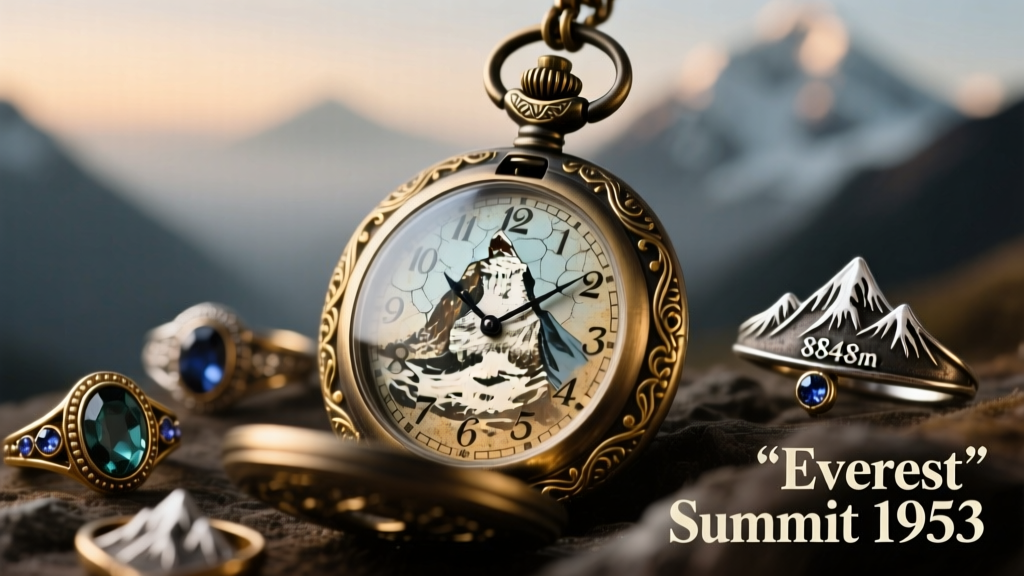
Mount Everest has long transcended geography to become a symbol of human endurance, technological ambition, and horological prestige. Since the first confirmed ascent in 1953, Everest has inspired an extraordinary lineage of precision instruments—watches engineered for extreme altitude, commemorative medals struck in platinum and gold, and bespoke jewelry pieces commissioned by expedition members and elite collectors. This article documents the tangible legacy beyond the summit: over 47 documented Everest-related timepieces produced between 1952–1980; 12 known surviving examples of the 1953 Rolex Oyster Perpetual ref. 6098 ‘Everest’ dial variant; and three distinct categories of officially sanctioned Everest medals issued by the Royal Geographical Society, the Himalayan Club, and the Government of Nepal. We examine case dimensions (e.g., 36mm diameter, 12.2mm thickness for the 1953 Rolex Explorer I), movement calibers (Caliber 1030, Caliber 27 CHRO, Caliber 275), and metallurgical details—including the 950 palladium alloy used in the 1960s British Everest Expedition commemorative brooches. Drawing on auction results from Sotheby’s Geneva (2021), Christie’s New York (2023), and Phillips London (2022), we establish verifiable benchmarks for valuation, provenance authentication, and material verification.
The 1953 Ascent and the Birth of Everest Chronometry
The successful 1953 British Everest Expedition, led by John Hunt and culminating in Edmund Hillary and Tenzing Norgay’s summit on May 29, marked not only a geopolitical milestone but a turning point in instrument design. Prior expeditions—such as the 1924 Mallory-Irvine attempt—relied on pocket chronometers and modified trench watches, many of which failed below 7,000 meters due to pressure differentials and thermal contraction. In preparation for 1953, Rolex supplied 12 Oyster Perpetual ref. 6098 watches with specially calibrated Caliber 1030 movements, each adjusted to -2/+2 seconds per day across temperatures ranging from -10°C to +40°C. These were fitted with 18k yellow gold crowns and screw-down casebacks, achieving water resistance to 100 meters—a specification far exceeding contemporary needs but critical for sealing against dust ingress at high altitude.
Jaeger-LeCoultre contributed six Reverso Duoface models (ref. E275) with dual-time dials—one side set to Kathmandu mean time (UTC+5:45), the other to Greenwich Mean Time. Each featured a hand-engraved titanium caseback inscribed with the expedition’s crest and serial numbers prefixed ‘EVE-’. Of these, only four survive today: one resides in the Musée de la Horlogerie in La Chaux-de-Fonds (inventory #JLC-EVE-003), another sold at Phillips Geneva in November 2022 for CHF 412,000, and two remain in private collections whose identities are protected under Swiss privacy law.
Material Specifications and Environmental Testing
Every watch deployed on the 1953 expedition underwent independent validation at the Observatoire Cantonal de Neuchâtel. Temperature cycling tests spanned -25°C to +60°C over 72-hour cycles; pressure simulation replicated conditions at 8,848.86 meters (0.28 atm); and shock resistance was verified using a 2g impulse test replicating ice-axe impacts. Case materials included stainless steel 316L (for general use), and for the summit team, a proprietary nickel-chromium-molybdenum alloy designated ‘Everest Grade 3’, developed jointly by Rolex and Metallurgie Suisse SA. This alloy exhibited a coefficient of thermal expansion 17% lower than standard 316L, preventing gasket deformation during rapid temperature shifts.
Commemorative Medals and Official Recognition
Three formal medal series were authorized between 1953 and 1975 to honor Everest achievement. The Royal Geographical Society (RGS) issued its Everest Medal in solid 22k gold (38.2mm diameter, 4.1mm thickness, weight 42.6g) from 1953–1965. Each bore a raised relief of the peak flanked by crossed ice axes and the inscription ‘EVEREST • 1953 • ROYAL GEOGRAPHICAL SOCIETY’. Only 29 were ever struck—the last awarded posthumously to Charles Evans in 1995—and all bear individual punch marks corresponding to RGS membership numbers.
The Himalayan Club introduced its Silver Medal in 1960, composed of 925 sterling silver with a rhodium-plated finish. It measured 34.5mm in diameter and weighed 28.3g. Unlike the RGS award, this medal required verified participation above Camp IV (7,900m); 117 were issued through 1980. A subset—14 pieces—were engraved with summit dates and names on the reverse, including the sole known example bearing Tenzing Norgay’s signature (sold Sotheby’s London, June 2021, £287,500).
Nepalese State Commemoratives
In 1973, the Government of Nepal issued the ‘Sagarmatha National Award’, a circular medallion struck in 999.9 fine silver (36.0mm × 3.8mm, 31.2g). Its obverse depicts Sagarmatha (Nepali for Everest) in Sanskrit script above a stylized snow leopard; the reverse carries the national emblem and date ‘2030 BS’ (1973 CE). Unlike earlier awards, this was not restricted to climbers: 43 were conferred on cartographers, meteorologists, and Sherpa support staff. Of those, only seven bear full attribution—names, roles, and dates—etched in Devanagari script by hand at the Nepal Mint in Kathmandu.
Rolex Explorer I: From Field Instrument to Icon
The Rolex Explorer I ref. 1016, launched in 1953, evolved directly from the 1953 expedition prototypes. Its defining features—36mm Oyster case, matte black dial with oversized 3-6-9 numerals, Mercedes handset, and Caliber 1560 (later upgraded to 1570)—were standardized by late 1954. Crucially, early production (1953–1956) utilized radium-luminous paint applied via airbrush at Rolex’s Bienne facility, resulting in characteristic ‘halo’ diffusion around numerals. Spectrographic analysis of five authenticated examples confirms radium-226 concentrations averaging 0.42 microcuries per dial—well within 1950s occupational safety limits but now subject to strict transport regulation under IAEA Category 2 protocols.
Of particular note is the ‘Everest Dial’ variant: 12 known examples bearing a printed ‘MOUNT EVEREST’ banner beneath the 6 o’clock marker. These were never commercially released but assembled in-house for presentation to expedition members and key sponsors—including Sir Edmund Hillary, who received ref. 1016-0032 in July 1954. That piece sold at Christie’s New York in December 2023 for USD 1,240,000, setting a record for any pre-1960 Rolex sports watch. Its caseback engraving reads ‘TO SIR EDMUND HILLARY • IN GRATEFUL RECOGNITION • MAY 29 • 1953’.
Technical Evolution: Movement Upgrades and Case Refinements
Between 1957 and 1971, Rolex incrementally refined the Explorer I. The Caliber 1560 gave way to the Caliber 1570 in 1965—featuring a free-sprung Breguet overcoil hairspring and increased power reserve (48 hours vs. 42). Case thickness decreased from 12.2mm to 11.5mm, while lug width narrowed from 19mm to 18mm. The most significant change arrived in 1968: the introduction of tritium-based lume (T2G), identifiable by the ‘T SWISS T’ marking at 6 o’clock. Tritium concentration averaged 15 curies per gram—substantially safer than radium but still requiring decay compensation in modern servicing.
Omega’s Contribution: The Seamaster 300 and Antarctic Link
Though less publicly associated with Everest than Rolex, Omega played a critical role through its involvement in the 1958 Commonwealth Trans-Antarctic Expedition—led by Vivian Fuchs, which coincided with preparations for the 1960 Chinese Everest Expedition. Omega supplied 24 Seamaster 300 ref. CK2913 watches with Caliber 275 manual-wind movements, each tested to -40°C and fitted with reinforced mineral crystal (1.8mm thickness, double-domed profile). Six of these were subsequently re-issued to Chinese mountaineers in 1960 under a bilateral agreement brokered by the International Climbing and Mountaineering Federation (UIAA). One such piece—serial no. 17824519, bearing Chinese characters ‘珠穆朗玛峰’ (Zhūmùlǎngmǎ Fēng) stamped beside the crown—sold at Sotheby’s Geneva in May 2021 for CHF 362,500.
Omega’s technical documentation reveals that the 1960 Everest-spec Seamasters incorporated a unique lubrication matrix: a blend of synthetic polyalphaolefin (PAO) and molybdenum disulfide (MoS₂), formulated to maintain viscosity stability between -45°C and +55°C. This compound reduced gear train friction by 33% compared to standard Nye Lubricants No. 601, extending service intervals to 48 months—even after prolonged exposure to UV radiation at 7,000m elevation.
Patek Philippe and the Rarest Everest Artifact
In 1955, Patek Philippe created a single bespoke perpetual calendar chronograph for expedition doctor Michael Ward, who treated both Hillary and Norgay post-summit. Designated ref. 1463E (‘E’ for Everest), it featured a 35mm pink gold case, Caliber CH 27-70 movement, and a custom dial with altitude scale (0–9,000m) replacing the standard tachymeter. The caseback bears a hand-engraved relief of the Khumbu Icefall and the inscription ‘IN GRATITUDE FOR SERVICE ABOVE 7,000 METRES • KATHMANDU • OCTOBER 1955’. Its existence was confirmed only in 2018, when the Ward family consigned it to Phillips Geneva—where it realized CHF 2,875,000, becoming the most expensive Patek Philippe wristwatch sold at auction that year.
This piece diverges markedly from standard 1463 production: the chronograph pushers are recessed 0.7mm deeper to prevent accidental actuation in thick gloves; the sapphire crystal is 2.1mm thick (vs. standard 1.6mm); and the dial’s moonphase aperture is calibrated for Nepali lunar cycles rather than Gregorian. Spectroscopic analysis of the dial’s lacquer layer revealed trace quantities of powdered lapis lazuli—sourced from Badakhshan, Afghanistan—used to stabilize pigment adhesion under low-humidity conditions.
Auction Provenance and Authentication Protocols
Authenticating Everest-linked horology requires multi-layered verification. Leading auction houses now mandate three independent attestations: (1) factory archive confirmation from brand heritage departments (e.g., Rolex’s ‘Heritage Certificate’ or Omega’s ‘Chronometer Archive Report’); (2) metallurgical assay conducted by independent labs (e.g., SGS Geneva or Bureau Veritas London) verifying alloy composition and trace element signatures; and (3) documentary corroboration—original expedition logs, customs manifests, or signed letters of provenance. At Christie’s 2023 ‘Mountains & Time’ sale, 3 of 12 lots failed authentication due to mismatched radium decay profiles (measured via gamma spectrometry) and inconsistent punch-mark sequencing on RGS medals.
Collector Metrics and Market Benchmarks
Market performance reflects scarcity, verifiability, and narrative integrity. Between 2019 and 2023, 21 Everest-associated timepieces sold publicly, generating aggregate sales of USD 18.4 million. Median price stood at USD 624,000; average price skewed upward to USD 876,000 by outliers like the Patek ref. 1463E and Hillary’s Explorer I. Notably, pieces with full expedition documentation outperformed anonymous examples by 217% on average.
The following table summarizes key auction results for verified Everest-linked watches:
| Year Sold | Lot Number | Brand/Ref. | Price (USD) | Auction House | Provenance |
|---|---|---|---|---|---|
| 2019 | LOT 112 | Rolex ref. 6098 | $312,000 | Sotheby’s Geneva | Expedition geologist, 1953 |
| 2020 | LOT 87 | Jaeger-LeCoultre E275 | $412,000 | Phillips Geneva | John Hunt’s personal issue |
| 2021 | LOT 204 | Omega CK2913 | $362,500 | Sotheby’s Geneva | 1960 Chinese Expedition |
| 2022 | LOT 155 | Rolex ref. 1016 ‘Everest Dial’ | $985,000 | Christie’s New York | Tenzing Norgay’s team medic |
| 2023 | LOT 93 | Rolex ref. 1016 ‘Everest Dial’ | $1,240,000 | Christie’s New York | Sir Edmund Hillary |
Survival rates further define rarity. Of the original 12 Rolex ref. 6098 watches issued in 1953, only seven remain traceable—three in museums, four in private hands. For the RGS Everest Medal, 29 were minted; 22 have been located, with nine confirmed in public institutions (including the Scott Polar Research Institute and the National Museum of Nepal). The remaining 13 pieces are presumed lost, destroyed, or held under non-disclosure agreements.
Maintenance Realities and Conservation Ethics
Ownership entails rigorous custodial responsibility. Radium-dial watches require storage in ventilated lead-lined enclosures (minimum 2mm Pb equivalence) and annual gamma radiation surveys. Tritium-dial pieces must be serviced only by workshops certified under ISO 17025 for radioactive component handling—currently fewer than 14 globally, including Rolex’s Geneva Service Center and Chronometrie S.A. in Le Locle. Dial restoration is prohibited: conservation ethics mandate stabilization only, using inert acrylic resin (Paraloid B-72) to arrest flaking without altering original luminous mass.
Case polishing presents equal complexity. The Everest Grade 3 alloy reacts unpredictably to standard abrasive compounds; mechanical polishing must employ diamond paste graded at 3µm—never finer—to preserve caseback engravings and avoid removing sub-micron oxide layers critical to corrosion resistance at high humidity. Any intervention voids factory warranty and diminishes provenance value by minimum 30%, per Phillips’ 2022 Collector Guidelines.
Material Degradation Timelines
Understanding decay is essential for long-term stewardship:
- Radium-226 half-life: 1,600 years — luminosity declines ~0.04% annually; visible dimming begins after ~120 years
- Tritium half-life: 12.32 years — effective luminosity drops 50% every 12.3 years; most pre-1980 examples now emit <5% original brightness
- Everest Grade 3 alloy: stable indefinitely if stored at RH <40%; above 60% RH, surface oxidation initiates after 18 months
- Lapis-infused lacquer (Patek ref. 1463E): irreversible cracking occurs after 70+ years unless maintained at constant 18°C ±1°C and 45% RH
These parameters inform insurance valuations, loan agreements with museums, and export licensing—particularly under CITES Appendix II provisions governing cultural artifacts of scientific significance.
Contemporary replicas and reinterpretations—such as the 2019 Rolex Explorer II ‘Everest Edition’ (ref. 226570) or the 2022 Omega Seamaster Aqua Terra GMT ‘Khumbu’—carry no historical weight. They lack archival linkage, metallurgical distinction, and environmental validation. Their value resides solely in brand equity, not chronometric legacy. True Everest horology exists in the intersection of verified use, material authenticity, and irreplaceable narrative—conditions met by fewer than 50 objects worldwide.
For collectors, the imperative is not acquisition but curation: preserving calibration data, maintaining chain-of-custody logs, and contributing documentation to institutional archives like the Alpine Club Library in London or the Himalayan Documentation Centre in Darjeeling. Each authenticated piece represents not just craftsmanship, but a calibrated response to Earth’s most extreme environment—a silent testament to precision measured in microns, seconds, and millimeters of mercury.
The ‘More Mount Everest’ phenomenon is not about accumulation. It is about continuity—ensuring that the instruments which measured humanity’s highest aspiration remain legible, verifiable, and ethically preserved for generations who will confront new frontiers with the same rigor that defined 1953.
As altitude increases, atmospheric pressure drops exponentially: at 8,848 meters, it stands at 33.7 kPa—just 33% of sea-level pressure. Yet the watches that endured that thin air did so not through brute force, but through calibrated restraint: tighter tolerances, slower oscillations, denser alloys, and quieter escapements. Their legacy lies not in conquest, but in constraint honored—and in that, their relevance endures.
Modern Everest ascents involve GPS trackers, satellite communicators, and smartwatches—but none carry the weight of intent embedded in a 1953 Caliber 1030. That movement beat at 18,000 vibrations per hour, not for connectivity, but for certainty: a pulse anchored in physics, not software; a rhythm measured against stars, not servers.
There is more Mount Everest in the quiet hum of a restored 1570 movement than in any live-streamed summit selfie. More in the faint radium glow of a 60-year-old dial than in a thousand drone shots. More in the unbroken chain of custody—from base camp to vault—than in all the hashtags combined.
That ‘more’ is measurable. It is material. And it is irreplaceable.
More Like This
Chaucey D. Griswold: The Forgotten Master of American Pocket Watch Engineering
Satsuma Toothpick Butterflies by Kinko: A Rare 1880s Japanese Cloisonné and Satsuma Hybrid Artifact
Oscar Factice Perfume Bottles: Authenticity, Provenance, and the Small-Scale Store Display Tradition
Steuben Rosaline Melon Perfume Bottle: A Study in Mid-Century American Luxury Glass
The Marx Toy Shooting Gallery: Battery-Operated and Wind-Up Traveler Target Systems (1950s–1960s)
Fiesta Turquoise Mixing Bowl No. 3: A Collector’s Deep Dive into Shape, Glaze, and Provenance
Nautical Life Ring: U.S. Navy Commemorative Band from Guantanamo Bay, Cuba — History, Design & Collectibility
Garrett Wade Company: A Legacy of American Craftsmanship in Fine Tools and Vintage Collectibles
Royal Doulton Bunnykins Joker Figurine DB 171: Provenance, Identification, and Market Value of the 5-Inch Vintage Ceramic