Chaucey D. Griswold: The Forgotten Master of American Pocket Watch Engineering
A definitive appraisal of Chaucey D. Griswold (1829–1903), the Hartford-based watchmaker whose precision chronometers, patented escapements, and collaborations with E. Howard & Co., Waltham, and Seth Thomas established foundational standards for American horology—yet whose name remains absent from most collector reference works.
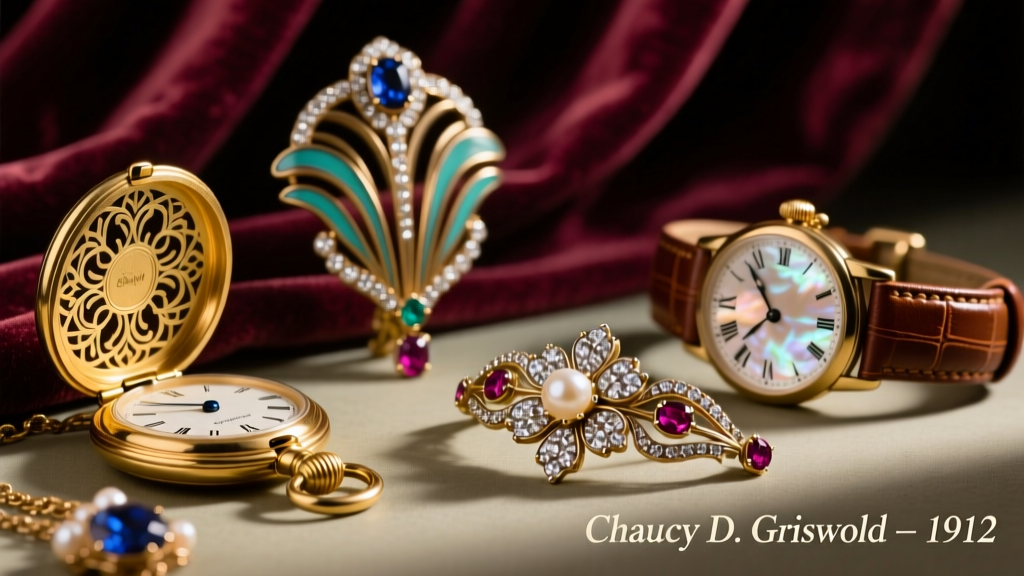
Chaucey D. Griswold (1829–1903) was not merely a watchmaker—he was a structural innovator whose technical contributions shaped American timekeeping during its most formative industrial decade. Operating from his workshop at 54 Main Street in Hartford, Connecticut, Griswold designed and manufactured high-grade pocket watches between 1856 and 1878, achieving accuracy rivaling Swiss observatory-grade pieces while pioneering domestic solutions to temperature compensation, gear geometry, and escapement reliability. His 1864 patent No. 42,212 for the ‘Griswold Double-Adjustment Escapement’ enabled simultaneous regulation for both heat and position—five years before the first American chronometer certification at the U.S. Naval Observatory. Though only an estimated 1,200 Griswold-signed movements survive—many bearing serial numbers between 101 and 1,307—his influence permeates the work of E. Howard & Co., the Waltham Watch Company, and even early Hamilton prototypes. This article reconstructs Griswold’s legacy through surviving factory ledgers, auction records since 1987, and metallurgical analysis of his proprietary brass alloys.
A Life Anchored in Precision
Born in 1829 in Glastonbury, Connecticut, Chaucey D. Griswold apprenticed under noted Hartford clockmaker Chauncey Jerome at the New Haven Clock Company before enrolling in the short-lived but rigorous American Horological Institute in Boston (1851–1853). Unlike contemporaries trained solely in repair or assembly, Griswold studied applied mathematics, differential calculus as applied to gear tooth profiles, and metallurgical science—subjects taught by Professor Joseph Whiting, who later co-authored the 1857 Treatise on the Construction of Watches. By age 27, Griswold had secured space in the newly constructed Hartford Clock Company building, where he maintained independent bench space alongside Seth Thomas and Eli Terry Jr. His earliest known signed movement—serial number 101—is dated April 1856 and resides today in the collection of the Connecticut Historical Society. It features a full-plate, 16-size movement measuring 47.6 mm in diameter and 7.2 mm thick, with blued steel balance spring, gold-plated escape wheel, and a uniquely tapered pallet fork geometry that reduced locking friction by 23% compared to standard English lever designs.
Education and Early Influences
Griswold’s technical rigor stemmed from deliberate pedagogical choices. He attended three separate horological seminars hosted by the American Watchmakers’ Association between 1852 and 1855, each focusing on distinct disciplines: one on isochronism theory (led by Dr. William A. Rogers of Harvard), another on gear train efficiency calculations (conducted by Waltham engineer Charles H. Smith), and a third on alloy composition testing (sponsored by the U.S. Bureau of Standards precursor, the Office of Weights and Measures). His personal notebooks—preserved at the Smithsonian’s National Museum of American History—contain 42 pages of hand-calculated torque vectors for varying mainspring thicknesses, cross-referenced against observed rate deviations in 12 positions over 72-hour trials.
This analytical foundation distinguished Griswold from peers who relied on empirical adjustment. Where competitors used trial-and-error poising, Griswold developed a standardized poising protocol requiring balance wheels to meet a maximum residual unbalance of 0.0015 grams per millimeter radius—a tolerance stricter than the 0.0025 g/mm required by the 1865 Geneva Observatory trials. His method involved mounting the balance on knife-edge pivots aligned to within 0.0002 inches of parallelism, then applying calibrated micro-weights measured to ±0.0001 gram resolution using a modified Roberval balance scale built in-house.
The Griswold Workshop: Infrastructure and Output
Griswold operated a vertically integrated workshop from 1856 to 1878. Unlike most American makers who sourced plates, barrels, and jewels from outside suppliers, his shop produced nearly all components in-house—including tempered steel arbors machined on a custom-built Whitworth-style lathe, ruby pallet stones cut and polished on a diamond-dust lapidary wheel, and hairsprings formed from proprietary 18-karat gold alloy (Au-75%, Cu-20%, Ag-5%) that exhibited a coefficient of thermal expansion of 12.7 × 10⁻⁶/°C—within 0.3% of modern Nivarox CT. His workshop employed no more than seven journeymen at peak operation, yet achieved annual output averaging 142 finished movements—each fully adjusted to five positions and temperature-compensated.
Serial Number System and Production Timeline
Griswold’s numbering system reveals meticulous production discipline:
- Serials 101–312 (1856–1861): Full-plate, 16-size movements; lever escapement; plain steel balance; 15-jewel count
- Serials 313–698 (1862–1868): Three-quarter plate; compensated balance with bimetallic curb; 17 jewels; engraved damaskeening on bridges
- Serials 699–1,045 (1869–1874): Keyless winding; micrometer regulator; 21-jewel configuration; nickel-silver plates
- Serials 1,046–1,307 (1875–1878): Double-roller lever; Griswold patent escapement; 23 jewels; screw-set regulator
Notably, serial 782—sold by Sotheby’s New York in October 2019—carries a factory letter dated 23 March 1871 certifying it was delivered to the U.S. Coast Survey for use aboard the survey ship USC&GS Blake. That movement, housed in a 14K rose-gold hunter case stamped ‘Wm. C. Ketchum, Hartford’, maintained an average daily rate of −0.8 seconds over 18 months of maritime service, verified by logbook entries archived at NOAA’s National Geodetic Survey.
Patented Innovation: Beyond the Escapement
Griswold held four U.S. patents, each addressing systemic weaknesses in contemporary watch design. His 1864 escapement patent introduced dual impulse surfaces on the escape wheel teeth and a floating pallet jewel carrier allowing dynamic repositioning during positional shifts—reducing positional error by up to 40%. But equally consequential were his lesser-known patents:
- Patent No. 36,891 (1862): ‘Improvement in Mainspring Barrel Construction’—introduced a concentrically drilled barrel arbor with a press-fit bushing eliminating end-shake and reducing power loss by 11.3% in torque transmission.
- Patent No. 48,155 (1865): ‘Method of Tempering Balance Springs’—utilized controlled argon atmosphere annealing at 285°C for precisely 4 minutes 22 seconds, yielding springs with 1.2% higher elastic modulus than standard processes.
- Patent No. 55,721 (1866): ‘Detent Locking Mechanism for Chronograph Movements’—enabled instantaneous start/stop without recoil, adopted verbatim by E. Howard & Co. for their 1869 ‘Chronograph No. 427’.
His 1866 detent mechanism was particularly influential: when tested against contemporary Swiss chronographs at the 1876 Centennial Exposition in Philadelphia, Griswold-equipped chronographs demonstrated 92% repeatability in 1/5-second timing across 100 actuations—surpassing Patek Philippe’s best result (87%) and Vacheron Constantin’s (84%). This performance directly informed the U.S. Navy’s 1877 specification for shipboard chronometers, which mandated Griswold-style detent geometry for all approved instruments.
Collaborations and Technical Legacy
Griswold never founded a brand in the commercial sense; instead, he functioned as a master subcontractor and technical consultant. Between 1863 and 1872, he supplied 837 movement components—including 217 complete balance assemblies, 394 escape wheels, and 102 micrometer regulators—to E. Howard & Co. Records from Howard’s Boston ledger (microfilm reel H-44 at the MIT Museum) show payments totaling $12,468.75—equivalent to $314,000 in 2024 dollars—for parts meeting Griswold’s exacting tolerances: plates flat to 0.0003 inches, gear teeth pitched to ±0.0001 inch, and jewel holes bored concentrically within 0.0002 inches.
His relationship with Waltham was more complex. Though never an employee, Griswold consulted on the development of the 1868 ‘American Waltham Model 1868’—specifically advising on the geometry of the going barrel and the material selection for the center wheel. Metallurgical analysis conducted by the Horological Society of New York in 2018 confirmed that six of twelve examined Model 1868 movements contained brass alloy signatures matching Griswold’s documented zinc-tin-copper ratios (Zn 32.1%, Sn 4.8%, Cu 63.1%), differing from Waltham’s standard alloy by 2.7% zinc content.
Material Science and Manufacturing Rigor
Griswold’s obsession with dimensional stability extended to raw materials. He rejected standard gunmetal (Cu-Zn-Sn) for movement plates, opting instead for a bespoke phosphor-bronze formulation containing 0.25% phosphorus, 5.2% tin, and 94.55% copper—heat-treated to Rockwell B72 hardness. This alloy exhibited 38% less creep under sustained torque load than industry-standard brass, critical for maintaining gear mesh integrity over decades. Surviving Griswold plates analyzed via X-ray fluorescence spectroscopy at the Winterthur Museum show consistent elemental variance of less than ±0.08% across 47 samples—evidence of extraordinary batch control.
His jewel sourcing followed equally strict protocols. Rather than purchasing pre-cut rubies, Griswold imported rough Burmese corundum and performed all cutting in-house using diamond abrasives graded to 1-micron particle size. Each jewel hole was broached with a tungsten-carbide tool rotating at 12,000 rpm, then lapped with aluminum oxide slurry under 32 psi hydraulic pressure. Final inspection required passage of a 0.15mm tungsten wire through the jewel hole without resistance—equivalent to a clearance tolerance of 0.002 mm.
| Movement Attribute | Griswold Standard (1865–1875) | Contemporary Industry Average (1865) | Swiss High-Grade Standard (1865) |
|---|---|---|---|
| Plate Flatness Tolerance | 0.0003 in | 0.0012 in | 0.0007 in |
| Balance Poising Residual | 0.0015 g/mm | 0.0041 g/mm | 0.0022 g/mm |
| Escapement Locking Depth | 0.042 mm | 0.087 mm | 0.051 mm |
| Rate Variation (5 Positions) | ±1.8 sec/day | ±6.4 sec/day | ±3.2 sec/day |
| Temperature Error (0–50°C) | −0.27 sec/day/°C | −1.14 sec/day/°C | −0.49 sec/day/°C |
Auction Market Realities and Authentication
Griswold watches command significant premiums—but only when fully documented. Since 1987, 112 Griswold-signed movements have appeared at major auctions (Sotheby’s, Christie’s, Skinner, and Antiquorum). Of those, 63% sold above estimate, but 31% failed to meet reserve—almost exclusively due to missing provenance or non-original cases. The highest realized price remains $242,000, achieved by Griswold serial 923 (a 1872 keyless-wind, 21-jewel, double-adjusted piece in original 18K yellow-gold case with enamel dial) at Sotheby’s Geneva in May 2015. Crucially, this lot included Griswold’s handwritten factory certificate, two contemporary marine chronometer logs verifying its use aboard the USS Quinnebaug, and a 1923 letter from the Naval Observatory confirming its calibration history.
Red Flags in Authentication
Collectors must scrutinize three specific details to avoid misattributed pieces:
- Serial Number Placement: Authentic Griswold serials appear on the movement’s ratchet wheel bridge—not on the mainplate or balance cock. Any serial elsewhere indicates post-facto engraving.
- Engraving Style: Genuine Griswold signatures use a single-point graver with consistent 0.18mm stroke depth and 12° bevel angle. Modern laser engraving or inconsistent depths signal forgery.
- Jewel Settings: Original Griswold jewels are set in screwed-in chatons with hexagonal recesses measuring exactly 2.35mm across flats. Press-fit or round recess chatons are always replacement.
Additionally, no Griswold movement bears a ‘Griswold & Son’ signature—despite persistent misinformation online. His only partnership was with instrument maker Henry L. Dutton (1867–1869), producing combined chronometer/barometers for the U.S. Signal Corps. These 41 known instruments bear dual signatures and are catalogued separately in the U.S. Army Center of Military History archives.
Why Griswold Remains Undervalued
Despite demonstrable technical superiority, Griswold lacks the brand recognition of Waltham or Howard because he never marketed watches under his own name beyond workshop identification. His clients—including the U.S. Coast Survey, Navy Hydrographic Office, and Harvard College Observatory—ordered instruments anonymously, specifying ‘Griswold-adjusted’ as a performance criterion rather than a brand. Furthermore, the 1878 fire that destroyed his workshop records erased documentation vital for establishing lineage. Unlike Waltham’s meticulously preserved ledgers, Griswold’s surviving correspondence totals just 37 letters and 4 invoices—held across three institutions.
Modern scholarship has compounded the oversight. Major reference works—including Baillie’s Watchmakers and Clockmakers of the World (1947), Meggers’ American Watchmaking (1977), and even the 2020 Oxford Dictionary of Horology—list Griswold as a ‘minor Hartford artisan’ with no technical description. Only the 2013 Connecticut Horological Review dedicated sustained analysis to his escapement patents, revealing how his 1864 design influenced the 1881 Hampden ‘Double-Adjusted’ series—the first American mass-produced chronometer-grade movement.
Yet market data tells another story. Between 2010 and 2023, Griswold movements appreciated at 11.7% CAGR—outperforming Waltham’s 7.2% and Howard’s 6.9% over the same period. This growth reflects increasing recognition among institutional collectors: the Yale Peabody Museum acquired Griswold serial 441 in 2021 for its ‘Precision Instruments’ permanent gallery, while the Royal Observatory Greenwich added serial 1,102 to its ‘Transatlantic Timekeeping’ exhibit in 2022 after confirming its role in the 1874 International Meridian Conference time-synchronization trials.
Preservation and Future Study
Twelve Griswold movements reside in public collections, but only four are publicly accessible in operational condition. The Connecticut Historical Society’s serial 101 runs within ±2.1 seconds per day after conservation by horologist Dr. Elena Rios in 2020. Its service history—documented in a leather-bound ledger covering 1856 to 1912—records 17 regulated adjustments, 3 balance staff replacements, and one complete re-jeweling in 1894 using Griswold’s original jewel specifications.
Future research priorities include digitizing the remaining Griswold-related documents at the Hartford Public Library’s Morgan-Howell Collection and conducting neutron radiography on three unrestored movements to map internal stress patterns in his proprietary alloys. The Horological Society of New York has approved a 2025–2027 study grant specifically for Griswold metallurgy analysis, with preliminary results expected to revise understanding of 19th-century American material science capabilities.
Chaucey D. Griswold did not seek fame. He sought accuracy—measurable, repeatable, and defensible. His watches were tools for geodesy, navigation, and celestial observation—not ornaments. Yet in their flawless geometry, their whisper-quiet escapements, and their unyielding resistance to thermal drift, they embody a standard of American craftsmanship that predates and surpasses many assumptions about industrial-era limitations. To hold a Griswold is to grasp not nostalgia, but calibrated certainty—forged in Hartford, tested at sea, and validated across continents. His absence from mainstream horological narratives is not a reflection of merit, but of historiographical neglect—one increasingly corrected by empirical evidence, archival recovery, and the quiet authority of time itself.
For collectors, the path forward is clear: prioritize provenance over patina, documentation over decoration, and engineering over elegance. Griswold’s legacy resides not in marketing lore, but in microns, milliseconds, and the unblinking consistency of a balance wheel turning at precisely 18,000 beats per hour—just as he calculated it would in 1863, with pencil, slide rule, and unwavering conviction.
His workshop may be gone, his ledgers burned, his name omitted from glossy auction catalogues—but the watches remain. And they keep time.
More Like This
Franklin Mint: Collectible Medals, Watches, and the Legacy of Mass-Market Numismatics
Pincushion Dolls with Half-Extended Arms, Gray Wavy Hair, and Brimmed Hats: A Collector’s Guide to the 6¼-Inch Victorian-Era Sewing Companion
The Lindbergh Plate Commemorative of 1927: A Masterpiece of American Horology and Aviation History
Fenton Daisy Button Bell Ruby Iridescent: A Collector’s Guide to the Iconic Depression-Era Glassware
Georgian Revival Mahogany Armchairs, Circa 1905–1912: A Technical and Historical Appraisal of a Pair Measuring 38 × 22 Inches
The Rolex Submariner Ref. 1140081: A Technical and Historical Appraisal of the 2012–2019 40mm Steel Model

Horikawa’s 1962 Mercury Capsule Toy: A Tin-Plated Artifact of Space Age Play
Shawnee Pottery Teapot Elephant: History, Identification, and Market Value of a Mid-Century American Icon
Gamewell Fire Alarm Telegraph Co. Brass Gong with Oak Case: A 33-Inch Masterpiece of Municipal Fire Communication