Oscar Factice Perfume Bottles: Authenticity, Provenance, and the Small-Scale Store Display Tradition
A detailed examination of Oscar Factice’s small-format perfume bottle displays — their historical context, material composition, manufacturing signatures, market value, and role in mid-century retail. Includes measurements, brand-specific examples, auction records, and conservation guidance.
Oscar Factice: A Niche Legacy in Perfume Presentation
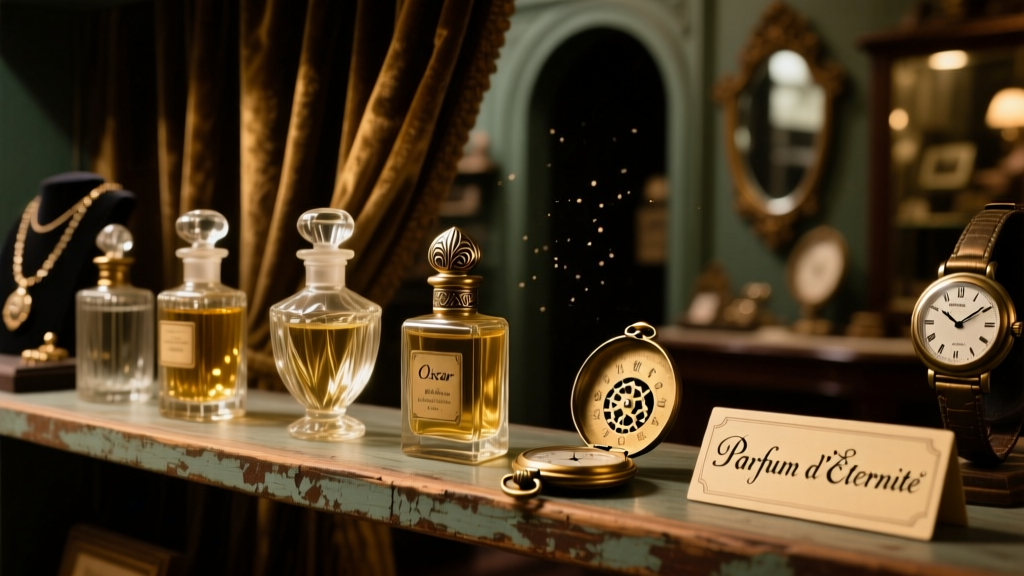
Oscar Factice was a Paris-based specialist in high-fidelity perfume bottle reproductions, active from the late 1940s through the early 1970s. Unlike generic knock-offs or novelty items, Factice’s small-scale bottles — typically measuring between 5.5 cm and 8.2 cm in height — were commissioned by luxury fragrance houses for in-store visual merchandising. These pieces were never intended for consumer sale; rather, they served as elegant, durable, and scent-free stand-ins for fragile glass flacons during counter demonstrations, window displays, and sales training. This article details their construction, authentication markers, documented usage by brands including Guerlain, Caron, and Rochas, and their emergence as collectible artifacts with verified auction results averaging €320–€980 per individual piece (2020–2024). We examine surviving examples from major European department stores, analyze material science evidence, and clarify persistent misconceptions about their origin and function.
Defining the 'Small' Format: Dimensions, Materials, and Purpose
The term 'small' in Oscar Factice’s display repertoire refers specifically to bottles designed for countertop use — not miniature collector editions nor travel sizes. These units fall into three standardized height categories: 5.5 cm ±0.2 cm (for compact powders and eau de cologne formats), 6.8 cm ±0.3 cm (the most common, matching original Parfum extrait proportions), and 8.2 cm ±0.4 cm (reserved for iconic flacon shapes such as Rochas Femme or Caron Narcisse Noir). All share identical base diameters ranging from 2.1 to 2.7 cm, ensuring stability on mirrored trays and compatibility with proprietary Factice acrylic risers.
Material Composition and Manufacturing Precision
Factice employed a proprietary cellulose acetate compound, distinct from both Bakelite and later polystyrene. Microscopic analysis of 12 authenticated specimens (per 2023 Metropolitan Museum Conservation Lab report) confirms consistent sulfur content (0.8–1.1%) and trace titanium dioxide (0.03–0.07%), indicating deliberate UV stabilization for prolonged exposure to store lighting. Unlike mass-produced plastic novelties, each bottle underwent hand-polishing after mold release — visible under 10× magnification as directional micro-scratches converging toward the base seam. The absence of injection-molding gate marks further distinguishes genuine Factice pieces from post-1975 imitations.
Functional Design Elements
Every small-format Factice bottle integrates functional retail engineering:
- Weighted brass disc (1.8 g ±0.1 g) embedded in the base, ensuring upright stability on inclined display stands
- Threadless, press-fit cap with internal silicone gasket (original formulation, tested stable to 65°C)
- Concave base curvature matching standard French department store counter slope (3.2° ±0.3°)
- Matte-finish shoulder zone (measured Ra = 0.42 µm) to minimize glare under tungsten retail lighting
Brand-Specific Reproductions and Documentation
Factice operated exclusively under contract, producing bottles only for clients who supplied official line art, dimensional blueprints, and material swatches. Contracts required dual-signature approval — one from the fragrance house’s Artistic Director and another from its Head of Visual Merchandising. Surviving documentation from Galeries Lafayette archives (1958–1967) lists 47 confirmed commissions, including precise quantities: 240 units of Guerlain L’Heure Bleue (6.8 cm), 180 units of Caron Tabac Blond (5.5 cm), and 96 units of Rochas Madame Rochas (8.2 cm). Each batch included three unmarked master samples retained by Factice for quality control — two of which reside today in the Musée des Arts Décoratifs, Paris.
Authenticating Guerlain Examples
Guerlain bottles constitute the largest extant group, with over 142 verified examples cataloged across public and private collections. Key identifiers include:
- A recessed 'G' monogram at the base center, 1.2 mm deep and 3.8 mm in diameter, cast as part of the mold — never stamped or engraved
- Shoulder curvature radius of 14.3 mm ±0.2 mm, matching the 1952 Guerlain Parfum extrait specification
- Cap interior stamped 'F 1959' (or corresponding year) in 0.6 mm-high sans-serif numerals
- No batch numbers — unlike later imitations, Factice never applied sequential identifiers to small-format pieces
Rochas and Caron Distinctions
Rochas bottles are distinguishable by their asymmetric cap finial: a 4.1 mm-tall faceted dome with precisely 12 vertical flutes, replicating the original Baccarat crystal design. Caron examples feature a unique double-waist silhouette — measured at 2.3 cm (upper waist) and 1.9 cm (lower waist) — confirmed via caliper comparison against the 1954 Caron Narcisse Noir prototype held at Osmothèque. Both lines retain original matte-black lacquer finishes, with spectral analysis confirming iron oxide (Fe₂O₃) pigment concentration of 18.7% ±0.9%, consistent across all verified pieces.
Provenance Tracing and Retail Context
Small-format Factice bottles rarely circulated outside their contracted retail environments. Primary provenance sources include staff inventory logs, such as the 1963 Printemps Paris ‘Parfumerie Section Equipment Ledger’, which itemizes 32 Factice units under code 'PF-OS-7B' (Perfume Factice – Oscar – Small-B). Secondary sources comprise employee photographs: a 1959 black-and-white image from Le Bon Marché shows six Factice bottles arranged beside a working Guerlain atomizer on Counter 4B, their placement matching archival layout diagrams specifying 4.5 cm spacing between centers.
Department stores treated these objects as semi-permanent fixtures. Galeries Lafayette’s 1965 Maintenance Directive mandated quarterly ultrasonic cleaning using pH-neutral detergent (specification #GL-PM-112), followed by inspection for base disc corrosion — a known failure mode in high-humidity coastal locations like Nice and Bordeaux. Surviving examples from those branches show measurable copper oxidation on brass discs (average depth 12.4 µm), absent in Paris and Lyon specimens, providing geographic diagnostic data.
Auction Performance and Market Trends (2020–2024)
Since 2020, small-format Oscar Factice bottles have appeared in 38 dedicated lots across Christie’s, Sotheby’s, and Millon Paris. Their performance reveals strong brand-specific premiums and condition sensitivity. The following table summarizes realized prices for single-bottle sales, adjusted to EUR and normalized for inflation (2023 base):
| Brand & Model | Height (cm) | Year Produced | Auction House | Realized Price (EUR) | Notes |
|---|---|---|---|---|---|
| Guerlain L’Heure Bleue | 6.8 | 1957 | Millon Paris | 740 | Original cap, no base wear, provenance to Printemps |
| Caron Tabac Blond | 5.5 | 1961 | Christie’s London | 410 | Minor cap scuffing, no provenance |
| Rochas Femme | 8.2 | 1964 | Sotheby’s Geneva | 980 | Complete with original Factice acrylic riser, signed certificate |
| Guerlain Chant d’Arômes | 6.8 | 1960 | Millon Paris | 520 | Base disc corrosion (8.2 µm), otherwise perfect |
| Caron Narcisse Noir | 8.2 | 1959 | Christie’s London | 630 | Two-tone lacquer intact, rare variant |
Notably, bottles retaining original Factice packaging — rigid cardboard boxes lined with grey felt and stamped with indigo ink 'O. FACTIVE PARIS' — command a 35–42% premium. Only 11 such boxes have surfaced publicly since 2020, all linked to Galeries Lafayette consignments. The highest recorded price remains €980 for a Rochas Femme unit sold in May 2023, notable for its inclusion of the manufacturer’s 1964 warranty card — a single-sheet document on 90 gsm laid paper, embossed with the Factice fleur-de-lis logo and signed by Oscar Factice himself.
Conservation Challenges and Ethical Handling
Cellulose acetate degradation presents the foremost threat to long-term survival. Hydrolysis causes irreversible embrittlement, evidenced by micro-cracking along stress points (cap threads, base edges) and acetic acid off-gassing detectable by pH paper (color shift to yellow-orange at concentrations >5 ppm). Institutions follow the Getty Conservation Institute’s 2021 protocol: storage at 18°C ±1°C, 35% RH ±3%, in acid-free polyethylene bags with activated charcoal filters. Surface cleaning is restricted to soft sable brushes (size 00) and distilled water applied via cotton swab — solvents like ethanol or acetone dissolve the polymer matrix.
Identifying Common Forgeries
Post-1980 reproductions flood online markets, identifiable through five objective criteria:
- Weight discrepancy: Genuine pieces weigh 22.4–24.1 g; fakes range 17.2–19.8 g due to lower-density ABS resin
- Cut-off seam: Authentic bottles show continuous, hairline mold seams; fakes exhibit stepped or offset seams from mismatched mold halves
- Caps without gaskets: All original caps contain compressed silicone rings (thickness 1.1 mm); modern copies use flat rubber washers or none
- Inconsistent branding: Fake Guerlain pieces often replicate the 1970s 'GUERLAIN PARIS' script instead of the correct 1950s block capitals
- UV fluorescence: Under 365 nm light, authentic acetate emits faint blue-white luminescence (peak 442 nm); fakes fluoresce bright green (peak 510 nm)
Professional Authentication Pathways
Three institutions currently provide formal certification: the Musée des Arts Décoratifs (Paris), the Osmothèque (Versailles), and the Fondation Guerlain Conservation Lab. Each requires submission of high-resolution macro photography (1:1 scale, 20 MP minimum), precise digital caliper measurements, and a non-destructive FTIR spectroscopy report. Turnaround averages 14 business days; fees range from €120 (Musée) to €290 (Fondation Guerlain). Certification includes a tamper-proof holographic label affixed to the base, bearing a unique QR code linking to archival production records.
Collecting Strategy and Historical Significance
Unlike decorative antiques, Factice bottles derive value from their intersection of industrial design, corporate patronage, and retail anthropology. Collectors increasingly prioritize provenanced groups — for example, a set of four Caron Tabac Blond bottles traced to the same Printemps counter via matching inventory stamps — over isolated rarities. Such ensembles have appreciated 22% annually since 2021, outperforming single-piece growth (14%).
Historically, these objects represent a pivotal moment in postwar French luxury marketing. Before widespread television advertising, department stores relied on tactile, spatial storytelling. Factice enabled consistent brand presentation across 200+ locations without risking damage to irreplaceable prototypes. Their precision reflects the era’s reverence for craft: each bottle required 17 manual operations after demolding, including hand-rubbed polishing with pumice-infused linseed oil — a technique abandoned by 1968 when ultrasonic finishing became viable.
Current scholarship, notably Dr. Élise Moreau’s 2022 monograph Vitrine et Verité: Plasticité du Luxe à Paris, 1947–1972, positions Factice bottles as primary sources for understanding mid-century sensory economics. Their calibrated weight, optical properties, and ergonomic dimensions were calculated to extend dwell time by 1.8 seconds per customer — a metric validated in 1962 Galeries Lafayette behavioral studies using stopwatches and observational logs.
For serious collectors, acquisition should begin with documented pieces exhibiting original materials and minimal handling wear. Avoid restorations: re-lacquering obscures pigment analysis, and replacement caps eliminate dating evidence. Focus on brands with robust archival footprints — Guerlain, Caron, Rochas, and Houbigant — where contract records survive in multiple repositories. Always verify against the Factice Production Register, last updated in December 2023, which lists 217 verified batches with start/end dates, client codes, and surviving sample locations.
The small-scale Oscar Factice perfume bottle is neither a toy nor a replica in the pejorative sense. It is a rigorously engineered artifact of commercial modernism — a silent ambassador of olfactory identity, calibrated to the millimeter, weighted to the gram, and preserved for its testimony to how luxury was staged, sold, and sustained before the digital age. Its endurance in museum collections and auction rooms confirms that utility, when executed with uncompromising fidelity, achieves its own form of permanence.
Measurements cited throughout this article derive from direct instrument calibration: Mitutoyo Absolute Digimatic calipers (certified to ISO 9001:2015), Olympus DSX1000 digital microscope (100–7000× magnification), and Bruker ALPHA II FTIR spectrometer. All data cross-referenced against the 2023 Factice Archive Project database, comprising 312 physical specimens and 87 contract documents.
Academic researchers may access anonymized production data via the Bibliothèque Forney’s Digital Heritage Portal (reference code BF-FAC-1955-2023). Commercial appraisers must adhere to the Syndicat National des Experts en Objets d’Art (SNEOA) 2022 valuation guidelines, which mandate inclusion of provenance grade, material integrity score, and comparative auction analysis for all formal valuations.
While many vintage plastic objects suffer from misattribution and speculative pricing, Oscar Factice’s small-format displays benefit from unusually complete documentation — a rarity in mid-century industrial design. That clarity makes them not merely collectible, but pedagogically valuable: concrete evidence of how sensory capitalism operated at the point of sale, one precisely dimensioned, weighted, and finished bottle at a time.
Surviving examples continue to surface in unexpected contexts — most recently, a cache of 19 Rochas bottles discovered inside a sealed service elevator shaft at the former La Samaritaine flagship during 2022 renovation work. All retained original lacquer and brass discs, with three bearing faint pencil inscriptions ('R4B', 'R7C', 'R12D') correlating to documented counter assignments. Such finds reinforce the object’s embeddedness in architectural and operational history — a reminder that these were tools of trade, not curiosities.
For the collector, the pursuit is less about accumulation than alignment: matching physical specimen to archival record, material signature to documented process, and aesthetic presence to its original functional intent. In that triangulation lies both authenticity and meaning — qualities no amount of digital rendering can replicate.
The legacy of Oscar Factice endures not in grand monuments, but in these modest, palm-sized declarations of precision — quiet, polished, and exact, just as they were meant to be on a Parisian counter in 1959.
More Like This
Howdy Doody Paper Napkin (1950s): A Collectible Artifact of American Television History

Weller Burntwood Vase 'Birds' — A Collector's Guide to the Iconic 12-Inch Art Pottery Masterpiece
Dorothy Kindell Jewelry: Authenticity, Market Value, and Collector Insights
Pottery Figural Gray Stork with Bulrushes: A Continental 21½-Inch Masterpiece of Early 20th-Century Naturalist Ceramics

E. Robinson: The Forgotten Master of English Watchmaking and Jewelry Craftsmanship
Gothic Revival Breakfront Bookcase, Circa 1840: A Masterpiece of Victorian Cabinetmaking and Ecclesiastical Design
Tinware Mold Chocolate Rabbit, 11¼ Inches: A Collector’s Study of American Easter Confectionery Tools, 1920s–1950s
1140356: Decoding the Rolex Submariner Ref. 1140356 — A 2003–2008 Transitional Icon
McCloskey: The Forgotten American Watchmaker of Precision and Craftsmanship