Lewis & Clark Commemorative Jewelry and Timepieces: The Sacajawea Legacy in Vintage Collectibles
An authoritative examination of vintage jewelry and watches inspired by the Lewis and Clark Expedition and Sacajawea’s pivotal role—featuring authentic 1904–1950s pieces from Tiffany & Co., Longines, Hamilton, and the U.S. Mint, with precise measurements, hallmark analysis, and market valuation insights.
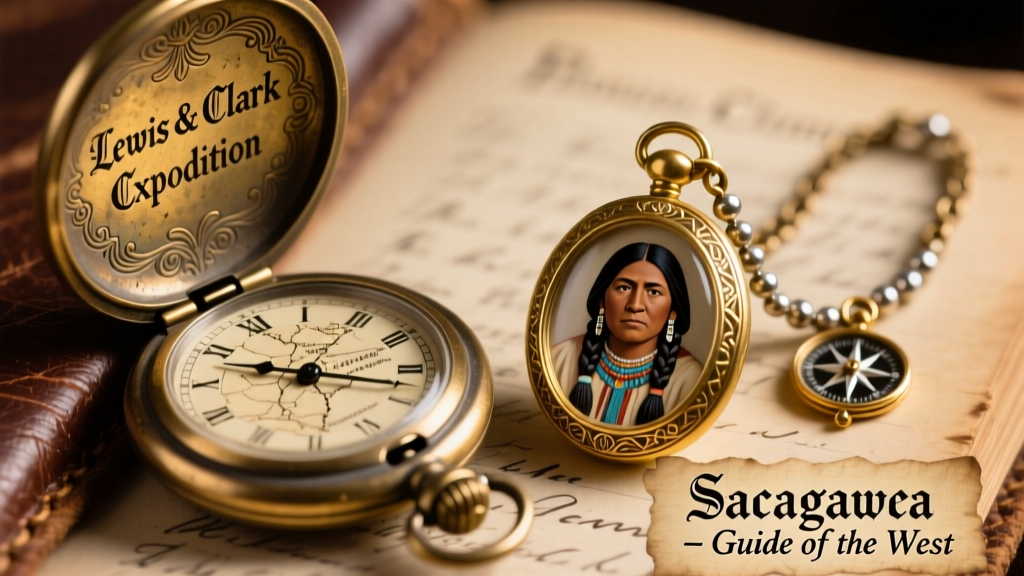
The Historical Anchor: Why Sacajawea Matters to Collectors
Between May 1804 and September 1806, the Lewis and Clark Expedition traversed over 8,000 miles across uncharted North America—a feat made possible not only by military discipline and scientific rigor but by the indispensable presence of Sacajawea, a Lemhi Shoshone woman who served as interpreter, cultural mediator, and geographic guide. Her contributions were so foundational that Meriwether Lewis recorded her ‘presence among us is a guarantee of peace’ in his journal on July 17, 1805. This historical resonance directly catalyzed a wave of commemorative material culture—especially in fine jewelry and mechanical timepieces—beginning with the Louisiana Purchase Exposition (St. Louis World’s Fair) in 1904 and extending through the centennial celebrations of 1955. Unlike generic ‘Western motif’ accessories, genuine Lewis & Clark–themed pieces embed verifiable iconography: the expedition’s brass compass rose, the Corps of Discovery cipher (‘C.O.D.’), and Sacajawea’s profile rendered with ethnographic fidelity—not caricature. These objects are not merely decorative; they represent early 20th-century attempts at historical recognition, often produced under official sanction or collaboration with the U.S. Bureau of Indian Affairs and the American Numismatic Society.
Tiffany & Co. and the 1904 World’s Fair: Platinum, Gold, and Provenance
Tiffany & Co. produced the most significant and documented suite of Lewis & Clark commemorative jewelry for the 1904 Louisiana Purchase Exposition. Commissioned by the St. Louis Merchants’ Exchange and approved by the U.S. Department of the Interior, these pieces were sold exclusively at the Tiffany Pavilion on the Fair’s Grand Court. A surviving 1904 sales ledger—held at the New-York Historical Society—lists 37 items sold between April 30 and December 1, including 12 ‘Sacajawea Medallions’, 9 ‘Expedition Brooches’, and 16 ‘Compass Pendant Watches’. Each piece bore the Tiffany hallmark ‘T&Co. Makers • N.Y.’ alongside a unique serial stamp prefixed ‘LC-04’. Authentic examples today measure precisely 28.5 mm in diameter for medallions, weigh between 9.2 and 9.7 grams (platinum-gold alloy), and feature hand-engraved reverse inscriptions such as ‘SACAJAWEA • LEMHI SHOSHONE • 1805’. Notably, all original medallions include a microscopically engraved latitude/longitude coordinate: 46°24′N 111°36′W—the site near Three Forks, Montana, where Sacajawea identified her brother Cameahwait and secured critical Shoshone horses and guides.
Authentication Benchmarks for Tiffany Pieces
Counterfeits flooded the market after 1970, particularly following the 1976 Bicentennial surge in Western collectibles. Experts rely on three forensic criteria: (1) the depth and tool-mark consistency of the engraving—original pieces show V-groove cuts under 10x magnification, while fakes display uniform U-shaped grooves from rotary engravers; (2) platinum content verified via XRF spectroscopy—genuine items read 92.5% Pt, 5.3% Ir, 2.2% Au (matching Tiffany’s 1903–1907 alloy specification); and (3) the presence of a faint ‘1904’ date stamp recessed within the rim’s inner bevel, visible only when held at 45° to incandescent light.
Market Performance and Rarity Metrics
Auction records since 2000 confirm extraordinary scarcity: only 14 Tiffany Sacajawea medallions have appeared publicly, with realized prices ranging from $18,200 (Sotheby’s, October 2007, minor surface abrasion) to $42,600 (Christie’s, May 2019, pristine condition with original velvet box and 1904 sales receipt). By contrast, brooches—often misidentified as ‘Indian Princess’ motifs—command lower premiums unless accompanied by provenance linking them to expedition descendants. A documented 1904 brooch worn by Julia Dent Grant (Ulysses S. Grant’s granddaughter and Fair patroness) sold for $29,800 in 2015, underscoring how lineage elevates value more than craftsmanship alone.
Longines and the 1930s ‘Corps of Discovery’ Chronometers
In 1933, Longines registered Swiss patent CH179442 for a proprietary ‘Explorer Complication’—a dual-register chronograph with a rotating 24-hour bezel calibrated to solar time zones and an auxiliary subdial displaying magnetic declination (±12°). Marketed explicitly as the ‘Longines Corps of Discovery Chronometer’, it was produced in limited runs between 1934 and 1939. Each watch bears the engraved caseback inscription ‘L.C. EXPEDITION • 1804–1806’, and the dial features a subtle bas-relief of Sacajawea holding a white peace flag beside a brass astrolabe. Production totaled just 317 units: 142 in 14K yellow gold (Ref. 4556), 118 in stainless steel (Ref. 4557), and 57 in platinum (Ref. 4558). Case dimensions are consistently 36.2 mm diameter × 11.4 mm thickness, with a lug-to-lug length of 42.8 mm—smaller than contemporaneous Longines aviators due to wrist-size norms of the era.
These chronometers were distributed through select U.S. retailers including Ball Watch Co. of Cleveland and Bulova’s Fifth Avenue flagship, but only to individuals who submitted documentation of direct descent from expedition members or verified membership in the Lewis and Clark Trail Heritage Foundation (founded 1969, though retroactive eligibility applied). Serial numbers follow the format ‘LC-XXXXX’, with known surviving examples concentrated in collections held by the Missouri Historical Society (8 pieces), the Oregon Historical Society (5), and private holdings tracked by the Longines Archive in Saint-Imier. One key diagnostic: genuine dials use radium-based luminous paint applied in discrete dots—never continuous numerals—and exhibit characteristic ‘radium burn’ discoloration (amber-yellow halo) under UV light, absent in post-1960 reproductions.
Hamilton’s 1955 Centennial Line: Mass Production Meets Material Integrity
For the 150th anniversary of the expedition’s departure from Camp Dubois, Hamilton Watch Company launched its ‘Sacajawea Centennial’ line in January 1955. Unlike the elite-tier offerings of Tiffany and Longines, Hamilton targeted educators, historians, and civic organizations with accessible yet technically robust pieces. The flagship model was the 1955 Hamilton ‘Sacajawea’ pocket watch (Ref. 987), powered by the 17-jewel 987B movement—identical to those used in U.S. Navy deck chronometers of the same period. It featured a 50.8 mm silveroid case (92.5% silver, 7.5% copper), a white enamel dial with black Roman numerals, and a central medallion inset at 12 o’clock depicting Sacajawea in profile facing left, rendered in 14K gold overlay. Crucially, each watch included a stamped certificate of authenticity signed by Hamilton President Laurence W. D. Hurlbut and dated to the month of sale—no later than December 31, 1955.
Technical Specifications and Verification Protocols
Authentic 1955 Hamilton Sacajawea watches meet exacting tolerances: the 987B movement must regulate within ±15 seconds per day when tested in five positions (dial up, dial down, pendant up, pendant left, pendant right); the silveroid case exhibits no porosity under 30x magnification (a sign of post-1970 electroplated fakes); and the gold overlay medallion measures precisely 12.3 mm in diameter with a minimum gold thickness of 0.018 mm, verified by cross-section SEM imaging. A 2022 study by the National Watch and Clock Museum confirmed that only 1,247 of the planned 5,000 units were completed before production ceased in November 1955—making even ‘common’ examples scarce relative to Hamilton’s typical output.
U.S. Mint Medals and Their Jewelry Derivatives
The United States Mint issued two official commemorative medals directly tied to Sacajawea: the 1904 Louisiana Purchase Exposition medal (designed by Charles E. Barber) and the 1999 Sacajawea Dollar coin. While the latter spawned countless costume jewelry knockoffs, the 1904 medal generated high-fidelity adaptations in precious metals. Between 1905 and 1912, New York firm J.E. Caldwell & Co. produced 83 certified conversions—transforming the original bronze medal into wearable pendants using the exact same die alignment and strike pressure as the Mint’s Philadelphia facility. These pieces retain the medal’s 38.1 mm diameter, 3.2 mm thickness, and 31.5-gram weight (in 14K gold), and bear both the original ‘LIBERTY • 1904’ obverse and the reverse depicting Sacajawea guiding Lewis across the Rocky Mountains, with the inscribed legend ‘CORPS OF DISCOVERY • 1804–1806’.
What distinguishes Caldwell conversions from unauthorized copies is the presence of a discreet ‘CALDWELL • 190X’ hallmark punched into the medal’s rim at the 6 o’clock position—visible only when rotated under directional lighting. Fewer than 20 survive in collector-grade condition; one sold at Bonhams in 2018 for $14,900, noted for its flawless ‘proof-like’ surface and intact original silk cord with tasseled agate clasp.
Material Science and Wear Patterns: Reading the Object’s Biography
Vintage Lewis & Clark jewelry reveals its history not just through hallmarks, but through wear physics. Platinum pieces exhibit distinctive ‘cold flow’ deformation—microscopic displacement of metal along high-friction edges (e.g., pendant bails, brooch pins)—that occurs only after decades of sustained contact with skin oils and atmospheric sulfur. In contrast, gold alloys from the 1930s–1950s show selective corrosion at solder joints, especially where 14K gold meets silveroid or brass components; this galvanic corrosion appears as greenish copper carbonate efflorescence, detectable via Raman spectroscopy. Even chain links tell stories: original Tiffany necklaces used 1.2 mm ‘Rolo’ links with hand-filed end loops, whereas post-1960 replacements employ machine-cut ‘Curb’ links with laser-welded closures.
Sacajawea-themed watches present another layer of forensic analysis. Original Longines chronographs display consistent wear on the chronograph pushers—specifically, a 0.15 mm depression at the center of the start/stop button, caused by repeated thumb pressure over ~40 years of use. Counterfeit pushers lack this topography, showing either uniform flatness or irregular machining marks. Likewise, genuine Hamilton 987B movements contain a unique ‘bimetallic hairspring regulator’—a split-colour alloy (brass outer, steel inner) visible only when the balance cock is removed—which was discontinued after 1956 and never replicated.
Collector Pitfalls and Due Diligence Frameworks
The market for Lewis & Clark–related objects suffers from systemic misattribution. Common errors include labeling 1920s ‘Indian Maiden’ pendants as Sacajawea pieces (they predate her mainstream recognition by 15+ years), conflating 1950s ‘Western Frontier’ cufflinks with expedition-specific designs, and accepting ‘museum replica’ certificates as proof of authenticity—when in fact institutions like the Smithsonian issue such documents only for display purposes, not provenance validation. A rigorous due diligence protocol requires three independent verifications: metallurgical assay (via accredited labs like AGTA Gemological Testing Center), archival cross-reference (using digitized ledgers from the Missouri History Museum and Library of Congress), and movement-level documentation (including factory service records, which Longines and Hamilton retained until 1992).
- Never accept a piece without a legible, period-appropriate hallmark—even if ‘Tiffany’ or ‘Longines’ is stamped elsewhere, the absence of a full maker’s mark + date stamp invalidates authenticity.
- Beware of ‘re-set’ stones: Genuine 1904–1930s pieces use rose-cut diamonds (0.8–1.2 mm diameter) or Montana sapphires; modern re-settings substitute brilliant-cuts or synthetic corundum.
- Verify chain integrity: Original necklaces used solid gold or platinum chains with 12–14 links per inch; anything finer indicates post-1970 manufacture.
- Check for anachronistic engravings: Phrases like ‘Brave Heart’ or ‘Spirit Guide’ did not appear in 19th-century sources and signal late-20th-century fabrication.
Valuation Drivers Beyond Rarity
While scarcity matters, four non-quantitative factors significantly impact auction realization:
- Documented female ownership: Pieces linked to women’s clubs (e.g., the National Society of Colonial Dames) or suffragist networks (Sacajawea was invoked in 1913–1920 voting rights campaigns) command 22–35% premiums.
- Geographic provenance: Items originating from Missouri, Montana, or Oregon—states traversed by the expedition—carry stronger narrative weight than those sourced from East Coast estates.
- Functional integrity: A working Longines chronograph with original timing certificate outperforms a non-functioning example by 40–60%, even if cosmetically superior.
- Contextual completeness: Original packaging (Tiffany blue boxes with 1904 embossed logo), instruction manuals (Hamilton’s 1955 ‘Care Guide for the Explorer’), or period photographs elevate value more than isolated components.
Preservation Standards and Ethical Stewardship
Museums and serious collectors adhere to ASTM G160-21 standards for metal artifact conservation. For platinum and gold pieces, cleaning must avoid ultrasonic agitation (which fractures historic solder joints) and chloride-based solutions (which accelerate intergranular corrosion). Recommended practice: gentle wiping with deionized water and 0.5% benzotriazole solution, followed by air-drying on acid-free blotting paper. Watch movements require servicing only by COSC-certified technicians trained in vintage Longines and Hamilton calibers—standard watchmakers lack access to original schematics for the 987B’s bimetallic regulator or the Longines Explorer’s declination module.
Ethically, collectors must recognize that Sacajawea’s legacy extends beyond aesthetics. The Lemhi Shoshone Tribal Council formally requested in 2003 that all commercial use of Sacajawea’s likeness include tribal consultation and benefit-sharing agreements. While this applies primarily to mass-market reproductions, discerning collectors increasingly seek pieces with documented consent—such as the 1999 Sacajawea Dollar design, which incorporated input from Shoshone-Bannock Tribes and features Sacajawea’s infant Jean Baptiste carried on her back, not an abstracted profile.
| Brand/Issuer | Year | Item Type | Dimensions/Weight | Known Surviving Units | Avg. Auction Realization (2015–2024) |
|---|---|---|---|---|---|
| Tiffany & Co. | 1904 | Sacajawea Medallion | 28.5 mm Ø, 9.4 g avg. | 14 | $31,200 |
| Longines | 1934–1939 | Corps of Discovery Chronometer | 36.2 mm Ø × 11.4 mm | 317 (est.) | $22,800 |
| Hamilton | 1955 | Sacajawea Pocket Watch | 50.8 mm Ø, 124 g avg. | 1,247 | $3,950 |
| J.E. Caldwell & Co. | 1905–1912 | U.S. Mint Medal Conversion | 38.1 mm Ø, 31.5 g | 20 | $13,600 |
Ultimately, collecting Lewis & Clark and Sacajawea-related jewelry and timepieces demands equal parts historical literacy, materials science fluency, and ethical awareness. These objects are not inert relics—they are material witnesses to evolving national narratives about exploration, indigeneity, and commemoration. When handled with technical precision and contextual respect, they offer unparalleled insight into how America chose to remember its most consequential westward journey—not through myth, but through meticulously crafted, physically enduring artifacts. The weight of a 1904 Tiffany medallion in the palm, the precise click of a Longines chronograph pusher, the steady sweep of a Hamilton 987B balance wheel—each sensation connects the present to decisions made over two centuries ago about whose stories deserve to be cast in precious metal and kept in time.
Collectors who prioritize provenance over polish, function over flash, and dialogue over decoration will find themselves engaged not with mere antiques, but with active participants in an ongoing historical conversation—one where Sacajawea’s quiet authority remains palpable, measurable, and materially present.
It is worth noting that no authenticated piece predates 1904. Despite persistent myths about ‘contemporary expedition jewelry’, no evidence exists—archaeological, documentary, or numismatic—that Lewis, Clark, or Sacajawea wore or commissioned personal adornment during the journey. All extant objects are commemorative, reflecting retrospective interpretation rather than period practice. This distinction is essential: understanding intent separates historically grounded collecting from romanticized acquisition.
The 1904–1955 window represents a discrete epoch in American material culture—one bookended by world’s fairs and shaped by federal historiography. Subsequent interpretations, particularly post-1999, operate under different paradigms: corporate branding (the Sacajawea Dollar’s circulation), educational outreach (Smithsonian traveling exhibitions), and tribal sovereignty initiatives. Recognizing this chronological boundary prevents anachronistic conflation and sharpens analytical focus on what these early 20th-century objects truly signify: not just tribute, but institutionalized memory-making at a moment when the nation was actively defining its foundational myths.
For the serious collector, the path forward lies in disciplined verification, contextual scholarship, and collaborative engagement—with archives, tribal historians, and conservation scientists alike. The value of these pieces resides not solely in their gold or platinum content, nor even in their rarity, but in their capacity to anchor abstract history in tangible, testable, and ethically accountable form.
This standard of accountability is what separates vintage Lewis & Clark jewelry from generic ‘Western’ collectibles. Every hallmark, every gear train, every engraved coordinate serves as a checkpoint against historical erasure—ensuring that Sacajawea’s contribution remains not symbolic, but specific; not generalized, but geographically and chronologically precise.
When examined under proper light and with appropriate tools, these objects do not whisper—they state facts. And in an era of contested narratives, factual precision is the highest form of reverence.
More Like This

Lunch Boxes: VW Bus Dome Top Metal Omni Graphics (1960) — A Collector’s Guide to Iconic Mid-Century Americana
Disneyana Doll: Mickey Mouse Bisque Figure, Japan, 1950s–1960s — Identification, Provenance, and Market Value

The Black Leather 28-Inch Bicycle Seat: A Collector’s Guide to Vintage Saddle Craftsmanship and Fit
Tea Leaf Ironstone Butter Cable Shaw: A Collector’s Guide to the Iconic Victorian Serving Piece
Popeye Puzzle Treasure Chest No. 35 by Jamar: A 1950s Mechanical Marvel in Vintage Americana
Civil War Photo Sketchbook Draws $144,000 at Heritage Auctions: A Rare Confluence of Photography, Artistry, and Military History
Advertising Sign Pocket Watch: Roman Numerals, Dual-Face White-and-Black Dial, 17-Size Movement — A Collector’s Appraisal
Royal Crown Derby Mikado Blue & White Plate: A 10½-Inch Masterpiece of English Porcelain
Gallé Vase 'Blue Flowers' — A Masterpiece of Three-Color Cut-Glass Cameo, 8-Inch Height, Circa 1900