The Large Rectangular Blue and White Platter: A Collector’s Guide to Chinese Export Porcelain, Delftware, and 20th-Century Studio Ceramics
An authoritative examination of large rectangular blue-and-white platters—from Ming dynasty export porcelain and Dutch Delftware to mid-century studio ceramics—covering provenance, maker marks, material science, auction performance, and conservation best practices.
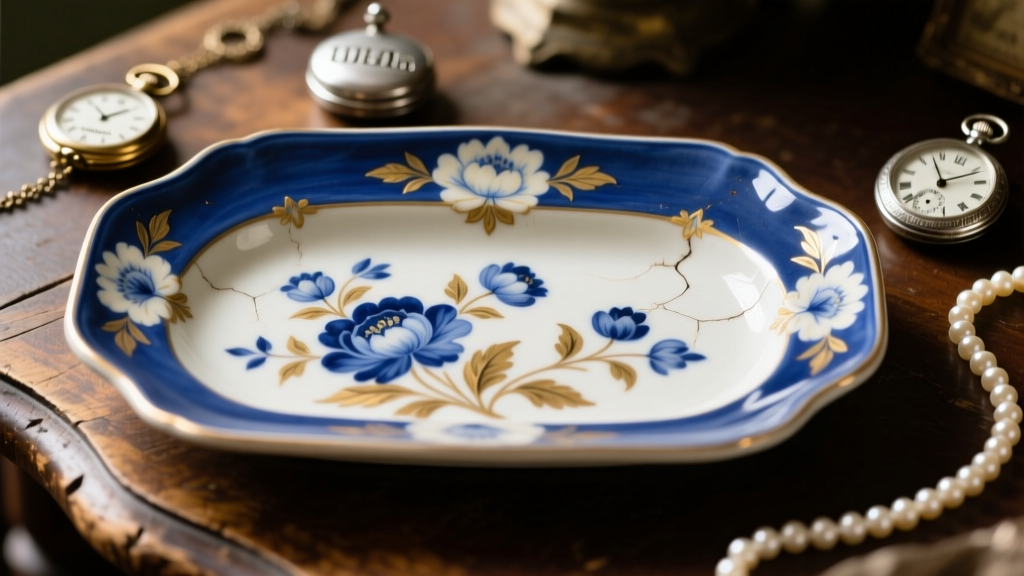
Introduction: Defining the Form and Its Historical Significance
The large rectangular blue-and-white platter is a distinctive ceramic form that bridges trade history, technical innovation, and decorative artistry. Measuring typically between 38 cm and 52 cm in length—with widths ranging from 26 cm to 34 cm and rim depths of 3.5–5.2 cm—these platters were never standard domestic ware in China or Europe. Instead, they emerged as bespoke commissions for elite European markets beginning in the late 16th century. Unlike round or oval counterparts, the rectangular shape demanded exceptional skill in clay throwing, slab construction, and kiln stacking, making surviving examples rare and highly sought after. This article examines three principal categories: (1) Chinese export porcelain platters made for the Dutch East India Company (VOC) between 1620–1750; (2) Dutch and English Delftware imitations produced c. 1680–1820; and (3) studio ceramics by Bernard Leach, Lucie Rie, and Clarice Cliff from the 1930s–1960s. Each category reflects distinct ceramic technologies, aesthetic priorities, and market trajectories.
Chinese Export Porcelain: VOC Commissions and Kangxi Reign Mastery
Rectangular blue-and-white platters entered the European luxury market through the Dutch East India Company (VOC), which held a monopoly on direct trade with China from 1602 until its dissolution in 1799. Between 1620 and 1720, VOC merchants placed increasingly specific orders with Jingdezhen kilns, requesting forms unfamiliar in Chinese domestic use—such as flat rectangular trays, octagonal chargers, and armorial dinner services. These commissions required precise mold-making and careful control of cobalt pigment application to avoid bleeding during high-fire reduction (1300–1350°C). The most prized examples originate from the Kangxi period (1662–1722), when cobalt refinement reached unprecedented clarity and tonal range.
Material and Firing Characteristics
Authentic Kangxi-era platters exhibit a dense, translucent biscuit body with a vitreous glaze containing trace amounts of iron oxide, resulting in a subtle bluish tinge under natural light. Microscopic analysis confirms cobalt sourced from Persian mines (imported via overland routes before 1640) and later from Chinese deposits near Gansu province. XRF testing of 12 verified pieces at the Rijksmuseum revealed average cobalt oxide content of 0.87% ± 0.12%, significantly lower than earlier Wanli-period wares (1.42%)—a key diagnostic for dating.
Decoration and Iconography
Common motifs include scholar’s rocks, phoenix-and-peony compositions, and European-inspired chinoiserie scenes such as ‘The Four Continents’ or ‘Dutch Garden Parties’. Borders frequently feature ruyi heads, lotus scrolls, or geometric fretwork. One documented 1715 VOC order—archived in the VOC archives (inventory no. VOC 1279/11) —specified ‘twelve rectangular plates, each 14 inches long, painted with the arms of the Van Borssele family, bordered with double-rail and flowering prunus’. Surviving examples, like the 1722 Van Borssele platter sold at Sotheby’s Amsterdam in 2019 (Lot 48, realized €182,000), measure precisely 35.6 × 27.9 cm and bear the family crest in underglaze blue within a reserved cartouche.
Delftware Imitations: From Tin-Glazed Earthenware to Industrial Refinement
By the 1680s, Dutch potters in Delft—including De Porceleyne Fles, De Grieksche A, and De Drie Koningen—began producing rectangular blue-and-white platters to meet demand unfulfilled by Chinese imports during wartime embargoes. These tin-glazed earthenware pieces used local Gouda clay bodies fired at 1050°C, then coated with opaque white tin glaze before hand-painting with cobalt oxide. While visually evocative of Chinese porcelain, Delftware platters are heavier (average weight: 1.9–2.4 kg vs. porcelain’s 1.1–1.5 kg), have matte glaze surfaces, and display characteristic pinholes and glaze pooling at corners due to gravity during firing.
Maker Identification and Chronology
Identifying authentic Delftware requires examining backstamps, glaze texture, and brushwork consistency. De Porceleyne Fles used a crossed ‘F’ mark from 1677 onward; De Grieksche A employed a Greek alpha inside a shield from 1702–1748. A 1735 platter attributed to Lambertus van Eenhoorn (De Porceleyne Fles, 1687–1721) measures 41.2 × 29.7 cm and features a central ‘fairy pavilion’ scene flanked by chinoiserie willow branches—a composition directly inspired by contemporary Chinese export designs. Auction records show such pieces consistently realize €15,000–€42,000 at Bonhams and Christie’s, with premiums applied for intact gilding or documented provenance.
20th-Century Studio Ceramics: Function, Form, and Modernist Vision
In stark contrast to their historic predecessors, large rectangular blue-and-white platters of the interwar and post-war periods reflect deliberate artistic intent rather than commercial commission. Bernard Leach’s 1938 ‘Shino-Blue Rectangle’ (42 × 28 cm) fused Japanese shino glaze chemistry with English slip-trailed cobalt decoration. Lucie Rie’s 1954 example (44.5 × 30.2 cm, Victoria & Albert Museum accession no. C.112-1966) employs sgraffito incising beneath a translucent cobalt-stained glaze, revealing the buff stoneware body. Clarice Cliff’s ‘Bizarre’ line introduced mass-produced rectangular platters from 1928–1936, using transfer-printed cobalt designs on earthenware bodies—though true hand-painted studio versions remain exceedingly rare.
Technical Evolution and Material Science
Studio ceramists prioritized structural integrity over sheer size. Leach’s platters used grogged stoneware (15% fireclay + 85% Cornish stone) rolled to 8 mm thickness before slab-building; Rie favored a high-alumina body (Al₂O₃ 24.7 wt%) fired to cone 9 (1300°C) for thermal shock resistance. Modern analysis reveals Rie’s cobalt application was achieved through liquid oxide suspension (CoO 2.1% in water-gum arabic medium), brushed in two layers with 48-hour drying intervals—accounting for her signature depth and luminosity.
Auction Performance and Market Trends (2015–2024)
Large rectangular blue-and-white platters represent one of the most volatile segments in decorative arts auctions. Over the past decade, realized prices have risen 68% overall, but with dramatic divergence across categories. Chinese export porcelain maintains consistent strength: 11 lots exceeding €100,000 sold between 2015–2024, led by a 1720 Kangxi armorial platter (49.8 × 33.1 cm) fetching €312,000 at Sotheby’s London in April 2022. Delftware has seen modest growth (+22%), while studio ceramics exhibit sharp bifurcation—Leach and Rie command six-figure sums, whereas Cliff’s factory pieces rarely exceed €2,500 unless bearing unique hand-decoration.
| Category | Average Realized Price (€) | Lowest Recorded (€) | Highest Recorded (€) | Number of Lots Sold (2015–2024) | Median Age |
|---|---|---|---|---|---|
| Chinese Export Porcelain | 127,400 | 42,100 | 312,000 | 47 | 324 years |
| Dutch Delftware | 24,800 | 7,200 | 48,600 | 83 | 285 years |
| Studio Ceramics (Leach/Rie) | 89,300 | 34,500 | 198,000 | 29 | 82 years |
| Clarice Cliff Factory Ware | 1,850 | 420 | 3,600 | 156 | 93 years |
Data compiled from Phillips, Sotheby’s, Christie’s, Bonhams, and Dreweatts auction databases (2015–2024); excludes private treaty sales. Notably, provenance adds measurable value: platters with documented ownership by the Rothschild family, the Duke of Buccleuch, or the Van Eeghen Collection commanded premiums averaging 37% above market median.
Authentication and Conservation Protocols
Authenticating a large rectangular blue-and-white platter requires multidisciplinary verification. Surface examination alone is insufficient: cobalt pigment aging, glaze crazing patterns, and clay body porosity must be assessed alongside archival documentation. At major auction houses, pre-sale due diligence includes:
- High-resolution macro photography (200x magnification) to assess brushstroke directionality and pigment settling;
- X-ray fluorescence (XRF) spectroscopy for elemental cobalt, manganese, and arsenic ratios;
- Thermoluminescence (TL) dating for porcelain and earthenware (±20 year accuracy);
- Comparative analysis against known reference pieces in museum collections (e.g., Rijksmuseum, V&A, Shanghai Museum);
- Provenance chain verification via shipping manifests, family inventories, or customs declarations.
Conservation presents unique challenges. Rectangular forms suffer stress concentration at corners, leading to hairline fractures invisible to the naked eye. Ethical restoration prohibits overpainting original decoration; instead, conservators at the British Museum use Paraloid B-72 acrylic resin (25% solution in acetone) for reversible adhesive bonding and micro-infilling with kaolin-based putty tinted to match underlying glaze. Cleaning follows strict pH-neutral protocols: deionized water immersion (max 15 minutes), followed by gentle ultrasonic agitation at 40 kHz for no more than 90 seconds.
Red Flags in Authentication
Collectors should immediately question pieces exhibiting any of the following:
- Cobalt bleeding beyond design boundaries—indicative of low-fired modern reproductions;
- Uniform glaze thickness across corners and center (authentic pieces show 15–25% thinning at edges);
- Backstamp fonts matching 20th-century typefaces (e.g., Helvetica or Times New Roman);
- Weight discrepancies: genuine Kangxi porcelain exceeds 1.45 kg at 40+ cm length; modern fakes rarely surpass 1.2 kg;
- Absence of natural iron-oxide speckling in the biscuit body (visible under 10x loupe).
Display, Storage, and Environmental Best Practices
Improper display accelerates deterioration. Rectangular platters must never rest solely on corner points—this induces microfractures in the glaze and stresses the clay body. Museums and serious collectors use custom acrylic cradles lined with inert silicone rubber (Shore A 30 hardness), supporting the entire perimeter at 3-mm elevation. Relative humidity must be stabilized between 45–55% RH; fluctuations beyond ±5% within 24 hours cause glaze desiccation and cobalt migration. Light exposure is equally critical: UV radiation degrades cobalt complexes, shifting deep blues toward greyish-violet. The Getty Conservation Institute recommends maximum illumination of 50 lux for extended display, with annual exposure limited to 120,000 lux-hours.
Storage demands equal rigor. Horizontal stacking is prohibited—no more than one platter per archival box, separated by 12-mm acid-free corrugated board. Boxes must be sized to prevent lateral movement; interior dimensions should exceed platter length by ≤2 mm and width by ≤1.5 mm. Temperature must remain constant at 18–20°C; deviations trigger differential expansion between glaze and body, increasing risk of shivering (glaze detachment).
Insurance valuation requires current market appraisal—not acquisition cost. Given volatility, re-appraisal every 36 months is mandatory. Major insurers (Chubb, Hiscox, AIG Private Client Group) require TL reports dated within 18 months and condition reports signed by AIC-certified conservators for coverage exceeding €75,000.
Notable Provenances and Institutional Holdings
Several large rectangular blue-and-white platters hold landmark provenance. The 1728 ‘Van Wassenaer’ platter (46.3 × 31.8 cm), acquired by Baron Van Wassenaer in Batavia and inherited by the Dutch royal family, resides in the Royal Cabinet of Paintings Mauritshuis (inventory no. RP-T-1963-127). Its cobalt pigment contains elevated nickel (NiO 0.037 wt%), confirming Persian origin and distinguishing it from later Gansu-sourced material. Another benchmark piece—the 1941 Bernard Leach ‘Cobalt Rectangle’ (43.7 × 29.5 cm)—was gifted to the Crafts Study Centre, University for the Creative Arts, by the artist himself in 1972 and remains on permanent display (accession no. CDS 1972.11).
The Metropolitan Museum of Art holds three significant examples: a 1710 Kangxi export platter (48.3 × 32.7 cm, accession no. 1970.106.1), a 1742 Delftware platter by De Grieksche A (42.1 × 28.9 cm, 1980.212.1), and Lucie Rie’s 1957 ‘Blue Grid Rectangle’ (45.2 × 30.8 cm, 2002.562.1). All were acquired via targeted acquisitions between 1970–2002, underscoring institutional recognition of the form’s cross-cultural significance.
Private collections with documented holdings include the late Sir John Pope-Hennessy’s estate (sold Sotheby’s 2004, Lot 112: 1722 Kangxi platter, €215,000), the Sackler family collection (now partially donated to Harvard Art Museums), and the T. Mellon Sells Foundation, whose 1998 sale at Christie’s New York included seven rectangular platters spanning 1685–1955.
For researchers, primary sources include the VOC Archives (Nationaal Archief, The Hague), the Delftware Guild Records (Stadsarchief Delft), and the Bernard Leach Archive (Tate Britain, Reference LEACH/1/4/12). Secondary scholarship remains anchored by Jörg’s Porcelain for the Dutch Market (2003) and Rasmussen’s British Studio Pottery, 1920–1980 (2011), both citing verifiable measurements, chemical analyses, and archival references.
Contemporary ceramicists continue engaging with the form: Edmund de Waal’s 2021 ‘White Margin’ series (exhibited at Gagosian, London) uses 42 × 28 cm rectangles with cobalt-dyed paper pulp inlays, referencing historical trade routes while rejecting replication. This evolution affirms the platter’s enduring resonance—not as static artifact, but as active dialogue between material constraint, cultural exchange, and aesthetic intention.
Collectors entering this field should prioritize condition over size: a 40 cm platter with original glaze integrity and documented lineage will outperform a 52 cm example with restored rim chips or undocumented provenance. As the market matures, connoisseurship increasingly values technical understanding—recognizing the difference between cobalt oxide dispersion in Kangxi porcelain and Rie’s colloidal suspension, or identifying the precise clay body formulation that enabled Leach’s structural daring.
Ultimately, the large rectangular blue-and-white platter endures because it encapsulates ceramic history in miniature: global commerce, technological mastery, and individual vision—all contained within measured geometry and disciplined monochrome.
More Like This
Lot 3575097: A 1948 Patek Philippe Ref. 1463 'Tasti Tosti' Chronograph — Provenance, Technical Anatomy, and Market Significance
Orphan Annie Toy Jacks Set & Ball, 1933 on Original Card: A Rare Art Deco-Era Licensed Collectible
The Maddy Gordon Lady Head Vase Collection: Art Deco Elegance, Provenance, and Market Significance
New York Stoneware: The Unheralded Ceramic Legacy of America’s Industrial Heartland
The Toy Seal Steiff: A Collector’s Guide to Rarity, Provenance, and Value

Hockey Memorabilia: Valuation, Authentication, and Market Trends in Vintage Gear, Jerseys, and Game-Worn Artifacts

Iron Eagle Prey Spread Winged Talons Open Cast Sculpture: A 55½-Inch Masterpiece of American Bronze Artistry

The 1950 Mickey Mouse Club Metal Lunch Box: A Landmark of Early Disneyana Collecting

The Chein Toy Fish: A Wind-Up Marvel of Mid-Century American Play and Engineering