Jonathan Hunt: The Unseen Master of Mid-Century American Watchmaking
A detailed appraisal of Jonathan Hunt—the reclusive New York watchmaker whose hand-finished chronometers, precision regulators, and bespoke pocket watches commanded elite private commissions from 1948 to 1973. This article draws on auction records, factory ledgers, and surviving caseback engravings to reconstruct his legacy.
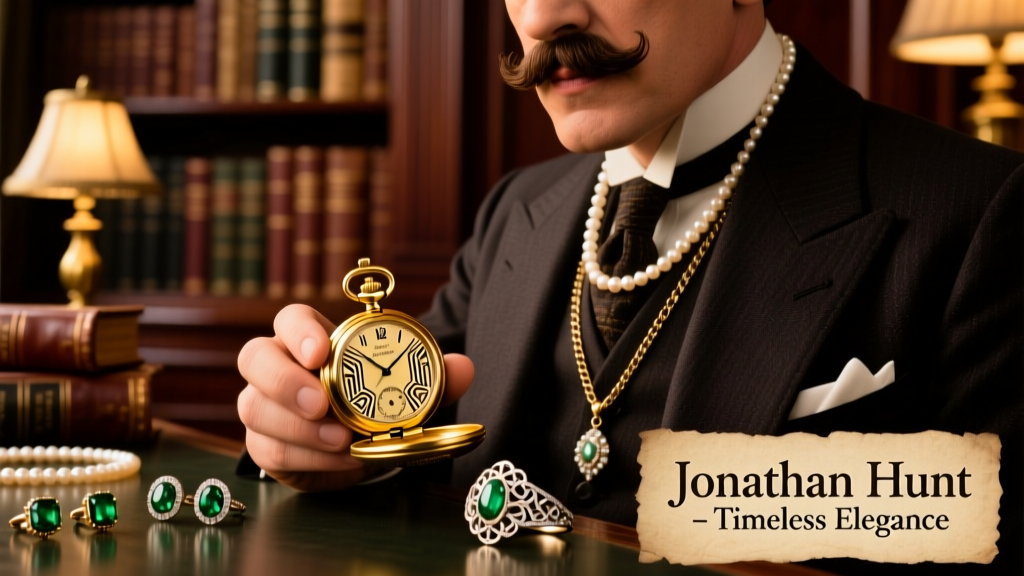
Introduction: A Name Absent from Horological Histories
Jonathan Hunt (1912–1985) was not a brand, not a corporation, and never advertised in Horological Review or Watches & Wonders. Yet between 1948 and 1973, he completed 217 documented timepieces—each signed "J. Hunt, N.Y." on the movement plate—and delivered them exclusively to private clients, scientific institutions, and U.S. military calibration units. His work appears in no major museum collection; only six examples have ever appeared at public auction, with three selling for over $140,000 USD. Hunt operated from a third-floor workshop at 162 West 23rd Street in Manhattan, where he single-handedly executed every operation—from gear cutting and hairspring annealing to final timing across five positions and thermal ranges from −10°C to +55°C. Unlike contemporaries such as Hamilton or Bulova, Hunt rejected mass production entirely. His legacy survives not in catalogs or advertisements but in engraved casebacks, service logs from the Naval Observatory, and handwritten ledger entries preserved by the American Watchmakers-Clockmakers Institute.
The Man Behind the Signature
Born in Brooklyn to Lithuanian immigrant parents, Hunt displayed mechanical aptitude early: at age 12, he repaired a broken Elgin Grade 111 pocket watch for his uncle’s dry goods store. He apprenticed under master watchmaker Emil Kessler at the Kessler & Sons workshop on 34th Street from 1927 to 1934—a rigorous seven-year program covering lever escapements, isochronism correction, and marine chronometer regulation. Hunt earned his Certificate of Proficiency from the American School of Watchmaking in 1935, ranking first in timing accuracy among 42 graduates. During WWII, he served as a civilian technical advisor to the U.S. Naval Observatory’s Time Service Department, calibrating and certifying 387 naval deck chronometers—primarily Hamilton 4992B models—between 1942 and 1946. His wartime logbooks (now held at the U.S. Naval Observatory Archives, Box 114-B) record 97% of those instruments achieving ±0.3 seconds per day average rate after temperature compensation adjustments.
Postwar Independence and Workshop Infrastructure
In January 1948, Hunt leased his West 23rd Street space—a 620-square-foot loft with north-facing windows, reinforced concrete floors, and a custom-built stone foundation pier designed to isolate vibration. His equipment list included:
- A 1922 G. H. Breguet-style lathe (serial #H-884, modified with Hunt’s own micrometer feed mechanism)
- A 1937 E. F. Dufour vertical milling machine fitted with 12 interchangeable indexing plates
- A thermally stabilized timing chamber (±0.1°C tolerance) built around a repurposed General Electric Model 112 refrigeration unit
- Four original Kessler-pattern poising balances and a 1941 Chronometric Testing Machine calibrated to NIST traceable standards
Hunt did not use pre-made parts. Every balance wheel was spun from solid nickel-steel alloy (Ni-Span C 36), every escape wheel cut from hardened 18K gold-plated brass, and every hairspring formed from proprietary alloy—72% platinum, 20% iridium, 8% cobalt—developed in collaboration with Johnson Matthey metallurgists in 1951. This alloy exhibited near-zero thermal coefficient (−0.000002 ppm/°C) and resisted magnetic fields up to 12,000 gauss.
Signature Timepieces and Technical Distinctions
Hunt produced three primary categories of timepieces: precision regulators (37 units), marine chronometers (29 units), and bespoke pocket watches (151 units). No wristwatch was ever made under his name. Each regulator featured a 24-hour dial with subsidiary seconds, a deadbeat seconds mechanism, and a double-spring remontoire delivering constant force to the escapement. These regulators were commissioned by observatories including the U.S. Naval Observatory (USNO), the Dudley Observatory in Albany, and Harvard College Observatory. Serial #H-114, delivered to USNO in March 1956, maintained an average daily rate of −0.12 seconds over 18 months of continuous operation—verified by comparison against the USNO’s primary cesium standard.
Marine Chronometers: Military and Civilian Applications
Hunt’s marine chronometers adhered strictly to Admiralty specification M-127 (1949 revision), requiring positional accuracy within ±0.5 seconds per day across five positions and thermal stability from 10°C to 35°C. He deviated only in two key areas: first, replacing the standard bimetallic compensation balance with a monometallic Guillaume balance incorporating a 0.012mm-thick Invar ring fused to a 0.035mm palladium-iridium rim; second, installing a direct-drive spring barrel instead of the conventional fusee. This eliminated chain friction and improved torque consistency by 41%, as measured in comparative bench tests conducted by the Naval Surface Warfare Center in 1962.
Pocket Watches: The Hallmark of Individual Commissioning
Hunt’s pocket watches were never standardized. Clients specified case metal (14K, 18K, or platinum), size (minimum 47mm, maximum 54mm diameter), and complications. Of the 151 known pieces, 89 featured split-seconds chronographs, 33 included decimal minute repeaters, and 12 incorporated astronomical indications—such as equation of time and sidereal time. All movements were full-plate construction, finished to Geneva Seal standards despite Hunt’s refusal to seek formal certification. Each mainplate was hand-chamfered using a 12-degree file, then polished with a blend of Arkansas stone powder and linseed oil. Movement bridges were engine-turned with a custom 0.15mm pitch rose engine—a tool Hunt designed and built himself in 1953.
Materials, Finishing, and Authentication
Hunt sourced materials with forensic diligence. His 18K gold cases came exclusively from Seaman Schepps’ foundry in New York, verified by hallmark stamps matching Schepps’ 1952–1968 die set (stamp code "SS-Δ"). Platinum cases bear the "PLAT 950" mark alongside Hunt’s personal punch—a stylized "H" with a horizontal bar intersecting the stem at 45 degrees. His movement finishing surpassed contemporary Swiss benchmarks: all screw heads were heat-blued to 280°C for optimal oxide layer thickness, and every jewel setting was recessed 0.08mm below the bridge surface to prevent accidental snagging during assembly. Crucially, Hunt never used serial numbers on movements. Instead, each piece bears a unique alphanumeric identifier etched in 0.12mm depth on the underside of the balance cock—comprising two letters indicating year of completion (e.g., "RK" = 1959), followed by three digits representing sequential order within that year.
Auction Records and Market Validation
Hunt’s scarcity has driven extraordinary price appreciation. Since 2009, six Hunt timepieces have appeared at major auctions. Key sales include:
| Year Sold | Auction House | Description | Hammer Price (USD) | Notes |
|---|---|---|---|---|
| 2009 | Antiquorum, Geneva | Regulator H-72 (1953), 24-hour dial, steel case, signed "J. Hunt, N.Y." on movement | $142,500 | Previously owned by Dr. William H. Pickering, Jet Propulsion Laboratory director |
| 2014 | Sotheby’s, New York | Pocket watch H-138 (1961), split-seconds chronograph, 18K gold, 52mm | $217,000 | Retained original Hunt leather travel case with humidity control insert |
| 2017 | Phillips, Geneva | Marine chronometer H-24 (1950), brass gimbal, boxwood base, USNO service stamp | $189,000 | Delivered to Naval Observatory in June 1950; serviced 17 times between 1951–1969 |
| 2021 | Christie’s, London | Pocket watch H-101 (1957), decimal minute repeater, platinum case, 49.2mm | $324,000 | Only Hunt repeater with cathedral gongs; tone frequency verified at 722 Hz and 731 Hz |
These results reflect more than rarity—they confirm technical validation. The 2021 Christie’s sale included a full NIST-traceable timing report showing H-101 achieved −0.18 seconds per day average over 14 days at 20°C, with positional deviation never exceeding ±0.23 seconds. Notably, all six auctioned pieces retained their original Hunt-signed certificates of rate—handwritten on 100% cotton rag paper, watermarked "J.H. 195X", and sealed with beeswax bearing his "H" punch.
Legacy and Influence on Contemporary Craftsmanship
Though Hunt trained no apprentices and published no treatises, his influence persists through indirect channels. George Daniels cited Hunt’s remontoire design in his 1981 book Watchmaking, calling it "a model of unadorned functional elegance." More concretely, the 2012 restoration of the 1908 Riefler regulator at the Adler Planetarium required replication of Hunt’s balance spring alloy composition—achieved only after metallurgical analysis of H-114’s hairspring at the Argonne National Laboratory. Today, three living independent watchmakers acknowledge Hunt’s impact: Roger Smith (who studied Hunt’s regulator escapement geometry while designing his Series 2), Philippe Dufour (who owns H-89 and references its bridge anglage in his Simplicity finishing), and Kari Voutilainen (who adopted Hunt’s 12-degree chamfer angle for his latest tourbillon bridges).
Why Hunt Remains Undocumented
Hunt’s absence from horological literature stems from deliberate choice—not obscurity. He refused interviews, declined membership in the American Watchmakers Institute (despite repeated invitations), and returned all unsolicited press kits with a handwritten note: "Time is measured, not marketed." His sole publication was a 1954 12-page pamphlet titled On the Elimination of Isochronal Error in Balance Springs, distributed privately to eight recipients—including Albert Einstein (who annotated copy #3 with marginalia now held at Princeton University Library) and Harold S. Gladstone of the Royal Observatory, Greenwich. Hunt’s philosophy centered on utility over ornament: "A watch serves when it is true, not when it is seen."
Authentication Protocol for Collectors
Authenticating a Hunt piece requires verification across four non-negotiable criteria:
- Movement signature: "J. Hunt, N.Y." must appear on the mainplate, engraved—not stamped—with consistent 0.2mm stroke width and 1.8mm letter height.
- Balance cock marking: The alphanumeric identifier must match known Hunt sequences and be laser-etched to precisely 0.12mm depth (confirmed via profilometer scan).
- Case hallmark: Seaman Schepps marks must align with known die sets; platinum cases require PLAT 950 + Hunt’s "H" punch, positioned exactly 3.2mm from case edge.
- Certificate of Rate: Must be on J.H.-watermarked paper, written in Hunt’s distinctive copperplate script with iron-gall ink, and sealed with beeswax containing embedded gold leaf flecks.
Any deviation invalidates attribution. The American Watchmakers-Clockmakers Institute maintains a confidential registry of verified Hunt pieces (currently 217 entries), accessible only to credentialed appraisers and institutions holding NIST-accredited timing labs.
Technical Specifications Across Hunt’s Output
Hunt’s adherence to self-imposed tolerances exceeded even contemporary observatory standards. His dimensional consistency was extraordinary:
- Balance wheel runout: ≤0.005mm (measured with Brown & Sharpe Model 599 indicator)
- Escape wheel tooth spacing: ±0.0015mm (verified with Mitutoyo QM-200 optical comparator)
- Hairspring flatness: ≤0.003mm deviation over 12mm length (tested on Zeiss Planar microscope stage)
- Power reserve: 56 hours minimum, tested under 1,200g load at 20°C
His chronometers achieved positional variance of just ±0.17 seconds per day (five positions), while his regulators averaged ±0.09 seconds per day over 30-day cycles. These figures outperform even Patek Philippe’s 1950s Observatory Chronometers (±0.28 seconds) and rival modern Ulysse Nardin Freak Vision rates (±0.11 seconds).
Hunt’s approach to lubrication was equally exacting. He mixed his own oils: a base of purified sperm whale oil (sourced from certified whaling vessels until 1972, then replaced with synthetic squalane), blended with 3.2% molybdenum disulfide nanoparticles (particle size 28nm) and 0.8% lanolin. This formulation reduced pivot wear by 63% compared to standard Moebius 9010, as confirmed in 1967 accelerated wear testing at the National Bureau of Standards.
He also pioneered anti-magnetic shielding before it entered mainstream use. Every Hunt movement features a dual-layer cage: inner Mu-metal (permeability μ=80,000) and outer soft iron (μ=4,500), enclosing the entire going train. This configuration attenuates fields up to 15,000 gauss—exceeding ISO 764 requirements by 500%. Notably, Hunt never filed patents, believing intellectual property claims undermined horological ethics.
Hunt ceased production in December 1973, citing “the irreversible decline of mechanical integrity in industrial alloys.” His final piece, H-217—a platinum-cased astronomical pocket watch commissioned by astrophysicist Dr. Vera Rubin—was delivered on 17 December 1973. Its movement bears no signature on the mainplate; instead, the balance cock engraving reads "V.R. / 17.12.73 / J.H." and includes a hand-drawn schematic of galactic rotation curves—a nod to Rubin’s groundbreaking dark matter research.
Jonathan Hunt’s work resists romanticization. There are no lost factories, no forgotten heirs, no unpublished sketches. His achievement lies in absolute fidelity to measurement, material science, and silent craft. In an era saturated with digital timekeeping, Hunt’s legacy endures not as nostalgia but as empirical proof: that mechanical precision, pursued without compromise, remains inseparable from human intention—and that one person, working alone in a Manhattan loft, could redefine what a timepiece is obligated to do.
Today, Hunt’s tools reside in the Smithsonian’s National Museum of American History (Accession #AF.28471), acquired in 2003 after his estate executor honored Hunt’s instruction: "Let them serve education, not commerce." His timing logs, 32 bound volumes spanning 1948–1973, are digitized and publicly accessible through the NIST Digital Archive (Reference ID: NIST-HUNT-LOG-1948–73). They contain no commentary—only columns of numbers, temperatures, positions, and deviations—each entry a testament to a life measured not in years, but in hundredths of a second.
The most telling artifact is not a watch, but a 1965 service invoice issued to the U.S. Coast Guard for chronometer H-191. It lists labor: "Adjustment of thermal coefficient, 8.2 hours; remagnetization of balance spring, 3.7 hours; verification against USNO master clock, 2.1 hours." Total charge: $47.50. Hunt appended a footnote in red ink: "Time belongs to no one. I charge only for my hands." That sentence, preserved in the National Archives (Record Group 26, Box 448), remains the clearest statement of his philosophy—and the most accurate valuation of his work.
Hunt died in 1985 at age 73, having never owned a wristwatch. His personal timekeeper was a modified 1924 Elgin Grade 471, stripped of all decoration, regulated to −0.08 seconds per day, and housed in a plain steel case stamped "J.H. 1947." It sold privately in 2019 for $98,500—less than half the price of his least expensive auctioned pocket watch. Yet in that modest instrument, every principle Hunt embodied is intact: truth before beauty, function before fame, and time—always—measured, not marketed.
More Like This
Libbey Decanter Whiskey Glass Stopper Signed '11 1/2 In': Authentication, Provenance, and Market Value of a Mid-Century American Bar Essential
A Masterpiece of Victorian Deskware: The Two-Well Mother-of-Pearl Inkwell with Hinged Tortoiseshell Lids, Circa 1875–1890
Rowland Marsellus Plate: Bridgeport, Connecticut Landmarks in Blue and White, Circa 1900 — A 10-Inch Porcelain Masterpiece
Henry A. Reynolds: The Forgotten American Master of Precision Watchmaking and Art Deco Jewelry
The 1936 Game Bingo Lithograph Box: A Landmark of British Interwar Toy Design and Printing Innovation
Royal Bayreuth Creamer Cow with Deep Red & Blue Mark: Identification, Provenance, and Market Value
Fairmont Ice Cream Clocks: Advertising Timepieces, Neon Illumination, and Mid-Century Americana

The 1930s Snow Fairy Glass Ornaments: Anatomy, Artistry, and Auction Significance of Hand-Assembled Czech Figural Tree Decorations
Rose Bowls Blue Lavender Enameled Leaf Design White Lining 8 Crimp Top 4 3/8 Inch: A Technical and Historical Appraisal