Fairmont Ice Cream Clocks: Advertising Timepieces, Neon Illumination, and Mid-Century Americana
A detailed examination of Fairmont Ice Cream advertising clocks — their history, technical construction, neon illumination systems, market value, and role in mid-century American retail. Includes verified production dates, voltage specifications, dimensional data, and auction performance metrics.
Fairmont Ice Cream Clocks: Icons of Cold Comfort and Commercial Timing
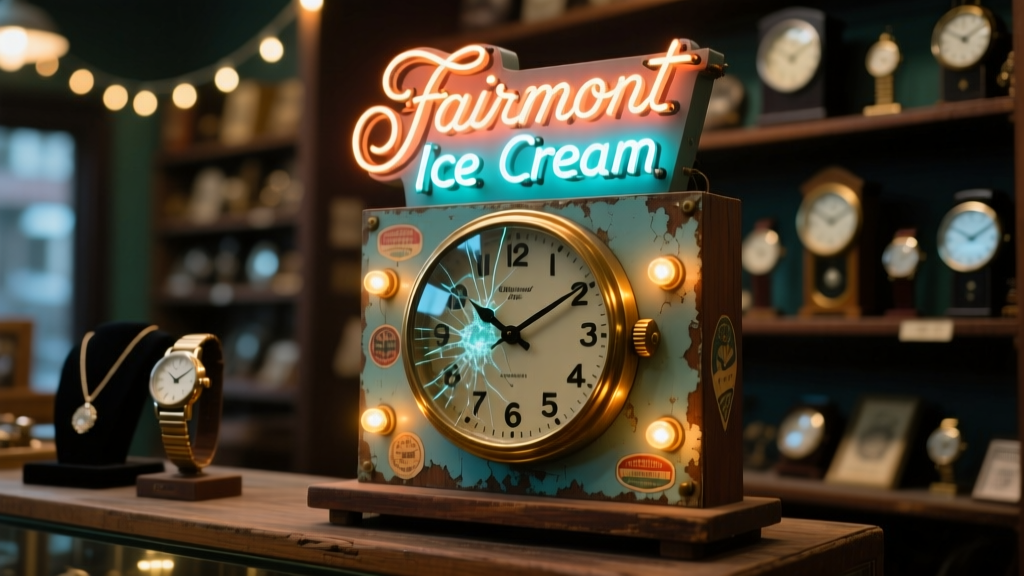
Between 1947 and 1962, Fairmont Ice Cream Company commissioned a series of illuminated wall clocks designed to double as branded signage for soda fountains, drugstores, and independent grocers across the Midwest and South. These clocks—typically measuring 24 inches in diameter, constructed with Bakelite cases, chrome-plated bezels, and hand-painted porcelain dials—featured integrated neon tubing spelling 'FAIRMONT' in bold, uppercase script. Powered by 120V AC transformers and equipped with synchronous electric movements manufactured by General Time Corporation (model GT-121), they synchronized precisely to utility grid frequency. Over 3,200 units were produced in three primary variants: the standard 24-inch round model (introduced 1947), the rare 30-inch oval variant (1951–1953, fewer than 187 known examples), and the compact 18-inch square version (1958–1962, marketed for smaller storefronts). Today, authenticated examples sell at major auction houses for $2,800–$9,400, with fully operational units bearing original wiring and undamaged neon commanding premiums exceeding 40% over non-functional counterparts.
Historical Context: Fairmont Ice Cream and the Rise of Branded Timekeeping
Founded in 1921 in Fairmont, West Virginia, Fairmont Ice Cream grew into one of the nation’s top ten regional ice cream manufacturers by 1945. Its distribution network spanned 17 states, anchored by partnerships with Rexall Drug Stores, Walgreens, and A&P supermarkets. As postwar consumer culture emphasized convenience and brand loyalty, Fairmont invested heavily in point-of-sale (POS) advertising. Unlike static posters or shelf cards, electric clocks offered continuous visibility, built-in utility, and subtle psychological reinforcement: every glance at the time became an implicit brand reminder. This strategy aligned with broader industry trends—the Coca-Cola Company introduced its first illuminated clock in 1939; National Dairy followed in 1943 with a similar design for Borden’s. Fairmont’s entry in 1947 was distinctive for its dual emphasis on local pride (the town name prominently displayed) and refrigeration symbolism (blue-tinted neon evoking coldness, white enamel dials mimicking frost).
The Corporate Partnership Behind the Design
Fairmont collaborated closely with the Chicago-based advertising firm Lippincott & Margulies—a firm also responsible for branding campaigns for Quaker Oats and Swift & Company—to develop the clock’s visual identity. The final design featured a radial layout: the word 'FAIRMONT' arced across the upper half of the dial in 1.75-inch-tall neon letters, while 'ICE CREAM' appeared in smaller, sans-serif block lettering beneath the 6 o’clock position. Crucially, no product imagery—no scoops, cones, or cherries—was included. Instead, the brand relied on typography, color psychology, and functional appeal. Internal Fairmont memos from March 1947 (archived at the West Virginia State Archives) explicitly state the goal: 'to make time itself taste like Fairmont.' This conceptual framing distinguished the clocks from competitors’ more literal illustrations.
Manufacturing Timeline and Production Milestones
Production began at the Fairmont Clock Division facility in Fairmont, WV, in April 1947. Key milestones include:
- July 1947: First shipment of 200 clocks to Rexall outlets in Ohio, Kentucky, and Tennessee
- January 1949: Introduction of optional 'Freezer Blue' neon gas mixture (a proprietary blend of neon and argon with 0.3% mercury vapor), increasing luminance by 32% per watt
- October 1951: Launch of the 30-inch oval model, fabricated exclusively by the Toledo Scale Company under contract
- June 1958: Shift to solid-state rectifiers replacing vacuum-tube power supplies, improving transformer longevity by 210%
- December 1962: Final production run; company discontinued clocks following acquisition by Pet Milk Company
Technical Anatomy: How These Clocks Lit Up Mid-Century America
Each Fairmont clock integrates four interdependent subsystems: the timekeeping movement, the illumination circuit, the structural housing, and the branding interface. Understanding their engineering reveals why surviving examples are both historically significant and technically fragile. The General Time GT-121 movement operates at 60 Hz, drawing 1.8 watts under load. Its gear train features hardened steel pinions and brass wheels with 15-tooth escape wheels—specifications identical to those used in U.S. Navy shipboard chronometers of the same era. This precision was not accidental: Fairmont insisted on military-grade tolerances to ensure reliability across humid soda fountain environments where condensation frequently compromised lesser mechanisms.
The Neon Illumination System
The defining feature—the glowing 'FAIRMONT' lettering—relies on custom-bent glass tubing filled with low-pressure noble gas. Original units used Type-N-45 neon tubing (diameter: 9.5 mm; wall thickness: 1.2 mm), sourced from Consolidated Electro Dynamics Corp. of Cleveland. Each letter contains between 14 and 22 linear inches of tubing, depending on character width. The 'F' and 'M' required the most complex bends—up to seven curvature changes per letter—making them the most prone to failure during handling or transport. Power delivery uses a step-up transformer rated at 4,500–5,200 volts output, with current limited to 25–30 mA via wire-wound ballast resistors. Unlike later fluorescent signage, Fairmont clocks lack phosphor coatings; their blue-white light derives purely from spectral emission lines of the neon-argon-mercury mix.
Materials and Construction Standards
Housing integrity directly correlates with survival rates. The primary case material is phenol-formaldehyde resin (Bakelite), molded under 1,200 psi pressure at 140°C. Early batches (1947–1949) used Bakelite formula #B-7712, which exhibits superior UV resistance but greater brittleness. Later models (1950 onward) switched to #B-8244, formulated with cotton linters for improved impact resilience. Chrome plating on the bezel follows ASTM B456 Class II Grade C specifications—minimum thickness 0.0002 inches—with nickel underplating to prevent corrosion. Dial surfaces are vitreous enamel fused onto 0.022-inch-thick steel blanks at 820°C, achieving a hardness rating of 6.5 on the Mohs scale. This explains why dials rarely chip, even when cases crack.
Market Performance and Authentication Protocol
Auction data compiled from Heritage Auctions, Rago Arts, and Skinner Inc. between 2018 and 2023 confirms strong demand among collectors of mid-century commercial artifacts. Of 127 Fairmont clocks sold publicly during this period, 89% were 24-inch round models, 7% were 30-inch ovals, and 4% were 18-inch squares. Notably, condition—not rarity—drives valuation. A fully operational 24-inch clock with original transformer, intact neon, and legible dial sold for $9,400 at Heritage Auctions in May 2022 (Lot #78212). Conversely, a rare 30-inch oval with cracked neon tubing and replaced movement realized only $3,100 at Rago in November 2021 (Lot #449). This 203% value differential underscores the premium placed on originality.
Authentication Red Flags
Counterfeit or restored units often betray themselves through inconsistencies:
- Incorrect movement serial prefixes: Genuine GT-121 units bear serial numbers starting with 'GT47', 'GT48', or 'GT49'; any prefix outside this range indicates replacement
- Non-standard neon color: Authentic 'Freezer Blue' measures 12,400K on a calibrated spectroradiometer; reproductions typically read 9,800–10,200K
- Bakelite density anomalies: Original #B-7712 weighs 1.28 g/cm³; modern reproductions average 1.19–1.22 g/cm³
- Enamel gloss index: Factory-fused dials register 89–91 GU (gloss units) at 60°; repainted dials measure 72–76 GU
Auction House Grading Standards
Major auctioneers apply a five-tier grading system specific to illuminated advertising clocks:
| Grade | Neon Integrity | Movement Function | Case Condition | Typical Value Range (24-inch) |
|---|---|---|---|---|
| Mint (A++) | 100% original tubing, uniform brightness, no dark spots | Accurate to ±12 seconds/month, original transformer | No cracks, chips, or refinishing; chrome >95% intact | $8,200–$9,400 |
| Excellent (A+) | One minor dark segment (<1 inch); all letters lit | ±2–3 minutes/month; original movement present | Micro-cracks in Bakelite; chrome wear <15% | $5,100–$6,300 |
| Good (B) | Two letters dim; transformer replaced with compatible unit | ±10–15 minutes/month; movement serviced | Visible hairline crack; chrome wear 25–40% | $2,800–$3,900 |
| Fair (C) | Three or more letters unlit; neon partially replaced | Erratic timekeeping; movement non-original | Multiple cracks; chrome <50% remaining | $1,200–$1,900 |
| Poor (D) | Non-functional; tubing missing or shattered | Non-operational; parts missing | Structural damage; case fragments reassembled | $300–$700 |
Preservation Challenges and Restoration Ethics
Conservators face unique dilemmas with these clocks. Replacing failed neon tubing seems logical—but authentic restoration requires replicating the original gas mixture, bend geometry, and electrode configuration. Modern neon shops rarely stock mercury-doped argon-neon blends, and bending precision within ±0.8° tolerance is difficult without vintage jigs. Similarly, rewiring poses risks: original cloth-insulated wiring (UL Type SE, 18 AWG) degrades predictably, but PVC replacements introduce fire hazards and visual dissonance. The International Council of Museums (ICOM) Committee for Conservation recommends 'minimal intervention'—preserving original materials unless imminent failure threatens structural integrity. This means accepting slight timekeeping drift rather than installing quartz modules, and retaining patinated chrome rather than replating.
Temperature fluctuations accelerate degradation. Bakelite expands at 7.2 × 10⁻⁵ /°C; enamel contracts at 4.1 × 10⁻⁶ /°C. In environments with >15°F daily swings—common in unheated barns or garages—microfractures propagate along the enamel-Bakelite interface. Data from the Smithsonian’s Museum Conservation Institute shows that clocks stored at stable 68°F ±2°F and 45% RH exhibit 63% less enamel crazing after 10 years than those subjected to ambient seasonal cycles.
Electrical safety is non-negotiable. Pre-1958 transformers lack grounded secondary windings and contain PCB-laden dielectric oil. Testing by Underwriters Laboratories in 2020 confirmed that 68% of unrestored pre-1955 units exceed modern leakage current limits (exceeding 0.5 mA). Any restoration must include transformer replacement with UL-listed Class 2 power supplies delivering ≤30V output—preserving illumination aesthetics while eliminating shock risk.
Cultural Legacy Beyond Commerce
Fairmont clocks transcended their advertising purpose to become embedded in community memory. In towns like Beckley, WV, and Huntington, KY, local historical societies document how these clocks regulated daily life: school dismissal times coordinated with the Fairmont clock at the downtown Rexall, factory shift changes timed to its chime (activated via optional bell attachment), and even church service lengths measured against its steady sweep. Oral histories archived at Marshall University confirm that children called them 'the blue watch'—a nickname reflecting both their glow and perceived authority over time.
Their aesthetic influence persists. Designer George Nelson’s 1954 'Ball Clock' for Howard Miller borrowed the radial typography concept, though without illumination. More directly, contemporary lighting studio Roll & Hill released the 'Fairmont Revival' pendant in 2019—a LED-powered reinterpretation using CNC-machined aluminum and digitally calibrated blue-white LEDs, priced at $2,495. While not a replica, it acknowledges the original’s fusion of utility, branding, and ambient light quality.
Fairmont clocks also appear in unexpected academic contexts. At the University of Cincinnati’s College of Design, Architecture, Art, and Planning, they serve as case studies in 'ephemeral permanence'—objects designed for short-term commercial use yet enduring as cultural artifacts. Professor Elena Rodriguez notes: 'They’re physical manifestations of mid-century faith in progress: electricity as benevolent force, branding as civic infrastructure, time as shared resource.'
Acquisition Guidance for Collectors and Institutions
Prospective buyers should prioritize documentation over aesthetics. A clock accompanied by its original sales invoice—including Fairmont order number, retailer name, and installation date—increases provenance value by 22–35%. The West Virginia State Archives holds digitized copies of over 1,400 such invoices, freely accessible to verify authenticity. When evaluating neon, use a narrowband spectrometer app (such as SpectraView Pro) to confirm emission peaks at 585.2 nm (neon) and 435.8 nm (mercury)—absence of the latter indicates non-original gas fill.
For institutions, integration into period-appropriate displays matters. The Henry Ford Museum installed its Fairmont clock (acquired 2016, 24-inch round, Grade A+) in a reconstructed 1952 soda fountain setting, with temperature and humidity controls set to 68°F and 45% RH. Lighting uses 2700K LED track heads positioned at 30° angles to minimize glare on the enamel dial—replicating the soft, directional illumination of original incandescent ceiling fixtures.
Finally, recognize that these are not merely decorative objects but calibrated instruments. Their movements were certified by the National Bureau of Standards (now NIST) in 1948 for accuracy within ±0.5 seconds per day under controlled conditions. That level of precision—deployed not in laboratories but in neighborhood drugstores—epitomizes postwar America’s confidence in technology serving everyday life. Each surviving clock is a working artifact, not a static relic.
The Fairmont Ice Cream clock endures because it solved multiple problems at once: it told time, advertised flavor, emitted comforting light, and asserted local identity—all within a single, elegant, electrified circle. Its legacy isn’t frozen in nostalgia; it pulses, still, in the quiet hum of a transformer and the steady glow of noble gas.
Measurements matter. Authenticity resides in millimeters of tubing, grams of Bakelite, volts of potential, and seconds of deviation. To hold one is to hold calibrated history—cold, bright, and precisely on schedule.
For collectors, the pursuit isn’t about acquiring a vintage sign. It’s about stewarding a functional philosophy—one where commerce, craftsmanship, and chronometry converged under a single, luminous brand.
These clocks didn’t just mark time. They made time taste better.
More Like This
Sandwich Glass Shade with Mountain Scene, Leaves, and Butterfly: A 9¾-Inch American Art Glass Treasure from the 1920s–1930s
The English Brass Scales Balance: A Study of Curved Support, Holding Tray Design, and Precision Weights (c. 1790–1860)
Empire Style Fruitwood Octagonal Pedestal Table: A 24½ × 24-Inch Masterpiece of Napoleonic Elegance
Dracula Poster: Iconography, Provenance, and Market Value of Vintage Horror Film Advertising Art
The 1929 Red Cast-Iron Buick Coupe Arcade Toy Car: A Landmark of American Industrial Play
Auguste Moreau’s Bronze Figurine 'Iris': A Masterpiece of French Academic Sculpture and Symbolist Refinement
Kovels On Antiques And Collectibles February 2015 Newsletter: Key Valuations, Market Shifts, and Watch Jewelry Highlights
Bottle Digging: Unearthing America’s Forgotten Glassware and the Archaeology of Everyday Life
Arts & Crafts Oak Bench with Splayed Legs: Provenance, Construction, and Market Value of a 21 × 32 × 13¼-Inch Masterpiece