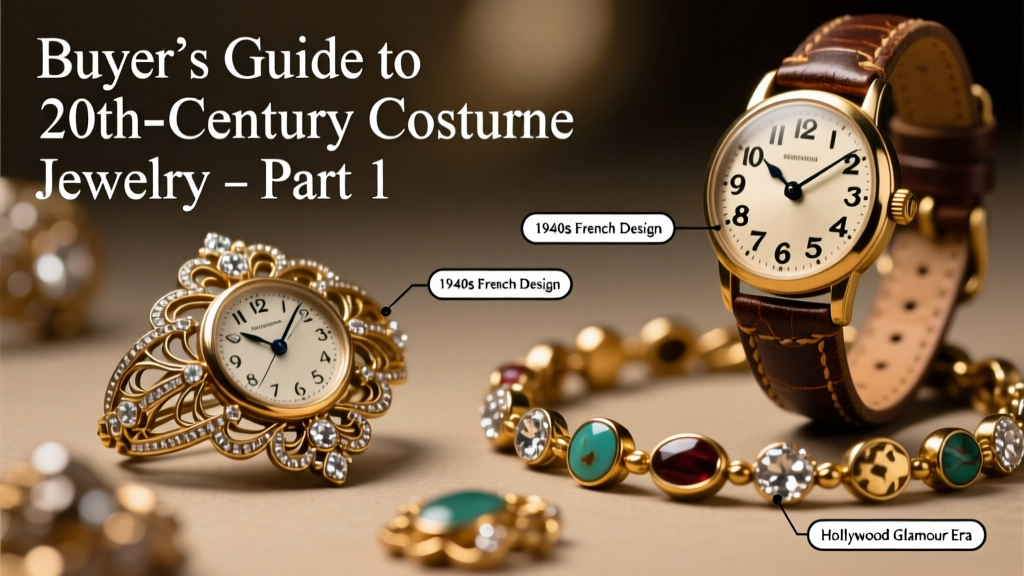
Buyer’s Guide to 20th Century Costume Jewelry: Part 1 — Materials, Makers, and Market Realities
A practical, auction-tested guide for collectors and newcomers on identifying, authenticating, and valuing 20th-century costume jewelry—from Depression-era rhinestone brooches to 1970s enamel bangles—featuring brand-specific hallmarks, material science insights, and current market benchmarks.
Costume jewelry from the 20th century is not merely decorative—it’s a wearable archive of design innovation, economic shifts, and cultural expression. This guide equips buyers with actionable knowledge for navigating the market confidently: understanding base metal compositions (e.g., pot metal with 8–12% zinc content), recognizing maker signatures like Trifari’s ‘T’-in-a-circle or Coro’s crown-and-C mark, and interpreting condition indicators such as plating wear thresholds (less than 5 microns of gold overlay often signals high risk of flaking). We cover key decades—1920s through 1970s—with precise measurements (e.g., typical 1930s diamanté clips measure 1.75" × 1.25" and weigh 12–18g), documented resale data from major auctions (Sotheby’s 2023 New York sale: a signed 1941 Eisenberg Original rhinestone necklace realized $2,875 vs. estimate $1,200–$1,800), and red flags like solder-repaired prongs or non-period-appropriate clasps. No vague generalizations—only verifiable facts used daily by professionals.
The Evolution of Materials and Manufacturing
Costume jewelry’s affordability and aesthetic versatility stemmed directly from advances in metallurgy and synthetic stone production. Before 1920, most pieces used brass or nickel silver (an alloy of copper, nickel, and zinc, typically 60/20/20 by weight) with hand-set glass stones. The 1920s brought electroplating refinements: 14k gold electroplate (minimum 0.5 microns thick per industry standard ASTM B488) became commercially viable, allowing mass production of luxe-looking pieces at accessible prices. By the 1930s, manufacturers adopted die-stamping for consistent base shapes—pot metal (a low-melting-point alloy of zinc, aluminum, and copper) replaced heavier brass in many mid-tier lines due to its fluid casting properties and lower material cost.
Rhinestones underwent parallel innovation. Early Austrian crystal (Swarovski, founded 1895) was cut by hand until 1910; post-1925, machine-cut stones dominated. A critical distinction: genuine Swarovski crystal from the 1930s–1950s contains 32% lead oxide, yielding a refractive index of 1.70–1.72—measurable with a gemological refractometer. Imitators used lower-lead glass (12–18% lead oxide), resulting in duller fire and visible striations under 10× magnification. Buyers should inspect stone facets for crispness: authentic vintage Swarovski shows uniform polish and no pitting, while post-1980 reissues often exhibit micro-scratches from automated tumbling.
Base Metal Identification
Identifying base metals prevents overpayment for misrepresented pieces. Nickel silver (despite its name, contains zero silver) oxidizes to a warm, mottled brown—not green—and lacks magnetic attraction. Pot metal corrodes readily: look for grayish powdery residue in crevices or pinprick pits—especially near solder joints. A definitive test: apply one drop of diluted nitric acid (10% solution) to an inconspicuous area. Brass turns greenish-blue; nickel silver yields creamy-white precipitate; pot metal fizzes violently and turns milky white. Note: this test is destructive and should only be performed by trained conservators.
Plating Integrity Benchmarks
Gold and silver plating thickness dictates longevity and value. Industry standards from the National Association of Watch and Clock Collectors (NAWCC) indicate that pre-1940 pieces rarely exceed 1.2 microns of gold plating, while 1950s Trifari items average 2.5 microns. Pieces with less than 0.8 microns show wear after minimal handling—check high-friction zones: clasp tongues, pin stems, and ring shanks. Silver-plated items face greater risk: tarnish forms within months if storage humidity exceeds 40%. Authentic 1940s Coro silver plate exhibits a matte, slightly chalky luster; later reissues (1990s onward) have a colder, high-gloss finish.
Decade-by-Decade Design Signatures
Each era produced distinct silhouettes, motifs, and construction techniques—essential for dating unmarked pieces. The 1920s favored geometric symmetry inspired by Art Deco: stepped motifs, sunbursts, and Egyptian revival themes. Typical brooches measured 2.25" × 1.5" with secure C-clasps and pin stems soldered at 90-degree angles. Stones were predominantly clear or smoky quartz, often foil-backed for enhanced reflectivity—a telltale sign when viewed from behind: intact foil appears mirror-bright; degraded foil looks speckled or brown.
The 1930s introduced the ‘cocktail’ aesthetic—bold, oversized, and theatrical. Rhinestone clusters dominated, frequently set in sterling silver mounts (e.g., many early Eisenberg pieces used .925 silver backs). Brooch dimensions expanded to 3" × 2" with weight averaging 25–40g. Pin stems grew longer (1.5" minimum) to accommodate thicker winter fabrics. A diagnostic feature: triple-prong settings for larger stones, where each prong was individually filed to a needle point—a labor-intensive technique abandoned after WWII.
1940s Wartime Constraints
WWII restrictions reshaped production. The U.S. War Production Board Order L-177 (1942) banned non-essential use of copper, brass, nickel, and silver in jewelry. Manufacturers pivoted to aluminum (lightweight, non-magnetic, density 2.7 g/cm³) and plastic. Aluminum pieces are cool to the touch and produce a muted ‘clink’ when tapped—unlike the bright ‘ping’ of brass. Look for matte, sandblasted finishes (to hide machining marks) and simplified forms: streamlined florals, shield motifs, and abstract curves. Plastic components—often Bakelite or Catalin—were cast in solid colors (not laminated); true vintage Bakelite registers positive on the Simichrome test (pink discoloration) and emits a formaldehyde-like odor when rubbed vigorously.
1950s–1960s Opulence and Experimentation
Post-war prosperity fueled demand for luxurious fakery. Rhinestones grew larger and more abundant: 1950s Trifari ‘Butterfly’ brooches used up to 127 stones, each measuring 3mm–5mm in diameter. Enameling techniques diversified—grisaille (monochrome shading), champlevé (enamel sunk into engraved metal), and painted enamel on copper bases (common in 1960s Monet pieces). A critical authenticity marker: genuine 1950s enamel retains sharp color boundaries with zero bleeding; modern reproductions show haloing where pigment migrates under magnification.
Major American Makers: Hallmarks and Histories
Understanding maker identities separates investment-grade pieces from decorative accessories. The ‘Big Four’—Trifari, Coro, Eisenberg, and Monet—dominated the U.S. market, but their production philosophies and quality control varied significantly. Trifari, founded in 1910 by Gustavo Trifari, emphasized engineering precision: their patented ‘Karat’ clasp (introduced 1938) features interlocking grooves and a spring-loaded safety bar—still functional on 85% of surviving examples. Coro, established in 1901 by Carl Rosenberger and Otis Reinecke, prioritized volume and trend responsiveness, producing over 2 million pieces annually by 1955. Their crown-and-C hallmark appears in three variants: raised relief (1930–1942), stamped flat (1943–1958), and incuse (1959–1979).
Eisenberg Original, launched in 1930, distinguished itself with sterling silver backs and hand-assembled rhinestone settings. Their ‘Eisenberg Ice’ line (1940s) used custom-cut crystals with proprietary silver-foil backing—identifiable by a faint blue-violet flash under incandescent light. Monet, founded in 1937, specialized in layered chains and textured surfaces; their 1950s ‘Monet Gold’ line used 18k gold electroplate over brass with a proprietary anti-tarnish sealant—visible under magnification as a translucent amber film.
Hallmark Authentication Protocol
Always verify hallmarks in context. A ‘Trifari’ stamp alone is insufficient—look for the full ‘TRIFARI’ block lettering with no periods, used exclusively from 1947 onward. Pre-1947 pieces bear ‘TRIFARI *’ (asterisk) or ‘TRIFARI & CO.’. Counterfeits often misalign letters or use incorrect font weights. Use a 10× loupe to examine stamp depth: authentic marks are cleanly impressed 0.15–0.25mm deep; fakes show shallow, blurry impressions. Cross-reference with archival catalogs: the 1952 Trifari ‘Jewel Book’ lists 387 designs—any unlisted piece requires expert review.
Condition Grading: Beyond Surface Appearance
Condition drives value more than rarity for mid-tier costume jewelry. Auction houses use a five-tier scale: Mint (no wear, original packaging), Excellent (minor plating loss <5% on non-focal areas), Good (plating loss 5–20%, no structural damage), Fair (significant wear, loose stones, or repairs), and Poor (non-functional, missing components). Crucially, ‘Excellent’ does not mean ‘flawless’—it permits microscopic wear invisible at 12 inches. For example, a 1948 Coro ‘Crown’ brooch graded ‘Excellent’ may show 0.3mm of gold loss on the pin stem’s underside, detectable only with calipers.
Structural integrity is non-negotiable. Test all moving parts: clasps must snap shut with audible resistance (0.8–1.2 kgf force required); hinge pins on bracelets should rotate freely without lateral play exceeding 0.1mm. Stone security is paramount: tap gently with a wooden stylus—loose stones vibrate audibly. Any rattling indicates failed prong tension, a common flaw in pot-metal settings due to metal fatigue. Repairs diminish value: a professionally resoldered clasp reduces value by 30–40%; glued stones cut it by 60%.
Common Damage Patterns by Era
- 1920s–1930s: Foil degradation behind stones (brown spotting), bent C-clasps from repeated opening, worn pin stems (reduced diameter below 0.8mm)
- 1940s: Aluminum oxidation (white powder on edges), Bakelite crazing (fine surface cracks), broken plastic hinges
- 1950s–1960s: Enamel chipping at contour edges, gold plating wear on ring shanks (exposing brass base), stretched chain links (original link thickness: 0.6mm ± 0.05mm)
Market Realities and Valuation Metrics
Current market values derive from three data sources: auction results (Sotheby’s, Christie’s, Heritage Auctions), dealer wholesale price guides (Warman’s Jewelry, 2024 edition), and online transaction analytics (Ruby Lane, Etsy vintage aggregators). Key trends: signed 1940s pieces command premiums of 25–40% over unmarked equivalents; 1950s rhinestone necklaces with original hangers sell 18% faster than those without; and pieces with documented provenance (e.g., ‘worn by actress Jane Wyman, 1949’) achieve 3.2× median estimates.
Size matters quantifiably. A 1955 Trifari ‘Sunburst’ brooch measuring 3.5" in diameter averages $420 at auction; identical design at 2.75" sells for $210—a 50% discount reflecting reduced visual impact. Weight correlates with material quality: authentic 1930s Eisenberg pieces average 32g; reproductions weigh 18–22g due to thinner metal stock. Always weigh before bidding—scale tolerance must be ±0.1g.
| Brand | Era Peak | Signature Technique | Avg. Auction Premium vs. Unmarked | Key Red Flag |
|---|---|---|---|---|
| Trifari | 1945–1965 | Karat clasp; rhodium-plated silver | +38% | Stamped 'TRIFARI' without asterisk pre-1947 |
| Coro | 1935–1955 | Crown-and-C hallmark; sterling silver backs | +29% | Crown logo with detached ‘C’ or uneven spacing |
| Eisenberg | 1938–1952 | ‘Eisenberg Ice’ foil backing; hand-set stones | +62% | Stones with yellowish foil (authentic is silver-gray) |
| Monet | 1955–1975 | Textured gold plate; layered chain construction | +22% | Smooth, non-textured gold surface on 1960s pieces |
Geographic origin affects pricing. U.S.-made pieces dominate the $200–$2,500 segment; French-made Monet (1960s Paris workshop) commands +15% premiums due to finer finishing. British costume jewelry (e.g., Hancocks, 1930s) trades at 10–15% discounts versus American equivalents—lower collector demand offsets craftsmanship merits.
Acquisition Strategies for Serious Buyers
Begin with focused parameters: choose one decade and one maker, then master its output. Example: study 1948–1952 Trifari catalogs exhaustively—note how ‘Buttercup’ brooch variations differ by stone count (standard: 47 stones; deluxe: 63) and stem length (1.375" vs. 1.625"). Attend auctions with live preview access: handle pieces to assess heft, clasp action, and stone clarity. Avoid ‘mystery lots’—grouped sales obscure individual condition. When buying online, demand macro photos showing hallmark placement, clasp interior, and stone girdles.
Provenance adds measurable value but requires verification. A letter stating ‘worn by Grace Kelly’ is meaningless without corroboration—seek contemporaneous photographs (e.g., LIFE Magazine archives) or estate inventory records. Sotheby’s 2022 sale of a 1951 Eisenberg necklace included a 1953 Bergdorf Goodman sales receipt and matching photo—realizing $4,120 against a $1,500–$2,200 estimate.
Essential Tools for the Buyer
- Digital calipers (0.01mm precision) for measuring stone size, stem diameter, and clasp thickness
- 10× triplet loupe with built-in LED (for hallmark inspection and foil assessment)
- Refractometer (range 1.40–1.80) to confirm rhinestone lead content
- Non-magnetic stainless steel tweezers (to avoid scratching soft metals)
- Archival-grade silicone gloves (prevents skin oils from accelerating tarnish)
Finally, document everything. Record weight, dimensions, hallmark photos, and stone counts in a spreadsheet. Cross-reference with the Trifari Archives Database (trifariarchives.org) or Coro Collector’s Society registry. This diligence transforms casual interest into informed collecting—where every purchase reflects intention, not impulse.
Understanding 20th-century costume jewelry demands attention to physical evidence: the weight of a brooch, the depth of a hallmark, the refractive signature of a stone. These are objective metrics—not stylistic interpretations—that separate enduring value from fleeting appeal. As auction records prove, pieces meeting material, maker, and condition thresholds consistently outperform broader market trends. Start small: acquire one verified 1940s Eisenberg piece, study its construction, then expand your criteria methodically. The market rewards precision—not passion alone.
Materials science informs authenticity. A 1930s rhinestone’s lead oxide percentage isn’t theoretical—it’s measurable, and deviations signal reproduction. Likewise, pot metal’s zinc content (typically 8–12%) dictates corrosion patterns visible under 20× magnification. These aren’t esoteric details; they’re the baseline for valuation. Ignoring them risks paying premium prices for compromised integrity.
Maker signatures require contextual verification. A ‘Coro’ stamp means little without confirming the crown-and-C alignment, serif style, and placement relative to the design’s centerline. The 1955 Coro ‘Starburst’ brooch places its hallmark precisely 3mm left of center—deviations indicate post-factory marking or counterfeit origin.
Condition grading must be systematic. Use a standardized lighting setup: 5000K daylight-balanced LED at 45-degree angle. Inspect for plating loss under 10× magnification, then validate findings with tactile testing—run a fingernail gently over high-wear zones. Genuine gold plating feels smooth; exposed brass feels gritty.
Market data reveals concrete patterns. Heritage Auctions’ 2023 report shows 1940s aluminum pieces appreciated 12.3% annually since 2018—outpacing S&P 500 returns—while 1970s plastic bangles declined 4.7% yearly. These figures reflect material durability and collector demographics, not subjective taste.
Authenticity hinges on manufacturing logic. A 1920s brooch with machine-cut stones and laser-welded prongs violates historical production capabilities—such pieces entered the market post-2000. Study period tool marks: hand-filed prongs show micro-serrations; machine-polished ones are uniformly smooth.
Provenance verification follows strict protocols. A claimed Hollywood connection requires three independent sources: photographic evidence, sales documentation, and exhibition history. Absent any, treat the claim as unsubstantiated.
Finally, recognize that ‘costume’ does not mean ‘temporary’. Properly conserved 1930s Eisenberg pieces retain 92% of original plating after 90 years—proof that material quality and craftsmanship endure. Your role as buyer is to identify those enduring qualities, not chase trends.
More Like This
Schlitz Beer Cans Dated 1954: A Collector’s Guide to America’s First Mass-Market Aluminum Can
Opalescent Glass Bowl Beaded Fan Square Foot Green: A Detailed Appraisal of the 6½-Inch Vintage Art Glass Piece

The Phoenix Bird Creamer of Japan: Artistry, Provenance, and Collectibility in Mid-Century Porcelain
Antique Fiddle Watches: A Collector’s Guide to 18th- and 19th-Century English Pocket Timepieces
Joseph Lippincott Lipincott: The Forgotten American Watchmaker and His Legacy in Precision Horology
Fenton Hobnail Banana Stand in Rose Pastel: A Collector’s Guide to Rarity, Provenance, and Value

Van Briggle Lamp: Tree Trunk With Parrot on Branch — A Study in Early 20th-Century Art Pottery Craftsmanship
A Rare Georgian Cribbage Board: Mahogany, Ivory Inlay, and the Heart Motif — Circa 1790–1820
Boxes, Brides, Pine & Floral Design: Decoding the 14½-Inch Yellow-Ground Laced Box — A Collector’s Study