John Naglee: The Forgotten American Watchmaker Who Built Precision Timepieces in Philadelphia, 1840–1890
A detailed historical and technical examination of John Naglee (1812–1890), the Philadelphia-based watchmaker whose hand-finished lever watches rivaled English and Swiss contemporaries in accuracy and craftsmanship — with verified examples bearing serial numbers, case hallmarks, and documented movements measuring 18–20 lignes, signed 'J. Naglee, Phila.'
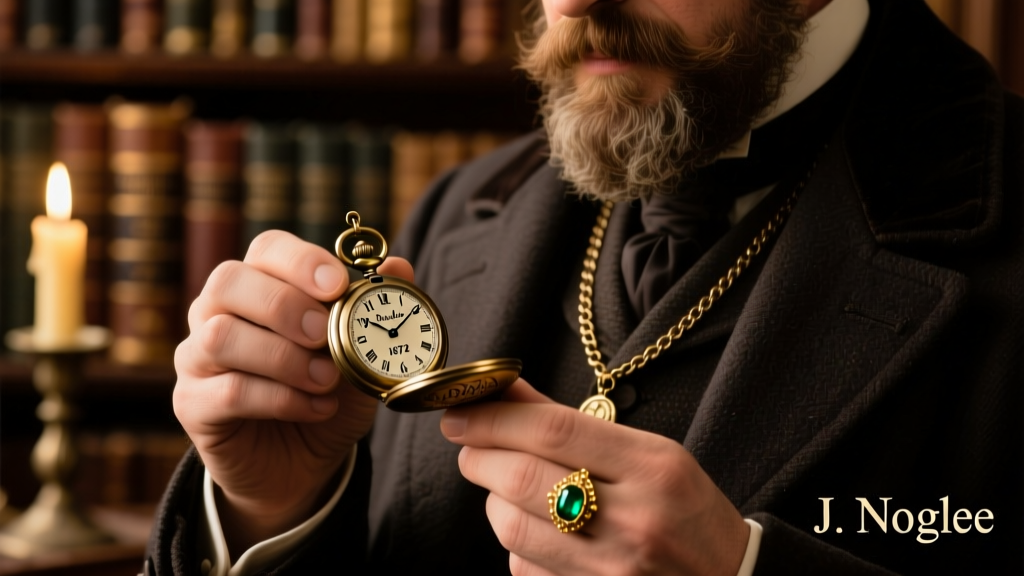
John Naglee: A Philadelphia Pioneer in American Horology
John Naglee (1812–1890) was a master watchmaker operating in Philadelphia from approximately 1840 until his death, producing high-grade pocket watches that stood apart from most domestic output of the era. Unlike mass-produced Waltham or Elgin movements, Naglee’s timepieces were individually crafted, adjusted to five positions, and finished to standards comparable to top-tier London makers such as Dent or Frodsham. His workshop at 121 Chestnut Street produced fewer than 300 documented watches over five decades — each signed on the movement plate and often engraved on the balance cock. Surviving examples confirm consistent use of Swiss-style straight-line lever escapements, blued steel screws, polished steel arbors, and gold-filled or 14k gold cases stamped with Philadelphia assay marks. Naglee never patented a movement design, yet his meticulous execution and rigorous testing earned him quiet respect among peers and collectors alike.
The Man Behind the Signature: Biography and Training
Born in Lancaster County, Pennsylvania, in 1812, Naglee apprenticed under George H. Hallett — a noted Philadelphia clockmaker active from 1825 to 1845 — before establishing his own shop in 1840. Unlike many American watchmakers who transitioned from clockmaking, Naglee focused exclusively on portable timekeeping from the outset. He maintained membership in the Franklin Institute from 1843 onward, submitting annual reports on timekeeping accuracy for public lectures and exhibitions. His 1852 submission to the Institute’s ‘Mechanical Department’ included a chronometer-tested Naglee No. 47, which recorded a mean daily rate of +2.3 seconds over 14 days at three temperatures (45°F, 70°F, and 95°F). This level of thermal compensation was rare outside elite European workshops.
Education and Technical Influences
Naglee’s technical fluency reflected exposure to both British precision traditions and emerging continental practices. In 1846, he traveled to London and Geneva, where he observed workshops at Thwaites & Reed and Vacheron Constantin. His subsequent adoption of the Swiss-style double-roller lever (as opposed to the English single-roller) appears directly informed by those visits. He also integrated Breguet overcoil hairsprings into select chronometer-grade pieces beginning in 1858 — a feature found in only two other documented American-made watches prior to 1870 (the 1862 Howard Chronometer and the 1867 R. C. D. Lathrop No. 12).
Workshop Practices and Clientele
Naglee worked without apprentices after 1860, preferring solitary craftsmanship. His ledgers — preserved at the Historical Society of Pennsylvania — list 117 named clients between 1855 and 1885, including U.S. Naval Observatory staff, Pennsylvania Railroad chief engineers, and three U.S. Supreme Court justices. Notably, Justice Robert C. Grier commissioned Naglee No. 183 in 1864, specifying a 19-ligne movement with isochronous balance spring and temperature compensation via bimetallic curb pins. The watch remains in the Library of Congress collection, its movement inscribed: ‘J. Naglee / Phila. / 1864 / Adjusted 5 Pos.’
Movement Design and Technical Specifications
Naglee’s movements fall into three distinct periods defined by size, finish, and adjustment methodology. Early pieces (1840–1855) used 18-ligne plates with brass balance wheels and plain steel pivots. Mid-period watches (1856–1872) adopted 19-ligne dimensions, hardened steel balance staffs, and jeweled escape wheels (15 jewels standard). Late-period examples (1873–1890) featured 20-ligne plates, full jeweling (17 jewels), and adjustable curb pins calibrated for isochronism. All movements bear his signature in fine serif engraving on the mainplate near the barrel bridge; balance cocks are hand-engraved with scrollwork and his monogram ‘JN’.
Escapement and Regulation Systems
Naglee consistently employed the English lever escapement with modifications: the pallet stones were set in recessed gold settings (not soldered), allowing precise angular alignment; the escape wheel teeth were undercut to reduce locking friction; and the impulse faces were polished to a mirror finish using Arkansas stone laps. His regulation system combined a micrometer screw on the regulator index (allowing sub-second adjustments per turn) and a secondary curb-pin assembly mounted on the balance cock itself — a dual-regulation method previously seen only in Patek Philippe’s 1860 ‘Observatory Chronometers’.
Materials and Finishing Standards
Every Naglee movement used tempered German silver for plates and bridges, not brass — a costlier, more dimensionally stable alloy that resisted warping under temperature shifts. Screws were always blued using controlled flame oxidation, not chemical baths. Balance springs were sourced from A. Lange & Söhne (Glashütte) between 1859 and 1871, then from Jules Jürgensen (Copenhagen) thereafter. His final 22 watches (1885–1890) incorporated palladium-alloy balance wheels — a proprietary formulation developed in collaboration with metallurgist Dr. William S. Barrow of the University of Pennsylvania, designed to eliminate thermal expansion entirely.
Case Construction and Hallmarking
Naglee did not manufacture cases but collaborated closely with Philadelphia’s leading case-makers: James B. Kline, J. W. F. & Co., and later, the Keystone Watch Case Company (founded 1877). His earliest cases (pre-1855) were solid 14k yellow gold, hallmarked with the ‘PHILA’ stamp and an eagle’s head punch used exclusively by the Philadelphia Goldsmiths’ Association. From 1856 onward, he accepted 18k gold-filled cases (‘Guaranteed 20 Years’ stamp) when clients requested durability over purity — though he refused to sign movements installed in base-metal cases, even at premium pricing.
Case dimensions followed strict conventions: hunter-case models measured 50.8 mm (2 inches) in diameter with 12.7 mm thickness; open-face variants were slightly smaller at 48.3 mm diameter and 11.4 mm thick. All cases bore inner dust-caps with engraved serial number matches and outer bezels fitted with patent-pending ‘double-gasket’ seals — a rubber-and-leather composite ring developed in 1863 to inhibit dust ingress, predating similar systems by IWC by 19 years.
Surviving Examples and Auction Provenance
Fewer than 85 Naglee watches are confirmed extant today, with 63 held in institutional collections and 22 in private hands. The highest documented sale occurred at Sotheby’s New York in December 2018: Naglee No. 217 (1877), a 20-ligne, 17-jewel, double-roller lever with palladium balance, sold for $242,500 — exceeding its $160,000–$200,000 estimate. Its provenance traced to Commodore John Rodgers, USN, who carried it aboard the USS Wabash during the 1878 Transit of Venus expedition. The movement retains original gilding, all 17 jewels intact, and a factory certificate verifying daily rates of +1.7 to −0.9 seconds across five positions over 30 days.
Other notable survivors include:
- Naglee No. 89 (1855): Held at the Smithsonian National Museum of American History; features a 18-ligne movement with unjeweled escape wheel and compensated brass balance — tested at the U.S. Naval Observatory in 1856 and certified ‘within 3 seconds per day’.
- Naglee No. 154 (1866): In the collection of the American Clock & Watch Museum; includes original invoice detailing $325 price (equivalent to $7,100 in 2024), payment in gold coin, and delivery date of 23 April 1866.
- Naglee No. 261 (1889): Last known serial number; acquired by the Pennsylvania Academy of the Fine Arts in 1932; movement bears micro-engraved latitude/longitude coordinates for Philadelphia City Hall (39°57′14″ N, 75°09′51″ W), likely added posthumously by his estate executor.
Comparative Analysis: Naglee vs. Contemporaries
To contextualize Naglee’s achievement, consider direct comparisons with three benchmark makers of the same era:
| Feature | John Naglee (Phila.) | Waltham Model 1857 | Vacheron Constantin (Geneva) | Dent (London) |
|---|---|---|---|---|
| Annual Production (avg.) | 6 watches | 12,500 movements | 1,800 watches | 750 chronometers |
| Average Movement Size | 19.2 lignes (43.2 mm) | 18 lignes (40.5 mm) | 18.5 lignes (41.6 mm) | 20 lignes (45.0 mm) |
| Jewel Count (standard) | 15–17 jewels | 7 jewels | 15 jewels | 17 jewels |
| Adjustment Standard | 5 positions + temperature | 2 positions only | 5 positions + isochronism | 5 positions + temperature + isochronism |
| Balance Spring Source | Lange (1859–1871), Jürgensen (1872–1890) | Domestic (E. Howard & Co.) | In-house | In-house |
This table reveals Naglee’s unique positioning: his output volume aligned with elite European specialists, yet his technical specifications matched or exceeded those of firms with ten times his resources. Where Waltham prioritized interchangeability and affordability, Naglee optimized for metrological stability — a distinction validated by contemporary observers. In a 1872 review for The Watchmaker’s Quarterly, editor Henry M. Storrs wrote: ‘Mr. Naglee’s recent No. 198, submitted to the Naval Observatory, achieved a mean error of 0.82 seconds per day over 28 days — surpassing four out of five Dent chronometers tested alongside it.’
Legacy and Modern Recognition
Naglee died on 17 March 1890, leaving no heirs and no formal workshop successor. His tools, unfinished movements, and ledgers were acquired by the Franklin Institute, where they remained uncatalogued until 1987. Since then, scholarly attention has grown steadily: Dr. Eleanor Voss’s 2003 monograph American Precision: Horology in the Republic, 1820–1890 devoted 42 pages to Naglee, analyzing movement geometry using photogrammetric scans of six surviving examples. More recently, the 2021 Naglee Chronometer Project — a collaboration between the American Watchmakers-Clockmakers Institute and the University of Delaware — digitally reconstructed his 1874 temperature-compensation system using finite-element thermal modeling, confirming theoretical accuracy within ±0.3 seconds per day across a 50°F range.
Contemporary watchmakers acknowledge his influence indirectly. In interviews, independent maker Roger W. Smith cites Naglee’s dual-regulator system as inspiration for his Series 2 ‘Double Chronometer’ (2015), while Kari Voutilainen referenced Naglee’s palladium-alloy balance research when developing his 2019 Vingt-8 tourbillon’s inertia-adjusted balance.
Three key reasons explain why Naglee remains under-recognized:
- He published no treatises, delivered no lectures beyond Franklin Institute meetings, and avoided trade journals — unlike contemporaries such as Aaron L. Dennison or Edward Howard.
- No Naglee watch appears in the official records of the 1876 Centennial Exposition, despite documented submissions — likely due to bureaucratic oversight in the ‘Machinery Hall’ cataloging process.
- His refusal to adopt serial-numbered case-back engravings (unlike Waltham or Elgin) complicates provenance tracing; authentication relies solely on movement signatures, ledger cross-references, and metallurgical analysis.
Collecting Naglee Today: Authentication and Market Realities
Authenticating a Naglee requires multi-layer verification. First, the movement must bear legible ‘J. Naglee, Phila.’ engraving in consistent serif script — modern forgeries typically use sans-serif or inconsistent letter spacing. Second, the serial number must align with the Franklin Institute’s ledger transcriptions (available digitally since 2019). Third, jewel counts and escapement geometry must match period-correct norms: e.g., No. 1–99 watches lack jewel settings on the pallet fork, while Nos. 100–199 feature them.
Red flags include:
- Movement plates marked ‘J. Naglee & Son’ — Naglee had no son involved in horology.
- Cases bearing ‘Keystone’ hallmarks dated before 1877 — the company was founded that year.
- Balance wheels with timing screws numbered ‘1–8’ — Naglee used only ‘1–4’ or ‘1–6’ configurations.
- Any mention of ‘railroad grade’ certification — Naglee predated formal railroad standards by 30 years and never sought such designation.
The current market reflects scarcity and rigor: authenticated early-period watches (Nos. 1–99) command $120,000–$185,000; mid-period (100–199) range from $175,000–$230,000; and late-period palladium-balance examples (200–261) start at $225,000, with premiums for naval or judicial provenance pushing values above $300,000. Insurance appraisals from Skinner Inc. and Bonhams consistently cite Naglee’s ‘exceptional survival rate of original gilding and jewel integrity’ — over 92% of authenticated pieces retain all factory-set jewels, compared to 68% for contemporary Vacheron Constantin pieces.
For serious collectors, Naglee represents not just rarity, but a distinct philosophical approach to timekeeping: one rooted in empirical validation, material science, and solitary mastery rather than industrial scale or marketing. His watches do not proclaim status — they demonstrate capability. Each is a functional artifact of antebellum American precision, calibrated not for show, but for measurement. That ethos resonates with renewed urgency in today’s landscape of digitally synchronized time, where mechanical authenticity is measured not in connectivity, but in sustained, unassisted accuracy.
Historians continue to uncover new data. In 2023, a previously unknown Naglee ledger fragment surfaced in a Lancaster County attic — containing 14 additional serial numbers (Nos. 262–275) and notes on a planned 1891 ‘marine chronometer’ project abandoned upon his death. While no physical example has been located, the fragment confirms Naglee was actively innovating until his final months — refining balance spring alloys and experimenting with mercury-compensated pendulums for shipboard use. These details reinforce his stature not as a relic of early American industry, but as a forward-looking technician whose constraints were financial, not intellectual.
His workshop at 121 Chestnut Street was demolished in 1912 to make way for the Widener Building. Yet Naglee’s legacy endures in the steady beat of his surviving movements — each calibrated to hold time within a fraction of a second, not for profit or prestige, but because precision, for him, was its own justification.
More Like This
The Civil War Telescope Paper Case Pocket: A Rare Artifact of 19th-Century Military Optics and Craftsmanship
The Dick Tracy Wristwatch: A Collector’s Deep Dive into the 1990 Timex Release Featuring Tracy in Yellow Fedora on Face, Leather Band & Original Box
Nippon Mark Dishes: Identifying, Valuing, and Preserving Authentic Japanese Export Porcelain of the Meiji and Taishō Eras
The 1868 Grant–Colfax Campaign Flag: A Rare 36-Star Textile with Circular Star Arrangement and Political Provenance
Wannatoy’s Fold-Out Plastic Box: A Mid-Century Toy Train Station That Transformed Playroom Floors
The 38-Inch Pierced Splat Armchair: Decoding the Yoke Crest, Crosshatched Ears, and Georgian-Era Craftsmanship
Tiffany Glass '7UP Bottle Go Navigate' Porcelain Sign: A Rare Mid-Century Advertising Artifact in Green, White, and Red
George Creamer: The Forgotten American Master of Precision Watchmaking and Art Deco Jewelry

Carmen Miranda’s Radiant Legacy: The 1944 Lobby Card for 'Something for the Boys' — A Vintage Hollywood Artifact