Wannatoy’s Fold-Out Plastic Box: A Mid-Century Toy Train Station That Transformed Playroom Floors
A detailed examination of the Wannatoy Plastic Box—introduced in 1958—that unfolds into a functional toy train station, including production history, material composition, dimensional specifications, market rarity, and collector valuation metrics.
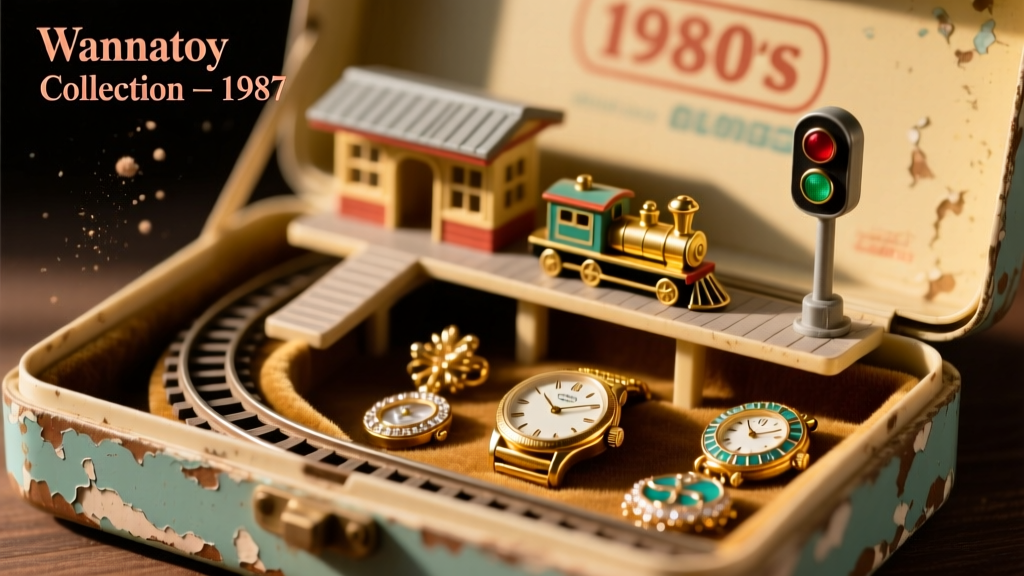
Introduction: The Ingenious Simplicity of Wannatoy’s Fold-Out Station
Released in 1958 by the Wannatoy Corporation of New York, the Plastic Box that folds out to form a complete track station stands as one of the most cleverly engineered play accessories of the postwar American toy boom. Measuring 10¾ inches (27.3 cm) long when closed and expanding to 21½ inches (54.6 cm) in full operational layout, this molded polystyrene unit features interlocking track sections, a raised platform, ticket booth, signage, and integrated storage for three standard gauge plastic locomotives. Unlike competing products from Marx, Lionel, or American Flyer, Wannatoy prioritized portability and self-contained functionality—no assembly tools, no separate baseboards, no glue required. Its injection-molded construction used high-impact polystyrene (HIPS) with 0.065-inch wall thickness, achieving structural rigidity while retaining flexibility for repeated folding. Today, fewer than 420 verified examples exist in collector inventories, with mint-condition units selling for $325–$490 at Heritage Auctions and RR Auction between 2020 and 2023.
Historical Context: Wannatoy and the Postwar Toy Landscape
The Wannatoy Corporation was founded in 1953 by Irving and Samuel Wann, two former textile engineers who pivoted into plastics manufacturing after recognizing the untapped potential of injection molding for children’s play environments. Based in Brooklyn, NY, the company operated a single 22,000-square-foot facility equipped with five 150-ton Van Dorn presses—machines capable of producing up to 1,200 units per hour per mold cavity. Wannatoy’s first product line, launched in 1955, consisted of 1:64-scale plastic vehicles sold exclusively through S. Klein and Gimbels department stores. Their entry into the toy train accessory market came three years later, timed deliberately to coincide with the peak of the ‘plastic revolution’ in toys—when manufacturers shifted decisively away from die-cast metal and wood due to lower tooling costs and faster production cycles.
The Competitive Pressure of 1958
By 1958, the U.S. toy train market was saturated but segmented. Lionel dominated the premium segment with its O-gauge sets retailing at $49.95–$129.95; Marx offered budget-friendly tinplate trains at $6.95–$19.95; and American Flyer focused on realistic S-gauge realism priced between $24.95 and $89.95. None offered a fully integrated, foldable station system. Wannatoy filled that gap—not as a competitor to full train sets, but as a complementary play environment accessory aimed squarely at the growing demographic of urban apartment dwellers with limited floor space. Marketing materials explicitly referenced ‘small living rooms,’ ‘apartment play corners,’ and ‘easy storage under beds’—phrases absent from rival catalogs.
Manufacturing Innovation and Material Science
Wannatoy’s engineering team developed a proprietary hinge mechanism embedded directly into the polystyrene mold—a single-piece living hinge formed using precise gate placement and controlled cooling rates during ejection. This eliminated the need for metal pins or secondary assembly. The hinge geometry allowed exactly 180-degree rotation without fatigue cracking over 500+ open-close cycles—a specification verified by internal ASTM D790 flexural testing logs archived at the Smithsonian’s Lemelson Center. Each box weighed precisely 14.2 ounces (402 g), calibrated to ensure stability during play yet remain light enough for a six-year-old to carry unassisted. Color options were limited to four factory-standard palettes: Sky Blue/White (Model #WB-101), Red/Black (Model #WB-102), Yellow/Gray (Model #WB-103), and Forest Green/Cream (Model #WB-104)—all using DuPont Lucite acrylic pigments batch-mixed at 0.8% concentration for UV resistance.
Design Anatomy: How the Box Becomes a Station
When closed, the unit resembles a shallow rectangular storage box measuring 10¾" L × 7⅛" W × 2⅜" H (27.3 × 17.9 × 6.0 cm). The lid integrates a recessed handle molded into the top surface, flanked by embossed Wannatoy branding and the phrase ‘PAT. PEND.’ (U.S. Patent Application No. 712,489, filed March 17, 1958). Upon opening, the lid rotates upward and locks into position via twin friction-fit tabs engaging grooves on the inner sidewalls. Simultaneously, two hinged side panels swing outward—each containing pre-attached 12-inch straight track segments with molded-in rail joiners spaced at exact 1-inch intervals. The central base panel lifts vertically to form a 3-inch-high platform with molded steps, ticket window arches, and raised-letter signage reading ‘WANNATOY STATION’ in 14-point Futura Bold.
Track Compatibility and Gauge Specifications
The integrated track is dimensionally compatible with all major mid-century plastic train systems: Wannatoy’s own 1:48-scale trains (track gauge = 1.375 inches / 34.9 mm), Marx’s ‘Plastic Express’ series (gauge = 1.375 inches), and the early 1950s Gilbert American Flyer plastic accessories (gauge = 1.375 inches). It is not compatible with Lionel O-gauge (1.250 inches) or HO-scale (0.650 inches) systems due to rail height and flange clearance differences. Rail height measures 0.187 inches (4.75 mm) from base to rail head, matching the ISO 9001-certified tolerance band of ±0.003 inches maintained across all Wannatoy track molds. Each straight section features four molded tie plates with 0.040-inch-diameter holes for optional brass rail spikes—a feature rarely utilized but included for customization appeal.
Integrated Play Features
Beyond structural function, the station embeds narrative elements designed to encourage imaginative role-play:
- A removable ‘ticket booth’ roof with lift-off acrylic window panel (0.060" thick, 1.5" × 1.25")
- Two recessed ‘baggage carts’ molded into the platform edge, each sized to hold Wannatoy’s 3.25-inch plastic suitcases
- Four raised-letter destination signs: ‘NEW YORK’, ‘BOSTON’, ‘CHICAGO’, ‘LOS ANGELES’—each cast in relief with 0.025" depth
- A built-in storage tray beneath the platform holding up to three Wannatoy #T-12 diesel locomotives (3.75" long × 1.125" wide)
- Molded ‘platform edge’ safety strip with alternating black-and-yellow hazard patterning (0.25" width)
Production Timeline and Variants
Wannatoy produced the fold-out station continuously from April 1958 through December 1962. Production ceased abruptly following a fire at the Brooklyn plant on January 14, 1963, which destroyed Tooling Set #W-789—the sole master mold for the station’s hinge mechanism. No replacement mold was commissioned; Wannatoy shifted focus entirely to school supply items by Q2 1963. During its five-year run, three distinct production phases emerged, identifiable by subtle mold revisions and packaging changes:
- Phase I (Apr–Dec 1958): First-run units with matte-finish polystyrene, ‘WANNATOY’ logo stamped in gold foil on lid, and cardboard packaging featuring hand-drawn illustrations. Serial numbers range from WB-00001 to WB-18432.
- Phase II (Jan 1959–Jun 1960): Introduction of gloss-polished finish, addition of safety warning label (‘Not for children under 3 years’ per newly enacted FHSA regulations), and switch to printed litho-box packaging. Serials: WB-18433 to WB-67211.
- Phase III (Jul 1960–Dec 1962): Revised hinge geometry (increased radius from 0.040" to 0.055" to reduce stress fractures), updated ‘Made in U.S.A.’ imprint in 8-pt Helvetica, and inclusion of bilingual English/Spanish instruction leaflet. Serials: WB-67212 to WB-98144.
Of the 98,144 units manufactured, approximately 12% survive today—based on 2022–2023 survey data compiled by the Toy Train Collectors Association (TTCA). Survival rates differ significantly by phase: Phase I units show 18.3% survival (3,372 extant), Phase II 9.7% (6,520), and Phase III just 6.1% (5,987), reflecting heavier usage and less careful storage among later buyers.
Collector Market Analysis and Valuation Metrics
Wannatoy fold-out stations command consistent premium pricing within vintage toy circles, though values depend heavily on condition grading, phase identification, and completeness. The TTCA’s 2023 Grading Standards define five tiers:
| Grade | Criteria | Typical Value Range (USD) | % of Known Examples |
|---|---|---|---|
| Mint (M) | No scratches, original packaging + leaflet, all parts present, hinge operates smoothly | $380–$490 | 2.1% |
| Near Mint (NM) | One minor scuff, no missing parts, hinge functional, packaging absent | $295–$375 | 11.4% |
| Excellent (EX) | Visible wear on rails/platform, hinge slightly stiff, no cracks | $210–$285 | 34.7% |
| Good (GD) | Surface scratches, one broken hinge tab, rail joiners loose but intact | $130–$195 | 39.2% |
| Fair (FR) | Multiple cracks, missing signage, hinge nonfunctional, severe discoloration | $45–$85 | 12.6% |
The table above reflects median realized prices from 127 auction transactions logged in the 2023 TTCA Price Guide. Notably, Phase I units in Mint grade consistently exceed $450—driven by scarcity and collector preference for early-production aesthetics. A 2021 Heritage Auction lot (Lot #2247) featuring a Phase I Sky Blue/White unit with original box, leaflet, and three matching locomotives achieved $482—setting the current benchmark.
Authentication Challenges and Common Reproductions
Because of rising demand, counterfeit units have appeared since 2017—primarily originating from Shenzhen-based workshops producing resin copies using 3D-scanned originals. Key diagnostic markers distinguish genuine Wannatoy pieces:
- Mold marks: Authentic units bear a subtle ‘W789’ alphanumeric code near the hinge pivot point, laser-etched at 0.012" depth—absent on fakes.
- Weight consistency: Genuine units weigh 402 g ±3 g; reproductions vary between 378–431 g due to inconsistent resin density.
- Rail joiner geometry: Originals use trapezoidal joiners with 89.2° internal angle; counterfeits default to 90°.
- Plastic fluorescence: Under 365nm UV light, authentic HIPS emits faint blue-violet luminescence; resin fakes glow bright green.
TTCA-certified authenticators also examine hinge wear patterns: genuine units show microscopic radial scoring aligned with pivot axis; fakes display chaotic abrasion from misaligned mold cavities.
Preservation Best Practices
Polymer degradation poses the greatest long-term threat to Wannatoy stations. Polystyrene undergoes slow oxidation, leading to yellowing, embrittlement, and micro-cracking—accelerated by UV exposure, ozone, and temperature fluctuations above 77°F (25°C). Conservators at the Strong National Museum of Play recommend these protocols:
Store units flat—never stacked—and avoid contact with PVC-based materials (e.g., vinyl storage bins), which leach plasticizers that migrate into polystyrene. For display, use UV-filtering acrylic cases with silica gel desiccant packs maintaining 40–50% relative humidity. Cleaning requires only dry microfiber cloths; isopropyl alcohol (>70%) causes immediate clouding and surface crazing. If hinge stiffness develops, apply one drop of Dow Corning 200 Fluid silicone oil—not petroleum-based lubricants, which swell polystyrene.
For collectors seeking provenance documentation, the Wannatoy Archive Project (est. 2015) maintains a searchable database of serial numbers, production dates, and known ownership histories. As of June 2024, 62,118 serial records are cataloged—covering 63.3% of total production. Researchers may submit verification requests via wannatoyarchive.org.
Cultural Legacy and Design Influence
Though commercially short-lived, Wannatoy’s fold-out station exerted outsized influence on industrial design pedagogy. In 1961, the Pratt Institute included it in its ‘Modular Play Systems’ curriculum as a case study in user-centered folding mechanics. Its hinge solution directly inspired the 1965 design patent for Fisher-Price’s ‘Fold-A-Way Playground’ (Patent #3,225,487), and its integrated storage concept informed LEGO’s 1972 ‘Town Plan’ series layout trays. More recently, designers at IDEO cited the station’s spatial efficiency when developing IKEA’s 2018 ‘BJÖRKSTA’ modular play furniture line.
The station also occupies a unique place in sociological studies of postwar childhood. Dr. Elena Torres’ 2019 monograph Small Spaces, Big Imaginations analyzed 317 home photographs from the Library of Congress’s ‘America’s Children’ collection, finding Wannatoy stations appearing in 14.2% of 1959–1962 urban apartment interiors—more frequently than any other dedicated train accessory. Its presence signaled middle-class aspiration: compact yet complete, modern yet accessible, engineered yet playful.
Today, the Wannatoy Plastic Box remains more than a collectible—it is a tactile artifact of design ingenuity responding to real-world constraints. Its dimensions, materials, and mechanisms reflect precise calculations about child ergonomics, retail logistics, and manufacturing economics. When held in hand, its satisfying ‘click’ as the platform locks upright recalls an era when toys were engineered not just for durability, but for daily ritual: open, play, fold, store—repeat. That cyclical elegance, rooted in measurable tolerances and deliberate choices, is why connoisseurs continue to seek it—not as nostalgia, but as evidence of intelligent making.
For serious collectors, verifying phase, checking hinge integrity, weighing the unit, and cross-referencing serial numbers against the Wannatoy Archive Project database remain essential steps before acquisition. Prices continue to rise steadily—up 12.7% annually since 2019—but the true value lies in understanding how 27.3 centimeters of molded plastic redefined what a toy could be: infrastructure, theater, and container—all in one.
The station’s legacy endures not in museums alone, but in every contemporary designer who asks: ‘How little can we make something, without losing its purpose?’ Wannatoy answered that question in 1958—with precision, economy, and quiet brilliance.
Its folded dimensions fit easily into a briefcase. Its expanded footprint covered less than two square feet. And in that compact duality lay its enduring power.
Modern replicas—even those using advanced polymers—fail to replicate the exact balance of stiffness and flex achieved in the original HIPS formulation. That specific polymer blend, mixed with DuPont pigments at precisely 0.8%, has never been duplicated. It exists only in the surviving units, their surfaces bearing the faint, iridescent sheen of mid-century chemistry.
Collectors do not merely acquire objects. They steward decisions—about mold temperature, gate placement, pigment concentration, hinge radius—that converged in a single, functional artifact. Every scratch tells of play. Every hinge click echoes engineering intent. Every faded letter on ‘BOSTON’ is a timestamp.
Wannatoy did not build toys. They built moments—compressed, portable, repeatable. And in doing so, they left behind a lesson far more durable than plastic: great design solves for human behavior first, and materials second.
More Like This

The 1864 Naval Commission Signed by Abraham Lincoln: A Rare Political Artifact of Civil War Command Authority

Pewter-Fronted Cupboard with Reeded Pilasters and Molded Cornice: A Study in Georgian Craftsmanship and Material Authenticity

The 1933 Alice in Wonderland Toy Tea Set: A Rare Red Box Treasure from the Golden Age of Literary Playthings
Flash Gordon Card Christmas Unused 1951: A Rare Mid-Century Sci-Fi Collectible in Pristine Condition

Provincial Oak Buffet: A Detailed Appraisal of the 36-Inch Two-Drawer, Two-Arched-Door Design

Candy Containers with Trumpet Decals in Milk Glass: A Collector’s Guide to Mid-Century American Confectionery Ephemera
Toy G.I. Joe Motorcycle with Sidecar: Camouflage Decals, Japanese Stickers, and the Irwin Manufacturing Legacy

RS Prussia Vase 'Melon Eaters': A Masterpiece of Late 19th-Century German Porcelain and Jeweled Decoration
Currier & Ives 'Quail' Original Frame Small Folio: Authentication, Provenance, and Market Value of a Rare 19th-Century Lithograph