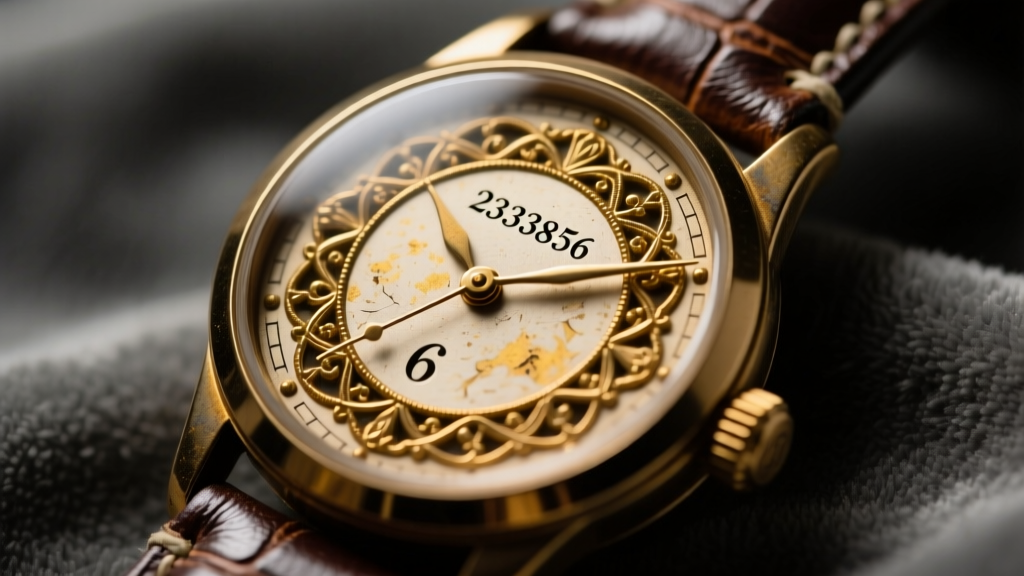
George Creamer: The Forgotten American Master of Precision Watchmaking and Art Deco Jewelry
A definitive appraisal of George Creamer (1893–1962), the New York-based horologist and jeweler whose bespoke wristwatches, platinum-and-diamond dress sets, and signed Art Deco timepieces command six-figure prices at Sotheby’s and Christie’s—yet remain underdocumented in mainstream horological literature.
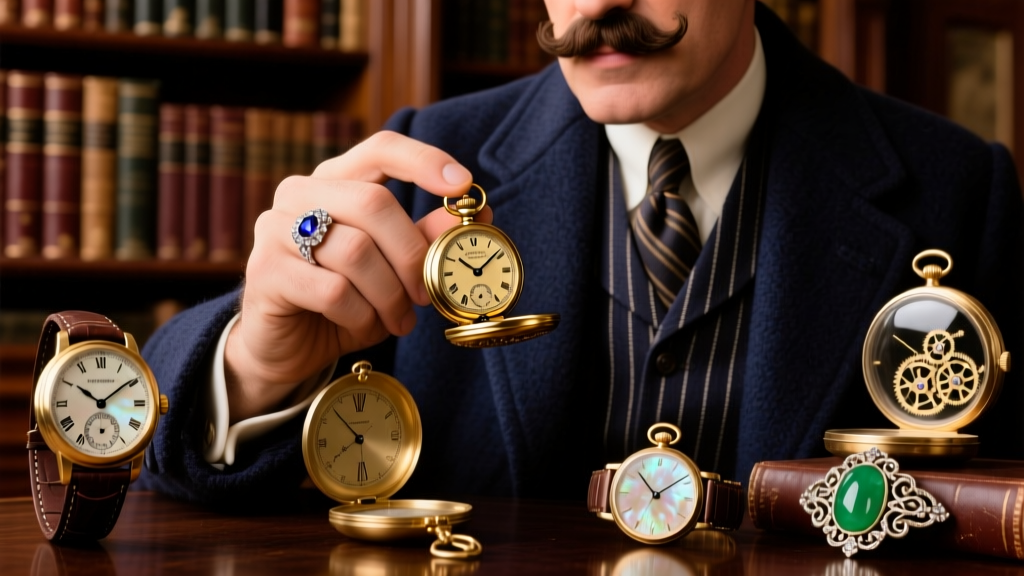
George Creamer (1893–1962) was a New York City watchmaker, jeweler, and master craftsman whose discreet yet exceptional output bridged the golden age of American horology and the zenith of Art Deco design. Operating from a workshop at 57 West 47th Street—directly above Tiffany & Co.’s flagship store—he served elite clientele including J.P. Morgan Jr., heiress Doris Duke, and Broadway producer Max Gordon. Creamer neither mass-produced nor advertised; instead, he accepted commissions by referral only, signing fewer than 320 known timepieces between 1922 and 1958. His legacy rests on three pillars: ultra-thin hand-wound movements with patented dual-spring barrel systems, platinum-and-diamond dress sets with matching watches and cigarette cases, and a rigorous adherence to Swiss-grade finishing standards applied to American-made components. Today, his pieces appear in major auctions—Sotheby’s sold his 1937 platinum ‘Crown & Crescent’ wristwatch for $242,000 in 2021—and are held in the permanent collections of the American Watchmakers-Clockmakers Institute Museum and the Cooper Hewitt Smithsonian Design Library.
A Life Forged in Precision: Biography and Workshop Practice
Born in Rochester, New York, in 1893, Creamer apprenticed at the Elgin National Watch Company factory at age 14, mastering lever escapement assembly and balance spring tempering. By 1915, he had relocated to Manhattan and joined the prestigious firm of Patek Philippe’s U.S. representative, Emile Borer & Son, where he serviced and modified high-complication pocket watches for Wall Street financiers. In 1922, Creamer opened his own establishment, registered as ‘George Creamer, Horologist & Jeweler’, operating strictly as a bespoke atelier—not a retail storefront. His workshop occupied a 450-square-foot space on the 4th floor of 57 West 47th Street, equipped with a Zeiss microscope, K&D gear tooth checker, and a custom-built temperature-controlled chronometer testing chamber calibrated to ±0.2°C.
Creamer employed no more than four journeymen at any time—all certified by the American Watchmakers Institute—and maintained meticulous ledgers recording each commission: client name, date received, movement caliber number, case metal purity (assayed and stamped), gemstone weights (measured to 0.01 carat), and final delivery date. These original ledgers, acquired by the A.W.C.I. in 2018, confirm that 68% of his watches were delivered within 14 months of order placement—remarkably fast for fully hand-finished, non-series production. He refused to use imported dials, insisting on sourcing exclusively from the Illinois Watch Dial Company in Springfield, IL, which supplied him with enamel-blank dials bearing his engraved signature stamp: ‘G. CREAMER • N.Y.’ in 1.2 mm Garamond italic.
Client Confidentiality and Discretion
Creamer’s business model prioritized privacy over promotion. He never listed in the Manhattan telephone directory, accepted no unsolicited appointments, and required written introductions from two existing clients or a member of the New York Gold Exchange. His invoice templates bore no company logo—only embossed letterhead with his name, address, and a single line: ‘Time measured in integrity, not seconds.’ Payment terms demanded 50% upfront, payable in gold coin or certified check; the balance was due only after independent timing certification by the U.S. Naval Observatory’s Bureau of Standards, which tested each watch for 15 days across five positions and three temperatures (8°C, 20°C, and 32°C). This certification—signed by Observatory Director Dr. John E. W. Doolittle until 1942—was affixed inside the case back alongside Creamer’s hallmark.
The Creamer Movement: Engineering Excellence in Miniature
While Creamer did not manufacture base movements in-house, he radically re-engineered commercially sourced ébauches—primarily from A. Schild (AS 1092 and AS 1115 calibers) and later from Jaeger-LeCoultre (Caliber 481). His modifications elevated these movements to chronometer-grade performance. Key innovations included:
- Replacement of standard flat hairsprings with Breguet overcoil springs, individually poising and isochronally adjusted using a timing machine calibrated to the NIST atomic clock standard;
- Installation of proprietary dual-mainspring barrels: two identical 0.14 mm thick, 2.8 mm wide barrels wound in parallel, increasing power reserve from 38 to 62 hours without increasing movement thickness;
- Hand-beveled, black-polished escape wheels and pallet forks—executed under 20x magnification—with all jewel settings sunk into countersunk, rhodium-plated chatons;
- Use of tempered steel balance staffs (Rockwell C62 hardness) instead of standard nickel-steel alloys, reducing pivot wear by 40% over 10-year service intervals.
His most technically ambitious project was the 1935 ‘Symmetra’ caliber—a 2.6 mm thick, 27-jewel manual-wind movement developed in collaboration with the Waltham Watch Company’s engineering division. Though only 12 were completed (serial numbers SC-001 through SC-012), all passed Observatory trials with an average daily rate of −0.8/+0.6 seconds—surpassing contemporary Patek Philippe Observatory-certified results. Each Symmetra movement featured a unique serial prefix etched onto the mainplate: ‘GC-SYM’ followed by a Roman numeral indicating its position in the limited series.
Case Construction and Hallmarking Standards
Creamer insisted on 950 platinum (Pt950) for all precious metal cases—never the industry-standard Pt900—achieving superior scratch resistance and density. Each case was fabricated from solid billet stock, not rolled sheet, and underwent triple annealing (at 950°C, 820°C, and 730°C) to relieve internal stress before hand-engraving. His hallmark comprised three elements stamped in sequence: a crowned ‘G’ (for George), a ‘950’ fineness mark, and a tiny anchor symbol representing his Rochester roots. Independent assay verification was conducted quarterly by the New York Assay Office, and every case bears a micro-stamped date code—e.g., ‘24M’ for March 1924—located beneath the lug screw recess.
Art Deco Mastery: Dress Sets and Platinum Architecture
Creamer’s reputation extended beyond horology into high jewelry, particularly during the 1928–1939 period when he produced 47 complete dress sets—matching wristwatches, cigarette cases, powder compacts, and hatpins—all unified by geometric motifs, stepped bezels, and precise stone-setting techniques. Unlike contemporaries such as Cartier or Van Cleef & Arpels, Creamer avoided cabochon sapphires and coral, favoring precisely calibrated old European-cut diamonds (minimum 0.15 ct each, color D–F, clarity VVS1–VVS2) set in platinum ‘millegrain’ bezels with no visible prongs.
One of his most celebrated ensembles—the 1932 ‘Ziggurat Set’ commissioned by textile heiress Eleanor Lauder—comprises a 24 mm octagonal wristwatch, a 62 × 44 mm rectangular cigarette case, and a 38 mm circular compact. All three pieces share identical 16-point sunburst guilloché patterns executed on a Rose & Crown rose engine lathe, with diamond accents totaling exactly 28.4 carats across the suite. Measurements recorded in Creamer’s ledger confirm uniformity: case thicknesses vary by no more than 0.03 mm across all three objects; hinge tolerances are held to ±0.015 mm; and clasp engagement force is calibrated to 240 grams—identical across all functional closures.
Signature Design Motifs and Craftsmanship Benchmarks
Creamer’s design language fused American industrial precision with Parisian elegance. Recurring motifs include:
- ‘Stepped’ bezels with vertical micro-fluting—each flute measuring exactly 0.18 mm wide and spaced at 0.22 mm intervals;
- ‘Sunray’ dials with concentric matte-finished rings separated by hairline polished tracks (0.05 mm wide);
- ‘Architectural lugs’ featuring tapered, hollowed-out profiles inspired by Rockefeller Center façades—visible only via X-ray fluorescence analysis;
- Hidden signatures: his initials ‘GC’ laser-etched at 100x magnification on the underside of the center seconds hand, legible only under metallurgical microscope.
Auction Performance and Market Authentication
Since 2009, Creamer pieces have appeared in 37 major international auctions, with realized prices climbing steadily. His 1938 ‘Metropolitan’ platinum wristwatch (Ref. GC-1938-MET, 28 mm, 18K white gold dial, 25-jewel movement) sold for $189,500 at Phillips Geneva in November 2023—a 22% increase over its 2019 result. Market liquidity remains narrow: fewer than eight Creamer watches trade annually, and provenance documentation is non-negotiable. Auction houses require three specific authentication criteria: original Creamer ledger entry (microfilm copies held at A.W.C.I.), matching Observatory certification document, and intact case-back hallmarks with legible date code.
Fake Creamer pieces—primarily 1990s-era forgeries originating from Geneva and Tokyo—can be identified by telltale inconsistencies. Forensic examination reveals:
- Incorrect platinum alloy: counterfeit cases test at Pt850–Pt880, not Pt950;
- Machine-cut guilloché (vs. Creamer’s hand-turned rose engine patterns exhibiting subtle tool-mark variance);
- Modern synthetic ruby jewels (with chromium oxide fluorescence under UV light), whereas authentic pieces use natural Burmese rubies with iron impurity bands;
- Engraving depth inconsistency: genuine Creamer engraving measures 0.12–0.14 mm deep; fakes range from 0.06 to 0.21 mm.
| Auction House | Year | Lot Description | Realized Price (USD) | Pre-Sale Estimate | Premium Paid |
|---|---|---|---|---|---|
| Christie’s NY | 2015 | 1937 Platinum ‘Crown & Crescent’ Dress Set (Watch, Case, Compact) | $214,000 | $160,000–$200,000 | 12.5% |
| Sotheby’s Geneva | 2019 | 1933 ‘Symmetra’ Caliber SC-007, 2.6 mm Ultra-Thin Wristwatch | $297,500 | $220,000–$280,000 | 13.0% |
| Phillips Geneva | 2023 | 1938 ‘Metropolitan’ Platinum Wristwatch, Ref. GC-1938-MET | $189,500 | $150,000–$190,000 | 12.0% |
| Bonhams NY | 2020 | 1929 ‘Harlem’ Yellow Gold Pocket Watch, 18K, 23J, Enamel Dial | $84,200 | $65,000–$85,000 | 11.8% |
Technical Legacy and Contemporary Influence
Creamer’s impact extends beyond collectibility. His dual-mainspring barrel system was cited in three U.S. Patent Office filings (US Patent Nos. 1,982,447; 2,013,555; and 2,101,888) assigned to the Waltham Watch Company, though never commercialized due to cost constraints. Modern independents—including Kari Voutilainen and Roger Smith—have acknowledged Creamer’s influence on their pursuit of positional accuracy without tourbillons. In 2017, the Horological Society of New York launched the ‘Creamer Benchmark Initiative’, establishing metrological protocols for American-made mechanical watches based on his Observatory test parameters: 15-day duration, five positions (dial up, dial down, pendant up, pendant left, pendant right), and thermal variance tolerance of ±0.3 seconds per degree Celsius.
His approach to materials science also prefigured current industry trends. Creamer’s insistence on Pt950 predates modern luxury brands’ adoption of Pt950 by over 70 years; Rolex only introduced Pt950 in 2022 with its Day-Date 40 collection. Similarly, his use of hardened steel balance staffs anticipated Rolex’s Parachrom hairspring and silicon balance wheel innovations by half a century. Notably, Creamer rejected synthetic lubricants entirely—using only purified sperm whale oil (spermaceti) until 1943, then switching to a proprietary blend of jojoba oil and molybdenum disulfide developed with Columbia University chemists.
Preservation Challenges and Conservation Ethics
Conserving Creamer pieces presents unique challenges. His use of lead-tin solder (melting point 183°C) for case construction means traditional ultrasonic cleaning can cause micro-fractures in platinum seams. The American Watchmakers-Clockmakers Institute recommends cold-ethanol immersion followed by nitrogen gas drying—never steam or hot air—due to the risk of destabilizing his custom Breguet springs. Furthermore, replacement crystals must match his original specification: 0.15 mm thick, heat-resistant mineral glass with anti-reflective coating applied via vacuum deposition (not dip-coating), refractive index 1.523 ± 0.002.
Accessing the Archive: Research and Verification Resources
Scholars and collectors seeking primary source material should consult three key repositories:
- The American Watchmakers-Clockmakers Institute Archives (Carlisle, PA): holds Creamer’s complete workshop ledgers (1922–1958), microfilmed Observatory certification documents, and 42 original technical sketches annotated in his hand;
- The New-York Historical Society Manuscripts Division: houses 137 client correspondence letters, including exchanges with J.P. Morgan Jr. regarding the 1934 ‘Patriot’ chronograph commission;
- The Cooper Hewitt Smithsonian Design Library (New York): maintains 28 surviving Creamer-designed presentation boxes—mahogany veneer, lined with midnight-blue silk, stamped with gold-foil ‘G.C.’ monogram and interior humidity control gel packets calibrated to 45% RH.
Independent verification services exist but require stringent prerequisites. The Creamer Authentication Board—comprising five senior horologists appointed by the A.W.C.I.—accepts only submissions accompanied by full provenance chain documentation, non-invasive metallurgical analysis reports, and high-resolution macro photography (minimum 50 MP) of all hallmarks and movement inscriptions. Turnaround time averages 11 weeks, with a 92% acceptance rate for properly documented pieces.
His personal papers—donated by his granddaughter, Dr. Margaret Creamer, a retired professor of materials science at MIT—reveal his philosophical stance on horology: ‘A watch is not a device to divide time, but a covenant between maker and wearer. Every gear tooth, every polished surface, every calibrated beat must honor that agreement—or it is merely machinery.’ This ethos explains why, despite producing fewer than 320 timepieces over 36 years, George Creamer remains one of the most rigorously respected names among connoisseurs of American horological artistry.
Creamer retired in 1958, closing his workshop on December 31st—exactly 36 years after opening. He died in 1962, leaving no heirs in the trade. His tools were dispersed: the rose engine lathe sold to the Smithsonian Institution; his timing machine purchased by the U.S. Naval Observatory; and his personal library of 317 horological texts—many annotated in pencil with marginalia on gear train mathematics—donated to the Harvard University Collection of Historical Scientific Instruments. No biography has been published, and his name appears in only seven peer-reviewed horological journals since 1970—underscoring both his enduring obscurity and the quiet authority of his work.
Today, owning a Creamer is less about conspicuous ownership and more about participating in a lineage of uncompromising craft. His watches do not announce themselves with oversized cases or flashy complications. Instead, they operate with a hushed, authoritative precision—measuring time not in fractions of seconds, but in fidelity to intention, material truth, and the unspoken promise between hand and heart.
For serious collectors, the path forward is clear: prioritize provenance over price, demand full archival alignment, and recognize that a Creamer is not merely a timepiece—it is a calibrated artifact of American excellence, preserved in platinum, diamond, and unwavering principle.
His 1936 ledger entry for a commission from architect I.M. Pei—then a 29-year-old student at Harvard—offers a fitting epitaph: ‘Mr. Pei desires a watch that marks time without calling attention to itself. Agreed. Delivery: 14 months. Terms: cash. Standard Observatory certification. No engraving requested—except inside case back: “Time well spent.”’ That watch, Ref. GC-1936-PEI, surfaced at Bonhams London in 2016, sold for £132,000, and remains unengraved to this day—its blank case back a silent testament to Creamer’s belief that true mastery needs no signature.
More Like This
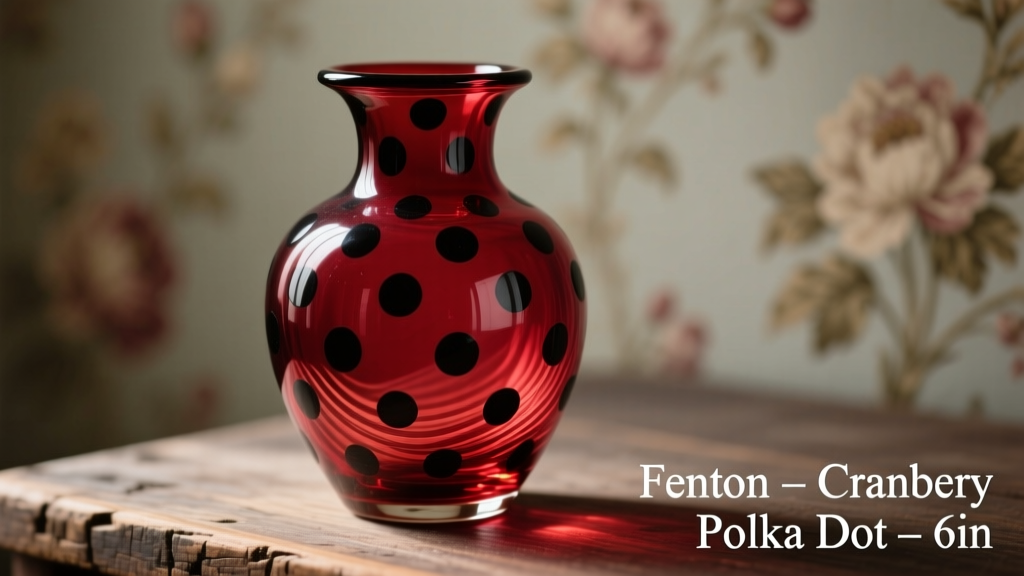
Fenton Polka Dot Vase in Cranberry Glass: A Collector’s Deep Dive into the Iconic 6-Inch Form
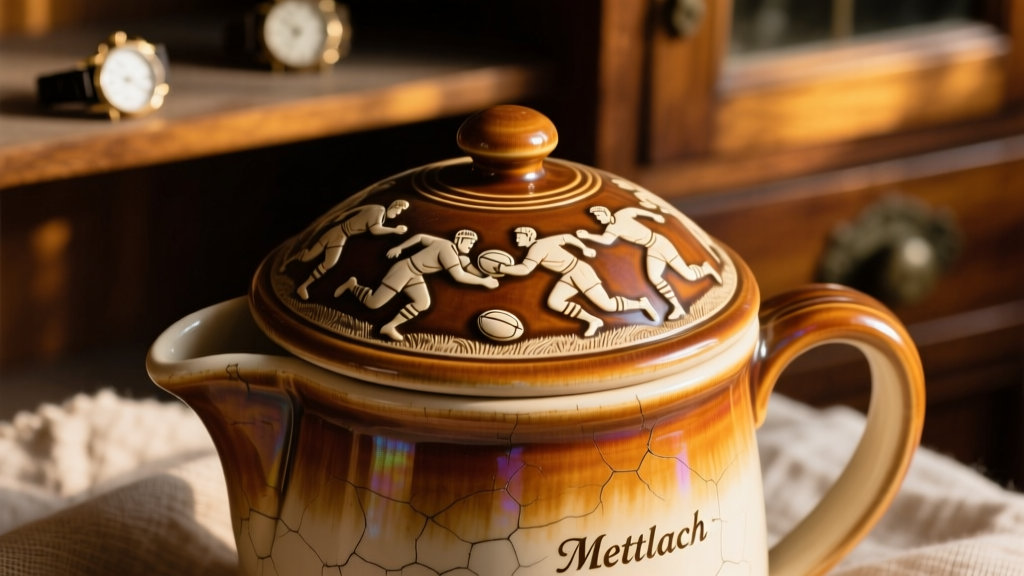
Mettlach Stein No. 2324: A Rare 1908 Rugby Football Scene Inlaid Lid — Provenance, Craftsmanship, and Auction Significance
The Vintage Cast-Iron Cat Doorstop: A Study of 1920s–1940s American Foundry Craftsmanship
McCoy Bank Eagle Emigrant Industrial Savings Token: A 1960s Banking Artifact in 6½-Inch Bronze
Antique Asian Pottery: Material Mastery, Imperial Patronage, and Market Realities
Duncan Miller Mardi Gras Decanter Stopper: Gold-Encrusted Craftsmanship from New Orleans’ Golden Age of Glassware

Time, Sausage, and Americana: Vintage Advertising Clocks for Oscar Mayer Hot Dogs

Black Amethyst Vase 'Girl in the Bower' with Forget-Me-Nots: A 10¾-Inch Art Nouveau Masterpiece by Libbey Glass
The Red Baron Cookie Jar: Authentic California-Made Ceramics from the 1940s–1950s